Leverage is the most misunderstood tool in trading. Beginners see it as a gain accelerator, when it's mainly a consequence amplifier. Used well, it's a harmless technical setting. Used badly, it turns a small mistake into an irreversible disaster. The truth is that leverage is almost never your real problem: your position size is.
- Leverage doesn't increase your edge, it amplifies what you're already doing, for better or worse.
- What matters isn't the leverage offered, but the real risk of your position.
- A high available leverage obliges you to nothing: you can use a tiny fraction of it.
- The real danger is sizing your position from the leverage instead of from your risk.
A broker offering you 1:500 leverage isn't doing you a favor: it's offering to let you ruin yourself five hundred times faster if you use it badly. Leverage lets you control a position far bigger than your capital. It's mathematically neutral: it multiplies your gains and your losses alike. The problem is never leverage itself, it's what traders do with it.
The good news is that once you understand the link between leverage, position size and risk, leverage stops being a danger and goes back to being what it is: a simple setting. This guide explains what leverage really is, why it's only an amplifier, and how to neutralize it by always thinking in risk rather than in multiplier.
What leverage really is
Leverage is the ability to control a position whose value exceeds your capital. A 1:100 leverage means that with 1,000 you can open a 100,000 position. The broker, in a sense, lends you the difference, and only asks you to deposit a margin to cover potential losses. It looks like magic, but there's no magic: you carry all the risk of the full position, not just of your margin.
That's where the confusion is born. The beginner looks at their leverage and thinks 'I can make a hundred times more'. They forget the second half of the sentence: '...and lose a hundred times more'. Leverage creates no value, it merely enlarges the scale. On a position with no statistical edge, big leverage just accelerates ruin.
Leverage is only an amplifier
Here's the fundamental point most traders take years to absorb: leverage adds nothing to your edge. If your strategy has positive expectancy, it stays positive with or without leverage; if it has negative expectancy, leverage just accelerates the losses. Leverage is a multiplier, and multiplying a bad result by a hundred gives a very bad result, faster.
Leverage doesn't make a bad trader good. It makes a bad trader broke faster, and a good but reckless trader just as vulnerable.
That idea is liberating, because it shifts your attention from leverage (which you don't control, your broker sets it) to the only thing that counts: the real risk you take on each position. Once you think in risk, the leverage figure becomes almost anecdotal.
The real number to watch: your true risk
Available leverage tells you nothing about what you really risk. What counts is the percentage of your capital you lose if your stop is hit, and that depends on your position size and stop distance, not on the maximum allowed leverage. You can have a 1:500 account and risk only 0.5% per trade, or a 1:10 account and ruin yourself risking 30%. Leverage is just a ceiling, not an obligation.
| Situation | Leverage offered | Trade's real risk | Verdict |
|---|---|---|---|
| Prudent | 1:500 | 0.5% | Healthy |
| Reasonable | 1:100 | 1% | Healthy |
| Reckless | 1:30 | 10% | Dangerous |
| Suicidal | 1:100 | 40% | Ruin imminent |
The table shows the same leverage can cover completely opposite behaviors. High leverage with a small real risk is perfectly healthy; modest leverage with a huge risk is deadly. Stop judging a trade on its leverage, judge it on its real risk as a percentage of your capital.
The mistake that burns accounts
The fatal mistake is sizing your position from the available leverage rather than from your risk. The beginner thinks: 'I have 1,000 and 1:100 leverage, so I can open 100,000, let's go'. They open the maximum position their margin allows, and a mere 1% move against them wipes out all their capital. They let leverage decide their size, when their risk should have decided it.
The healthy approach is exactly the reverse: you start from your accepted risk (1% of capital), look at the distance to your stop, and derive the position size. Leverage never enters this calculation, it merely makes the position technically possible. If your computed size exceeds what your leverage allows, that's the only time leverage becomes a real constraint again.
The margin-call trap
A word on the margin call, the ultimate penalty for over-leverage. When your losses bring your capital close to the required margin, your broker automatically closes your positions to protect itself. You then take your losses at the worst possible moment, with no choice, often just before a potential reversal. Trading with a modest risk keeps you far from that threshold; trading at maximum leverage brings you closer with every adverse tick.
Why brokers offer so much leverage
It's worth understanding why some brokers offer spectacular leverage (1:500, 1:1000). It isn't generosity: it's a business model. The more leverage you use, the bigger positions you take, the more volume, spread and commissions you generate, and the more likely you are to get liquidated fast. High leverage attracts beginners with the promise of big gains on small capital, when it mainly accelerates their elimination. The broker wins either way.
That clarity changes your relationship with the leverage offered: it isn't a gift to exploit to the maximum, it's a tool of which you use the fraction that suits you. A savvy trader sees 1:500 leverage as mere technical flexibility (they'll be able to take the position they need), not as an invitation to load up. The difference between the trader who survives and the one who burns out often comes down to this single interpretation: the first sees a ceiling, the second sees a target.
Effective leverage: the real indicator
Beyond the maximum leverage your broker allows, there's a far more useful number: your effective leverage, i.e. the ratio between the total value of your open positions and your capital. If you have 10,000 in capital and 30,000 in open positions, your effective leverage is 3:1, whatever the maximum leverage your broker allows. It's that number, not the ceiling, that reflects the real risk you carry at a given moment.
Monitoring your effective leverage spares you the insidious trap of accumulation. You can take several modest positions that, together, represent a huge exposure without you realizing, because each seems reasonable on its own. Effective leverage aggregates everything and tells you the truth about your overall exposure. A low effective leverage (often below 3 to 5:1 for a prudent trader) is a far better health indicator than your account's maximum leverage, which says nothing about what you actually do.
Leverage and instrument volatility
The same leverage doesn't carry the same danger depending on the instrument you trade. A 1:20 leverage on a calm currency pair has nothing to do with 1:20 on a very volatile index or a crypto that moves 10% in a day. What matters is the asset's possible move multiplied by your leverage: it's that product that determines the scale of your capital swings, not the leverage figure in isolation.
That's why you should adapt your effective leverage to the volatility of what you trade: less leverage on jumpy assets, a bit more on calm ones, always within your risk-per-trade limit. A trader who applies the same leverage to all instruments takes, unknowingly, very different risks from one market to another. Reasoning in real risk (how much I lose if my stop is hit) rather than in leverage automatically solves this, because it already incorporates volatility via the stop distance. It also means your leverage settings should evolve as an instrument's volatility changes over time, rather than staying fixed forever: a currency pair that was calm for months can suddenly become erratic around a major economic release, and a leverage level that was reasonable last week can become reckless overnight without you touching a single setting.
Classic mistakes beyond over-sizing
Over-sizing isn't the only way to misuse leverage. An equally common mistake is averaging down on a losing position by using available leverage to open extra size, hoping to lower your average entry price. That practice, already risky without leverage, becomes explosive with it: each addition increases your total exposure and brings you closer to a margin call at the exact moment the market is proving you wrong.
Another classic mistake is changing size mid-streak, reacting to your results rather than to your plan. After several wins, the temptation to increase effective leverage to 'speed things up' is strong; after several losses, the temptation to increase it to 'win it back' is just as strong. Either way, you let your emotional state drive your exposure, which is the exact opposite of consistent risk management.
Finally, many traders ignore leverage's effect on their psychological tolerance for volatility. A position with high effective leverage makes your balance swing far more violently on screen, which wears down your composure and pushes you to exit a good trade too early or panic on a normal move. Leverage doesn't just affect your account, it directly affects your ability to execute your plan calmly.
A worked example: two traders, same capital
Imagine two traders starting with 5,000 each on the same instrument. The first uses 2:1 effective leverage and risks 1% of capital per trade, so 50. Over a hundred trades with a 45% win rate and a 1.8 reward-to-risk ratio, they end the year with a steady climb in capital, modest balance swings, and the mental capacity to keep executing their plan without being rattled by fluctuations.
The second trader, with the same strategy and the same win rate, uses 15:1 effective leverage, risking 8% of capital per trade. Statistically, their results should scale proportionally better, but in practice, a streak of five consecutive losses, an unremarkable scenario even with a positive edge, wipes out nearly 35% of their capital. Facing that brutal drop, they abandon their plan, panic-cut their size, then ramp it back up after a win to compensate, and finish the year worse off than if they'd kept their original risk.
This example illustrates a simple truth: the same statistical edge produces radically different psychological and financial trajectories depending on the real risk level applied, regardless of whether the underlying strategy is a winner on paper.
Leverage and swing trading: the cost of carry
Leverage has a hidden cost that day traders often ignore because they never pay it: financing or swap fees on positions held overnight. The bigger your position thanks to leverage, the heavier this carrying cost, calculated on the position's full value rather than your margin, weighs if you hold for several days or weeks. A swing trader using the same effective leverage as a day trader can see a significant chunk of their gain eaten away by these accumulated fees.
That doesn't mean avoiding leverage in swing trading, but that your risk calculation should treat this carrying cost as a variable in its own right, not a footnote. A trader comparing two similar setups should also compare their respective carrying costs if positions are held for several days, because that cost can turn a paper-winning trade into one that's barely profitable once fees are deducted. Reducing effective leverage on positions held longer is a simple way to limit that effect.
Keeping it under control with Tradoshi
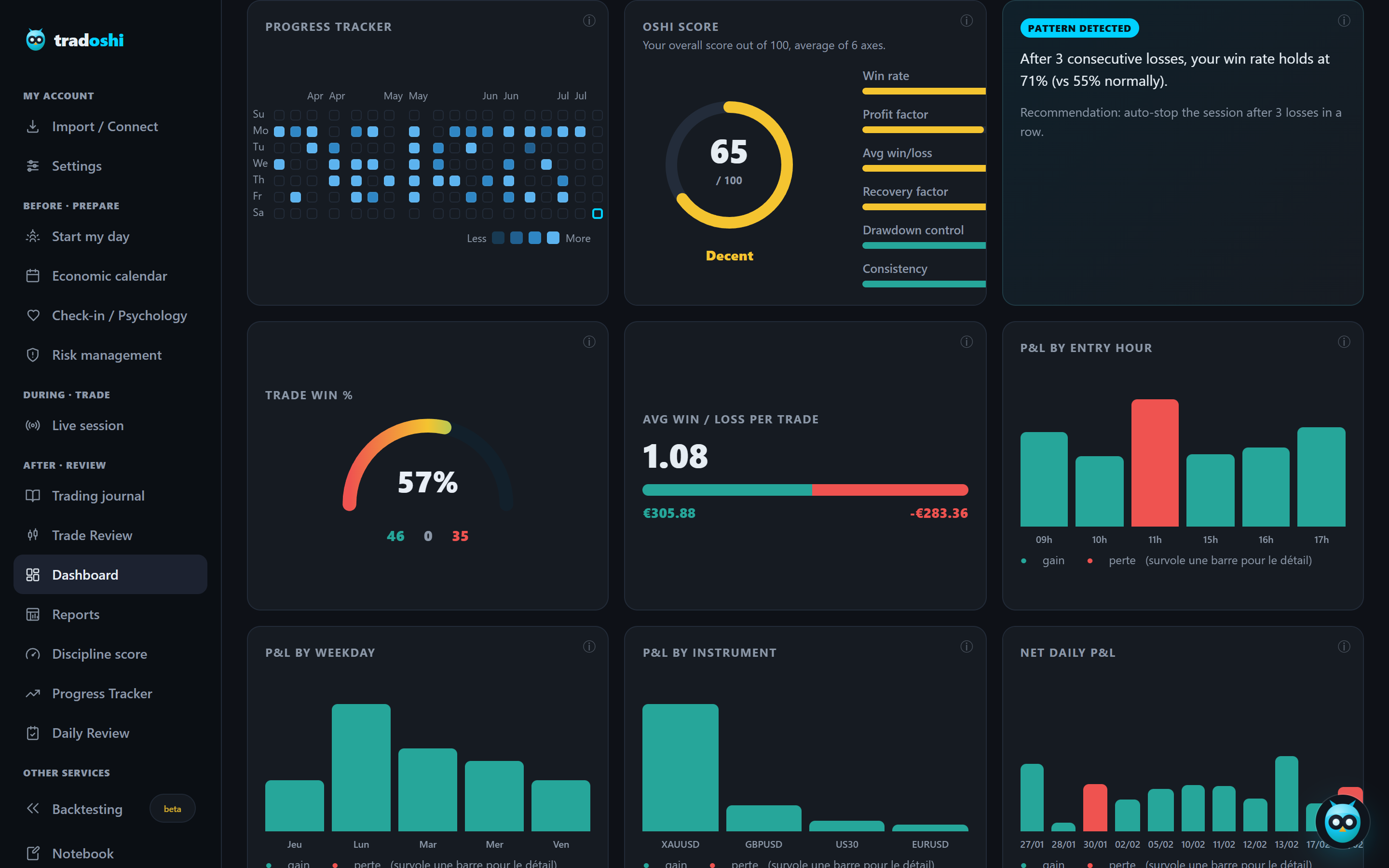
Leverage only becomes a problem when you lose sight of your real risk. Tradoshi computes, on each trade, the percentage of capital you actually engaged, so you always think in risk and never in multiplier.
- Real risk per trade: the percentage of capital engaged is computed from your stop, regardless of leverage.
- Over-sizing detection: trades where your size blows past your usual risk stand out.
- Management consistency: your average risk tells you whether you use leverage with discipline or in fits.
- Crossed with drawdown: you see the direct impact of over-leveraged trades on your capital curve.
Frequently asked questions
What is leverage in trading?
It's the ability to control a position whose value exceeds your capital. A 1:100 leverage lets you open a 100,000 position with 1,000 in margin. You carry the risk of the full position, not just your margin: leverage amplifies your gains and losses alike, it creates no value by itself.
What leverage should I use without burning out?
The question is misframed: don't think in leverage but in real risk. Whatever leverage your broker offers, size your position to risk only 0.5 to 1% of your capital per trade. With that discipline, you can have a 1:500 account and stay perfectly prudent, because you only use a fraction of it.
Is high leverage dangerous?
Available leverage is only a ceiling, not an obligation. High leverage with a small real risk is perfectly healthy; modest leverage with a huge risk is deadly. The danger is never the leverage figure, it's sizing your position from it rather than from your accepted risk.
Does leverage increase my chances of winning?
No. Leverage adds nothing to your edge: it multiplies what you're already doing, for better or worse. If your strategy has positive expectancy, it stays positive with or without leverage; if it's a loser, leverage just accelerates the losses. Multiplying a bad result by a hundred gives a very bad result, faster.
How do I size my position with leverage?
Always start from your risk, never from leverage. Decide how much you're willing to lose (1% of capital), look at the distance to your stop, and derive your size. Leverage doesn't enter this calculation: it merely makes the position technically possible. It only becomes a constraint again if your computed size exceeds what it allows.
What is a margin call?
It's when your losses bring your capital close to the required margin and your broker automatically closes your positions to protect itself. You then take your losses at the worst moment, with no choice. Trading with a modest risk keeps you far from that threshold; trading at maximum leverage brings you closer with every adverse tick.
What other leverage mistakes exist besides over-sizing?
Averaging down with leverage (adding to a losing position to lower your entry price, which increases exposure at the worst moment), changing your size in reaction to your results rather than your plan, and underestimating leverage's effect on your composure: a position with high effective leverage swings your balance more violently, which wears down your discipline even if the percentage risk is theoretically acceptable.
Does leverage cost anything if I hold positions for several days?
Yes, financing or swap fees on positions held overnight are calculated on the position's full value, not your margin. The higher your effective leverage, the heavier that carrying cost weighs if you hold for several days or weeks. In swing trading, that cost deserves a place in your risk calculation, since it can significantly eat into a trade that's a winner on paper.