Day trading concentrates all of trading's risk into an accelerated format: many trades, fast decisions, intense emotions, all in a single day. This intensity makes risk management both harder and more vital than elsewhere. This guide explains the specifics of risk management in day trading, the essential guardrails, and how to prevent the acceleration from turning against you.
- Day trading accelerates everything, including mistakes: risk must be tightly framed.
- The daily loss limit is the day trader's number-one guardrail.
- Trade frequency amplifies the weight of discipline and fees.
- Stopping after a losing streak protects against days that spiral.
Day trading has a characteristic that changes everything: the compression of time. Where a swing trader takes a few positions per week, a day trader can take several per day, which multiplies the chances to do well but also to do badly. This acceleration makes mistakes more frequent and faster to accumulate, and therefore risk management all the more critical, since there is far less time between a first slip and the moment it becomes a serious problem.
Managing risk in day trading isn't limited to sizing each trade well; you must also frame the day as a whole, because it's at that scale that spirals play out. This guide covers the guardrails specific to day trading, from risk per trade to the daily limit, and shows how to turn day trading's intensity into an asset rather than a danger.
Why risk is different in day trading
Day trading's specificity is density. Taking several trades per day means your edge, but also your mistakes, show up far faster than in swing trading. A bad habit that would cost dearly over months in swing trading can drain an account in a few days of day trading, simply because the number of trades is far higher.
This acceleration has a direct consequence: risk management can't be limited to the individual trade, it must frame the day. A day trader who manages each trade perfectly but has no guardrail at the day level can still blow up, chaining trades until a bad morning becomes a catastrophe. That's why the daily limit is the central concept of risk management in day trading, and why every other rule in this guide ultimately supports it.
The daily loss limit
The day trader's number-one guardrail is the daily loss limit: a maximum amount you allow yourself to lose in a day, beyond which you stop trading, no exceptions. This limit is vital because it bounds the damage of a bad day, preventing a difficult day from becoming an unrecoverable disaster.
In day trading, you can't control whether a day will be good or bad. But you can control how much a bad day can cost you. That's the whole point of the daily limit.
The daily limit's effectiveness comes from its non-negotiable nature. Decided cold, it must apply mechanically when reached, precisely when emotion would push you to continue to win it back. The day trader who respects their daily limit turns their worst days into controlled, predictable losses, which protects their capital and their ability to return the next day with a clear head.
Framing the losing streak
Alongside the amount limit, the day trader needs a guardrail on consecutive losses. A streak of losses isn't only costly in money, it degrades your mental state and pushes you toward revenge trading. Automatically stopping after a certain number of consecutive losses cuts the spiral before it accelerates.
This guardrail is especially useful in day trading because of the pace. In the heat of the action, it's easy to chain a loss, then another to win it back, then another, without taking the necessary step back. A rule to stop after N losses forces you to take a break when you need it most, when your judgment starts to degrade but you don't feel it yet. It's a protection against yourself, calibrated for day trading's intensity, and it works precisely because it doesn't ask you to trust your own judgment at the worst possible moment.
Frequency amplifies everything
Day trading's high frequency has an amplifying effect on two often-underestimated fronts. First, discipline: a small bad habit, repeated over dozens of trades per week, causes far faster damage than in swing trading. The day trader can't afford the laxity a less-frequent trader might tolerate, because their mistakes accumulate at high speed.
Second, fees. Each trade has a cost, spread and commissions, and in day trading, this cost is levied dozens of times per week. Fees that seem negligible on one trade become a major drain over hundreds of trades, capable on their own of turning a winning system into a neutral one. Managing risk in day trading also means closely watching this friction cost that frequency amplifies, and avoiding the overtrading that makes it explode.
Common risk-management mistakes
The first and most common mistake is setting your risk per trade based on how fast you want to get rich rather than on what the account can objectively withstand. An impatient day trader risks 3% or 5% per trade thinking it speeds up gains, without realizing it mostly speeds up the probability of ruin over a perfectly normal losing streak. Risk per trade must be calibrated to the account's survival, not to a desired speed of enrichment.
A second common mistake is adjusting risk after the fact, cutting size only after a big loss, when the damage is already done. A good day trader sets their risk per trade and daily limit cold, before the open, and never changes them mid-session under the sway of emotion. A third classic mistake is confusing the absence of losses with good risk management: a trader can string together winning trades while taking far too much risk, and only discover the problem at the first losing streak, often too late.
Calibrating position size: a concrete example
Take an illustrative example. A day trader has a 20,000 account and wants to risk 1% per trade, or 200. On an instrument where their stop sits 40 points from entry, each point worth 1, they can take a 5-unit position (200 divided by 40). If their setup has a tighter stop, at 20 points, they could take 10 units for the same 200 risk. Position size is never a fixed number, it always flows from the money risk and the stop distance.
This simple calculation is nonetheless ignored by many day traders, who pick a position size out of habit or psychological comfort rather than by calculation. A trader who always takes the same size, whatever their stop, lets their real risk vary widely from one trade to the next without even noticing, which contradicts the whole principle of risk management. Recalculating size on every trade, based on the setup's stop, takes a few seconds and durably protects the account.
Risk across sessions and volatility
Not all hours of the day are equal in day trading, and risk should adjust to the moment's volatility. Session opens (London, New York) and major economic releases create wider, faster moves, which widens the necessary stops and can justify cutting position size to keep the same money risk. Trading these moments with a size calibrated for a quiet session amounts to badly underestimating your real risk.
Conversely, quiet hours, often in the early afternoon on certain markets, offer fewer clear opportunities and can tempt the day trader to force trades to fill the void. The best risk management adapts not only size but also trading frequency to the quality of the context: trade less but better during quiet hours, and stay strict on size during volatile hours where moves are wider in both directions.
Day trading under prop firm rules
Day trading on a prop firm account adds an extra layer to risk management, because the firm's rules (maximum daily loss, maximum drawdown) sit on top of your own personal rules. A savvy day trader always calibrates their internal risk below the firm's imposed limits, never at the same level, to keep a safety margin against the unexpected.
This margin matters even more because the day trading format multiplies the chances of a mistake that brings you closer to the firm's limits. A trader who calibrates their risk per trade to land exactly on their prop firm's daily limit in case of a losing streak leaves themselves no room for error; a trader who keeps a comfortable margin can absorb a bad session without endangering their funded account.
Risk per trade in day trading
At the individual trade level, sizing principles stay the same as elsewhere, but their application requires more rigor because of the pace. Risking a small fixed percentage per trade is essential, but the day trader must also account for the fact that they take more trades: a risk per trade that seems moderate can accumulate a significant daily risk if positions are chained.
That's why risk per trade and the daily limit must be thought of together. If you risk 1% per trade and take ten trades in a bad day, you can lose far more than your risk per trade suggested. A savvy day trader calibrates their risk per trade based on the number of trades they usually take, so the total stays under their daily limit. Consistency between unit risk and daily risk is the key to sustainable day trading.
Protecting your mind in the intensity
Risk management in day trading isn't only technical, it's also mental, because the format's intensity tests psychology harshly. Fast decisions, the succession of trades and the chaining of emotions fatigue judgment over the course of the day. A day trader who ignores this mental fatigue makes their worst decisions at the end of the session, when their lucidity is at its lowest.
Managing this mental risk is an integral part of risk management in day trading. It goes through regular breaks, stopping when guardrails trigger, and recognizing your emotional state before and during the session. A day trader who monitors their fatigue and state as much as their numbers protects the most critical resource of their activity: their decision-making capacity. In such an intense format, preserving your mind is as important as protecting your capital, and the two are far more connected than most traders assume.
Adjusting risk with experience
Risk per trade doesn't have to stay fixed forever: a beginner day trader is better off starting with lower risk than the theoretical maximum, taking time to prove their execution's reliability over a large number of trades. Ramping up risk too early, before having enough history to judge one's own edge, amounts to betting big on a hypothesis that hasn't been verified yet.
Conversely, an experienced day trader, with hundreds of documented trades and a statistically established edge, can consider gradually increasing their risk per trade, always within reasonable limits. This progression should stay slow and data-driven, never based on a passing feeling of confidence after a good run. Risk is earned with proof, it isn't decided on a whim on a good day.
How Tradoshi helps you manage risk in day trading
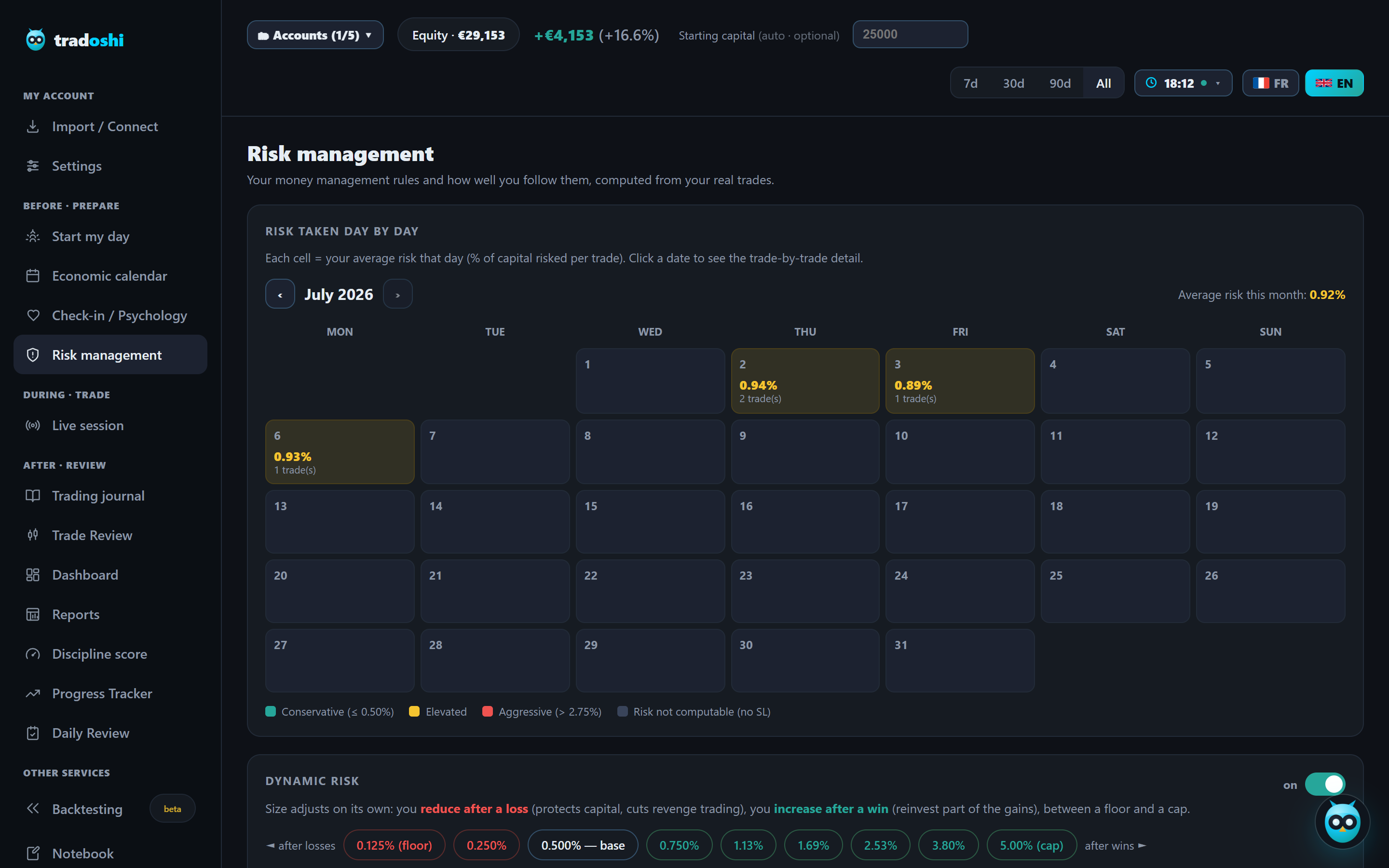
Tradoshi is built for day trading's intensity: it tracks your day loss, your consecutive losses and your risk in real time, and alerts you before the day spirals.
- Daily loss tracking vs your limit, with an alert when you approach the threshold.
- Consecutive-loss counter and pause alert to cut the spiral.
- Dynamic risk that reduces your size after a loss, suited to day trading's pace.
- Emotional check-in and discipline tracking to protect your mind in the intensity.
Frequently asked questions
Why is risk management so important in day trading?
Because day trading concentrates risk into an accelerated format: many trades, fast decisions, intense emotions in a single day. This density means your mistakes accumulate far faster than in swing trading, and a bad habit can drain an account in a few days. Risk management must frame the whole day, not just each trade.
What is a daily loss limit?
It's a maximum amount you allow yourself to lose in a day, beyond which you stop trading, no exceptions. It's the day trader's number-one guardrail: it bounds the damage of a bad day and prevents a difficult day from becoming an unrecoverable disaster. To be effective, it must be decided cold and non-negotiable once reached.
Should I stop after several losses in day trading?
Yes, it's an essential guardrail. A losing streak degrades your mental state and pushes toward revenge trading, and day trading's pace makes it easy to chain without stepping back. A rule to stop after N consecutive losses forces you to take a break when your judgment starts to degrade, before the spiral accelerates.
Do fees really matter in day trading?
Yes, more than elsewhere. Each trade has a cost (spread, commissions) levied dozens of times per week in day trading. Negligible fees on one trade become a major drain over hundreds of trades, capable of turning a winning system into a neutral one. Watching this friction cost and avoiding overtrading are part of risk management.
How do I calibrate my risk per trade in day trading?
By thinking of risk per trade and the daily limit together. If you risk 1% per trade and take ten trades in a bad day, you can lose far more than your unit risk suggested. Calibrate your risk per trade based on the number of trades you usually take, so the total stays under your daily limit.
How do I calculate my position size in day trading?
By dividing your money risk (for example 200 on a 20,000 account at 1%) by your stop distance in points. If the stop is 40 points away, you take 5 units; if it's 20 points, you can take 10 for the same risk. Position size should always flow from this calculation, never from habit or a fixed number.
Should I adjust my risk when day trading under a prop firm?
Yes, your internal risk should always stay below the firm's limits (daily loss, maximum drawdown), never at the same level. This safety margin lets you absorb a bad session without endangering your funded account, whereas risk calibrated to land exactly on the limit leaves no room for error.