Position size is probably the most important decision of a trade, and yet the one traders neglect most. You spend hours refining your entry, and choose your size on feel. But it's sizing, far more than the entry point, that decides whether you survive or blow up. This guide breaks down the most common position sizing mistakes and how to avoid them.
- Position size decides your survival far more than your entry point.
- Risk a fixed amount, not a fixed lot: your size must adapt to your stop distance.
- Increasing under emotion (revenge, euphoria) is the most destructive sizing mistake.
- Consistent sizing makes your results readable and your risk controlled.
Ask a trader how they choose their position size, and the answer is often vague: 'it depends', 'on feel', 'according to my confidence'. This approximation is one of the biggest performance leaks there is, because the same system applied with good or bad sizing gives radically different results.
Position sizing isn't a technical detail, it's the heart of risk management. It determines how much you lose when you're wrong, how much you win when you're right, and above all whether a losing streak stays bearable or becomes fatal. This guide reviews the sizing mistakes that ruin accounts, to help you spot and correct them.
Mistake 1: trading a fixed lot
The first mistake, very widespread, is always trading the same volume, for example one lot systematically, without accounting for your stop distance. The problem is that a trade's real risk doesn't depend on volume alone, but on volume multiplied by your stop distance. With a fixed lot, a trade with a wide stop makes you risk much more than a trade with a tight stop, without you realizing it.
The right approach is the reverse: first fix the amount you want to risk, then compute the position size matching that amount given your stop distance. That way, each trade risks the same sum, whatever your stop, which makes your risk constant and your results comparable. Moving from fixed lot to fixed risk is probably the most impactful sizing improvement for a beginner.
Mistake 2: risking too much per trade
The second mistake is simply risking too much on each trade. Risking 5, 10 or 20% of your capital per position is playing Russian roulette: a few consecutive losses, statistically inevitable, are enough to devastate the account. The paradox is that those who risk big don't do it out of ignorance of the math, but out of impatience or overconfidence.
| Risk per trade | Effect of 5 losses in a row |
|---|---|
| 1% | About -5%: harmless |
| 3% | About -14%: serious but manageable |
| 10% | About -41%: very hard to recover |
| 20% | About -67%: account nearly destroyed |
This table illustrates why most serious traders risk a small percentage per trade. At 1%, a streak of ten losses only costs about 10% of capital, leaving plenty of time to recover; at 10%, the same streak is catastrophic. Moderate risk isn't timidity, it's the survival condition that lets your edge express itself over time without a bad run eliminating you.
Mistake 3: increasing under emotion
The third mistake, and the most destructive, is varying your size under the sway of emotion. After a loss, the urge to win it back pushes you to double up on the next trade: that's revenge sizing, which turns a small loss into a disaster. After a big gain, euphoria pushes you to increase size, just before giving back everything you just won.
The worst moment to increase your size is precisely when you most want to: right after a loss you want to avenge, or right after a gain that makes you feel invincible.
This mistake is particularly insidious because it happens exactly when your judgment is most degraded. A size driven by emotion concentrates risk at the worst moment, when you're least lucid. The counter is to fix your size cold, according to a rule that doesn't depend on your state of the moment. Stable sizing, independent of your emotions and latest results, is the mark of a trader who controls their risk.
Mistake 4: inconsistency
Beyond emotional variations, a more subtle mistake is simply inconsistency: sizing your positions randomly, a bit on feel, with no clear rule. This inconsistency has a major hidden cost: it makes your results unreadable. If your size varies without logic, you can't know whether a good month comes from your edge or from having gone big at the right moment by luck.
Consistent sizing, on the contrary, makes your performance interpretable. When each trade risks the same percentage, your gains and losses reflect the quality of your decisions, not the randomness of your sizing. This consistency is also what lets you reason in R and measure your edge cleanly. Sizing inconsistency pollutes all your statistics and prevents you from understanding your own trading.
Mistake 5: ignoring correlations
A more advanced but very costly mistake is ignoring correlations between positions. If you take three correlated trades, for example three dollar-linked pairs in the same direction, you think you're risking 1% on each, but you're actually risking nearly 3% on a single underlying bet. In case of an adverse move, all three lose together, and your real risk was far higher than you thought.
Good sizing accounts for this reality by considering aggregate risk, not just the risk per isolated position. Concretely, this means reducing your size when you take several correlated positions, so your total risk stays controlled. Ignoring correlations means wrongly believing you're diversifying while you're concentrating, and it's a frequent cause of losses far bigger than anticipated during sharp market moves.
Calculating your position size, step by step
The fixed-risk theory is simple to state, but many traders trip up on the practical application. Take an example: a 10,000 account, risk set at 1% per trade, so 100. You spot an entry on EUR/USD at 1.0850 with a stop at 1.0820, a 30-pip distance. To risk exactly 100 on that distance, you divide the amount you want to risk by the pip value multiplied by the distance: the resulting size is the one that, if the stop is hit, costs you precisely 100, no more, no less.
The same calculation applies to any instrument, stocks, indices or crypto: you first fix the amount in your account currency you're willing to lose, then adjust the volume so the distance between your entry and your stop matches exactly that amount. Many platforms and free online calculators do this instantly, which makes the excuse 'it's too complicated to calculate every time' less and less valid. The real difficulty isn't the math, it's building the habit of doing it systematically rather than eyeballing your size.
Adjusting your size after a losing streak
A useful refinement, once the fixed-risk principle is understood, is to slightly vary that risk based on your recent form, in the opposite direction of what a tilting trader does. Picture a trader who normally risks 1% per trade: after three consecutive losses, they choose to cut their risk to 0.5% until they land a winning trade, then gradually return to their normal size. This approach, sometimes called anti-martingale sizing, protects capital precisely when the statistical or psychological odds of another loss are highest.
The value of this rule isn't only mathematical, it's also psychological: cutting your size after a losing streak removes some of the pressure, which helps you regain clean execution instead of tense, forced trading. Conversely, increasing your size after a losing streak to 'catch up faster' is exactly the revenge sizing reflex described earlier, and it's the best way to turn a bad week into a catastrophe. The simple rule to remember: when doubt rises, size shrinks, never the reverse.
Recalculating your size as your capital evolves
A subtler but common mistake, among traders who have grasped the fixed-risk principle, is to compute that risk once on their starting capital and never recalculate it. If your 10,000 account grows to 13,000, still risking 100 per trade means risking less than 1% of your real capital, which is cautious but denies you part of the growth your edge entitles you to. Conversely, if your account drops to 8,000 after a rough patch, still risking 100 means risking 1.25% of your real capital, which silently accelerates your slide toward ruin.
The right practice is to recalculate your risk in currency terms at a regular interval, say weekly or monthly, based on your current capital, not your opening capital. This recalculation naturally shrinks your euro or dollar size when you're losing, slowing the descent, and grows it when you're winning, speeding up growth without ever exceeding your target percentage. It's a simple, almost mechanical habit, but it profoundly changes an account's long-term trajectory compared to a size frozen on capital that no longer exists.
Mistake 6: treating every setup the same
A subtler mistake is to systematically risk the same percentage on every trade, regardless of setup quality. A signal that checks every one of your criteria, with strong confluence and a favorable market context, doesn't carry the same odds of success as a marginal signal taken because time is passing and you want to 'do something'. Treating both with exactly the same risk wastes part of the information you yourself produced by analyzing the trade in the first place.
Some experienced traders use a two- or three-tier conviction scale, for example 0.5% on a decent setup, 1% on a strong one, to match risk to the real quality of the opportunity. This practice needs to stay bound by rules written cold, never decided in the moment, otherwise it becomes an open door to emotional rationalization, where every trade suddenly becomes an 'A+ setup' that justifies a bigger size. Used well, a conviction scale is a refinement; used poorly, it recreates exactly the inconsistency problem it claimed to solve.
The healthy position sizing rule
From all these mistakes emerges a simple, robust rule: risk a small fixed percentage of your capital on each trade, adjusting the position size to your stop distance so that this percentage is respected. This single principle eliminates most mistakes at once: it makes your risk constant, independent of emotion, consistent, and compatible with long-term survival.
This rule can be enriched, for example by reducing risk after a losing streak or accounting for correlations, but on its own it already constitutes a solid base that protects your account. Position sizing doesn't need to be complicated to be effective; it needs to be applied consistently. Simple, consistent and moderate sizing almost always beats sophisticated but irregular sizing.
Sizing across correlated positions
Position sizing doesn't stop at a single trade in isolation; it also needs to account for what else is open at the same time. If you already hold a position and open a second, correlated one, sizing each at your usual 1% understates your combined exposure to whatever they both depend on. Good sizing discipline treats correlated positions as one combined risk budget rather than two separate 1% allowances, shrinking each so the total stays within your normal limit.
This is where sizing mistakes and correlation blindness reinforce each other: a trader who's careful about fixed risk on paper can still end up dangerously exposed simply because they never checked whether their open positions shared the same underlying driver. Building that check into your pre-trade routine, alongside the stop-distance calculation, closes one of the last gaps between sizing that looks disciplined and sizing that actually is.
How Tradoshi helps with your sizing
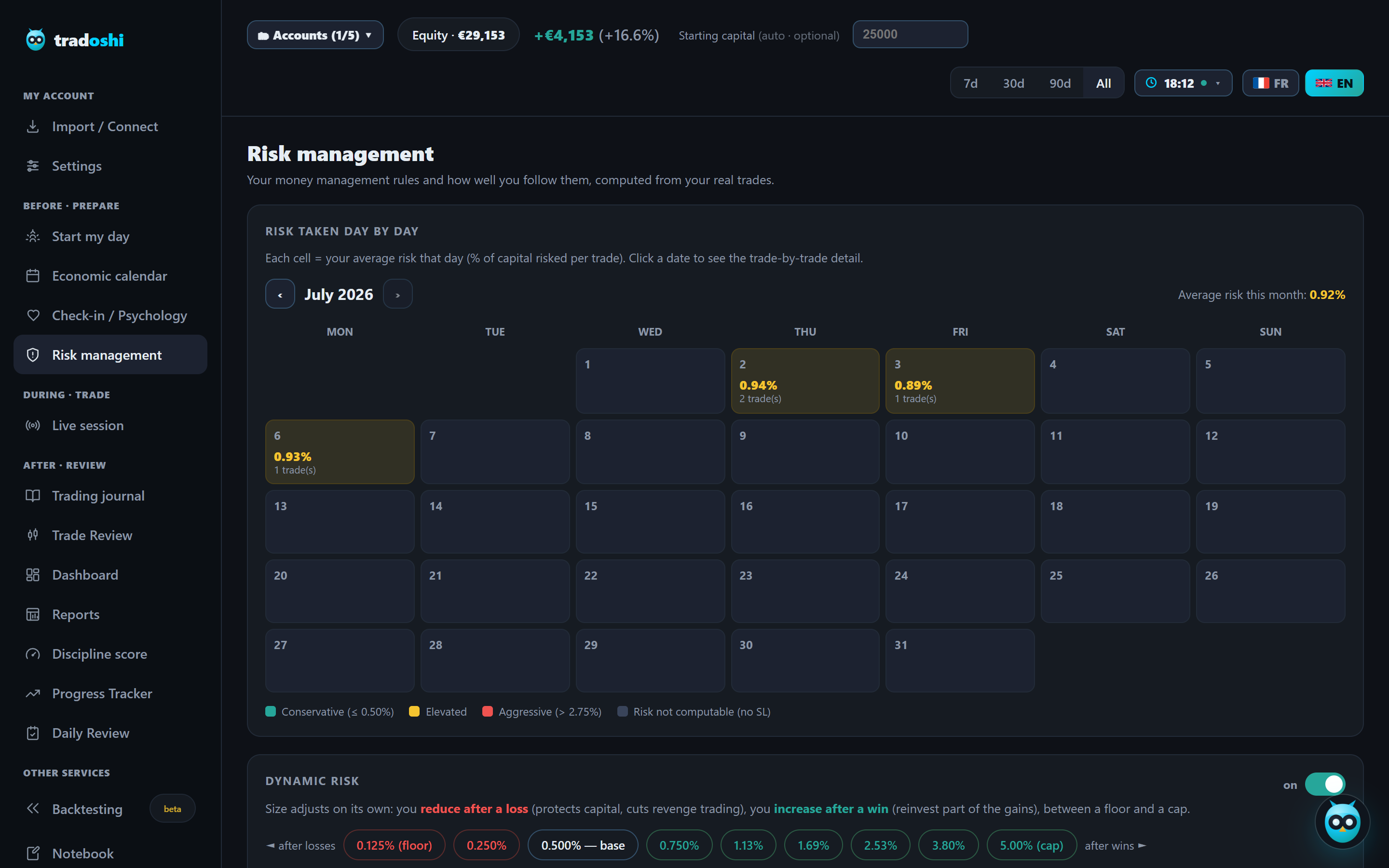
Tradoshi computes your real risk per trade and spots your sizing mistakes in your real trades. You see the percentage of capital risked on each position and have a calculator to size correctly.
- % of capital risked per trade computed on your real trades, to see your real risk and its drifts.
- Risk calendar showing your average risk per day and spotting excesses.
- Revenge sizing detection (size up after a loss) in your discipline score.
- Position calculator to size from your fixed risk and your stop.
Frequently asked questions
What's the biggest position sizing mistake?
Varying your size under emotion: doubling up after a loss to win it back (revenge sizing) or increasing after a big gain out of euphoria. This mistake concentrates risk exactly when your judgment is most degraded, turning a small loss into a disaster. The counter is to fix your size cold, according to a rule independent of your state.
Should I trade a fixed lot or a fixed risk?
A fixed risk. A trade's real risk depends on volume AND stop distance, not volume alone. With a fixed lot, a wide-stop trade makes you risk much more than a tight-stop trade, without you seeing it. First fix the amount to risk, then compute the size matching it given your stop.
How much should I risk per trade?
A small fixed percentage of your capital, often around 1%. At 1%, a streak of ten losses only costs about 10% of capital, leaving time to recover; at 10% per trade, the same streak is catastrophic. Moderate risk isn't timidity, it's the survival condition that lets your edge express itself over time.
Why is inconsistent sizing a problem?
Because it makes your results unreadable: if your size varies without logic, you can't know whether a good month comes from your edge or from betting big at the right moment by luck. Consistent sizing makes your performance interpretable, your statistics reliable, and lets you reason in R to measure your edge cleanly.
Should I account for correlations in my sizing?
Yes. Three correlated trades (for example three dollar-linked pairs in the same direction) at 1% each actually make you risk nearly 3% on a single underlying bet, because they lose together. Good sizing considers aggregate risk and reduces size when you take several correlated positions, to keep your total risk controlled.
How do I calculate my position size in practice?
First fix the amount in your account currency you're willing to lose (for example 100 on a 10,000 account at 1%), then compute the distance between your entry and your stop. Divide the amount to risk by that distance to get the exact size that makes you risk precisely that amount, no more, no less, regardless of instrument.
Should I reduce my size after a losing streak?
It's a healthy practice: cutting your risk, for example from 1% to 0.5%, after several consecutive losses protects your capital when doubt is highest, then you gradually return to normal size once you land a winning trade. The opposite, increasing size to catch up, is the revenge sizing reflex to avoid at all costs.