Risking 1% of your capital per trade is the most repeated rule in trading, and the most often ignored. It looks too cautious when you dream of doubling your account, almost timid. Yet it's exactly that apparent timidity that separates traders who last from accounts that blow up in a few weeks. Here's why that small number is your best life insurance.
- 1% per trade makes a losing streak painless: ten losses in a row cost only ~10% of capital.
- Big percentages are non-linear: risking 5% doesn't multiply your risk by 5, but far more.
- The rule protects your head too: a 1% loss doesn't trigger revenge trading.
- It's not a brake: at 1% per trade, a good year stays very profitable, with no risk of ruin.
When you discover trading, risking 1% per trade seems ridiculous. With 10,000 in capital, it means accepting to lose only 100 on a position, while you see four-figure gains scroll by on social media. The reflex is to risk more, 'to make it worth it'. That's precisely the reflex that drains accounts.
The 1% rule isn't a coward's rule, it's a survivor's rule. It rests on a relentless mathematical reality: losing streaks are inevitable, and only a modest risk lets you get through them undamaged. This guide explains the logic of the numbers, why 1% is the right dial for most traders, and how this discipline protects your capital as much as your mind.
The logic of the numbers
Let's start with the calculation that should convince any trader. With 1% risk per trade, how much is left after a losing streak? After ten consecutive losses, you've lost about 9.6% of capital (not exactly 10%, since each loss applies to a reduced capital). A scratch. At 5% per trade, the same streak puts you at -40%. At 10%, at -65%. The 1% trader carries on calmly; the other two are in survival mode or already dead.
| Risk per trade | After 5 losses | After 10 losses | After 20 losses |
|---|---|---|---|
| 1% | -4.9% | -9.6% | -18.2% |
| 2% | -9.6% | -18.3% | -33.2% |
| 5% | -22.6% | -40.1% | -64.2% |
| 10% | -41.0% | -65.1% | -87.8% |
Look closely at the last column. A streak of twenty losses isn't improbable over a career: it always ends up happening, even with an excellent system. At 1%, it leaves you nearly intact. At 10%, it has destroyed you three times over. That's the whole difference between surviving your own variance and being eliminated by it.
Why losing streaks are inevitable
Many beginners never plan for bad luck because they unconsciously believe it won't touch them. That's a misunderstanding of randomness. Even a 55%-win system regularly produces streaks of five, six, eight losses in a row. It's not a malfunction, it's the statistical nature of random sequences: results arrive in clusters, not in regular alternation.
So the question isn't 'will I suffer a long losing streak?' but 'when?'. And the only variable you control is what that streak will cost you. Risking 1% means deciding in advance that your worst streak can never knock you out of the game. You can't prevent bad luck, but you can make it harmless.
The non-linear effect of big risks
Intuition fools almost everyone here. People think risking 2% instead of 1% doubles the danger. In reality, the effect is far worse, because losses compound: each loss shrinks the capital the next one applies to, so the bigger you risk, the faster you dig a hole whose climb-back becomes exponentially hard. Going from 1% to 5% doesn't multiply your risk of ruin by 5, but by a far larger factor.
That's the deep reason professional traders, who sometimes manage millions, risk fractions of a percent per position. They aren't timid, they've simply understood that survival is played out on the flat part of the risk curve, and that any overshoot tips them into the zone where one bad patch becomes fatal.
The psychological benefit of 1%
We always talk about 1% as capital protection, but it's also, and perhaps above all, protection for your mind. A loss representing only 1% of your capital doesn't hurt. It triggers no panic, no urge to win it back, none of that knot in the stomach that pushes you to double up. You can watch it go by with detachment, log it, and take the next trade as if nothing happened.
A risk small enough not to scare you is a risk small enough not to make you crack. That's where risk management meets psychology.
Conversely, risking 5 or 10% turns every trade into an emotional event. Fear degrades your execution, you cut winners too early, hold losers too long, and a single loss can send you into a revenge-trading spiral. The 1% defuses all that upstream: it makes trading boring enough for you to stay rational.
Does 1% hold back performance?
The classic fear is that risking so little prevents serious gains. It's false. With a real edge and a decent ratio, 1% risk per trade produces solid growth over a year, without ever exposing you to risk of ruin. Performance comes from repeating an edge over many trades, not from the size of an isolated bet. Those who try to accelerate by risking big almost always end up giving it all back, and more.
If you want to grow your gains, the right path isn't raising your risk percentage, it's improving your edge (better ratio, better win rate) and letting your capital grow. As it grows, your 1% mechanically represents more money, without you ever raising your relative risk. That's compound growth, slow but unbeatable.
1%, 0.5% or 2%: how to choose
The 1% is a benchmark, not dogma. A beginner, or someone trading a not-yet-proven system, is well advised to drop to 0.5% while building a track record and gaining confidence. An experienced trader, with a solidly measured edge and discipline proven by their data, can consider 2% knowingly. Beyond that, you leave the survival zone, whatever your confidence.
The 1% and compound growth
The real power of fixed percentage risk reveals itself over time, through compound growth. Since your 1% is computed on your current capital, it increases in money as your account grows, without you ever changing your rule. A trader who risks 1% and wins steadily sees their positions grow naturally, carried by the rise in their capital, and their gains accelerate gently, like interest adding to interest.
This effect is slow at first and powerful over time, but it has one absolute condition: never suffer a big hole. A single severe drawdown breaks the compounding mechanic and sends you back years. That's precisely what the 1% protects: by limiting your losses, it preserves the base compounding works on. Risking small isn't only defensive, it's the fuel of compound growth, which rewards consistency and brutally punishes fits and starts.
The illusion of big percentages on social media
One reason beginners risk too much is what they see on social media: screenshots of spectacular gains, accounts doubled in a week, 'performances' that make risking small look like it's for the timid. What these screenshots never show is the dozens of accounts blown up by the same approach, nor the fact that a spectacular gain from big risk is statistically followed, sooner or later, by an equally spectacular loss.
Trading that lasts is invisible on social media because it's boring: nobody shares a screenshot of '+1.2% this week, respecting my risk'. Yet it's exactly that profile, repeated over years, that builds real wealth in trading. Never calibrate your risk on the loudest things you see online: those who shout loudest are either selling something or about to give back all their gains. The 1% is the choice of those who want to still be here in ten years.
Going below 1% when justified
The 1% is a reasonable ceiling, but there are situations where going below is the best decision. When testing a new unproven strategy, when coming back from a hard drawdown, when going through a stressful personal period, or when market volatility explodes, reducing your risk to 0.5% or less protects you while you're most vulnerable. There's no shame in trading small: it's a sign of maturity, not weakness.
The general idea is that your risk percentage should reflect your objective confidence in your edge and your situation of the moment, always downward, never upward under emotion. A mature trader adjusts their risk down in doubt and keeps it stable in confidence, but never raises it to win back or because they 'feel it'. This asymmetry (reduce when prudent, never increase by emotion) is at the heart of sound, lasting risk management.
1% on a prop firm account: even more safety margin
On a prop firm account, the 1% rule deserves tightening, because these accounts add a constraint a personal account doesn't have: a daily loss limit and a maximum drawdown that, once crossed, end the account with no negotiation possible. Risking 1% on a single trade is reasonable in the abstract, but if you string together several trades the same day, the accumulation can bring you dangerously close to the daily limit before you even notice.
That's why many traders going through evaluations lower their risk to 0.3-0.5% per trade on these accounts, even if it feels 'overly cautious'. The goal is no longer just surviving a losing streak on the account itself, but surviving the program's rule, which is often stricter than your own risk management. 1% stays a healthy ceiling on a personal account; on a prop firm account, it often becomes a maximum you never want to reach.
A numbered example over a full month
To make the 1% rule concrete, take a full month of trading. A trader with 10,000 in capital, 40 trades in the month, a 45% win rate and an average win/loss ratio of 1.8 to 1. At 1% risk per trade (100), the 22 losses cost about 2,200, and the 18 wins bring in about 3,240, for a net result close to +1,040, or about +10.4% for the month, with no losing sequence ever threatening the account.
The same month, with the same win rate and ratio but 5% risk per trade, a streak of six consecutive losses (statistically ordinary over 40 trades) alone would have swallowed nearly 26% of capital, and the trader would likely have drifted from their plan well before month's end, paralyzed by the size of the losses. The final result could have been positive or negative depending on the month's luck, but the path to get there would have been incomparably more dangerous, with a risk of going off the rails at every moment.
1% and the hidden fees that eat into the margin
One last point often forgotten: the theoretical 1% you compute before the trade isn't always the 1% you actually lose once spread, commissions and slippage are accounted for. On a tight stop, these costs can represent a significant share of the total risk, especially if you trade instruments with variable spread or outside high-liquidity hours.
The solution isn't to calculate more finely on every trade, which would quickly become unmanageable, but to give yourself a safety margin: aim for 0.9% rather than exactly 1%, or factor an average fee estimate into your effective stop distance. This small adjustment stops your real risk from silently drifting above your rule, trade after trade, without you noticing.
Checking it with Tradoshi
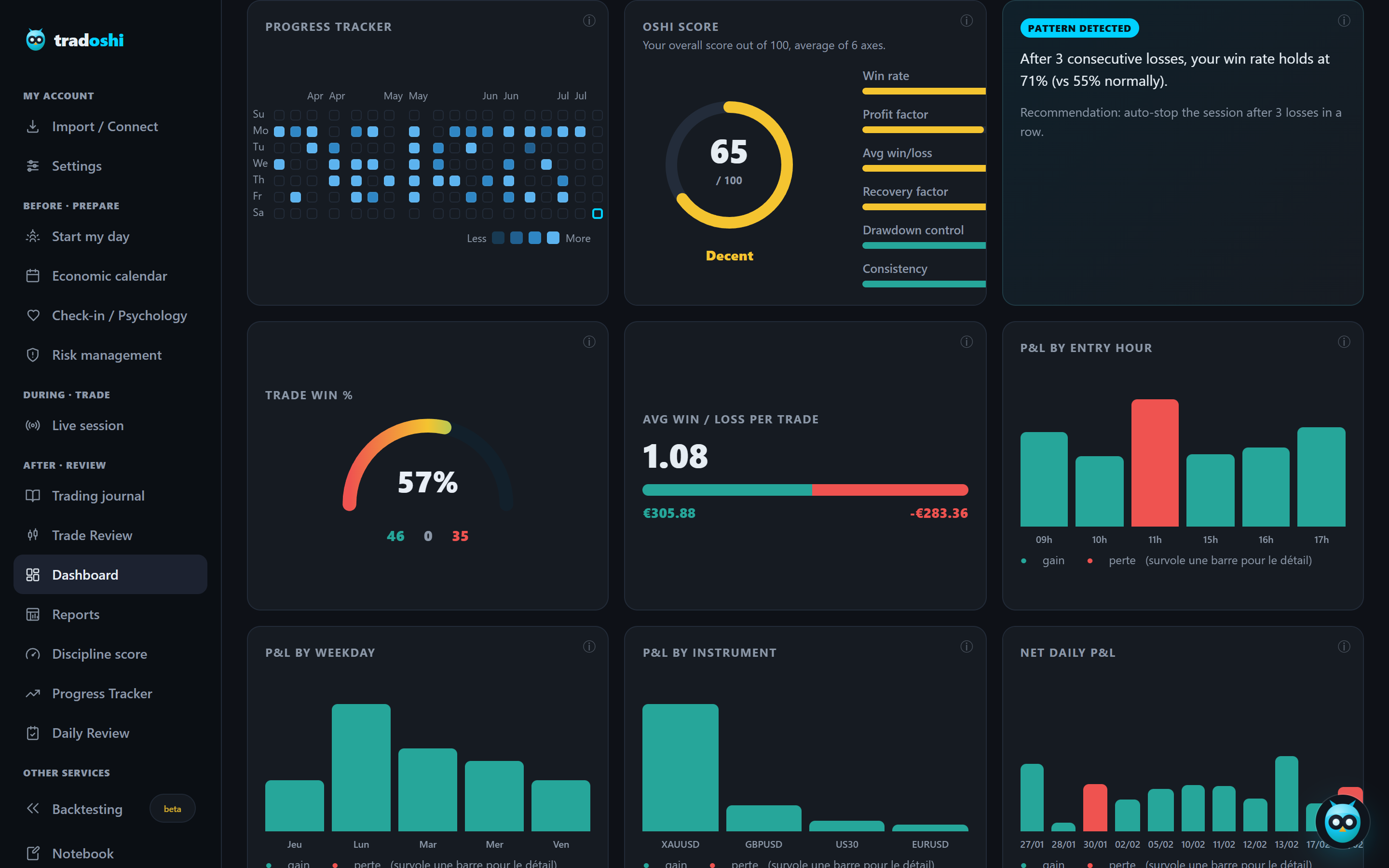
Deciding to risk 1% is easy; actually holding it on every trade is another matter. Tradoshi reads your stop and computes the percentage of capital truly risked on each of your trades, so you see whether you're honoring your rule or drifting without realizing it.
- Real risk per trade: computed automatically from your stop, no entry needed.
- Breaches detected: trades where you risked far more than 1% stand out immediately.
- Average risk: you see whether your management is consistent or slips in the hot moments.
- Crossed with drawdown: you see in black and white that your low-risk days protect your curve.
Frequently asked questions
Why risk only 1% per trade?
Because it lets you absorb long losing streaks without endangering your account: ten losses in a row cost only ~10% of capital. Since losses are inevitable and compound, a modest risk is the only way to guarantee long-term survival. The 1% protects your capital as much as your psychology.
Isn't 1% too little to make money?
No. Performance comes from repeating an edge over many trades, not from the size of an isolated bet. With a real edge and a decent ratio, 1% per trade produces solid growth over the year. To make more, improve your edge and let your capital grow, don't raise your risk percentage.
Can I risk more if I'm very confident?
That's exactly the trap. The market doesn't know your confidence level, and a 'sure trade' doesn't exist. Varying your risk by conviction injects uncontrolled variance and pushes you to load up precisely when your emotion is fooling you. Keep a fixed risk, independent of your feeling.
Should I compute the 1% on starting or current capital?
On current capital. If your account has grown, your 1% represents more money; if it's down, it represents less. Basing the calculation on current capital naturally shrinks your size when you lose and grows it when you win, which protects in drawdowns and compounds in good phases.
0.5%, 1% or 2%, which should I choose?
1% is the standard benchmark. Drop to 0.5% if you're starting out or your system isn't proven yet, while building a track record. An experienced trader, with a measured edge and discipline proven by their data, can consider 2%. Beyond that, you leave the survival zone whatever your confidence.
How does 1% help my psychology?
A 1% loss doesn't hurt: it triggers no panic, no revenge trading, no urge to win it back. You stay detached and rational, and take the next trade cleanly. A risk small enough not to scare you is a risk small enough not to make you crack, which is where risk management meets the mind.
How do I know I'm truly holding my 1% rule?
By measuring each trade's real risk after the fact, not just deciding it at entry. A tool that reads your stop and computes the percentage of capital engaged shows your real breaches: most traders discover they risk far more than they think, especially in emotional moments.
Should I lower the 1% rule on a prop firm account?
Yes, in most cases. These accounts add a daily loss limit and a hard maximum drawdown, which makes stacking several trades in one day more dangerous than on a personal account. Many traders drop to 0.3-0.5% per trade on these accounts to keep a real safety margin against the program's rule.
Do spread and fees drift my real risk above 1%?
Yes, especially on tight stops, where these costs weigh proportionally heavier. To avoid this silent drift, aim slightly below 1% (0.9% for example) or factor a fee estimate into your stop distance, rather than recalculating precisely on every trade.