Risk of ruin is the probability that your account drops low enough to never recover. It isn't a mathematician's abstraction: it's the one thing that can end your trading career in a single stroke. Understanding what makes it explode, and how to keep it near zero, matters more than any strategy.
- Risk of ruin depends on three things: your win rate, your ratio, and above all your position size.
- Risking big doesn't double your risk of ruin, it makes it explode non-linearly.
- Even a winning system can ruin a trader who risks too much per trade.
- Survival comes before return: a blown account has a -100% return, permanently.
Many traders focus on return ('how much can I make') and ignore the question that decides everything: 'what's the probability I lose it all'. That's risk of ruin. And it has a fearsome property: as long as it isn't zero, a long enough losing streak will, statistically, eventually arrive.
The good news is it's almost entirely under your control. It doesn't depend on the market or on luck, but on three levers you set yourself. This guide explains the mechanics, why position size is the dominant lever, and how to keep your risk of ruin so low it becomes a non-issue.
What 'ruin' really means
Ruin isn't necessarily a zero account. It's a loss level you don't come back from, in practice. Losing 50% of your capital requires a 100% gain just to break even. Losing 70% requires a 233% gain. Past a certain threshold, the recovery effort becomes so huge that the trader gives up, or takes desperate risks that finish the account. Ruin is that point of psychological and mathematical no return.
| Loss taken | Gain needed to break even |
|---|---|
| -10% | +11% |
| -25% | +33% |
| -50% | +100% |
| -70% | +233% |
| -90% | +900% |
This table is the deep reason defense comes before offense. Big drawdowns aren't recovered linearly: they dig a hole whose climb costs a disproportionate effort. Avoiding the hole is a thousand times better than knowing how to get out of it.
The three levers of risk of ruin
Mathematically, your risk of ruin depends on three variables: the probability of winning a trade (win rate), the relative size of your gains versus your losses (ratio), and the fraction of capital you risk each time (position size). The first two define your edge; the third defines your speed of destruction if things go wrong.
The crucial point: for a given edge, position size drives almost all of the risk of ruin. You can have a perfectly winning long-term system and still ruin yourself, simply because you risk too much per trade and a normal losing streak arrives before your positive expectancy has time to play out.
Why risking big is non-linear
Intuition says risking 2% instead of 1% doubles the risk. That's false, and dangerously optimistic. Risk of ruin grows non-linearly with position size. Doubling your risk per trade doesn't double your ruin probability, it multiplies it far more, because losses compound: each loss shrinks the capital the next one applies to, and big percentages dig exponentially deeper holes.
| Risk per trade | Risk of ruin (typical winning system) | Reading |
|---|---|---|
| 1% | Near zero | Survival zone |
| 2% | Low but real | Still manageable |
| 5% | High | One bad year is enough |
| 10% | Very high | Ruin nearly certain over time |
| 20% | Certain | A matter of time |
The exact figures depend on your edge, but the shape of the curve is always the same: flat and reassuring at the bottom, then shooting up. That's why professional traders risk fractions of a percent where beginners risk tens: they know they live on the flat part of the curve.
A winning system isn't enough
It's the most misunderstood paradox of trading: you can be right in the long run and go broke before you get there. Positive expectancy tells you what happens over thousands of trades; risk of ruin tells you whether you'll survive the few hundred between you and that long run. A real edge is worthless if a losing streak knocks you out before it can express itself.
That's exactly why position size management isn't optional. It doesn't make your system a winner, but it guarantees you'll still be there when your winning system does its job. Survival is the precondition for performance.
How to keep your risk of ruin near zero
- Risk a small fixed fraction per trade (0.5 to 1%), computed on your current capital.
- Set yourself a maximum daily loss: beyond it, you stop, whatever your conviction.
- Never double size to win it back; that's the behavior that turns a drawdown into ruin.
- Watch your positions' correlation: three correlated trades are one big risk in disguise.
- Measure your real risk afterward, to check your rules are held and not just displayed.
The myth of the protective big account
Many traders believe a bigger capital shields them from ruin. It's a dangerous illusion, because risk of ruin doesn't depend on your account's absolute size, but on the percentage you risk per trade. A trader with 100,000 risking 10% per position is no safer than a trader with 1,000 risking 10%: both travel the same destruction curve, just with different zeros. The number on your statement protects you from nothing; it's your risk discipline that protects you.
This confusion drives a precise, costly behavior: after growing their account, the trader feels invincible and relaxes their management, raising their percentages because they have 'room'. In reality, they've just reopened the door to the risk of ruin they had closed. The rule is the same at every capital level: it's the percentage risked, not the account amount, that decides your survival. A big badly-managed account blows up as fast as a small one, it just makes more noise falling.
The psychological point of no return
Risk of ruin isn't only mathematical, it has an equally real psychological dimension. Well before an account reaches zero, there's a threshold where the trader cracks: they lose faith in their system, start trading fear or revenge, and accelerate the fall themselves. This mental breaking point often arrives far earlier than mathematical ruin, sometimes as soon as -25 or -30%, depending on each person's psychological sturdiness.
That's why your real survival limit isn't the theoretical zero, but the loss level beyond which you stop trading rationally. Knowing that threshold, specific to you, and stopping well before reaching it, is part of managing risk of ruin as much as the percentage calculations. A trader who ruins themselves rarely does so all at once: they ruin themselves by first crossing their mental breaking point, then letting emotion finish the job.
Rebuilding after a big drawdown
If you've already suffered a deep drawdown, how you climb back determines whether you truly survive or sink again. The temptation to 'win it back fast' by raising risk is immense, but that's exactly what turns a recoverable drawdown into permanent ruin. The only healthy recovery is slow: reduce your size, return to ultra-prudent management, and rebuild the capital brick by brick, accepting it takes time.
This patience is counterintuitive when you're in the hole, because each day of slow recovery feels unbearable. But it's the only path that doesn't send you back to the bottom. Reducing your risk after a big drawdown isn't an admission of weakness, it's the decision that protects what's left and gives you a chance to come back. Those who ruin themselves permanently are almost always those who, at the bottom of the hole, dug faster to get out.
A numeric example comparing two traders
Take a purely illustrative example to make the mechanics tangible. Trader A risks 1% per trade on a 20,000 account, so 200 per position. Trader B, with the exact same edge (same win rate, same win/loss ratio), risks 5%, so 1,000 per position. Over a streak of eight consecutive losses, a scenario that happens from time to time statistically even with a good system, trader A ends up around 18,500, a manageable loss they can erase in a few weeks of normal trading. Trader B ends up around 13,400, a loss of over 30% that requires a gain of over 45% just to break even.
The key point of this example: both traders have exactly the same edge, the same strategy, the same winning and losing trades in the same order. Only the position size differs, and yet their trajectories diverge radically. It wasn't the quality of the strategy that separated these two traders, it was purely their risk management. It's the clearest demonstration that risk of ruin is controlled independently of the ability to generate an edge.
Risk of ruin on a prop firm account
On a prop firm account, risk of ruin takes a particular shape, because 'ruin' isn't only a loss of capital, it's also losing the account itself the moment the maximum drawdown is hit, often well before losing most of the capital. An account with a 10% maximum drawdown is 'ruined' in the sense of the challenge at -10%, a threshold many personal-account traders would consider an ordinary rough patch. This rule makes risk of ruin even more sensitive to position size than on a personal account.
That's why traders who succeed at prop firms systematically risk less than what the rule would theoretically allow. If the maximum drawdown is 10%, aiming for a risk of ruin near zero often means risking 0.5% or less per trade, to keep a comfortable cushion against a normal losing streak. Treating the firm's limit as a threshold to never approach, rather than a target to reach, is what separates traders who keep their funded account over time from those who lose it within weeks.
Risk of ruin and position correlation
The classic risk-of-ruin calculation often assumes trades independent of one another, but that isn't always the case. If you open several correlated positions at once, you aren't making several independent 1% bets, you're making one big bet disguised as several small ones. That invisible concentration pushes your real risk of ruin well beyond what your displayed per-trade percentage suggests, because a single piece of bad news can sink several positions at once instead of just one.
That's why mastering risk of ruin isn't just about choosing a good percentage per trade, it also requires watching how many of your open positions actually depend on the same market scenario. A trader who scrupulously respects their 1% per trade rule, but stacks five correlated positions, ends up with a risk of ruin much closer to that of a trader risking 5% on a single trade, without ever having consciously decided to.
What risk of ruin changes in your daily decisions
Once you've internalized risk of ruin as a priority, it concretely changes how you make every trading decision, not just your starting position size. Facing doubt about a setup, the question that should come first is no longer 'do I think I'm right?' but 'if I'm wrong, does the consequence stay inside my survival zone?'. That reframing, subtle as it looks, radically changes the kind of decisions you make in moments of uncertainty, because it shifts the center of gravity from prediction to protection.
In practice, that means accepting you'll miss opportunities that looked promising but whose required size to produce a meaningful gain would have exceeded your reasonable risk limit. Many traders find that frustrating at first, as if they were artificially capping their potential. But it's exactly the opposite: every opportunity passed up to stay inside a negligible risk-of-ruin zone is an opportunity to keep playing tomorrow, and trading is a game that only rewards those who stay at the table long enough to let their edge express itself over hundreds, then thousands, of trades.
Measuring it with Tradoshi
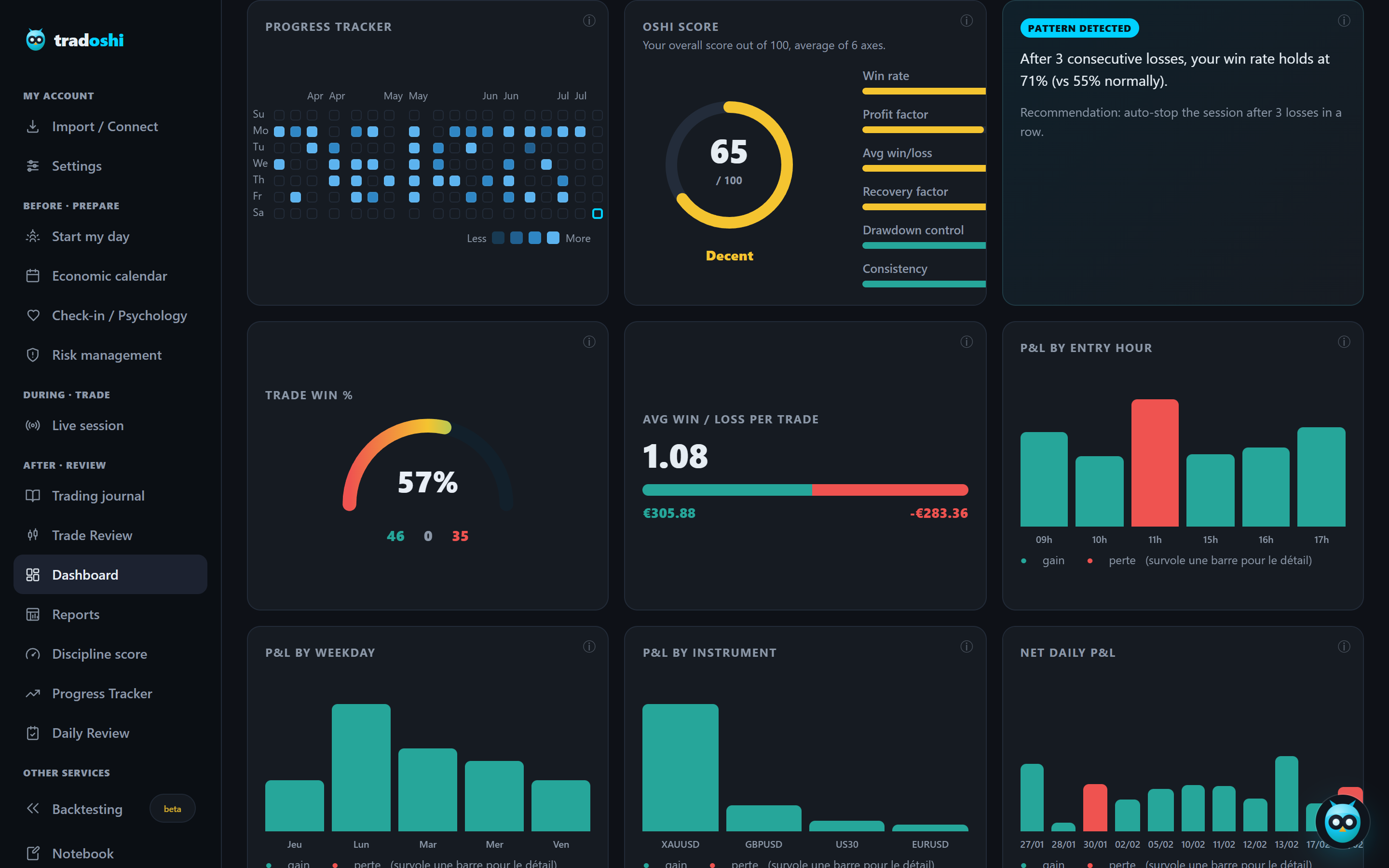
You can't manage a risk you don't measure. Tradoshi computes the percentage of capital truly risked on each trade (from your stop) and tracks your drawdown, so your risk of ruin stays a visible figure rather than a surprise.
- Real risk per trade: the engaged percentage is computed automatically, you see your rule breaches.
- Drawdown tracking: your maximum and current drawdown are displayed, your survival indicator.
- Drawdown mastery: an axis of the Oshi Score rates your ability to avoid digging big holes.
- Drift alerts: days where your risk climbs abnormally stand out in your stats.
Frequently asked questions
What is risk of ruin in trading?
It's the probability that your account drops to a level you can't come back from in practice. It isn't necessarily zero: past a certain loss (often around -50%), the effort to recover becomes such that the trader gives up or ruins themselves trying to win it back. Keeping it near zero is priority number one.
How do I reduce my risk of ruin?
The most powerful lever is position size: risk a small fixed fraction (0.5 to 1%) per trade. Add a daily loss limit, never double after a loss, and watch your positions' correlation. These simple rules are enough to drop your risk of ruin to a negligible level.
Can a winning system still ruin me?
Yes, and it's the most common trap. Positive expectancy describes the long run, but you can ruin yourself in the short run if you risk too much per trade: a normal losing streak is enough to knock you out before your edge has time to play. Survival is the condition for performance.
What drawdown is considered dangerous?
Beyond -25 to -30%, recovery already gets hard (you need +33 to +43% to come back). At -50%, you must double your capital just to break even. Treat any loss approaching these thresholds as a major alarm, not as a rough patch to overcome by risking more.
Should I aim for return or survival first?
Survival, no hesitation. A blown account has a permanent -100% return, no strategy recovers that. Traders who last optimize first to never take a fatal loss, then for performance. Return is what's left once ruin has been made nearly impossible.
Why does compounding matter for ruin?
Because losses stack multiplicatively, not additively. A -50% then a further -50% doesn't leave you at 0%, it leaves you at 25% of your capital. Each loss shrinks the base the next one hits, which is why deep drawdowns are so hard to climb out of and why small, fixed risk keeps you safe.
Can two traders with the same edge have a different risk of ruin?
Yes, completely. With the same win rate and ratio, a trader risking 1% per trade rides out a normal losing streak with no serious damage, while a trader risking 5% can lose over 30% of their capital on the same streak. Only position size differs, yet their trajectories diverge radically: it isn't the strategy that protects you, it's the sizing.
Is risk of ruin different on a prop firm account?
Yes, it's more sensitive. On a prop firm account, an account is 'ruined' the moment the firm's maximum drawdown is hit, often 10% or less, well before losing most of the capital. Traders who keep their funded accounts generally risk 0.5% or less per trade, to keep a comfortable cushion against a normal losing streak.
Does risk of ruin change if I trade several accounts at once?
Yes. If you replicate the same idea across several accounts without shrinking size on each, you aren't spreading risk, you're stacking it, and your real risk of ruin on that idea climbs well above what any single account's percentage suggests. Treat your accounts as one combined risk budget whenever you express the same market idea on more than one.