Once you have a system, the real work begins: refining it. The traders who progress aren't those who change method every month, but those who improve the same method through successive small adjustments, validated by data. This guide explains how to refine your trading process without destroying it, distinguishing the useful adjustment from the emotional tinkering that breaks a system.
- Refining isn't changing: you improve the same process through small adjustments, not permanent overhaul.
- Each adjustment must be data-based, not on your latest trades or emotion.
- One change at a time, to know what actually had an effect.
- Refinement comes from review, the ritual that turns experience into improvement.
Many traders confuse progress with permanent change. They modify their system at the slightest drawdown, add a filter after two losses, change market after a bad week. This zapping gives the illusion of acting, but it prevents any real progress, because you can't improve what you never let stabilize.
Refining your process is the opposite of zapping: it's keeping the same system long enough to understand it, then improving it through targeted adjustments, each validated by the facts. This guide shows you how to conduct this methodical refinement, where to focus your efforts, and above all how to distinguish real improvement from the emotional tinkering that destroys systems.
Refine rather than change
The fundamental distinction is between refining and changing. Changing means abandoning your system for another, which resets the counter and prevents you from accumulating the experience needed to master anything. Refining means keeping your system and improving one of its components, preserving everything that already worked. One destroys, the other builds.
The trader who refines treats their system as a craftsman treats their trade: through successive, patient improvements, on a stable base. They know a system needs time to reveal its strengths and weaknesses, and that a radical change erases this learning. Mastery comes from depth, not novelty, and refining is the path of depth.
Adjust on data, not emotion
The criterion separating a good adjustment from a bad one is its source. A good adjustment comes from analyzing your data over a sufficient sample: you notice, with the numbers to prove it, that one of your setups systematically loses, or that a time window costs you, and you adjust accordingly. A bad adjustment comes from your latest trades or your emotion of the moment.
Adjusting your system after two losses is like rewriting a game's rules because you just lost a hand. The problem isn't the system, it's the too-small sample.
This discipline is hard because emotion pushes you to act immediately after a loss. But reacting to a few trades means reacting to noise, not signal. A system can go through a perfectly normal losing streak without any adjustment being justified. Waiting until you have enough data to distinguish a real weakness from mere variance is the mark of the trader who refines intelligently.
One change at a time
When you refine, the golden rule is to change only one thing at a time. If you simultaneously modify your entry criterion, your risk management and your exit, and your performance changes, you'll never know which of the three is responsible. By isolating each adjustment, you can measure its real effect and keep or abandon it knowingly.
This one-variable-at-a-time approach requires patience, because it slows the pace of changes. But it's precisely this slowdown that makes refinement rigorous. Each adjustment becomes a small controlled experiment: you change one thing, let enough trades run, measure, conclude. Over several months, this accumulation of validated experiments improves your system far more surely than haphazard overhauls.
Give each version time to speak
An adjustment can only be judged over a sufficient sample. Changing a rule then concluding after five trades that it's good or bad means drawing a conclusion from pure noise. Each version of your system needs to produce enough trades for its statistics to become meaningful, otherwise you risk keeping a bad modification that got lucky, or rejecting a good one that got unlucky.
This statistical patience is what traders eager to improve lack most. They change too fast, judge too early, and never accumulate enough data per version to know what works. The trader who refines well accepts staying on a version long enough for it to prove its value, even if it means tolerating temporary uncertainty. It's the price of a refinement based on facts rather than impressions.
Where to focus first
Not all adjustments are equal in impact. Before refining your entry, often the part traders most want to tweak, first look at your exits and risk management, which usually have more effect on your performance. Many traders have a decent entry ruined by emotional exits, and would gain far more from fixing the exit than from perfecting the entry.
The best way to know where to focus is to let your data tell you. By breaking down your performance by component, you see where the biggest leak is. Maybe your entry is good but you cut your winners too early; maybe your selection is good but your risk is poorly calibrated. Refining intelligently means concentrating your efforts on the most failing component, not the one that itches you most.
Refinement comes from review
Refining a process isn't a one-off event, it's the product of regular review. It's by analyzing your trades week after week that you spot patterns, identify components to improve, and verify that your previous adjustments bore fruit. Without this review ritual, refinement becomes impossible, because you have neither the data nor the perspective to adjust rightly.
It's this loop, review, adjustment hypothesis, test, verification at the next review, that turns a frozen system into one that improves. Each cycle brings a small validated correction, and the accumulation of these micro-improvements, over months, produces a far more accomplished process than any radical change. Refining your process ultimately means installing this review discipline and letting time do its work.
A concrete example of refinement
Imagine a trader whose system shows a profit factor of 1.2 over their first hundred trades, decent but fragile. Breaking down their data, they notice that exits at the initial stop account for the majority of their losses, while trades managed with a trailing stop perform noticeably better. They form a precise hypothesis: replacing the fixed stop with a trailing stop across all trades should improve the profit factor.
They apply this single change, nothing else, and let a hundred new trades run before concluding. The profit factor climbs to 1.6. That's a successful refinement: a hypothesis born from data, a single change, a sufficient sample to judge, exactly the process that separates real improvement from a comfort adjustment. The trader didn't change systems, they improved one precise component, keeping everything that already worked.
Documenting your versions
Serious refinement deserves a written trace. Keeping a simple changelog of your system, the date of each adjustment, the exact rule changed, the hypothesis that motivated it, lets you know precisely which version produced which results. Without this trace, you risk forgetting why you changed a rule, or worse, accidentally reverting to an old version you had good reasons to abandon.
This changelog also becomes a long-term learning tool. Rereading it after several months, you see which types of adjustments really paid off and which changed nothing, sharpening your ability to form better hypotheses next time. Documenting your refinement turns a series of isolated attempts into a real, visible, actionable learning curve.
The trap of overfitting
There's an opposite risk to never adjusting: adjusting too finely, to the point of clinging excessively to your past trade history rather than to a durable market reality. That's overfitting: you add filters so precise, so specific to your last hundred trades, that your system becomes excellent on the past and fragile going forward, because it learned the noise as much as the signal.
The warning sign is a system riddled with very specific rules, each added to fix one particular losing trade. A robust rule should have a logical rationale independent of the data that inspired it, not just patch an isolated case. If you can't explain why a rule should work on future markets, beyond the fact it would have avoided one particular past loss, it's probably overfitting rather than genuine refinement.
Refining with an outside perspective
Refining alone has a limit: you're both judge and party, and certain biases in how you read your own data will stay invisible to you. Sharing your statistics and adjustment hypotheses with a mentor, a serious trading community, or even just a peer who challenges your conclusions, adds a layer of verification that introspection alone can't provide.
This outside perspective is particularly useful for spotting overfitting, because a fresh eye notices more easily when a rule looks tailor-made to fix a single bad trade rather than to answer a real market logic. You don't need constant agreement with this person, just someone capable of questioning your hypotheses before you apply them to real capital.
Knowing when to stop refining
Refinement isn't an infinite process. Past a certain point, each new adjustment brings increasingly marginal, even negative, gains, because you start optimizing details rather than structural components. Recognizing this plateau of diminishing returns is just as important as knowing how to refine: a stable system producing a repeatable edge doesn't need to be perpetually tinkered with.
The signal that it's time to stop, or slow down significantly, is simple: if your latest adjustments have produced no measurable change over several hundred trades, the energy you're spending on refinement would be better invested elsewhere, in the disciplined execution of what you've already validated. The best system isn't the most optimized on paper, it's the one you execute with the greatest consistency.
Accepting to stop refining also has an underrated psychological benefit: it frees up attention to focus entirely on execution, rather than staying in a permanent state of second-guessing. A trader who still doubts their system on every trade, because they keep endlessly tweaking it, executes worse than a trader who has made peace with a stable version and knows its strengths and limits.
Accounting for market regime
A common trap in refinement is forgetting that the market shifts regimes. An adjustment that improves your performance during a strong trending phase can turn out neutral or counterproductive during a ranging phase, without the system being broken at all. Judging an adjustment purely on its overall performance, without distinguishing the market context it was tested in, can lead you to keep or reject a change for the wrong reasons.
The right practice is to note, alongside each adjustment, the type of market context it was observed in. If an adjustment works well in trends but poorly in ranges, the conclusion isn't to abandon it, but to condition it: apply the rule only when the context fits. This level of nuance turns binary refinement, keep or discard, into contextual refinement, far more faithful to the market's shifting reality.
Imagine, for example, that a minimum volatility filter improves your profit factor from 1.3 to 1.5 over the last three months, a fairly calm period. Before adopting it for good, check how that same filter would have behaved during a noticeably more volatile month in your history. If it would have excluded most of your best trades from that period, your refinement might not be a general improvement, but an adaptation to one specific market regime, worth reassessing as soon as that regime changes.
How Tradoshi helps you refine your process
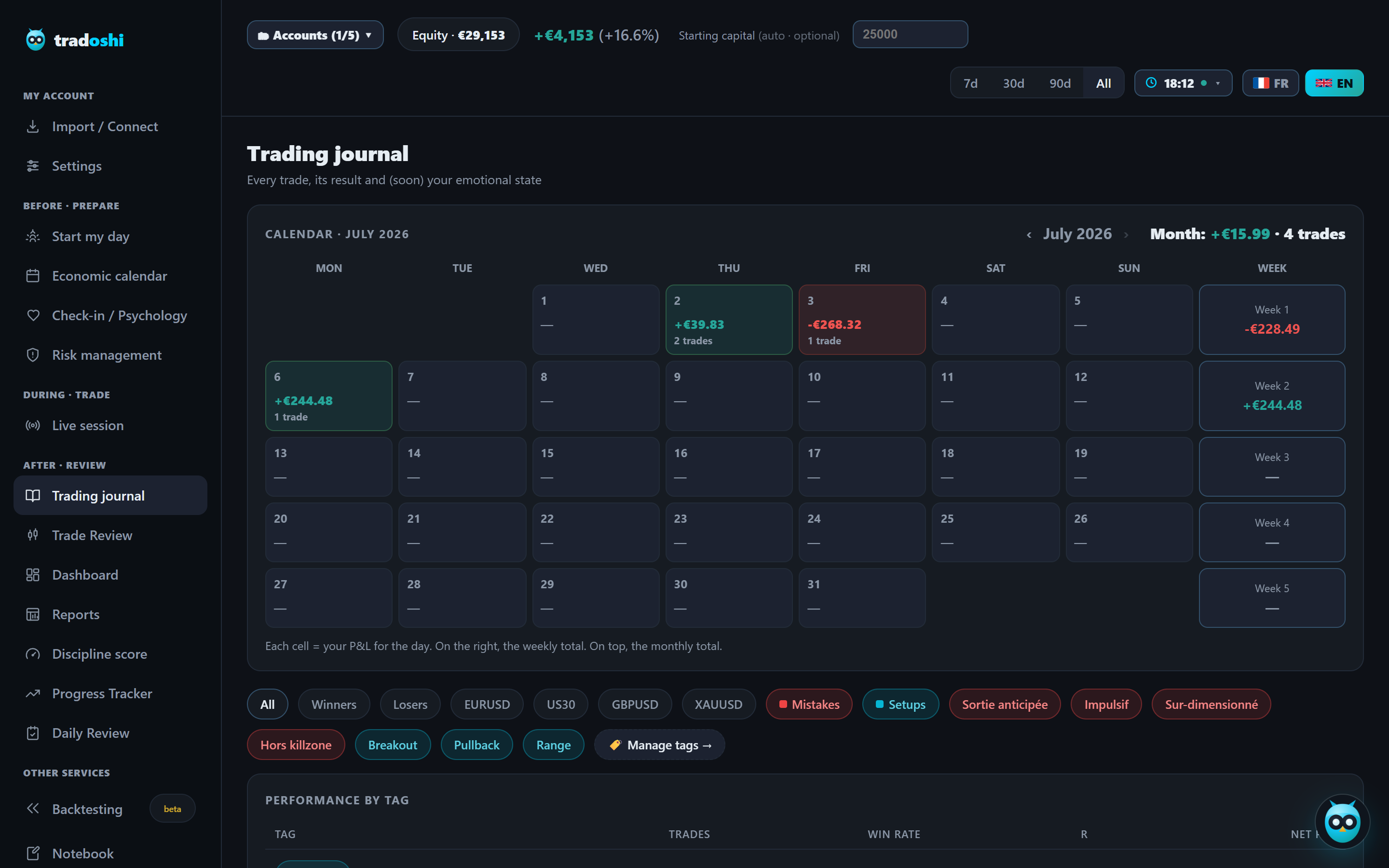
Tradoshi gives you the data to refine in the right place and verify that your adjustments work. It breaks down your performance by component and tracks your statistics over time, for a fact-based refinement.
- Breakdowns by setup, instrument and time to spot the component to improve first.
- Statistics tracked over time to verify an adjustment actually had an effect.
- Filters by period to compare before/after a change over a sufficient sample.
- Discipline score to distinguish a system problem from an execution problem.
Frequently asked questions
How do I refine my trading process?
By improving the same system through small targeted adjustments, each based on analyzing your data and not your latest trades. You change one thing at a time to measure its effect, give each version time to produce enough trades to be judged, and focus your efforts on the most failing component.
What's the difference between refining and changing systems?
Changing means abandoning your system for another, which resets the counter and erases your experience. Refining means keeping your system and improving one component while preserving what already worked. One destroys, the other builds. Mastery comes from depth on a stable base, not permanent novelty.
Should I adjust my system after a losing streak?
Not based on a few trades. A losing streak can be perfectly normal, mere statistical noise. Adjusting after two losses means reacting to noise, not signal, and risking breaking a good system. You must wait until you have enough data to distinguish a real weakness from ordinary variance.
Why change only one thing at a time?
Because if you modify several elements simultaneously and your performance changes, you'll never know which is responsible. By isolating each adjustment, you turn it into a small controlled experiment: you change one thing, measure its real effect, and keep or abandon it knowingly.
Where should I start to improve my trading?
Often with exits and risk management, more than the entry traders most want to tweak. Many have a decent entry ruined by emotional exits. Let your data tell you where the biggest leak is by breaking down your performance by component, and focus your efforts there, not on what itches you most.
What is overfitting in refining a trading system?
It's adjusting your system too finely to your past trade history, adding rules so specific they fit the noise rather than a real market signal. The warning sign is a rule added purely to fix one particular losing trade, with no rationale independent of the data that inspired it.
When should I stop refining my system?
When new adjustments stop producing measurable gains over several hundred trades. Past a certain point, refinement yields diminishing returns, and your energy is better invested in disciplined execution of the already validated system rather than perpetual tinkering.