Having trading rules is useless if you don't hold them, and holding them is far harder than writing them. The real challenge of discipline isn't knowing what to do, it's doing it when everything in you pushes to do otherwise. Here's how to define rules that work, and above all how to make them solid enough to withstand emotion.
- A good rule is precise and verifiable, not a vague good intention.
- Few well-held rules beat many ignored ones.
- Rules matter most in the hot moments, when emotion wants you to deviate.
- A rule you don't measure is a rule you probably don't respect.
Everyone knows you need rules in trading. The problem was never knowing it, it's holding. A trader can recite their ten rules by heart and break them all in the same session, swept up by a loss, an urge to win back, or a move they don't want to miss. Discipline isn't played out in knowing the rules, it's played out in respecting them under pressure.
The good news is that holding your rules isn't a matter of heroic willpower, it's a matter of design. Well-built rules almost hold themselves; badly-built ones break at the first stress. This guide explains what makes a good rule, why you need few, and how to make them inviolable by measuring them. A written rule is only worth something if you know how often you kept it: that is what a discipline score counts, trade by trade, instead of leaving it to memory.
What makes a good rule
A good trading rule has three qualities: it's precise, it's verifiable, and it's decided cold. Precise, because a vague rule leaves room for interpretation, and interpretation under emotion always leans the wrong way. Verifiable, because a rule you can't check afterward constrains you to nothing. Decided cold, because a rule invented in the heat of action is already a capitulation.
| Bad rule (vague) | Good rule (precise, verifiable) |
|---|---|
| I manage my risk well | I risk 1% max per trade |
| I don't overtrade | I take 3 trades max per day |
| I stop if things go badly | I stop after 3 losses in a row |
| I trade at the right times | I only trade 8-11am and 2:30-5pm |
| I stay disciplined | I never move a stop against myself |
Notice the difference: each good rule on the right can be verified on your real trades by a simple yes or no. That's a rule that constrains. The phrasings on the left sound good but oblige you to nothing, because they can never be objectively declared violated.
Few rules, well held
The classic mistake of the conscientious trader is to pile up rules. Twenty ultra-detailed rules give an impression of total control, but they're impossible to hold all at once, and you end up respecting none. Discipline doesn't come from the number of rules, it comes from their constant respect.
Better five rules you hold 100% than twenty you hold halfway. Pick the few rules that address your real leaks (the ones costing you the most money), and focus all your energy on those. Once they've become automatic, you can add others. Discipline is built brick by brick, not by pouring a whole wall at once.
Why rules cave under pressure
A rule is never tested when all is well. It's tested precisely in the moments when you most want to break it: after a stinging loss, facing an explosive move, when you're behind on your monthly target. That's where your emotional brain manufactures tailor-made exceptions: 'this time is different', 'I really feel it', 'just once'. These exceptions are the exact mechanism by which rules die.
A rule that allows a 'just this once' exception is no longer a rule, it's a suggestion. And suggestions protect no one.
The counter isn't to trust yourself more in those moments (you're at your weakest), it's to make the exception costly and visible. When every breach is logged and displayed in black and white, the little voice negotiating an exception runs into a measurable reality, and that's far more deterrent than willpower alone.
Making your rules inviolable: measurement
The difference between a trader who holds their rules and one who breaks them isn't strength of character, it's feedback. When you don't measure your rule adherence, you live in the comfortable fog where you can tell yourself you're 'broadly disciplined'. That fog is the breeding ground of indiscipline. It lets you minimize each breach and never see the overall pattern.
When, conversely, each rule is automatically checked on your trades and turned into a score, the fog vanishes. You see exactly which rule you break most, under what conditions, and what it costs you. What was an impression becomes data, and data you can correct. It's the most powerful mechanism for turning written rules into real discipline.
How to define your first rules
If you're starting from scratch, don't try to cover everything. Look at your worst past trades and ask: what simple rule would have prevented each of them? Those are your priority rules, the ones closing your real leaks. Here's an effective starting point for most traders:
- Maximum risk per trade (say 1% of capital).
- Maximum number of trades per day, to avoid overtrading.
- A stop rule after a defined number of consecutive losses.
- Allowed time windows, to trade only when your edge exists.
- An absolute ban on moving a stop against yourself.
Entry rules, management rules, exit rules
Not all rules are alike, and it's useful to classify them by moment of the trade. Entry rules define what you take: which setups, in what conditions, at what times. Management rules define what you do once in position: your risk, where you place your stop, whether you move it or not. Exit rules define how you close: target, trailing stop, partial exit. Most traders polish their entry rules and neglect the other two categories.
It's a mistake, because avoidable losses often come from management and exit, not entry. A good trade badly managed or badly closed becomes a bad result. By covering all three moments with clear rules, you eliminate improvisation where it costs most. Check that your rule set doesn't focus solely on 'when to enter': the rules telling you what to do once the trade is already running are at least as important.
The 'one at a time' rule
When you try to correct several bad habits at once, you usually correct none. That's why the best way to anchor new rules is to work on them one at a time. Pick the rule that addresses your costliest leak, focus only on it until it becomes an automatism, then move to the next. This sequential approach seems slow but is far more effective than trying to hold everything at once.
This method has another advantage: each mastered rule strengthens your confidence in your ability to hold the next. You build a streak of accumulating wins, instead of a long list of failures confirming that you 'lack discipline'. Discipline is built exactly like a skill, through the targeted repetition of a precise effort. By working one rule at a time, you turn a crushing goal ('become disciplined') into a sequence of reachable steps.
Writing your rules down
A rule that exists only in your head isn't really a rule: it's vague, revisable at will, and emotion rewrites it without you noticing. Writing your rules down freezes them, gives them an objective existence you can't quietly bypass. The mere fact of having to formulate them in writing forces you to make them precise, and reveals those that were too vague to be applied.
Keep your written rules visible while you trade, as a pilot keeps their checklist. It's not a lack of confidence in your memory, it's a recognition that under stress, memory and judgment degrade. Written, displayed rules confront you in real time with what you'd decided cold, and that confrontation is exactly what holds you back from deviating. What's written resists; what stays in the head bends.
Evolving your rules without betraying yourself
A rule isn't set in stone forever: it can and should evolve as your strategy matures, your capital grows, or you discover new leaks in your trading. The trap isn't changing a rule, it's changing it at the wrong moment and for the wrong reason. Evolving a rule after a cold analysis of several weeks of trades is legitimate; loosening it mid-trade because it's in your way never is.
Good practice is to reserve rule revision for a dedicated moment, like your weekly or monthly review, never during a trading session. Ask yourself coldly: has this rule cost me more than it protected over the period, backed by data rather than a momentary impression? If the answer is yes repeatedly and measurably, adjust it. If the answer comes from a single bad day where the rule stopped you from taking a trade that would have won, leave it alone: the randomness of one case never overturns a rule built on dozens of observations.
The rules most traders forget
Beyond the obvious risk and entry rules, some less-cited rules make a big difference. A rule on the number of screens or tabs open at once, to avoid the cognitive overload that pushes you to jump from one opportunity to another. A rule on the minimum state required to trade (sleep, calm, absence of major upset), because trading in a bad state degrades the execution of even your best technical rules. A rule on maximum size after an exceptional gain, so euphoria doesn't inflate your risk right after a great streak.
These so-called context rules are often neglected because they don't concern the trade itself, but the conditions under which it's taken. Yet a good share of trading errors don't come from a bad setup but from a good setup taken in bad conditions: tired, distracted, rushed. Widening your rules to cover this context, not just the trading action itself, closes leaks that classic rules often let through.
Personal rules vs imposed rules: the difference
If you trade for a prop firm, you deal with two layers of rules: the ones the firm imposes on you (daily loss limit, maximum drawdown, sometimes forbidden hours) and the ones you set for yourself. A frequent mistake is treating the firm's rules as the only ones that matter, and trading right up to their exact limits, with no personal margin. That's risky, because an imposed rule that closes your account the moment it's hit leaves you no room for execution error or an exceptionally bad day.
Good practice is to set personal rules noticeably more conservative than the imposed ones, creating a safety margin between your own limit and the one that, if crossed, ends the evaluation or the funded account. A trader who stops at -3% personal daily loss, while the firm's limit is -5%, protects themselves against an accidental overshoot caused by slippage or an execution mistake. This margin isn't excessive caution, it's risk management applied to the rule itself.
This layered approach also helps when you manage several funded accounts or several evaluations at once, each with its own limits. Rather than tracking each firm's rules separately in your head under pressure, decide a single personal standard stricter than the strictest of them, and apply that one standard everywhere. It's far easier to hold one consistent rule across every account than to remember which exact percentage applies to which firm in the middle of a losing trade.
How Tradoshi makes you hold your rules
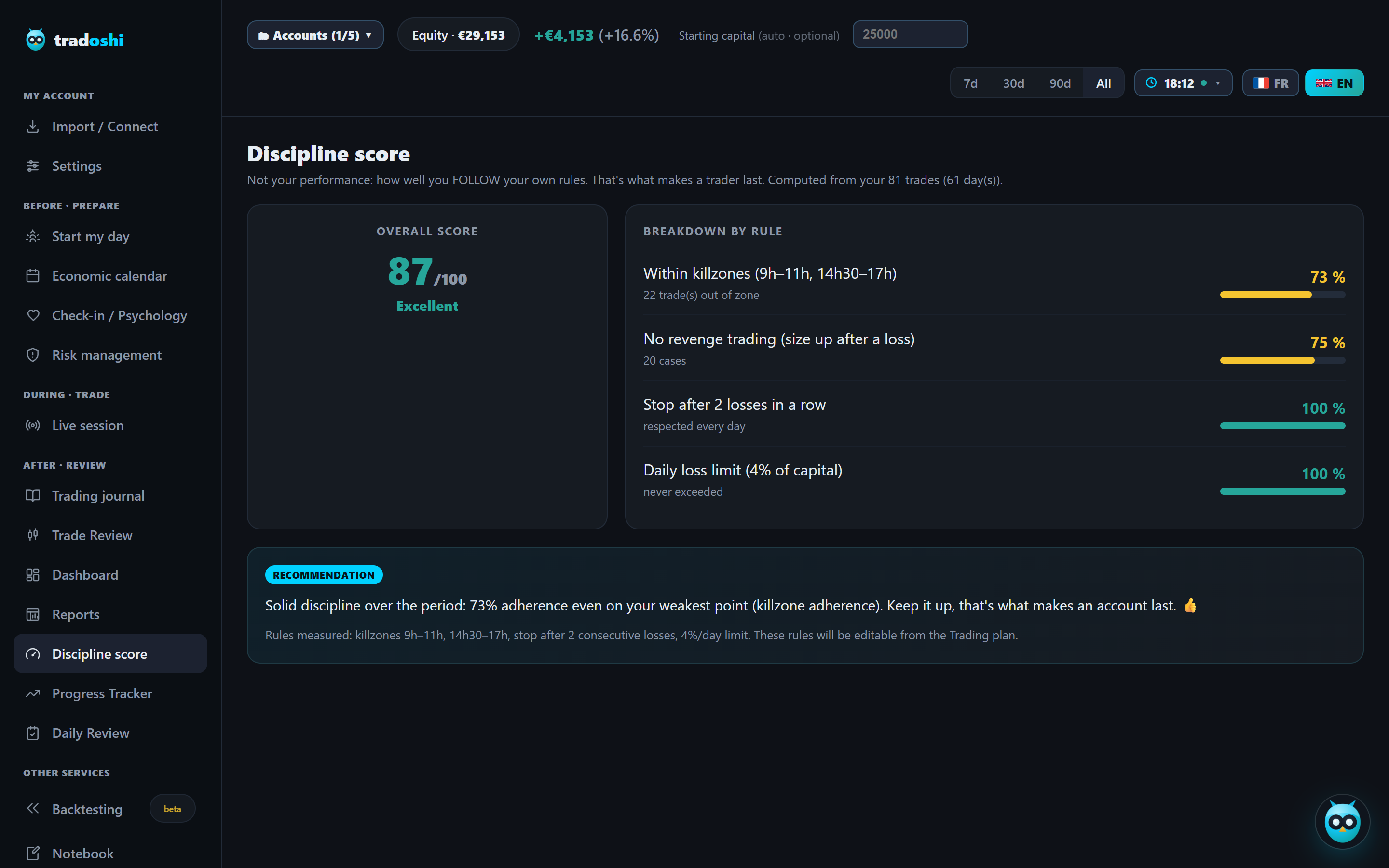
Tradoshi takes your rules and automatically checks them on each of your real trades, then condenses it all into a daily discipline score. Your rules stop being a list you forget and become a mirror that reflects, every day, the truth about your plan adherence.
- Rules verified: risk, killzones, stop after N losses, daily limit checked on your real trades.
- Discipline score: a daily 0-100 grade quantifying your overall rule adherence.
- Weak point identified: the rule you break most is highlighted so you can work on it.
- History: your streaks of disciplined days become visible and reinforce themselves.
Frequently asked questions
How do I define good trading rules?
A good rule is precise, verifiable and decided cold. Precise to leave no room for interpretation, verifiable to check it on your trades by a simple yes or no, decided cold so it isn't a capitulation invented in action. 'I risk 1% max per trade' is a rule; 'I manage my risk well' isn't.
How many rules should I have?
Few, but well held. Twenty detailed rules give an illusion of control but are impossible to respect all at once. Better five rules held 100% than twenty held halfway. Pick the ones closing your real leaks (what costs you most), make them automatic, then add others brick by brick.
Why can't I hold my rules?
Because rules are never tested when all is well, but in the moments you most want to break them: after a loss, facing a big move, behind on your target. Your emotional brain then manufactures 'just this once' exceptions. The counter isn't more willpower but making each breach visible and measured.
How do I make my rules more solid?
By measuring them. Without feedback, you live in a comfortable fog where you think yourself 'broadly disciplined' and minimize each breach. When each rule is checked on your trades and turned into a score, the fog vanishes: you see which rule you break most and what it costs. Measurement turns written rules into real discipline.
Which rules should I start with?
Look at your worst past trades and ask what simple rule would have prevented each. A good start: max risk per trade (1%), max trades per day, stop after N consecutive losses, allowed time windows, and a ban on moving a stop against yourself. These five rules close most common leaks.
Should rules be rigid or flexible?
Rigid on the survival principles (risk, stop, exit), flexible nowhere on those points. A rule that allows a 'just this once' exception is no longer a rule, it's a suggestion, and suggestions protect no one. You can evolve your rules cold, between sessions, but never loosen them in the heat of action.
Can I change a rule if it no longer suits me?
Yes, but only during a dedicated review, done cold, never during a trading session. Analyze several weeks of data before concluding a rule costs you more than it protects. A single bad day where the rule stopped you from taking a winning trade is never enough to overturn it: the randomness of one isolated case carries no weight against dozens of observations.
Which rules do traders forget most often?
Context rules: the minimum state required to trade (sleep, calm), a size limit after an exceptional gain to stop euphoria from inflating risk, or the number of tabs open at once to avoid cognitive overload. A good share of errors come from a good setup taken in bad conditions, not from a bad setup itself.
Should my personal rules match my prop firm's rules exactly?
No, they should be stricter. Trading right up to the firm's exact limits leaves you no room for an execution slip or an exceptionally bad day, since crossing them can end the account instantly. Setting a personal threshold noticeably more conservative than the imposed one, for example stopping at -3% when the firm's limit is -5%, creates a real safety margin.