The rule to stop after a defined number of losses is one of the most powerful in trading, and one of the hardest to hold. It stops you from turning a bad day into a disaster. The problem is that the moment you need it most is exactly when your brain screams at you to keep going to win it back.
- After several losses, your judgment is degraded: it's the worst moment to continue.
- The stop rule caps the damage before revenge trading takes control.
- The number is decided cold, never in the moment you're losing.
- Stopping isn't quitting: it's preserving your capital and your head for tomorrow.
There's a precise moment, in a trader's day, when everything can tip. It isn't the first loss, nor the second. It's the one too many, after which your brain stops following the plan and starts wanting to recover the lost money at any cost. Past that point, you're no longer trading the market, you're fighting your own frustration, and that fight you almost always lose.
The stop-after-X-losses rule exists to keep you from reaching that point. It's a simple safeguard: after a defined number of consecutive or daily losses, you stop, no negotiation. This guide explains why your judgment degrades after a losing streak, how to set the right threshold, and how to hold this account-saving rule precisely when accounts are most in danger.
Why your judgment degrades after losses
A loss isn't just a financial event, it's an emotional one that alters your brain. After a losing streak, you're under the effect of frustration, the urgency to recover, and a stress that narrows your vision. You no longer see the market objectively: you hunt for setups that don't exist, force entries, ignore your own rules because they suddenly seem too slow to pull you out of the hole.
It's a documented phenomenon: under the sting of a loss, our appetite for risk increases instead of decreasing, exactly the opposite of what it should. The brain wants to cancel the pain immediately, and it's ready to take absurd risks for that. Continuing to trade in that state means handing your decisions to your worst self. The stop rule takes you off the wheel before the crash.
What the rule prevents: revenge trading
The behavior the stop rule neutralizes has a name: revenge trading. It's that spiral where, after a loss, you take a trade you'd never have taken cold, often bigger, to recover in one shot. If it wins, you learn the worst possible lesson (that revenge pays) and you'll do it again. If it loses, you dig, and take even wilder risks to get out.
A single day of revenge trading can erase weeks of disciplined trades. The stop rule exists so that day never happens.
Revenge trading's signature is numbered: average losses explode late in the session and after two or three losses in a row, while average gains don't move. The stop rule cuts that spiral at the root, taking you out of the market before the third or fourth loss, the most destructive, occurs.
How to set the right threshold
The stop threshold is decided cold, never in action. There are two complementary forms, and many traders use both: a number of consecutive losses, and a maximum daily loss as a percentage of capital. The first protects you from streaks that degrade your mind; the second caps the financial damage of a bad day.
| Rule type | Example | What it protects |
|---|---|---|
| Consecutive losses | Stop after 3 losses in a row | Your mind (before revenge) |
| Daily loss | Stop at -3% on the day | Your capital (the worst case) |
| Number of trades | Stop after 5 trades | Against overtrading |
| Combination | First of the three reached | All three at once |
The right threshold depends on your strategy and capital, but a common benchmark is stopping after three consecutive losses or at a daily loss of 2 to 3% of capital, whichever comes first. The exact number matters less than the fact that it's decided in advance and non-negotiable once reached.
Stopping isn't quitting
Many traders experience stopping as a defeat, a surrender. It's the opposite. Stopping at the right moment is an act of strength, not weakness: it's the decision that preserves your capital and your mind for the coming days. The market will still be there tomorrow, with new opportunities, and you'll return fresh and clear-headed rather than burnt out and resentful.
The trader who stops after three losses loses three trades; the trader who continues can lose their week, their month, sometimes their account. The first suffered a normal bad day; the second turned a bad day into an avoidable disaster. The discipline of stopping is accepting the small controlled pain to avoid the large uncontrolled one.
How to hold the rule when it's hard
Holding the stop rule is hard because it asks you to stop precisely when everything in you wants to continue. Willpower alone isn't enough in that state. Here's what really works:
- Decide the threshold cold and write it down, so it isn't re-debatable in action.
- Physically close the platform once the threshold is reached: make resuming deliberately painful.
- Plan a replacement activity (a walk, sport) to release the frustration instead of trading it.
- Note what you feel at the moment of stopping: it anchors the lesson and defuses the emotion.
- Measure your rule adherence over time, to turn stopping into a reinforced habit.
Stopping on losses and stopping on gains
We always think of the stop rule after losses, but there's a symmetric, little-known rule: stopping after a big gain too. After a great day, euphoria and overconfidence push you to continue to 'make even more', and that's often where you give back part of what you just won. Setting a daily gain target beyond which you stop, or at least reduce, protects your good days from your own appetite.
The general idea is that both emotional extremes (frustration after losses, euphoria after gains) degrade judgment, in opposite directions but with the same result: bad decisions. A complete stop rule frames both, taking you out of the market when your state is no longer optimal, whether degraded by pain or by success. Many traders protect their capital from bad days but let it slip on good ones, for lack of thinking of this second rule.
The weekly stop rule
The stop rule doesn't only work at the day scale: it also has its weekly version, just as useful. Setting a maximum loss for the week gives you a second safeguard in case several bad days string together. Without it, a hard week can make you chain limit-loss days, each respecting the daily rule but adding up to a severe weekly drawdown that seriously dents your capital and your mind.
When you reach your weekly limit, the best decision is often to stop until the next week, time to step back, reread your trades cold and come back with a clear mind. This pause isn't a punishment, it's a protection: it stops you from pushing on in a period where, clearly, something is off, whether the market, your state or your execution. Knowing how not to trade during a bad week is a skill as precious as knowing how to trade during a good one.
Resuming after a stop
Stopping is one thing, resuming properly is another. After reaching your threshold and cutting, how you come back determines whether the stop served any purpose. The worst resumption is coming back the very next day with the idea of 'catching up' what you lost, your head still full of yesterday's frustration: you then restart exactly the cycle the stop was meant to break. The good resumption is neutral, like a fresh start, with no debt to recover.
For that, mentally separate the coming period from the one that went badly. What you lost belongs to the past; the next trade has no obligation to recover it. Resume with your normal size, your normal plan, without accelerating to win back. Ideally, before resuming, reread cold what led to the stop: was it variance or drift? That rereading turns the stop into learning, instead of a mere reprieve before the next bad patch.
Common mistakes with the stop rule
Many traders who fail to hold their stop rule never actually had a real rule, only a vague intention. The most frequent mistake is setting a threshold too high to feel reassured, something like 'I'll stop at -8%', which leaves plenty of room for tilt to set in long before it's even reached. A threshold that's too generous protects in theory but in practice leaves ample room to derail before touching it.
The second classic mistake is counting losses sloppily. Some traders only count 'clean' losses, the ones where the setup was respected, and forget off-plan trades, which are actually the first warning signals. Others reset the counter after a single winning trade, as if that isolated gain in the middle of a losing streak erased the degraded emotional state that preceded it. Counting honestly, without cutting yourself slack, is what lets the rule actually protect you.
The third mistake is treating the rule as negotiable depending on the day's mood. A stop rule that varies, 'I feel good today, I'll push to four losses', is no longer a rule, it's a suggestion that emotion will systematically rewrite in its favor. The rigidity of the threshold, including on days when you feel sharp, is precisely what makes it reliable on the days you're not.
A worked example: two traders, the same bad day
Picture two traders with a 10,000 account each, risking 1% per trade, or 100, and both suffering three consecutive losses on a Tuesday morning, a -300 hit. The first applies their stop-after-three rule and closes the platform. Their day ends at -3%, an ordinary bad day, quickly absorbed by the following weeks.
The second, without a rule or unable to hold it, keeps going. Frustrated, they double their size on the next trade to 'win it back fast', lose it, then chain two more off-plan trades before calming down. Their day ends around -7 to -8%, more than double the first trader's, and worse, they start tomorrow with an already dented mindset. Over a year, the gap between these two traders comes down to nothing but this rule held or not, repeated over dozens of similar days.
Adapting your threshold to your context
The right stop threshold isn't universal, it depends on your trading context. A trader in a prop firm evaluation, where a single daily loss limit can close the account for good, should set a personal threshold noticeably more conservative than the official limit, to keep a real safety margin. A trader on their own capital has a bit more latitude, but still benefits from staying strict, because that extra latitude is exactly what invites negotiating at the wrong moment.
Trading style matters too. A scalper taking many small trades can reasonably set a higher loss-count threshold than a position trader who only takes two or three trades a day, where each loss weighs proportionally heavier on the mind. Take the time to fit your threshold to your reality, your strategy and your account, rather than copying a generic number you read somewhere without checking it against your own situation.
How Tradoshi helps you stop
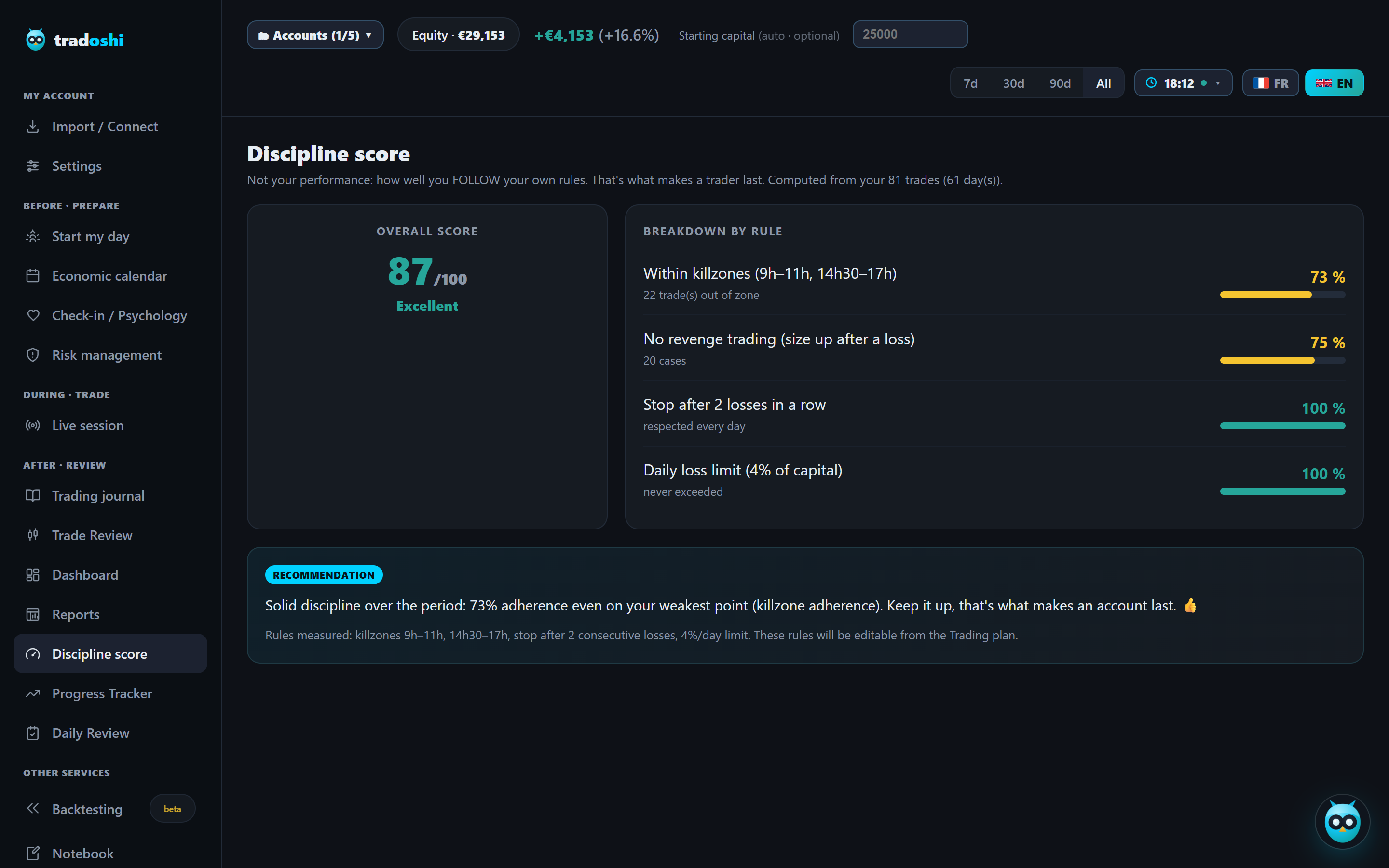
Tradoshi builds the stop rule into your discipline score and checks, on your real trades, whether you stop when you should. It makes visible what trades taken beyond your threshold cost, turning a good intention into a reflex proven by the numbers.
- Stop rule measured: your adherence to the loss threshold is checked on every trading day.
- Discipline score: days where you exceeded your threshold lower your grade and are highlighted.
- Cost of overshooting: you see how much trades taken after your stop threshold cost you.
- Emotional check-in: it helps you spot the 'I want to win it back' state before it makes you deviate.
Frequently asked questions
Why stop after a number of losses?
Because after a losing streak, your judgment is degraded by frustration and the urgency to recover: it's the worst moment to continue. The stop rule keeps you from reaching the point where you stop following your plan and start revenge trading. It takes you off the wheel before the crash.
After how many losses should I stop?
A common benchmark is stopping after three consecutive losses, or at a daily loss of 2 to 3% of capital, whichever comes first. The exact number depends on your strategy and capital, but the key is that it's decided cold, in advance, and non-negotiable once reached.
Isn't stopping just quitting?
No, it's the opposite of surrender. Stopping at the right moment preserves your capital and your mind for the coming days. The trader who stops after three losses loses three trades; the one who continues can lose their week or their month. The discipline of stopping is accepting a small controlled pain to avoid a large uncontrolled one.
Should I count consecutive losses or total loss?
Ideally both, since they protect different things. The number of consecutive losses protects your mind (before revenge sets in); the maximum daily loss caps the financial damage of the worst case. Many traders combine both and stop at the first threshold reached.
How do I hold the rule when I want to continue?
Willpower alone isn't enough in that state. Decide the threshold cold and write it down, physically close the platform once reached, plan a replacement activity to release the frustration, and note what you feel at the moment of stopping. Measuring your rule adherence over time turns it into a reinforced habit.
What should I do after stopping?
Leave the screen and do anything but trade: a walk, sport, something that releases the frustration instead of bringing it back to the market. Note cold what happened and what you felt, that's where the lesson anchors. Come back the next day fresh and clear: the market will offer new opportunities, but only if your capital and your head are intact.
Should the stop threshold be the same for every trader?
No. A trader in a prop firm evaluation should set a more conservative personal threshold than their official limit, to keep a safety margin. A scalper taking many small trades can tolerate a higher loss-count threshold than a position trader, where each loss weighs heavier. Fit the number to your strategy and your account rather than copying a generic benchmark.
What if I never manage to hold my stop rule?
First check that you're counting honestly: off-plan trades count as discipline losses too, and a single win in the middle of a streak doesn't reset the counter. Then make the breach measurable and visible instead of relying on willpower alone: a threshold tracked on your real trades, day after day, is far easier to respect than an intention kept in the back of your mind.