Confirmation bias is the mechanism that makes you seek the information confirming what you already believe, and ignore what contradicts you. In trading, it's a fearsome trap: once in a position, you no longer seek to know if you're right, you seek proof that you're right. And that's exactly how you hold a losing position far too long.
- Confirmation bias makes you see what you want to see once in a position.
- It turns a small loss into a big hole: you ignore the signals that contradict you.
- It affects everyone, it's not a flaw of intelligence but human wiring.
- The counter is to decide your exits cold, before the bias comes into play.
Once you've made a decision, your brain stops being an impartial judge and becomes a lawyer. It no longer seeks the truth, it seeks to defend the choice you've already made. That's confirmation bias, one of the best-documented cognitive biases, and it doesn't spare you because you're smart: it's part of the basic wiring of the human mind.
In trading, this bias is especially destructive, because it activates at exactly the wrong moment: when you're in a position and the market starts proving you wrong. Instead of recognizing the signals invalidating your trade, you start collecting the clues that reassure you, and you hold a losing position well beyond reason. This guide explains how the bias acts on your trades, why it's so hard to fight from within, and how to neutralize it by deciding in advance.
How the bias acts on a trade
Imagine you take a long position. As long as nothing happens, you're objective. But the moment price starts dropping against you, a shift occurs: your brain, now invested in this position, starts filtering information. You notice and amplify everything supporting your idea ('this support will hold', 'it's just a pullback') and you minimize or ignore everything contradicting it ('it's only a wick', 'the real move will resume').
This filtering isn't conscious: you genuinely feel like you're analyzing objectively. That's what makes the bias so dangerous. You don't tell yourself 'I'll ignore the negative signals', you simply ignore them, without noticing, because your brain makes them less visible. Meanwhile, your planned small loss grows, fed by the evidence you manufacture to stay in the trade.
Why it turns losses into disasters
Confirmation bias is the fuel of the trader's worst habit: holding a losing position too long. A loss becomes a disaster not all at once, but by accumulation, as you ignore signal after signal. Every broken level, every negative clue is reinterpreted to justify staying, and the loss swells well beyond what you'd planned and what your risk management allows.
The market doesn't ruin you in one trade. It ruins you by letting you believe, clue after clue, that this trade will reverse.
The worst part is reinforcement: when, by luck, a position held too long ends up reversing in your favor, the bias is rewarded. Your brain learns 'see, holding paid off', and you'll do it again, until the trade where price doesn't come back and the accumulated loss is catastrophic. Confirmation bias makes you win small battles the better to lose the war.
Why you can't fight it from within
The classic mistake is thinking you can defeat confirmation bias by sheer clarity, by 'staying objective'. It's impossible, because the bias operates precisely by giving you the illusion of being objective. You can't rely on your judgment to correct a flaw of your judgment: it's like asking a biased judge to recognize their own bias mid-hearing.
That's why the only reliable counter is external and prior: deciding your exit criteria cold, before entering, when the bias isn't yet activated because you don't yet have a stake in the trade. Once in the position, you're only executing a decision made by your impartial self. You no longer ask your biased judgment to decide, you follow a rail laid in advance.
The counter: deciding cold
Concretely, neutralizing confirmation bias means defining before each trade the exact point that invalidates your idea, and holding to it mechanically. It's no more complicated than that, but it's decisive:
- Before entering, define the precise price that proves you wrong (your stop = your invalidation).
- Write your scenario: under what conditions is this trade still valid, and which ones kill it?
- Place a real stop in the market, so as not to let the bias negotiate your exit live.
- Once in the position, stop reassessing: your assessment is done, let the stop do its work.
- Judge your trades afterward on objective criteria, not on the story you told yourself.
The bias in analysis too
Confirmation bias doesn't only strike open positions, it also pollutes your analysis. If you're convinced the market will rise, you'll unconsciously select the indicators, timeframes and levels that support that scenario, and dismiss those contradicting it. You build an analysis that looks solid but is really just a mirror of your starting conviction.
The counter here is to force the opposing view: before validating an idea, actively ask 'what would prove me wrong?' and honestly seek that evidence. If you can't find any argument against your scenario, you probably didn't really look. A good trader doesn't seek to be right, they seek not to be wrong, which is very different.
Confirmation bias in choosing your sources
Confirmation bias doesn't only pollute your individual trades, it also shapes the information you feed on. A bullish trader will spontaneously follow bullish analysts, read articles predicting the rise, join communities that share their bias. They thus build an information bubble that only reinforces what they already believe, without ever confronting them with opposing views. This echo chamber makes their bias even stronger and harder to perceive.
The counter is to actively seek disagreement. Deliberately follow analysts with the opposite view, read the arguments contradicting your scenario, surround yourself with people who don't hesitate to tell you you're wrong. It's not comfortable, but it's precisely the discomfort that shows you're leaving your bubble. A trader who only exposes themselves to comforting opinions ends up confusing the repetition of their belief with its validity. Seeking contradiction is an active antidote to the bias that otherwise feeds on your own comfort.
The illusion of after-the-fact mastery
A close cousin of confirmation bias is hindsight bias: the tendency to believe, after an event happened, that you saw it coming. In trading, this bias makes you rewrite the history of your trades: after a loss, you convince yourself you 'knew it', after a gain, that it was 'obvious'. This illusion of mastery stops you from honestly learning from your trades, because it distorts the memory of what you really thought at the moment of deciding.
The only bulwark against this bias is the written record. A journal that captures what you thought and felt at entry, before knowing the result, confronts you with the reality of your decisions rather than their flattering reconstruction. By rereading what you actually wrote cold, you often discover you 'knew' nothing at all, that your scenario was uncertain, that your confidence was misplaced. This honest confrontation is the only way to truly learn, because it stops you from telling yourself an after-the-fact story that protects your ego but deprives you of the lesson.
Cultivating useful doubt
Confirmation bias comes from a human need for certainty and coherence. Fighting it requires cultivating the opposite attitude: useful doubt, a willingness to question your own conclusions. The best traders aren't the most sure of themselves, but those who permanently keep a share of doubt about their own analysis, which makes them able to change their mind fast when the facts prove them wrong.
This doubt isn't paralyzing indecision, it's active humility facing the market's uncertainty. It translates concretely into habits: systematically formulating the scenario opposite to yours, asking before each trade 'what would prove me wrong?', and welcoming contradictory signals as precious information rather than threats to ignore. A trader who usefully doubts themselves is far better armed against confirmation bias than one convinced they're always right, because they keep open the door the bias seeks to close.
This useful doubt builds up with practice, a bit like a reflex you train. At first, actively formulating the scenario opposite to yours takes conscious effort and can feel almost counterproductive. With repetition, it becomes automatic, kicking in before the bias has even had time to filter the information. It's slow work, but every trade where you take the time to ask 'what would prove me wrong' strengthens that protective reflex a little more.
A worked example of the trap
Imagine a trader who risks 1% of their capital per trade, say 100 on a 10,000 account. They go long on a support, stop placed to risk exactly that 100. Price breaks the support with an aggressive first wick. Instead of exiting, they tell themselves it's 'just a stop hunt', mentally push back their tolerance limit, and let it run. Price keeps falling, they find a new argument ('it'll bounce at the next zone'), and so on.
By the time they finally exit, the real loss reaches 3% of the account, 300, three times the planned initial risk. This isn't an extreme case: it's the classic confirmation bias scenario in action, where each step seemed reasonable in the moment. The loss never jumped, it built up reassuring clue after reassuring clue, until it became a hole the trader would never have accepted had they seen it coming all at once.
Confirmation bias also caps your gains
Confirmation bias is often linked to losses held too long, but it acts just as much on winning trades, in the opposite direction. An anxious trader in a winning position unconsciously looks for reasons to exit: they notice every sign of weakness, every candle that slows, every indicator nearing a resistance zone, and ignore the signals confirming the trend continues. This version of the bias, tuned to confirming fear rather than hope, cuts gains well short of their real potential.
The mechanism is the same as for a losing position, only the direction changes: your brain seeks proof confirming what you feel (the fear of losing an acquired gain), not what's objectively true about the market. A trader who recognizes this mirror of the bias can apply the same counter: decide cold, before entering, how far to let a winner run, and stick to that rule rather than the anxiety of the moment.
Confirmation bias and overtrading
Confirmation bias doesn't stop at a single trade, it also contaminates your subsequent decisions. Once one trade confirms your macro thesis ('the market is bullish'), you tend to actively seek other opportunities going the same direction, without holding them to the same standard as your first analysis. You take a second trade because it 'confirms' the first, then a third, without noticing you're stacking correlated risk on a single idea.
This quiet overtrading is especially dangerous because it doesn't look like classic impulsiveness: each individual trade seems justified, analyzed, reasonable. That's exactly the trap. The counter is to treat every new position as an independent risk added to the others, and ask yourself whether you'd take it if it didn't already confirm what you believe. If the answer is no, the bias, not the analysis, made the decision for you.
How Tradoshi helps
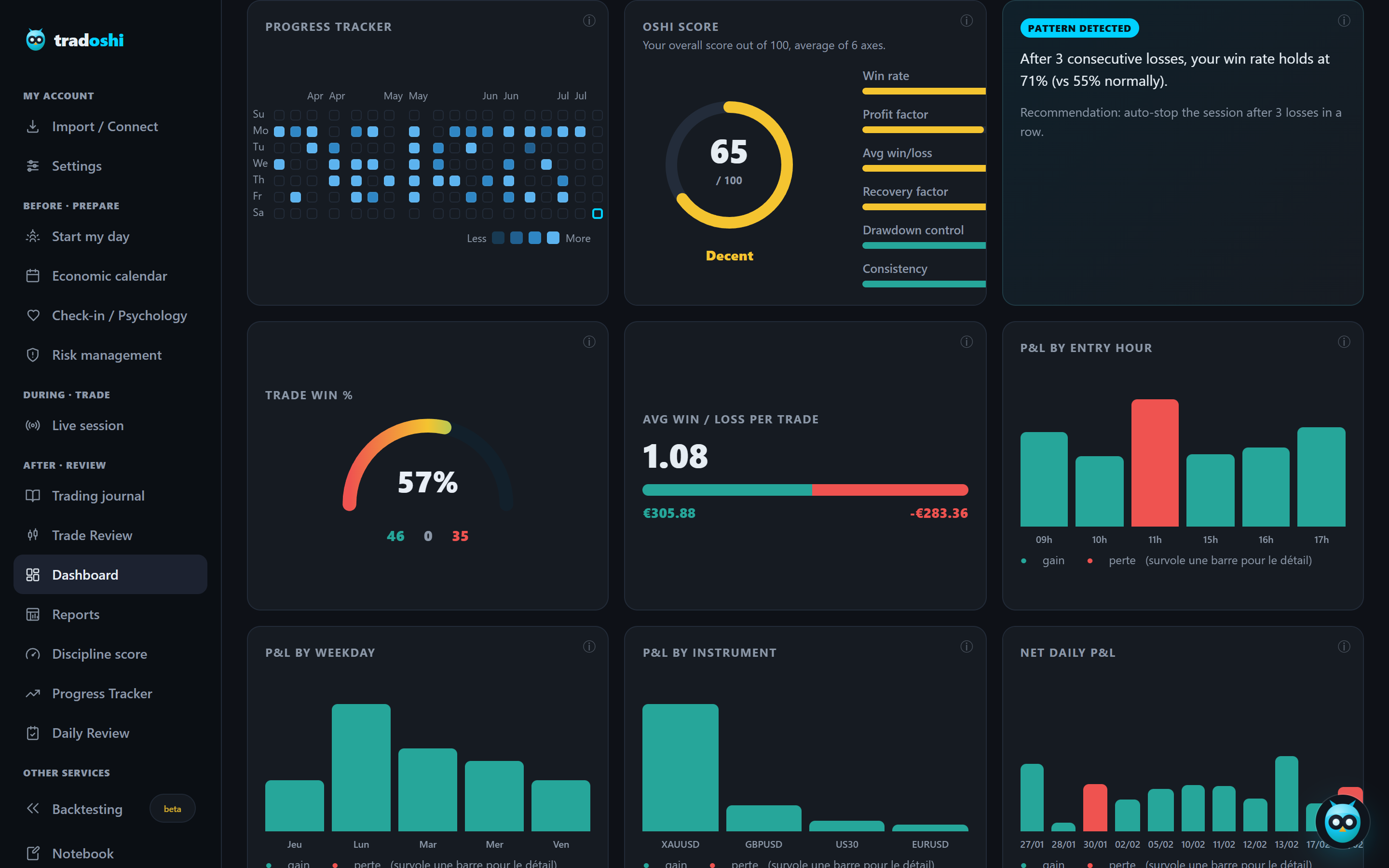
Tradoshi helps you judge your trades on objective criteria rather than the story your bias tells you, by measuring what really happened on your positions.
- Stop and R-multiple read: your invalidation is logged, you see whether you respected your exit or held too long.
- Discipline score: holding a loss beyond the stop stands out as a measured breach.
- Objective analysis: your stats are based on your real trades, not your biased perception.
- Emotional check-in: it helps you spot when you're justifying a trade instead of evaluating it.
Frequently asked questions
What is confirmation bias in trading?
It's the mechanism that makes you seek information confirming what you already believe and ignore what contradicts you. Once in a position, you no longer seek to know if you're right, you seek proof that you're right. It's what makes you hold a losing position too long, collecting reassuring clues while the loss swells.
Why does confirmation bias cause losses?
Because it makes you ignore, one by one, the signals invalidating your trade, turning a planned small loss into a big hole. Every broken level is reinterpreted to justify staying. Worse, when a position held too long reverses by luck, the bias is rewarded and you do it again, until the trade where price doesn't come back and the loss is catastrophic.
Does confirmation bias affect everyone?
Yes, it's basic wiring of the human mind, not a flaw of intelligence. Once a decision is made, your brain stops being an impartial judge and becomes a lawyer defending your choice. Nobody escapes it by clarity alone, precisely because the bias operates by giving you the illusion of being objective.
How do I fight confirmation bias?
Not from within: you can't rely on your judgment to correct a flaw of your judgment. The only reliable counter is external and prior: decide your exit criteria cold, before entering, when the bias isn't yet activated. Define the price that proves you wrong, place a real stop, and once in the position, let it do its work without reassessing.
Does the bias also affect my analysis?
Yes. If you're convinced the market will rise, you unconsciously select the indicators and levels supporting that scenario and dismiss those contradicting it. You build an analysis that's just a mirror of your conviction. The counter is to force the opposing view: actively ask what would prove you wrong, and honestly seek that evidence.
How do I judge a trade objectively?
By judging it on what really happened (did you respect your stop, what real R), not on the story you told yourself to stay in. Decide your criteria cold before entering, measure your trades afterward on objective data, and remember that a good trader doesn't seek to be right but not to be wrong, which is very different.
Does confirmation bias also affect my winning trades?
Yes, in the opposite direction. An anxious trader in a winning position unconsciously looks for reasons to exit, notices every sign of weakness and ignores the signals confirming the trend continues. This mirror of the bias, tuned to confirming fear, cuts gains well short of their real potential. The same counter applies: decide cold, before entering, how far to let a winner run.
Can confirmation bias cause overtrading?
Yes. Once one trade confirms your macro thesis, you actively seek other opportunities going the same direction, without analyzing them as rigorously as the first, stacking correlated risk on a single idea. Each trade feels individually justified, which is what makes this quiet overtrading hard to spot. Treat every position as an independent risk.