 By Benjamin Roure L'Hermitte
Revenge trading means jumping back into the market right after a loss to win it back, often with a bigger size and without waiting for your setup. A loss, then a position taken too fast, then another, and within an hour your account has shrunk far more than the original loss. That's not bad luck or a lack of talent: risk-taking after a loss has been measured, including among professionals. And a mechanism you understand can be cut.
- It's not weakness: among professional traders in Chicago, those who lost in the morning were about 16 percent more likely to take above-average risk in the afternoon (Coval and Shumway's study, cited below).
- The danger isn't the loss, it's the escalation: each revenge trade raises the size and lowers the quality. In the example below, 1% becomes 6%.
- It takes three forms: doubling down, the rushed off-setup entry, and fixating on the asset that hurt you.
- You don't reason an emotion mid-flight: you block it with rules decided cold, made visible and measured.
You just took a loss. Immediately, you open a new position, bigger, without really waiting for your setup. An hour later, your account has shrunk far more than the initial loss. Many traders recognize themselves here, including those who know exactly what revenge trading is. Knowing isn't enough: in the moment, the decision is made hot, before you've reread your plan.
That's precisely what makes this behavior so dangerous. It's not a technical gap you fix by reading one more book, it's an emotional reaction that makes you do, under pressure, the exact opposite of what you know to do when calm. The good news is that a predictable reflex can be defused, provided you understand it and set guardrails before it fires.
This article looks at what studies have actually measured after a loss, why the damage gets out of proportion, the three forms revenge trading takes, how to spot the reflex before it fires, what to do when it's already rising, and above all how to cut it with a simple protocol decided cold.
What happens after a loss: what studies have measured
Let's say it first: no study, to our knowledge, measures retail 'revenge trading' under that name. What research has measured is risk-taking after a loss. The most direct measure comes from professionals: in Coval and Shumway's study in the Journal of Finance (2005), Chicago Board of Trade proprietary traders who lose in the morning are about 16 percent more likely to take above-average risk in the afternoon than those with morning gains. That result is about those traders, not about a retail trader at a screen. It does show that being a professional with experience isn't enough to protect you from the tendency.
The most cited explanation comes from the lab. In Kahneman and Tversky's paper 'Prospect Theory' (Econometrica, 1979), the authors write that losses loom larger than gains of the same amount, and that most people turn into gamblers when facing a loss: between losing 3,000 for sure and an 80% chance of losing 4,000, 92% of the 95 respondents chose the gamble. These are hypothetical choices, put to students and faculty, with no money at stake. Applied to trading, that gives a reading, not a proof: a loss, even a small one your plan allowed for, can make you want to undo it right away. Two urges then fire: recover the money now, and prove you were right. Both push you to act fast, and fast is the enemy of trading.
One nuance matters. In Thaler and Johnson's study 'Gambling with the House Money and Trying to Break Even' (Management Science, 1990), run on students with small sums, a loss doesn't always push people to risk more: it can also make them more cautious. What becomes attractive is the bet that offers a chance to get back to zero. When gambling was the only way to erase the loss, about 70% of participants took the gamble. That is the very thinking of a revenge trade: you're no longer looking for a good trade, you're looking for the one that gets you back to even.
As for what happens in the body, the data are thin. In Coates and Herbert's study published in PNAS (2008), 17 traders on a London trading floor were followed for 8 business days: their cortisol rose with the variability of their results and with market volatility, but the authors found no significant difference in cortisol between losing days and winning days. Seventeen men, eight days, a quiet period in the markets: that is too little to state what a loss triggers in your brain. What can be seen, on the other hand, is behavior, and that is what you can measure in your own trading.
Rationalization: when emotion disguises itself as analysis
The most insidious trap is that in the moment, you don't feel irrational. You tell yourself a credible story to justify the revenge trade: 'the market will reverse', 'that was a fakeout', 'I'm just recovering my loss, it's not over-risking'. Rationalization dresses emotion up as analysis, and that's what makes revenge trading so hard to catch in the moment: it shows up looking like a good idea, backed by market arguments.
A simple way to unmask this rationalization is to ask yourself one question: would I take this trade if I had no loss to repair? If the answer is no, it's not analysis, it's disguised revenge. Prepare that question cold and write it down: in the heat of the moment, you're busy convincing yourself of the opposite.
Why the losses get huge
Revenge trading doesn't make you lose a little more, it can make you lose a lot more. Each revenge trade raises the size and lowers the quality of the entry. The table below is a worked example, not a measurement: a 1% loss becomes 3%, then 6%, because the size grows with each attempt. It's a self-sustaining spiral: the more you lose, the more you feel forced to win it back, the more you force, the more you lose.
| Trade | Size (risk) | Mental state | Cumulative result |
|---|---|---|---|
| 1 (planned) | 1% | Calm | −1% |
| 2 (revenge) | 2% | Frustrated | −3% |
| 3 (revenge) | 3% | Angry | −6% |
| 4 (revenge) | 4%+ | Panic | −10% and more |
So the real risk isn't the first loss, which was probably normal and planned for. It's the sequence. A disciplined trader and an impulsive one take exactly the same first loss; what separates them is what they do in the next ten minutes. A single day of revenge trading can erase weeks of patient gains. On Topstep's help page on its Daily Loss Limit, read in October 2026, the company writes that over 63% of traders have lost an account in a single day, without stating the period or the method behind that figure. It only holds for that company, but it shows the scale at which the risk plays out: the session.
The three faces of revenge trading
Revenge trading doesn't always take the same shape. Recognizing its three variants helps you locate yourself, because you never think 'I'm revenge trading', but you can think 'I'm doubling down'.
1. Doubling down
The best-known form: after a loss, you increase the size of the next trade to 'win it back in one shot'. Arithmetically it's the costliest: double the size and the possible loss doubles too, on an entry taken in worse conditions. A single oversized trade can cost more than a whole series of normal losses.
2. The rushed off-setup entry
Here you don't necessarily change the size, but you take a trade you'd never have looked at an hour earlier. The setup isn't there, but you need action, so you force it. You're no longer looking for a good opportunity, you're looking for a chance to recover, which isn't the same thing.
3. Fixating on the same asset
Price hurt you on one instrument, and you obsess over it, as if it owed you something. You re-enter it again and again, ignoring that the market doesn't remember your loss and owes you nothing. This fixation turns a neutral asset into a personal debt to recover.
The warning signs to know by heart
You can't cut a reflex you don't see coming. The goal is to make these signs so familiar that they trigger an automatic internal alarm the moment they appear:
- You size up right after a loss.
- You take a trade you wouldn't have looked at an hour earlier.
- You feel anger, urgency, a need to 'fix it'.
- You watch your last trade's result more than the chart.
- You catch yourself negotiating with your own rules ('just one more').
- You count in money lost to recover, no longer in setup quality.
Impulse vs plan: two ways to react to the same loss
| After a loss | Revenge reaction | Disciplined reaction |
|---|---|---|
| Size | Increase it to win it back | Keep it frozen |
| Timing | Enter right away | Respect an imposed cooldown |
| Setup | Force a mediocre trade | Wait for a real signal or stop |
| Emotion | Anger, urgency | Named, set aside |
| Goal | Recover the lost money | Execute the plan, period |
| In our example | 1% that becomes 6% | A loss that stays a loss |
The 4-rule protocol to cut the reflex
You don't reason an emotion mid-flight, you prevent it with rules decided cold. What follows is advice, not a study result: a simple, non-negotiable rule doesn't depend on your clarity at the moment you have the least of it. Here are the four that matter most:
- Consecutive-loss limit. After a set number of losses in a row (two or three), you stop for the day. No last trade, no exception. It's the most direct guardrail, because it cuts the spiral before it runs away.
- Mandatory cooldown after a loss. Impose a waiting time before any new trade. None of the studies cited here says how long it takes: pick a duration, write it down, and check in your journal whether the trades you take after that cooldown are better than the ones taken right away.
- Frozen position size. Your size is decided by your risk management, never by your mood. Never raise it to 'win it back': it's the rule that neutralizes the most destructive form of revenge trading.
- Rules written cold. Write these rules in advance, when you're clear-headed and calm, in the form 'if I lose two trades in a row, then I close the platform'. That format has been studied outside trading: in the meta-analysis by Gollwitzer and Sheeran (2006), which pools 94 independent tests, deciding in advance how to respond to a situation had a medium-to-large effect (d = 0.65) on goal attainment. None of it is about traders, but it's the best known reason to prefer a written rule to a good resolution.
What to do when it's already rising
Rules prevent, but you also need to react when you feel the urgency rising mid-session, before you've clicked. In those moments, the goal isn't to 'trade well', it's to break the automatism and take back control:
- Physically stand up from your desk, even for thirty seconds. The point is to put distance between the urge and the click.
- Breathe slowly a few times: it's a simple gesture that keeps you busy somewhere other than the buy button.
- Name your emotion out loud or in writing ('I'm angry, I want to win it back'). Writing it down also leaves a trace to reread in your journal.
- If doubt persists, close the platform. No opportunity justifies trading in a degraded state.
Prevention beats cure
The best revenge trading is the one that never happens, and much of it is decided before the first loss. The reasoning is simple, even though no study cited here measures it: the smaller your risk per trade, the less a loss weighs on your account, and the less you have to 'make back'. A 1% loss is made back with a normal trade; a 5% loss tempts you to force it.
Accepting in advance that losses are part of the job also helps. A trader who knows they'll have normal losing streaks has fewer reasons to experience each loss as an injustice to repair. Planning your daily loss limit before opening the platform means deciding your emergency exit while still calm, not while the house is burning. Prop firms have made it a rule: at Topstep, according to its help page read in October 2026, hitting the daily limit ends the session without being a rule violation; at FTMO, according to FTMO's page on its trading objectives read the same month, dropping below the day's limit is a violation. The details are in our guide to the prop firm daily loss limit.
Revenge trading feeds the other biases
Revenge trading doesn't live alone: it feeds and is fed by other psychological traps. It drives overtrading (multiplying positions to recover), it combines with FOMO (jumping on any move for fear of missing the rebound), and it can tip, after a few lucky recovery gains, into overconfidence. Cutting the revenge spiral therefore also takes an opening away from those other behaviors.
Two of these neighboring behaviors have been measured, on populations other than yours. First, the refusal to book a loss: across 10,000 accounts at a US broker, from 1987 to 1993, Terrance Odean's study of the disposition effect finds that stock investors sold their winning positions more readily than their losing ones. Then activity: across 66,465 households at a US broker, from 1991 to 1996, Barber and Odean's study 'Trading Is Hazardous to Your Wealth' measures 11.4% net a year for those that traded the most, against 18.5% for those that traded the least. And in France, the AMF study of retail investors' results on CFDs and forex, which followed 14,799 active clients over four years, states that the more trades a client makes, the larger the loss. None of these three studies talks about revenge: they only say that holding losers and multiplying trades were costly for the people observed.
Make the rule visible and measured
A rule kept in your head is easy to negotiate with. A rule that's measured and displayed, much less so. That's the job of Tradoshi's discipline score: it automatically spots revenge trading in your trades (size ballooning after a loss, entries too close together, results collapsing at the end of a losing day), shows you how much it cost you, and turns 'I should stop after two losses' into a number you can no longer ignore.
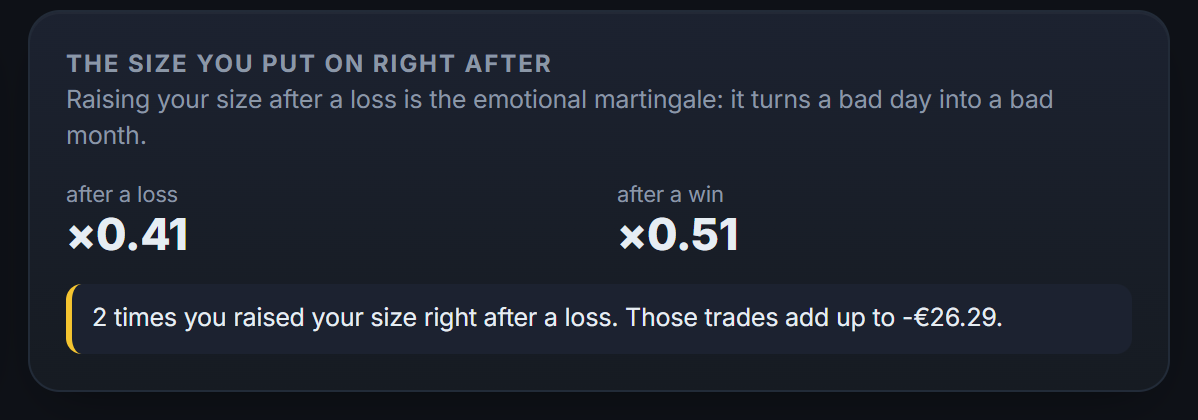
If your numbers show that your losing days are losing mostly because of the trades taken after the first loss, you have a precise reason to stop earlier. You correct an impression poorly; you correct a number that comes back every week better.
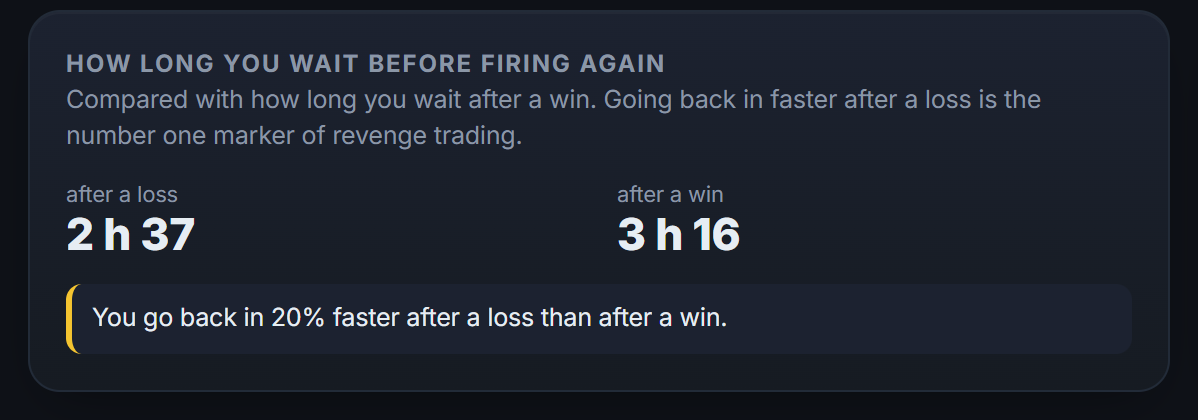
A concrete example
Take two traders with exactly the same account and the same first losing trade at −1%. The first applies their rule: they note the loss, respect their cooldown, find no valid new setup within the hour, and end the day at −1%. The second feels cheated, doubles the size on an average entry, loses again, fixates, and ends the day at −8%. Same market, same starting point, same initial loss. The whole difference lies in what they did with their emotion, not in their analysis.
Frequently asked questions
Is revenge trading just a lack of discipline?
No, not in the sense of a character flaw. Risk-taking after a loss has been measured among professional traders at the Chicago Board of Trade, not only among beginners. Discipline isn't being stronger than the urge in the moment, it's having set rules in advance that stop it from expressing itself.
How do I know if I'm revenge trading without realizing it?
By looking at your data, not your memory. In the moment you feel rational. Afterward, you can spot the signatures: size rising right after a loss, several entries close together, much worse results at the end of a losing day. A journal or a discipline score makes these patterns visible.
Should I stop completely after a loss?
Not after an isolated loss, which is part of the game. The useful rule is a threshold: after two or three consecutive losses, you stop for the day. It's not the loss that triggers the stop, it's the sequence, because the sequence is what does the real damage.
Does a cooldown after a loss really change anything?
None of the studies cited in this article measures the effect of a break on traders, so nobody can promise you a number. The value of the cooldown is practical: it separates the loss from the next decision, and it gives you time to return to your plan. It doesn't need to be long, it needs to exist and be non-negotiable. Your journal will tell you whether it changes your results.
How do I tell a real good setup from a revenge trade?
Ask yourself: would I take this trade if I had no loss to recover? If the answer is no, it's revenge disguised as analysis. A real setup exists independently of your last result; a revenge trade only exists because you just lost.
What if my next trade really was a good setup?
It might be, but you're badly placed to judge that right after a loss. Missing a good trade costs you a possible gain; spiraling into revenge trading can cost you several times your original loss. A rule that occasionally makes you miss a good trade is still a reasonable trade-off.
Does revenge trading go away with experience?
Nothing allows us to say so. In Coval and Shumway's study, it was Chicago Board of Trade professionals who took more risk in the afternoon after a losing morning: experience didn't protect them from it. What gets built over time is the guardrails: written rules, a loss limit, a journal that shows what those trades cost.
How do I stop when the urge to win it back is too strong?
By breaking the automatism physically: stand up, breathe, close the platform, step away from the screen. Deciding in advance what you'll do after stopping (a break, something else) keeps you from sitting at the chart ruminating and reopening a position.