You know your bad trading habits. You know you shouldn't move your stop, overtrade after a loss, or enter without a clear setup. And yet you do it again. That's the paradox of the bad habit: knowing it isn't enough to break it. This guide explains how these destructive automatisms form, and above all the concrete method to replace them, because you don't delete a habit, you replace it.
- A bad habit is an automatism, not a lack of knowledge: knowing it isn't enough.
- Every habit has a trigger: identify it and you hold the lever to change it.
- You don't delete a habit, you replace it with a better one on the same trigger.
- Measurement anchors change: seeing a habit's cost motivates you to break it.
Most traders treat their bad habits as a discipline or willpower problem. 'I just need to be more rigorous.' But willpower is a limited resource that depletes, especially under stress, precisely when the habit triggers. Counting on it alone condemns you to repeat the same mistakes.
Bad habits aren't character flaws, they're learned automatisms, trigger-behavior-reward loops your brain has engraved. The good news is that what was learned can be re-learned. This guide gives you the mechanics of habits and a method to reprogram them, rather than fighting them with willpower. It also covers why relapses are normal, how your environment shapes your automatisms, and how regular accountability helps the new behavior stick.
Why knowing isn't enough
The first, uncomfortable observation is that knowledge doesn't change behavior. You can perfectly know that moving your stop is a mistake, have read it a hundred times, have paid dearly for it, and do it again anyway the next time the market puts you under pressure. That's because the bad habit doesn't operate at the level of knowledge, but at the level of automatism.
A habit is an automatic response triggered by a situation, short-circuiting conscious thought. When the trigger appears, a loss, a tension, a fast move, the behavior unfolds almost on its own, before your rational part even reacts. That's why willpower always arrives too late, and why fighting a habit head-on with discipline alone is a losing battle.
The habit loop
Every habit, good or bad, follows the same three-part structure: a trigger, a behavior, and a reward. The trigger is the situation that launches the automatism. The behavior is what you do. The reward is the immediate relief or pleasure your brain gets from it, and it's this reward that reinforces the loop and engraves it a little more with each repetition.
| Habit | Trigger | Reward sought |
|---|---|---|
| Revenge trade | A loss that frustrates | Ease the pain, win it back |
| Moving the stop | Price approaches the stop | Avoid the pain of being wrong |
| Overtrading | Boredom, quiet market | Sensation of action |
| Cutting a winner early | A profit appears | Secure it, calm anxiety |
Understanding this loop is the key, because it shows you where to act. You can't easily remove the trigger (losses and tensions are part of trading), and you don't want to remove the reward (the need it satisfies is real). The only point you truly have a grip on is the behavior in the middle: you can replace it with another that responds to the same trigger and provides a similar reward, in a less destructive way.
Identifying your triggers
Before changing anything, you must know your triggers precisely. What situation, exactly, precedes each of your bad habits? Is it always after a loss? At a certain time? In a certain emotional state? As long as the trigger stays vague, you can't anticipate the habit, and you suffer it every time.
This is where a journal becomes indispensable. By noting the context of each impulsive trade, your state, the time, what had just happened, you surface the pattern. Many traders discover that their worst habit has a very precise, repetitive trigger, for example systematically after the second loss of the day. Once this trigger is identified, you go from passive victim to observer able to anticipate, and anticipation is half the battle.
Replace, don't delete
The classic mistake is trying to simply stop a bad habit by willpower, to create a void. But a void fills itself, usually with the return of the old behavior as soon as your guard drops. The method that works is replacement: keep the same trigger, but associate a new behavior with it that provides a comparable reward.
You don't break a habit by merely forbidding it. You break it by giving its trigger a better response, ready in advance.
Concretely, to each bad habit you associate a replacement behavior decided cold. The trigger 'I just lost' no longer triggers a revenge trade, but a planned ritual: stand up, step away from the screen for two minutes, breathe. The trigger 'price approaches my stop' no longer triggers moving the stop, but the acceptance planned in advance that this trade may be a loser. The replacement behavior must be precise, simple, and ready before the trigger appears.
Make the good behavior easy
A habit is taken more easily when the behavior is easy to execute and hard to circumvent. To install a good habit, reduce friction: make the good action automatic and the bad action costly. Systematically placing your stop at entry, for example, makes the stop habit almost effortless and the behavior of trading without a stop harder.
Conversely, increase friction on the bad habit. If you overtrade out of boredom, close the platform between your trading windows: reopening becomes a conscious effort that gives your reason time to intervene. If you move your stops, use orders that make the gesture more constraining. Each small obstacle placed on the path of the bad habit, and each ease offered to the good one, slowly but surely shifts your default behavior.
Measure to anchor change
Changing a habit is a slow process that requires consistency, and nothing supports consistency better than seeing your progress. Tracking your rule-adherence rate over time turns an abstract effort into a concrete curve, and seeing that curve rise is a reward in itself that reinforces the new behavior.
Measurement also serves as a reminder of the why. Seeing quantified what your old habit cost you, how much your revenge trades destroyed, how much your moved stops worsened your losses, sustains motivation in moments of weakness. The trader who has measured the real cost of their bad habits no longer fights them on principle, but out of well-understood self-interest, which is a far more durable motivation.
A concrete example of reprogramming
Imagine a trader who, systematically after a second loss in the same session, increases their size on the next trade to 'speed up' recovery. The trigger is clear: second loss of the day. The behavior is destructive: increased size under stress. Rather than just telling themselves 'I shouldn't do this anymore', this trader decides cold on a precise replacement: after a second loss, they close their platform for ten minutes, log what happened in their journal, and only reopen with a size strictly identical to their usual risk.
The first few times, this new behavior takes real conscious effort, because the old automatism is still stronger. But through repetition, the new gesture (close, log, breathe) itself becomes increasingly automatic, until it competes with and then replaces the old one. This mechanism isn't instant: expect several weeks, even several months depending on how entrenched the habit is, before the new reflex becomes your brain's natural path when facing this specific trigger.
Why relapses are part of the process
Changing a habit is almost never linear. You'll have relapses, days where the old behavior takes over despite your good intentions, particularly in moments of fatigue or high stress where your self-control capacity is lowest. This phenomenon is normal and documented in any behavioral reprogramming, not just trading: a relapse isn't a failure of the process, it's part of it.
The danger isn't the relapse itself, but the reaction it triggers. A trader who judges themselves harshly after a relapse, who tells themselves they'll never manage it, often abandons the change effort at that exact moment. The trader who treats the relapse as information ('here's the context where my old reflex is still strong') draws a lesson from it and adjusts their replacement strategy, for example by reinforcing friction on that specific situation. Overall consistency matters more than one-off perfection.
Tackling one habit at a time
A common trap is wanting to fix all your bad habits at once, as soon as you've spotted them in your journal. This approach spreads your attention and willpower, an already limited resource, across too many fronts at once, which almost always makes the whole effort fail. Better to isolate the bad habit costing you the most, quantified in your journal, and focus all your replacement efforts on that one alone until it's clearly under control.
Once this first habit is stabilized, which shows up as a lasting improvement in your discipline score on that specific point, you can tackle the next one with the same method. This sequential approach is slower in appearance than a total, immediate overhaul, but it produces results that hold, whereas attempts to change everything at once almost systematically collapse at the first moment of stress.
The role of your environment in the habit
A habit doesn't just live in your head, it also lives in your physical environment. Where you trade, the notifications that interrupt you, whether or not your phone is within reach, all of this environment makes your automatisms, good or bad, easier or harder to trigger. A trader who keeps their trading app permanently open on their phone creates an environment that favors overtrading, regardless of their willpower in the moment.
Changing your environment is often more effective and more durable than relying on mental discipline alone. Removing easy access to the platform outside your defined trading windows, turning off price notifications that constantly pull you back to the screen, or even physically changing where you trade rather than improvising from your couch, are simple adjustments that structurally reduce the chance for a bad habit to trigger. A well-designed environment does part of the work for you, without demanding your willpower at every moment.
Relying on regular accountability
An often-overlooked lever for anchoring a habit change is external accountability, knowing that your results and your rule adherence will be examined, whether by your cold-headed self or by a third party. Having to account for yourself, even informally, changes how you behave in the moment, a bit like driving more carefully knowing a speed camera exists on the road, even without seeing it precisely that day.
Concretely, this can take the form of a fixed weekly review where you coldly examine your trades against your rules, or a regular sharing of your statistics with a peer or a serious community of traders. It's not about shame or negative social pressure, but about creating a regular checkpoint where the gap between your intention and your actual behavior becomes visible and therefore correctable. Without this regular mirror, bad habits tend to persist quietly, never confronted with reality.
How Tradoshi helps you change your habits
Tradoshi makes your habits visible, identifies their triggers and measures what they cost you. You see your destructive automatisms in your real trades, and you track over time your ability to replace them.
- Behavior detection (revenge trading, overtrading, out-of-zone entries) in your real trades.
- Crossing with your emotional state to identify the triggers of each habit.
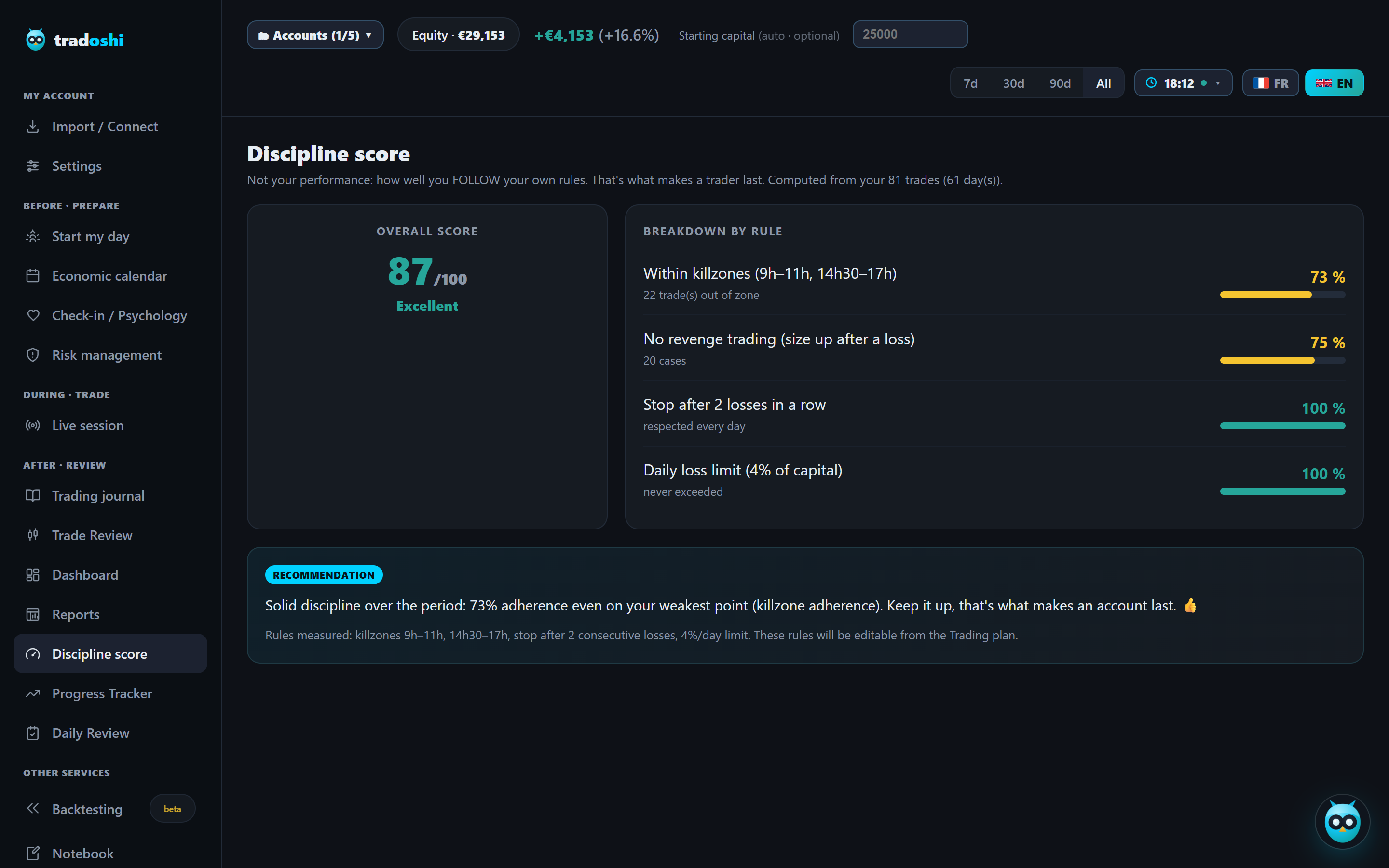
- Discipline score tracked over time to see your progress and anchor the change.
- Cost quantification of each bad habit, the best motivation to break it.
Frequently asked questions
Why do I repeat my bad habits even though I know them?
Because a bad habit doesn't operate at the level of knowledge but of automatism. When the trigger appears (a loss, a tension), the behavior unfolds almost on its own, before your rational part reacts. Willpower always arrives too late, which is why knowing it isn't enough to break it.
How do I break a bad trading habit?
By replacing it rather than trying to simply stop it. Identify the habit's trigger, then associate a new behavior decided cold with that same trigger, one that provides a comparable reward. A void created by mere prohibition fills with the return of the old behavior as soon as your guard drops.
What is the habit loop?
Every habit follows three parts: a trigger (the situation that launches the automatism), a behavior (what you do), and a reward (the immediate relief or pleasure that reinforces the loop). You can't remove the trigger or the reward, but you can replace the middle behavior with a better one.
How do I identify my triggers?
With a journal that notes the context of each impulsive trade: your state, the time, what had just happened. The pattern emerges through repetition. Many traders discover their worst habit has a very precise trigger, for example systematically after the second loss of the day. Identifying the trigger lets you anticipate the habit.
Is willpower enough to change my habits?
No. Willpower is a limited resource that depletes under stress, precisely when the habit triggers. Counting on it alone condemns you to repeat the same mistakes. It's better to reduce friction on the good behavior (make it automatic) and increase it on the bad one, to shift your default behavior.
Is it normal to relapse while trying to change a habit?
Yes, almost always. Relapses are part of the reprogramming process, particularly in moments of fatigue or high stress where your self-control capacity is lowest. The danger isn't the relapse itself but the reaction it triggers: it's better to treat it as information to use than as a failure that justifies giving up.
Should I fix all my bad habits at once?
No, that's a common mistake that spreads your willpower across too many fronts and makes the whole effort fail. Better to isolate the habit costing you the most, quantified in your journal, focus all your replacement efforts on it until it's under control, then move to the next one with the same method.