A trading checklist is the simplest and most underrated tool for stopping bad decisions. Surgeons and airline pilots, whose mistakes cost lives, rely on checklists. The trader, whose mistakes cost their account, thinks they can do without. That's a mistake: a checklist turns rules into reflexes and takes emotion out of the equation.
- A checklist forces consistency: every trade goes through the same checks, whatever your state.
- It removes emotion from the decision: you follow a list instead of improvising under pressure.
- It makes 'no' easy: if a criterion is missing, you skip the trade, no debate.
- Short and binary: each point is answered yes or no, in seconds.
In professions where error is fatal, the checklist isn't optional, it's a standard. An experienced pilot with ten thousand takeoffs still follows their checklist before every flight, because they know experience doesn't protect against forgetting, fatigue or haste. Trading is exactly the same kind of profession: a few seconds of inattention can erase weeks of work.
Yet most traders enter on feel, telling themselves 'this looks good'. A checklist replaces that vague impression with a series of objective checks each trade must pass. This guide explains why it works, how to build an effective one, and how it helps you automate your good decisions so emotion no longer gets a say.
Why a checklist works
A checklist works because it exploits a fundamental weakness of the human brain: under stress, our judgment degrades without us noticing. When emotion rises, we skip steps, drop checks, convince ourselves that 'this time, no need'. The checklist short-circuits that process: it doesn't ask you to remember or judge, it just asks you to tick.
By turning a complex decision into a series of simple questions, the checklist makes your behavior independent of your mood. Whether you're calm or wanting to win it back, the same trade goes through the same filters. That's exactly what you want in trading: consistent execution that doesn't vary with your inner state of the moment.
It takes emotion out of the equation
The trader's greatest enemy isn't the market, it's their own impulsiveness. Seeing a fast move and wanting to jump in, feeling a loss and wanting to avenge it, fearing to miss out and forcing an entry: these impulses take control in a fraction of a second. The checklist introduces a delay and a structure between impulse and action, and that simple space is often enough to defuse the bad decision.
A checklist doesn't make you smarter. It just stops you from being stupid at the worst moment, which is far more useful.
When you have to run your trade through five questions before entering, you can no longer act purely on impulse. Either the trade ticks every box, and then your emotion has no grip since the trade is objectively valid, or one is missing, and the checklist gives you a clear, non-negotiable reason to abstain.
How to build an effective checklist
A good trading checklist is short, precise and binary. Short, because a twenty-point list will never be followed; five to seven criteria suffice. Precise, because a vague criterion filters nothing. Binary, because each point must be answered yes or no in seconds, with no room for interpretation. Here's the structure of a typical pre-entry checklist:
| Criterion | Binary question |
|---|---|
| Context | Is the trade in the direction of my reference trend? |
| Setup | Is my exact entry signal present? |
| Risk | Is my stop placed and my size sized at 1%? |
| Ratio | Does my target offer a ratio of at least 1:2? |
| Time | Am I within an allowed time window? |
| State | Am I calm, and not wanting to win it back? |
The last criterion is the most important and most often forgotten: your own state. A perfect setup taken in a degraded emotional state is a bad trade disguised as a good one. Building a check of your mental state into your checklist is the best way not to trade your emotions instead of the market.
The easy-'no' rule
The checklist's real power is that it makes refusal simple and guilt-free. Without a checklist, saying no to a trade is hard: you doubt, you wonder if you're missing an opportunity, emotion pushes you to enter. With a checklist, refusal becomes mechanical: a criterion is missing, so you skip, period. It's no longer you giving up, it's the list deciding, and that delegation frees you from the pressure.
That ability to say no easily is what separates profitable traders from the rest. Most bad trades aren't analysis errors, they're trades you should never have taken and took anyway, for lack of a filter saying no on your behalf. The checklist is that filter.
From checklist to measurement
A checklist disciplines you before the trade; measuring your trades disciplines you after. The two complement each other perfectly. The checklist filters entry, and measurement tells you whether, in hindsight, you truly respected your criteria or told yourself stories while ticking the boxes a bit fast. Without that verification loop, a checklist can become an empty ritual you follow mechanically.
It's by crossing the two that discipline is truly built: the checklist sets the conditions, and measurement after the fact verifies you honored them. When you see that your off-checklist trades are statistically your worst, you gain the most solid motivation there is to respect it: the numbered proof.
Entry checklist and exit checklist
We almost always think of the checklist for entering, never for exiting, when the exit is at least as much a source of errors. An exit checklist asks you the right questions at closing time: is my target reached per my plan? Am I cutting out of fear or by my rule? Is my scenario invalidated? Am I holding a loss hoping for a reversal? These questions, asked mechanically, defuse the emotional exits that destroy the ratio.
The exit is the moment when fear and greed are strongest: fear of giving back a secured gain, greed of letting a loss run. An exit checklist forces you to confront your decision with your rules instead of leaving it to your emotion of the moment. Many traders have a disciplined entry and a chaotic exit, and it's that unstructured exit that shaves their gains and swells their losses. Structuring the exit as much as the entry is one of the most profitable adjustments.
The danger of the checklist becoming an empty ritual
A checklist has a paradoxical enemy: habit. From filling it repeatedly, you risk ticking it mechanically, without really checking, on autopilot. The checklist then becomes an empty ritual that gives you a false sense of rigor while having lost its filtering power. You tick 'yes' on criteria you didn't actually examine, just by reflex, and the safeguard no longer protects anything.
To avoid this, keep your checklist short and demanding, and regularly check, by rereading your trades, whether your answers were honest. If you discover that trades ticked 'compliant' actually violated a criterion, it's the sign you're filling your checklist too fast. A checklist only has value if each box corresponds to a real check, not a reflex. Measuring your trades after the fact is the best way to keep your checklist honest and alive.
Adapting your checklist with experience
A good checklist isn't fixed: it evolves with what your data teaches you. If you discover a certain criterion filters nothing useful, remove it to keep the list light. If you identify a recurring leak (say, your worst trades always happen in a certain context), add a criterion that addresses it. The ideal checklist reflects the lessons of your own history, not a generic list copied elsewhere.
This adaptation must happen cold, based on your past trades, never mid-session to allow a trade the checklist refuses. Revising your checklist between sessions, based on what cost you and what worked, makes it increasingly precise and personal. Over time, it becomes the distillation of everything you've learned about your own way of sabotaging yourself, and therefore the most effective tool for avoiding it.
Mistakes to avoid when building your checklist
Building a checklist seems simple, but certain mistakes keep recurring and cancel out its effectiveness. The first is copying someone else's checklist without adapting it. A checklist found in a book or on a forum reflects its author's strategy and weaknesses, not yours. A criterion essential for a scalper may be useless for a swing trader, and vice versa. Your checklist should come out of your own recurring mistakes, not a generic list.
The second mistake is including subjective criteria that leave too much room for interpretation, like 'the setup looks clean' or 'the context seems favorable'. A vague criterion filters nothing because you can always convince yourself it's met. Each point must be objectively verifiable, with a yes or no that doesn't depend on your mood of the moment.
The third mistake is wanting to include everything, to the point of turning the checklist into a twenty-line slab. A checklist that's too long takes too long to fill in, which pushes you to rush it or abandon it under time pressure, exactly when you need it most. Five criteria truly respected beat twenty ticked in a rush.
A worked example: the checklist that would have prevented an avoidable loss
To make this concrete, imagine a trader who spots a nice setup on an instrument they follow, with a 1:2.5 ratio and a favorable trend context. Excited by the opportunity, they enter without noticing the time falls outside their usual window, right before a major economic release they hadn't checked. The market reacts violently to the release, against their position, and their stop is hit with significant slippage that doubles their expected loss.
Had they followed a five-criterion checklist including the question 'am I within an allowed time window, with no major release imminent?', that trade would have been automatically screened out, without even needing to think about it. The checklist wouldn't have changed anything about their technical read, which was correct, it would simply have blocked the entry because of an external risk factor that the excitement of the moment made them forget.
This example, built to illustrate the mechanism, shows why the checklist protects even good analysis: the problem wasn't the setup, it was the context in which it was taken. An objective checklist catches this kind of blind spot far better than mental vigilance, which relaxes precisely when the opportunity looks great.
One checklist per strategy, not a universal one
If you trade several distinct setups or strategies, a single universal checklist almost always ends up too vague for one and too strict for another. A minimum-ratio criterion relevant to your breakout strategy may make no sense for your reversal strategy, which targets shorter moves with a different ratio. Forcing all your trades through the same grid produces either unjustified refusals or acceptances a poorly calibrated criterion should never have let through.
The solution is to have a short checklist per strategy, each tailored to that setup's specific criteria, rather than a single list meant to cover every case. That takes a bit more design work upfront, but each checklist stays short and relevant, which is the very condition of its effectiveness. The only criterion that should stay common to all your checklists, whatever the strategy, is your emotional state: whatever the setup, a degraded trader makes worse decisions on any strategy.
How Tradoshi complements your checklist
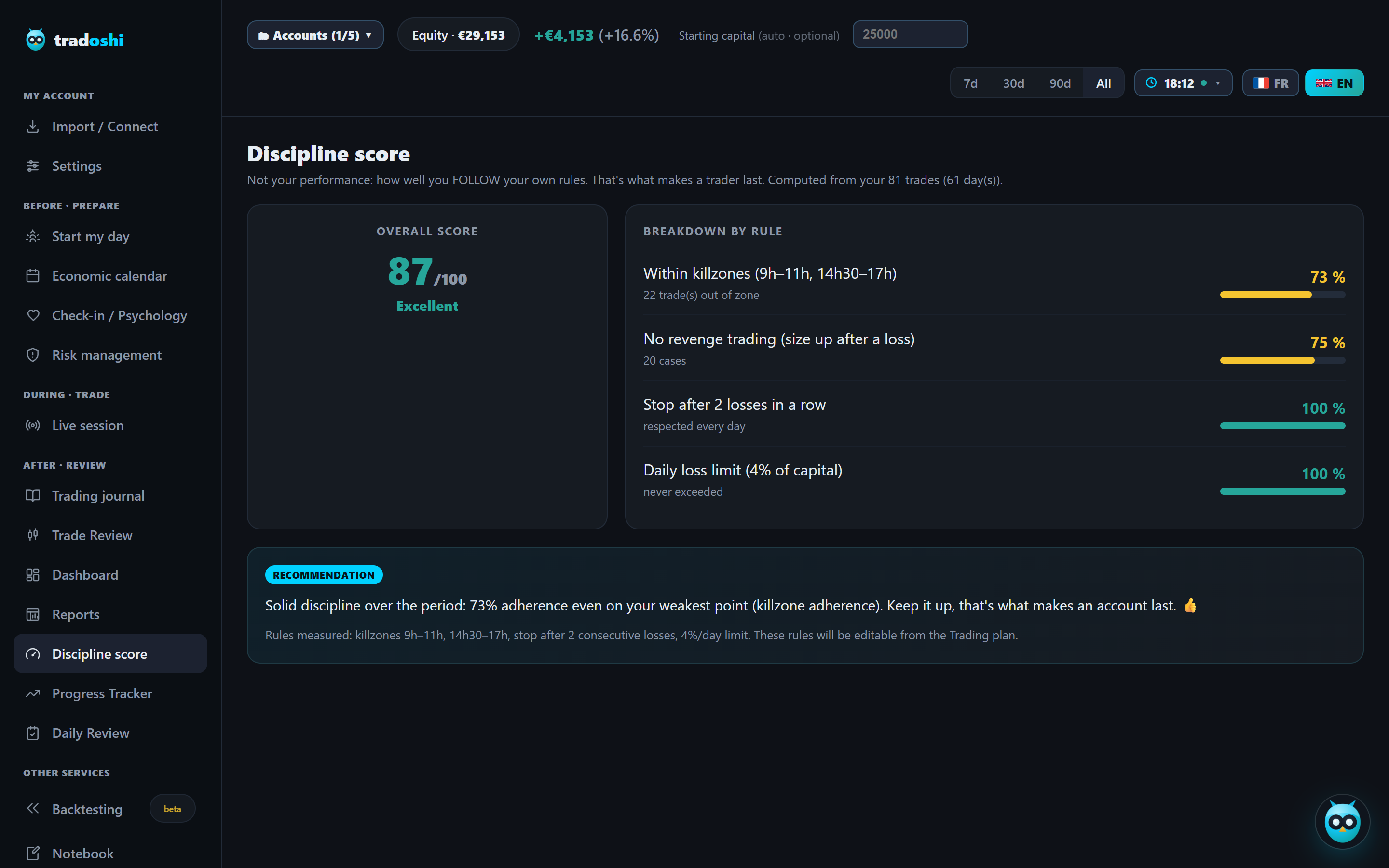
Tradoshi doesn't replace your entry checklist, it extends it by verifying, afterward, whether you respected your key criteria (risk, hours, stop) on your real trades, and showing you what off-rule trades cost.
- Criteria verified: 1% risk, time windows, stop rules automatically checked on every trade.
- Discipline score: a daily grade reflecting your overall adherence to your criteria.
- Emotional check-in: it complements the 'state' criterion of your checklist before the session.
- Numbered proof: your off-rule trades stand out as statistically more costly.
Frequently asked questions
What is a trading checklist for?
It runs each trade through the same objective checks, whatever your emotional state. Like pilots' or surgeons' checklists, it protects against forgetting, fatigue and haste. It removes emotion from the entry decision and forces consistent execution, independent of your mood of the moment.
What should go in a trading checklist?
Five to seven binary criteria: context (trend direction), the exact setup, risk (stop placed, size at 1%), ratio (at least 1:2), allowed time, and above all your emotional state (are you calm?). Each point must be answered yes or no in seconds, with no room for interpretation.
Should a checklist be long?
No, on the contrary: a long checklist will never be followed. Five to seven criteria suffice. Effectiveness comes from the simplicity and binary nature of each point, not the number. A short list you follow on every trade is infinitely better than an exhaustive one you drop after a week.
How does a checklist reduce emotion?
It introduces a delay and a structure between impulse and action. When you have to run your trade through several questions before entering, you can no longer act purely on impulse. Either the trade ticks every box and is objectively valid, or one is missing and you have a clear, non-negotiable reason to abstain.
Why include my emotional state in the checklist?
Because a perfect setup taken in a degraded state is a bad trade disguised as a good one. The market hasn't changed, but you have: under stress, your execution deteriorates. Adding a check of your mental state ('am I calm or wanting to win it back?') is the best way not to trade your emotions instead of the market.
Is a checklist enough to be disciplined?
It disciplines entry, but it must be complemented by measurement after the fact. Without verification, a checklist can become an empty ritual you tick too fast. By crossing the checklist (before) and measurement of your real trades (after), you see whether you truly respected your criteria, and you get the numbered proof that your off-rule trades are your worst.
Can I copy another trader's checklist?
It's not recommended as-is. A checklist found in a book or on a forum reflects its author's strategy and weaknesses, not yours. A criterion essential for a scalper may be useless for a swing trader. Use an existing checklist as a starting point, but adapt it based on your own recurring mistakes.
Do I need a different checklist for each strategy?
Yes, if you trade several distinct setups. A universal checklist almost always ends up too vague for one and too strict for another, because relevant criteria (ratio, context) differ by strategy. Keep a short checklist per strategy, with your emotional state as the only criterion common to all of them.