Confidence is essential to trade, overconfidence is deadly, and the line between the two is far thinner than people think. Real confidence rests on data and discipline; overconfidence rests on a good streak and ego. One makes you execute your plan calmly, the other makes you betray it while feeling invincible. Knowing how to tell them apart is vital.
- Confidence rests on data, overconfidence on a good streak and ego.
- Confidence makes you follow your plan; overconfidence makes you betray it.
- Overconfidence often follows gains: that's the most dangerous moment.
- The counter is staying anchored to the numbers, not the impressions of the moment.
A trader without confidence can't trade: they hesitate, doubt every entry, cut gains out of fear, freeze after a loss. Confidence is the fuel of calm execution. But that same confidence, pushed too far, turns into its toxic opposite: overconfidence, that state where you think yourself better than your results and relax precisely the safeguards that were making you win.
The problem is that the line between the two isn't visible from within. At the moment you tip into overconfidence, you don't feel it as excess, you feel it as legitimate confidence, earned by your recent successes. That's the whole trap. This guide explains what distinguishes real confidence from overconfidence, why the latter often follows gains, and how to stay on the right side of the line.
What distinguishes confidence from overconfidence
The fundamental difference between confidence and overconfidence lies in their foundation. Real confidence rests on evidence: a tested system, a trade history, discipline demonstrated by your data. It's calm, sober, and doesn't make you deviate from your plan, on the contrary it lets you execute it without trembling. It says: 'I trust my process, so I apply my rules'.
Overconfidence rests on nothing solid: it comes from a recent good streak and an ego feeding on it. It's euphoric, agitated, and pushes you to do more, to think yourself above your own rules. It says: 'I'm on form, I can afford to load up, to skip checks'. Where confidence makes you follow your plan, overconfidence makes you betray it in the name of your supposed superiority.
| Real confidence | Overconfidence |
|---|---|
| Rests on data | Rests on a good streak |
| Calm and sober | Euphoric and agitated |
| Makes you follow your plan | Makes you betray your plan |
| 'I trust my process' | 'I can afford more' |
| Stable over time | Rises and collapses with results |
Why overconfidence follows gains
Overconfidence has a favored trigger: the winning streak. After several winning trades, your brain produces a surge of confidence that quickly overflows reason. You attribute your recent successes to your talent, forgetting the share of favorable variance that contributed, and conclude you've 'figured out' the market. That's exactly when danger is maximal, because your guard drops just when you feel strongest.
The trader is never as vulnerable as at the peak of a good streak, when they confuse their recent luck with permanent talent.
This mechanism is cruel because it's self-reinforcing in the short term: the more you win, the better you think you are, the more risk you take, and as long as luck lasts, it seems to work. Then variance turns, and you find yourself taking your biggest risks precisely when the market stops rewarding you. Overconfidence makes you give back in a few trades what your discipline patiently built.
The danger of lacking confidence
We must also talk about the other extreme, because lacking confidence is just as crippling. The trader who doubts everything hesitates on entries, misses good setups, cuts gains out of fear, and no longer dares take risk after a loss. A winning system is useless if you don't have the confidence to execute it. Many traders have a real edge but waste it for lack of confidence in their own plan.
The target isn't to eliminate confidence but to calibrate it: enough to execute your plan without trembling, not enough to think yourself above your rules. That calibrated confidence doesn't come from a motivating speech, it comes from one reliable source: your data. When you see in black and white that your process works over time, you gain solid confidence that doesn't depend on your last streak.
Staying on the right side of the line
The key to staying in real confidence and avoiding overconfidence is keeping your confidence anchored in the numbers rather than in impressions. Here's how:
- Base your confidence on your full history, not your last trades.
- After a good streak, be especially vigilant: that's when overconfidence lurks.
- Never change your rules (risk, size) under the sting of high confidence.
- Watch your emotional state: euphoria is a warning signal, not a sign of strength.
- Return regularly to your data to recalibrate your confidence against reality.
The confidence that comes from data
The most solid confidence, the kind that doesn't collapse at the first drawdown and doesn't turn into overconfidence at the first gain, is the one that rests on objective data. When you can see your edge measured, your discipline scored, your consistency over time, your confidence stops depending on your emotions of the moment. It becomes a fact, not a feeling, and a fact doesn't panic in a losing streak nor get drunk in a winning one.
That's the big difference between the amateur and the professional: the amateur draws confidence from their last results, the professional draws it from their process measured over the long term. Anchoring your confidence in your data gives you a stable base that holds you in the highs and the lows, without ever tipping into paralyzing doubt or destructive excess.
Building this kind of data-driven confidence takes time, and that's precisely its strength: it can't be manufactured overnight by a good week or destroyed overnight by a bad one. Every session logged adds a small brick to a foundation that gets harder to shake as it grows, which is exactly why traders who track their numbers over months tend to be calmer under pressure than those relying on how they feel that day.
Rebuilding confidence after a failure
A major failure, a big drawdown or a marked losing streak can durably crack a trader's confidence, to the point of paralyzing them. Rebuilding it doesn't come from a motivational speech or a big successful trade that 'erases' the failure, but from a methodical return to consistency. Stringing together disciplined days, even modest ones, proves to your brain that you and your system still work, and that concrete proof rebuilds confidence far better than any positive thinking.
The key is to rebuild confidence on the solid foundations of behavior, not the shifting sands of results. A confidence rebuilt on a big gain is as fragile as that gain is random; a confidence rebuilt on a streak of well-executed days is solid because it rests on what you control. After a failure, reduce your size, return to the essentials, and let the repetition of good days rebuild, stone by stone, a confidence that this time won't depend on your last streak.
Confidence calibrated by setup
Mature confidence isn't uniform: it's calibrated to the objective quality of each situation. Not all setups are equal, and an experienced trader feels different confidence depending on whether they're facing their best setup in ideal conditions, or a borderline configuration in an uncertain context. This modulation of confidence, when it rests on objective criteria and not on mood, is a sign of competence, not instability.
The danger would be confusing this legitimate calibration with the emotional variation of confidence. Healthy confidence varies with the measured quality of the setup, decided cold; toxic confidence varies with your mood, your last streak or your overconfidence of the moment. Learning to tell the two apart lets you adjust your commitment to the real quality of opportunities without falling into the traps of fear or euphoria. Confidence then becomes a refined decision tool, rather than a suffered emotion.
Confidence and position size
Confidence has a concrete and dangerous translation: position size. Many traders unconsciously increase their size when they feel confident and reduce it when they doubt. But since confidence is often highest at the worst moment (overconfidence after a good streak), this correlation pushes them to load up precisely when they should be cautious, and to hold back when they should act normally.
Discipline consists of decoupling your position size from your level of emotional confidence. Your size should depend on your predefined risk and your stop distance, not on how you feel. By keeping a fixed risk independent of your mood, you neutralize the most costly way overconfidence and doubt sabotage your results. A trader who lets their confidence dictate their size takes, unknowingly, their biggest risks in their least reliable states; one who keeps a stable size protects themselves from their own psychology.
A simple check to see if you're drifting: compare the size of your last three trades to your usual average. If it has increased significantly without your percentage risk having changed, that's a sign something, excess confidence or frustration, is driving your hand rather than your rule. This simple check, done regularly, catches the drift before it becomes costly.
A worked example of overconfidence
Imagine a trader who has applied a strict 1% risk rule for months. After a streak of seven winning trades in a row, rare but not impossible, they feel fully in control. On the eighth trade, they quietly double their size without really admitting it: 'just this once, the setup is too good'. The trade goes against them, and the loss, at 2% of capital, wipes out the gains of the two previous good trades on its own.
This scenario is mundane, precisely because overconfidence never presents itself as excess in the moment. The trader in the example didn't feel like they were betraying their rule, they felt like they were seizing an exceptional opportunity. That's the whole problem: overconfidence always speaks the language of legitimacy, never that of risk.
Overconfidence also damages your analysis
Overconfidence isn't limited to position size, it also degrades the quality of your analysis. A euphoric trader skips steps of their usual checklist, neglects to check the macro context, ignores levels contradicting their scenario. They no longer seek to confirm the trade is good, they take it for granted because their last trades were.
This shortcut is dangerous because it removes exactly the safeguards that produced the good streak. The rigorous process that made you win becomes, under the effect of overconfidence, a formality you rush through. Staying rigorous on analysis, even (especially) after a winning streak, is one of the markers that distinguishes a mature trader from one unknowingly sabotaging themselves.
Group pressure and collective overconfidence
Overconfidence isn't always individual, it can also spread through a group. A community of traders in the middle of a collective winning streak encourages each other, amplifies convictions, and minimizes the voices calling for caution. This social climate pushes everyone to take more risk than they would alone, because the group's confidence acts as extra validation, regardless of its actual justification.
Protecting yourself from this effect requires particular vigilance: remember that collective euphoria isn't proof, and that the group's performance never replaces your own data. A solid trader keeps their rules independent of the surrounding mood, whether euphoric or panicked, precisely because the crowd is statistically wrong at the extremes.
How Tradoshi anchors your confidence
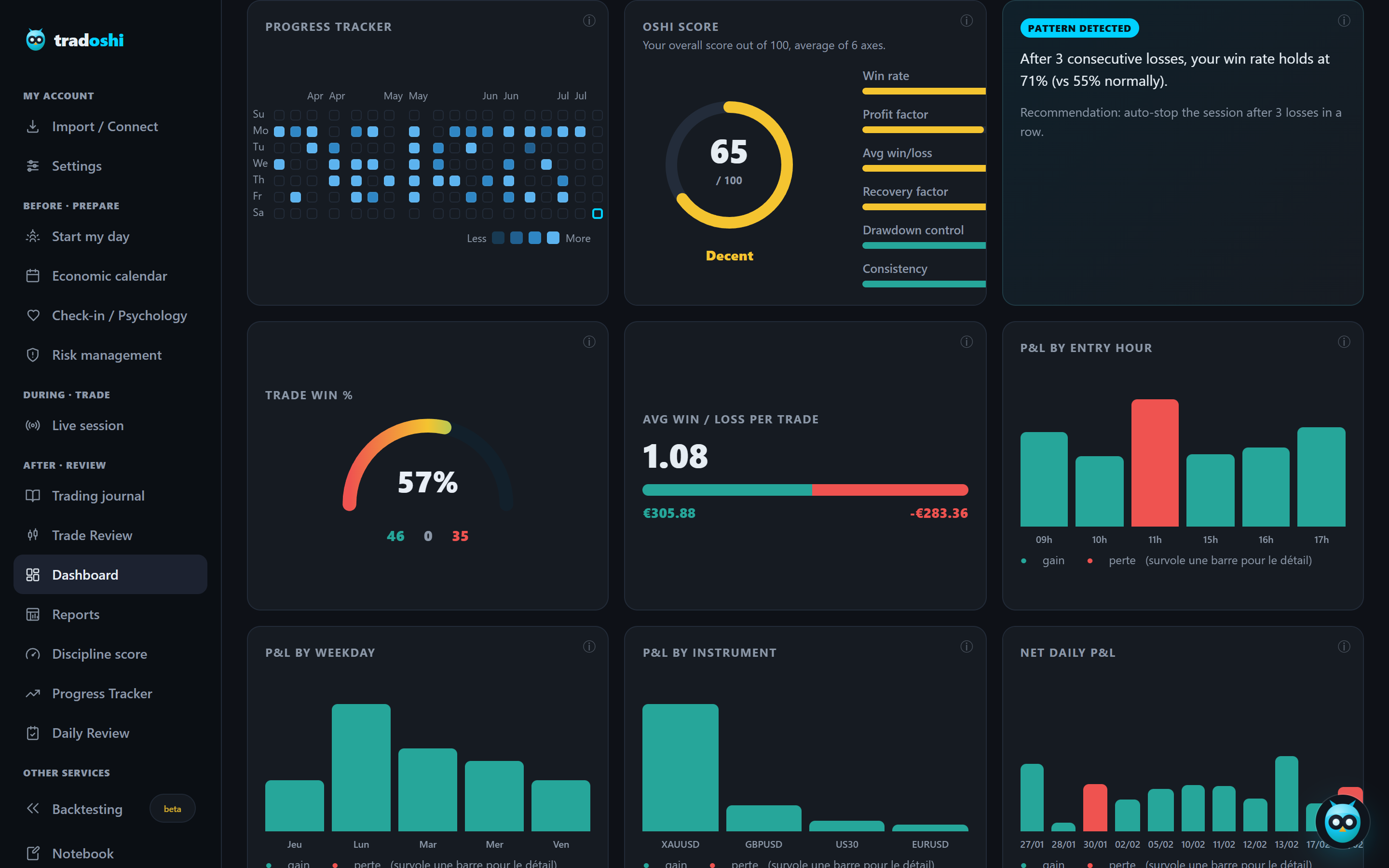
Tradoshi anchors your confidence in your real data rather than your impressions of the moment, by giving you an objective measure of your edge and your discipline, stable in the highs and the lows.
- Oshi Score: an overall grade of your performance, based on your real trades, not your last streak.
- Discipline score: it detects the relaxation of overconfidence after gains.
- Long history: your confidence rests on your consistency over time, not your last trades.
- Emotion → performance: it reveals whether your overconfident days cost you money.
Frequently asked questions
What's the difference between confidence and overconfidence?
Real confidence rests on data (a tested system, a history, demonstrated discipline): it's calm and makes you follow your plan. Overconfidence rests on a recent good streak and ego: it's euphoric and makes you betray your plan while thinking yourself above your rules. One makes you execute calmly, the other makes you deviate in the name of an imagined superiority.
Why does overconfidence follow gains?
Because after several winning trades, your brain produces a surge of confidence that overflows reason: you attribute your successes to your talent, forgetting the share of favorable variance, and think yourself above the market. It's the most dangerous moment: your guard drops just when you feel strongest, and you take your biggest risks right before variance turns.
Is lacking confidence also a problem?
Yes, just as much. The trader who doubts everything hesitates on entries, misses good setups, cuts gains out of fear and no longer dares after a loss. A winning system is useless without the confidence to execute it. The target isn't to eliminate confidence but to calibrate it: enough to execute without trembling, not enough to think yourself above your rules.
How do I avoid tipping into overconfidence?
Keep your confidence anchored in the numbers rather than impressions. Base it on your full history, not your last trades. Be especially vigilant after a good streak, never change your rules under high confidence, and treat euphoria as a warning signal, not strength. Return regularly to your data to recalibrate.
Where does solid confidence in trading come from?
From your objective data, not a motivating speech. When you see your edge measured, your discipline scored and your consistency over time, your confidence becomes a fact rather than a feeling. A fact doesn't panic in a losing streak nor get drunk in a winning one. It's the difference between the amateur, who draws confidence from their last results, and the pro, who draws it from their measured process.
Is euphoria after a gain a good sign?
No, it's a warning signal. Euphoria is the symptom of overconfidence, not real strength. It pushes you to do more, load up, skip checks, exactly the behaviors that make you give back your gains. A clear-headed trader is as wary of their euphoria as of their frustration: both degrade their decisions, in opposite directions.
How does overconfidence affect my analysis, not just my size?
A euphoric trader skips steps of their checklist, neglects the macro context and ignores levels contradicting their scenario. They no longer seek to confirm the trade is good, they take it for granted. This shortcut removes exactly the safeguards that produced the good streak: staying rigorous on analysis, especially after gains, distinguishes a mature trader from one sabotaging themselves.
Is the collective confidence of a group of traders dangerous?
Yes. A community in the middle of a winning streak encourages each other, amplifies convictions and minimizes cautious voices, pushing everyone to take more risk than alone. The group's confidence acts as validation, regardless of its real justification. Keep your rules independent of the surrounding mood: the crowd is statistically wrong at the extremes.
How do I quickly check I'm not drifting toward overconfidence?
Compare the size of your last three trades to your usual average. If it has increased without your percentage risk having changed, something is driving your hand rather than your rule. This simple check, done regularly, catches the drift before it becomes costly and brings you back to a size decided cold rather than dictated by your mood of the moment.