A winning trader's mindset doesn't look like what most imagine. It's neither overflowing self-confidence, nor total coldness, nor a gift for reading markets. It's a set of precise attitudes toward risk, loss and uncertainty, built over time. This guide breaks down the pillars of the winning mindset and how to develop them concretely, rather than waiting for them to appear on their own.
- The winning mindset is built, it's not a birth trait.
- It rests on accepting loss as a normal part of the job.
- It judges the process, not the result of an isolated trade.
- It comes from preparation and rules, not raw willpower.
We talk a lot about mindset in trading, often vaguely and a bit magically, as if it were enough to 'think positive' or 'have confidence'. This fuzzy approach leads nowhere. A winning trader's mindset isn't a vague state of mind, it's a set of precise, identifiable attitudes, worked on one by one.
The good news is that these attitudes aren't innate. No one is born with the ideal trader's mindset; it's built through practice, preparation and measurement. This guide gives you the concrete pillars of this winning mindset, and above all ways to develop them, rather than waiting for them like an epiphany that will never come.
Accept loss as normal
The first pillar of the winning mindset, and the most counterintuitive, is the total acceptance of loss. A winning trader doesn't experience a loss as a failure or an injustice, but as a normal, expected cost of their activity, just as a merchant accepts unsold goods. This acceptance changes everything, because it's the refusal of loss that triggers the worst behaviors.
As long as you experience every loss as a wound, you'll try to avoid it or avenge it, which pushes you to move your stops, refuse to realize your mistakes, or revenge trade. The trader who has internalized that losing is part of the game cuts their losses without drama, moves to the next trade without resentment, and protects their capital. This peace with loss isn't resignation, it's the foundation of all durable discipline. It isn't learned in one sitting: it's built trade after trade, by watching the account concretely survive each loss accepted without drama, which makes the next one a little easier to take.
Think in probabilities
The second pillar is the shift from thinking in certainties to thinking in probabilities. The beginner wants to be right on every trade; the winning trader knows they'll be wrong often, and that it doesn't matter as long as the whole is positive. They don't reason trade by trade but in series, like a poker player who plays a losing hand without emotion because they know their edge over a thousand hands.
The winning trader doesn't seek to be right, they seek to win over time. These are two different goals, and only the second keeps an account alive.
This probabilistic thinking lifts an enormous weight. When you accept that the result of an individual trade is largely random, you stop judging yourself on each outcome, and you shift your attention to what you control: the quality of your decisions, repeated a large number of times. It's a fundamental change of perspective, transforming how you experience each trade and each day.
The traps that sabotage the winning mindset
Overconfidence after a winning run is a trap just as dangerous as discouragement after a loss. Imagine a trader who's just strung together eight winning trades in a row. They start believing their method can no longer fail, increase their size with no clear plan, and take trades outside their setup because they 'feel' the market. This slide is a form of reverse tilt, triggered not by loss but by success, and it's just as destructive, because it exposes a larger amount of capital to a less rigorous decision.
Perfectionism is another common trap. Wanting a win rate close to 100%, refusing to accept that a good decision can still lose, pushes toward hesitation and overanalysis. A perfectionist trader misses valid trades because they're waiting for one more confirmation that will never come, or abandons a genuinely profitable system after a few perfectly normal losses. Comparing your results to other traders on social media is a third classic trap: every journey, every account size and every risk tolerance is different, and that comparison feeds a doubt that has nothing to do with the real quality of your trading.
| Situation | Weak mindset reaction | Solid mindset reaction |
|---|---|---|
| After 5 losses in a row | Doubles size to win it back | Keeps the same size, checks the plan |
| After a strong winning run | Increases risk, feels invincible | Sticks to their usual rules |
| A perfect trade that loses | Questions the whole system | Accepts it, it's short-term randomness |
| Compared to a more profitable trader | Doubts their method, switches it | Focuses on their own process |
Building emotional discipline day by day
The winning mindset isn't built in extraordinary moments, but in the repetition of a simple ritual. Before each session, take two minutes to name your emotional state and reread your rules for the day: this short ritual brings you back into a deliberate mindset rather than a reactive one. After the session, a brief debrief, what worked well, what slipped, anchors the lessons while they're still fresh, instead of letting them fade over time.
Another concrete tool is the trade checklist: a short list of conditions to tick off before entering a position (valid setup, calculated risk, coherent market context). This checklist removes part of the emotional load from the decision, turning it into a near-mechanical verification. Over time, these small daily rituals, repeated hundreds of times, do far more for your mindset than a one-off burst of motivation or an inspirational quote read in the morning.
A concrete example: getting through a losing streak
Take an illustrative example. A trader risks 1% of their capital per trade and strings together five consecutive losses, a scenario that's entirely normal statistically for a system with a 50% win rate. With a weak mindset, each loss feeds the frustration: they increase their size on the sixth trade to 'catch up' faster, turning a 5% drawdown into a much heavier risk on a single position, at the worst possible psychological moment.
With a solid mindset, that same trader keeps their risk at 1% on the sixth trade, exactly as on the first. They know, because they've measured it, that a streak of five losses stays within the normal statistical bounds of their system. The outcome of the sixth trade will be whatever it is, but the decision itself stays identical to one made cold. It's this identical behavior, independent of emotional context, that concretely distinguishes the two mindsets on the ground.
The mindset facing plateaus
An often-overlooked aspect of the winning mindset is its ability to get through plateaus, those periods where performance stalls for no apparent reason. After a phase of rapid progress, it's normal to go through weeks, sometimes months, where results stop moving forward even though nothing in your execution has changed. Many traders interpret this plateau as a signal to change method, which is often a mistake.
The winning mindset gets through a plateau by distinguishing stagnating results from a stagnating process. If your execution stays solid and your edge holds over time, a performance plateau is a normal variation, not an alarm signal. Giving in to impatience and switching strategy at every plateau prevents a system from ever getting the time to fully express itself, and condemns you to constantly starting over from zero.
Judge the process, not the result
The third pillar flows from the previous one: the winning trader judges the quality of their process, not the result of an isolated trade. They know a good decision can lose and a bad one can win, because of short-term randomness. Congratulating yourself for a gain from a mistake, or cursing yourself for a loss from a good trade, is learning the wrong lessons.
Adopting this view requires maturity, because it goes against the natural need for immediate gratification. But it's what allows staying consistent: a trader who judges their process stays calm in a series of well-executed losses, and stays vigilant in a series of poorly-executed gains. They let themselves be neither euphoric nor crushed by short-term results they know are partly random. This stability is a distinctive mark of the winning mindset.
Keep the same attitude whatever the trade
A reliable sign of a solid mindset is behavioral consistency: the winning trader risks the same thing, applies the same rules and keeps the same calm, whether the previous trade was a big gain or a big loss. They don't double their size in euphoria nor cut it in fear; they stay faithful to their plan regardless of their emotional state of the moment.
This consistency is hard because emotions constantly push toward adjusting: increase after a good run (overconfidence), tense up after a loss (fear or revenge). The winning mindset is recognized by this ability to trade the same way on a euphoric Monday and a grueling Friday. It doesn't come from an absence of emotion, but from a system of rules solid enough to hold despite emotion.
The mindset is built through preparation
The winning mindset isn't decreed in the moment, it's prepared cold. A trader who has defined their plan in advance, who knows exactly what to do in each scenario, approaches the market with a serenity the improviser will never know. Preparation removes an enormous mental load, because the hard decisions were already made when the head was clear.
This is a crucial and often-neglected point: what we take for a mindset problem is often a preparation problem. The trader who panics generally doesn't have a weak mindset, they have a fuzzy plan. By clarifying your entry, exit, risk-management and stop rules cold, you build a solid mindset not through willpower, but through organization. Calm in action is almost always the fruit of preparation in calm.
Anchor the mindset through measurement
The final lever for building a winning mindset is measurement. A solid mindset feeds on confidence in one's edge, and that confidence can only come from real data. Seeing that your system is statistically winning over hundreds of trades lets you get through a losing streak without doubting, because you know, with the numbers to prove it, that the streak is normal and your edge holds.
Measurement also anchors good behaviors by showing you they pay. Seeing that your disciplined days earn more than your emotional ones, or that your rule adherence improves over time, turns the abstract principles of the winning mindset into rewarded habits. The mindset then stops being a matter of willpower or character, and becomes the product of a virtuous loop between preparation, measured action and fact-based confidence.
The body, an invisible foundation of the mindset
The winning mindset doesn't live in a vacuum, it rests on a baseline physical state. A trader who slept poorly, skipped meals or trades in a state of chronic fatigue loses part of their judgment capacity before even opening their platform. Physical fatigue translates directly into lower patience, higher irritability and a greater tendency to skip steps in their plan, often without even noticing it in the moment.
Taking care of your body isn't a side note to trading, it's a direct component of mental performance. A trader who sleeps enough, who pauses before an important decision, who avoids trading in a state of unresolved outside stress (an argument, accumulated fatigue, illness) protects the most precious resource of their activity: their ability to decide clearly. Ignoring this physical dimension means building a solid mindset on fragile foundations, ones that sooner or later give way under pressure.
How Tradoshi helps you build your mindset
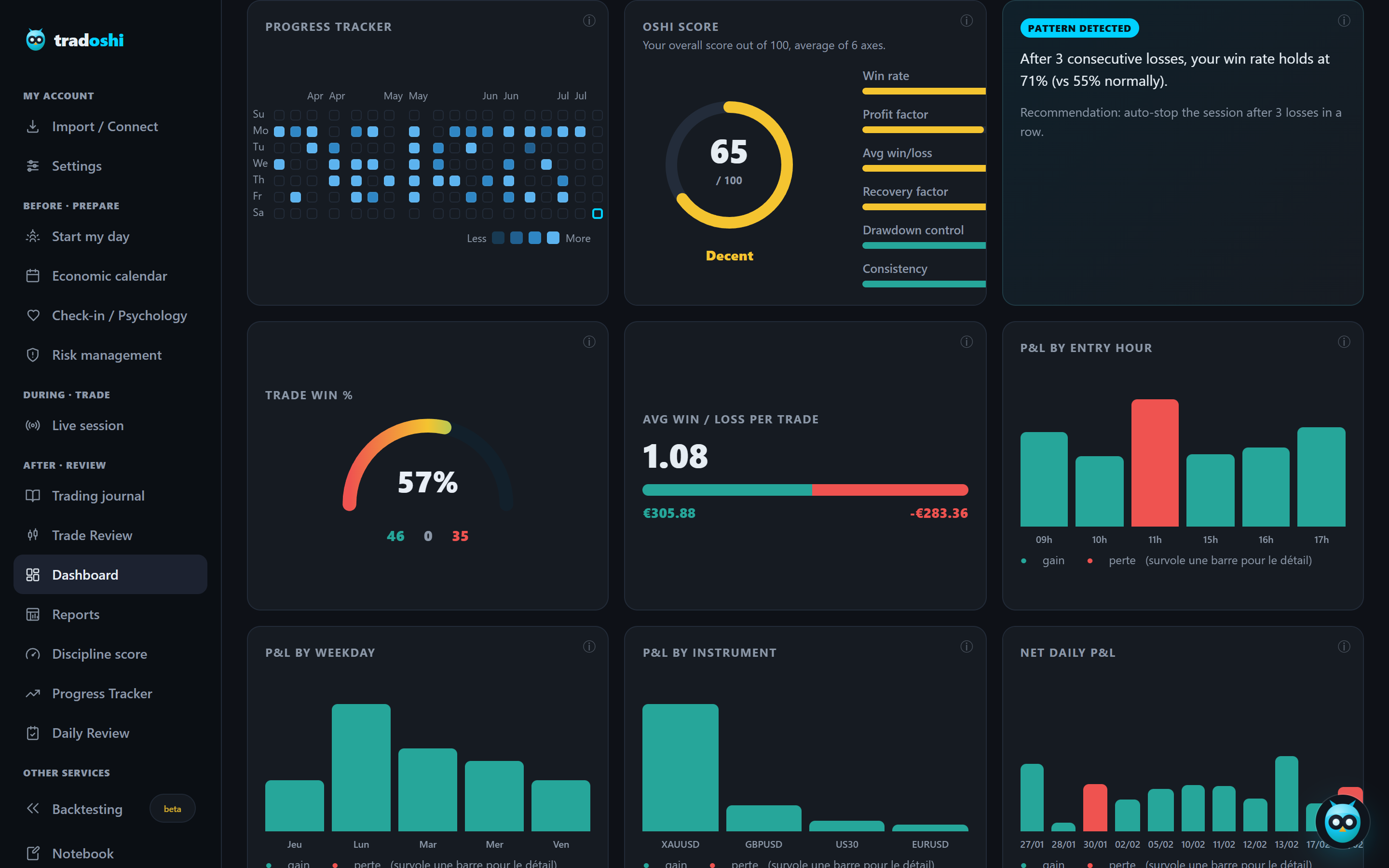
Tradoshi turns the abstract pillars of the winning mindset into concrete data. It shows you that your edge holds, that discipline pays, and that your losses are normal, exactly the fuel a solid mindset needs.
- Underlying statistics to feed confidence in your edge and get through losing streaks without doubting.
- Discipline score to judge your process, not the result of an isolated trade.
- Emotion crossed with performance to prove your calm earns more than your emotion.
- Day plan to prepare your decisions cold and approach the market serene.
Frequently asked questions
What is a winning mindset in trading?
It's neither a gift nor a vague 'think positive', but a set of precise attitudes: accept loss as a normal cost, think in probabilities rather than certainties, judge your process rather than the result of an isolated trade, and keep the same size and calm whatever the previous trade. These attitudes are built, they aren't innate.
Is the trader mindset innate?
No. No one is born with the ideal trader's mindset. It's built through practice, preparation and measurement. It's even good news: since these attitudes are learned, you can develop them one by one rather than waiting for an epiphany that will never come.
How do I accept losses in trading?
By experiencing them as a normal, expected cost of the activity, just as a merchant accepts unsold goods, rather than as a failure or injustice. It's the refusal of loss that triggers the worst behaviors (moving stops, revenge trading). Peace with loss isn't resignation, it's the foundation of all durable discipline.
How do I stay calm when trading?
Calm in action is almost always the fruit of preparation in calm. What we take for a mindset problem is often a fuzzy-plan problem. By defining your entry, exit, risk and stop rules cold, you remove the mental load of hard decisions, which were already made when your head was clear.
How do I develop confidence in trading?
Through measurement, not self-persuasion. Real confidence feeds on real data: seeing that your system is statistically winning over hundreds of trades lets you get through a losing streak without doubting, because you know the streak is normal and your edge holds. Fact-based confidence is far more solid than displayed confidence.
How do I handle overconfidence after a winning run?
By keeping exactly the same risk rules as after a loss. Overconfidence is a form of reverse tilt, triggered by success rather than loss: it pushes you to increase size with no plan and step outside your setup because you 'feel' the market. A solid mindset applies the same discipline whether it just came off a winning streak or a losing one.
How do I get through a performance plateau?
By distinguishing stagnating results from a stagnating process. If your execution stays solid and your edge holds over time, a plateau is a normal statistical variation, not a signal to change method. Switching strategy at every plateau prevents a system from ever getting the time to fully express itself.