A trading system isn't an entry strategy, it's a complete set of rules covering everything: what to trade, when to enter, how much to risk, when to exit, and when to do nothing. Most traders only have a piece of a system, an entry idea, and improvise the rest. This guide explains how to build a complete, coherent and applicable trading system, rather than a collection of intuitions.
- A system covers everything, not just the entry: selection, risk, exit, stop.
- It must be written and precise: a fuzzy system isn't a system, it's an intuition.
- Risk management is the core, not the entry everyone chases.
- A good system is simple, so it's applicable under pressure.
Ask a beginner trader to describe their system, and they'll almost always talk about their entry signal: a moving-average crossover, a pattern, a level. But the entry is only a small part of a system, and probably the least decisive. This imbalance explains why so many traders with good entry ideas lose anyway.
A real trading system is a set of rules covering all decisions, from market selection to stopping for the day. Building this system means turning an intuitive, inconsistent practice into a reproducible, measurable process. This guide gives you the components of a complete system and the method to assemble it.
A system, not a signal
The first thing to understand is that a trading system is a whole, not an isolated signal. It answers five distinct questions: what to trade, when to enter, how much to risk, when to exit, and when to stop. Each of these decisions must have its rule, because each influences your result, and a single one left to improvisation can ruin an otherwise excellent system.
This global view changes how you work. Instead of endlessly seeking the perfect entry signal, you build a coherent whole where each piece is defined. A mediocre entry signal inserted into a rigorous risk-management and exit system can be profitable; a brilliant entry signal drowned in improvisation on everything else won't be. The system is greater than the sum of its signals.
The five components of a system
A complete system breaks into five blocks. Selection defines which markets and conditions you trade. Entry specifies the exact moment you open a position. Risk management sets how much you risk and where you place your stop. Exit determines how you take your gains. Stop establishes when you cease trading, on a trade, a day or a streak.
| Component | Question it answers |
|---|---|
| Selection | What to trade, and in which conditions? |
| Entry | At what precise moment do I open? |
| Risk management | How much do I risk, where's my stop? |
| Exit | How do I take my gains? |
| Stop | When do I stop (trade, day, streak)? |
A system where these five blocks are defined and written is applicable and measurable. A system where some blocks are missing leaves holes that emotion will fill at the worst moment. It's often in these holes, the improvised exit, the absence of a stop rule, that the biggest losses lodge. Building your system means methodically plugging each of these holes.
Risk management is the core
Contrary to the beginner's intuition, it's not the entry but risk management that is the core of a system. It determines whether you survive long enough for your edge to express itself, and whether a losing streak stays bearable or becomes fatal. A system with an average entry but rigorous risk management almost always beats a system with a brilliant entry but poorly-controlled risk.
Concretely, your system must clearly define your risk per trade as a percentage of capital, the placement of your stop, and possibly the adjustment of your size to context. This part isn't the most exciting, but it's the one that makes the difference between a trader who lasts and one who blows up. Give it the greatest care, because it's the foundation everything else rests on.
Writing your system so it exists
A system that isn't written doesn't really exist: it floats in your head, changing with your mood and your latest trades. Writing forces precision and makes the system verifiable. As long as your rules stay impressions, you can reinterpret them at will, which amounts to not having any. Putting them in black and white turns them into commitments you can keep and measure.
A system in your head bends to your emotions. A written system stands up to you. That's the whole difference between suffering your trades and steering them.
The writing exercise also reveals the holes in your system. By trying to precisely formulate your exit rule, for example, you may discover you don't have a clear one, and that you exit on instinct every time. Each vagueness the writing brings to light is a decision you were making under emotion without realizing it. Writing your system makes it both real and improvable.
Simple to be applicable
A frequent trap is building a system that's too complex, with multiple conditions, filters and exceptions. Such a system is seductive on paper but inapplicable under pressure: when it's time to trade, you can't check fifteen criteria in real time, and you end up improvising, which cancels all the work. Complexity is the enemy of execution.
A good system is as simple as possible while staying effective. It must fit in your head, be verifiable in a few seconds, and leave little room for interpretation. Simplicity isn't a weakness, it's a condition of consistent application, and consistent application matters far more than theoretical sophistication. Better a simple system applied perfectly than a complex one applied at random.
Test before you trust
A system only deserves your trust once tested on enough data. Before committing serious capital, you must verify it has a real edge, through an honest backtest or a forward test on small size. Skipping this step means trading blind a system that has never proven it wins, confusing conviction with validation.
The test also gives you your system's reference statistics: its expected win rate, its profit factor, its typical losing streak. These benchmarks are valuable, because they then let you distinguish normal performance from drift. When you know your system's usual losing streak, you get through it without panicking; when you don't, every bad run looks like a catastrophe. Testing means giving yourself the means to trust your system at the right moment.
An example of a complete system, block by block
To make these five components concrete, imagine an illustrative day-trading system. Selection: only two liquid instruments, traded only during the first two hours of the session, never around major macro announcements. Entry: only on a return to a key level identified beforehand, with confirmation of a reversal signal on the working timeframe. Those levels often come from demand and supply zone trading. Risk management: 0.5% of capital per trade, stop always placed beyond the technical invalidation point, never below an arbitrary round number.
Exit: half the position secured at 1R, the rest left to run to the next structural level with the stop moved to breakeven. Stop: automatic pause after two consecutive losses in the same session, full stop for the day after a cumulative loss of 2% of capital. This imaginary system isn't perfect or universal, it only serves to show how five precise rules, written in advance, turn a trading idea into a complete protocol you can follow without improvising on every decision.
Evolving your system without destroying it
A trading system isn't set in stone forever, but it also shouldn't change with every disappointing trade. The crucial distinction is between adjustment, a minor refinement based on data accumulated over a long period, and zapping, a fundamental change decided in the heat of recent frustration. The first moves a system forward, the second prevents it from ever proving itself.
Good practice is to set a review frequency in advance, quarterly for example, where you coldly examine your accumulated statistics and decide whether an adjustment is warranted. Between these reviews, you apply your system as written, even if it goes through a losing streak that makes you uncomfortable. This periodic review discipline, rather than continuous and reactive, is what lets a system improve without ever losing the consistency that makes it measurable.
The mistakes that sabotage an otherwise solid system
Even a well-designed system can fail because of execution mistakes that have nothing to do with its logic. The most frequent is selective adherence: scrupulously applying the rules you like (the entry, the strategy itself) while improvising on the ones that cost immediate comfort (the stop after a losing streak, the exit that cuts a promising gain). A system is only reliable if all its rules are followed, not just the pleasant ones.
Another frequent mistake is judging the system on a handful of recent trades rather than on its whole history. Three losses in a row on a system with a real edge over a hundred trades change nothing statistically, but they're often enough to make a trader doubt when they lose sight of the bigger picture. It's precisely to avoid this trap that systematically tracking your real statistics, over time, is essential: it objectively reminds you where you stand, beyond the emotion of the moment.
Documenting edge cases and exceptions
A well-built system also anticipates out-of-the-ordinary situations: what do you do if a major macro announcement drops while you're in a position? What do you do if a technical outage prevents you from closing a trade at the planned moment? What do you do if two valid signals appear simultaneously on two correlated instruments? These edge cases are individually rare, but together they represent a meaningful share of the situations where improvisation costs the most, precisely because they fall outside the usual path your system covers.
Documenting your response to these scenarios cold, even simply ('in case of an imminent macro announcement, I don't take a new position and tighten my stop on open positions'), avoids having to improvise a crucial decision at the worst moment, under stress and urgency. This anticipation of edge cases doesn't need to be exhaustive from the start: it naturally grows richer with every unusual situation you encounter, provided you make a habit of noting it and folding it into your written system.
Fitting your system to your own profile
A system that's perfect on paper but incompatible with your personality and life constraints will never be applied consistently. A system that requires watching the screen continuously doesn't suit someone with a busy schedule; a system that tolerates large drawdowns doesn't suit someone who loses their composure at the slightest visible loss. Building a system also means knowing yourself honestly, not just optimizing abstract statistics.
This fit between the system and the person who must execute it matters as much as the system's theoretical profitability. A system slightly less optimal on paper but that you can follow 95% of the time will almost always beat a theoretically superior system you only follow 60% of the time because it puts you under pressure you can't handle. The best system isn't the most sophisticated one, it's the one you're able to execute, session after session, without exhausting yourself or betraying it.
How Tradoshi helps you build and validate your system
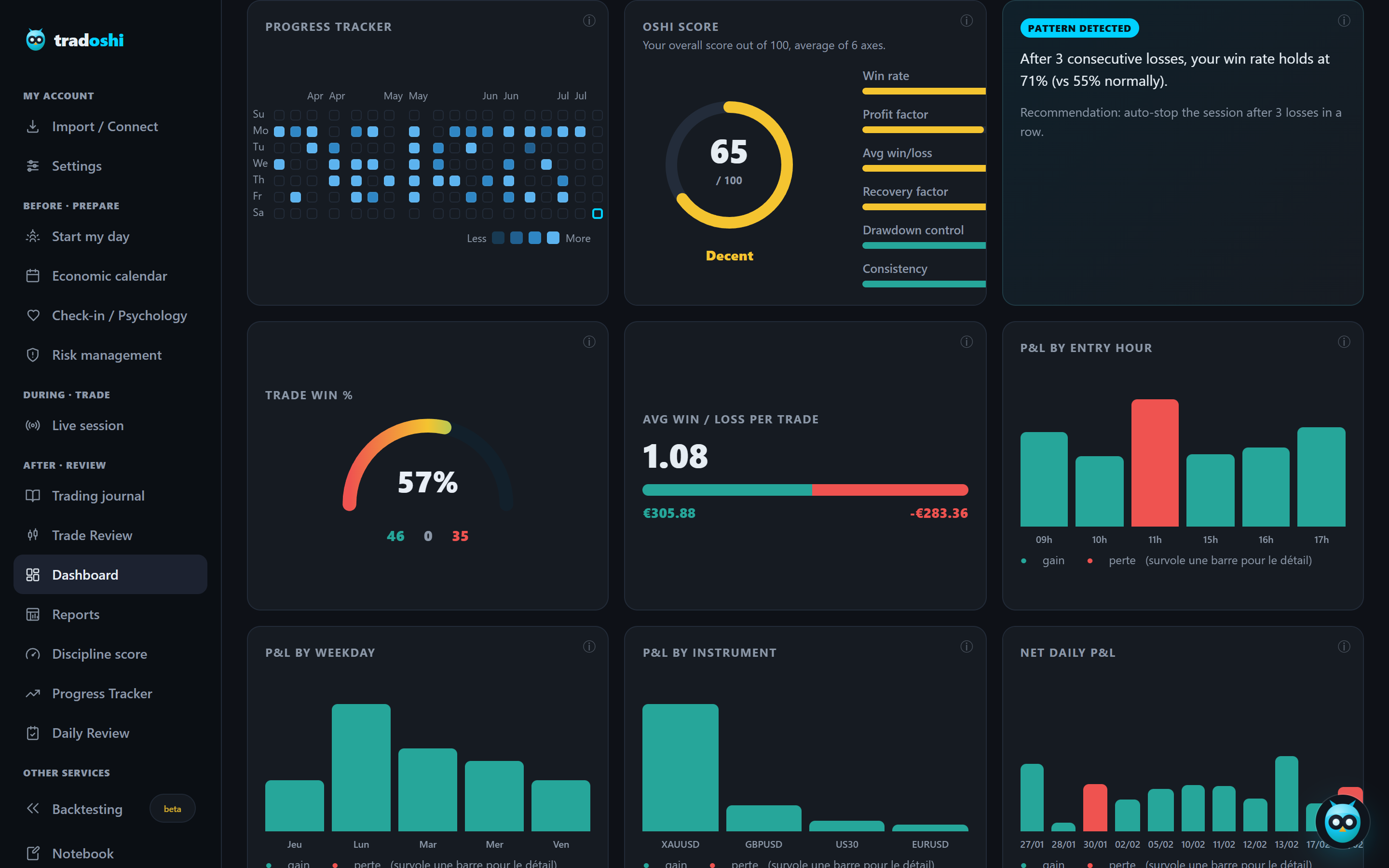
Tradoshi lets you verify whether your system truly wins and whether you follow it. It computes its statistics on your real trades and measures your discipline, to distinguish a system problem from an execution problem.
- Complete statistics (win rate, profit factor, expectancy, average R) to validate your system's edge.
- Discipline score to measure whether you apply your system or improvise.
- Breakdowns by setup and time to refine your selection rule.
- Integrated risk management (rules, dynamic risk) to frame the core of your system.
Frequently asked questions
What is a trading system?
It's a complete set of written rules covering all your decisions: selection (what to trade), entry (when to open), risk management (how much to risk, where to place the stop), exit (how to take gains) and stop (when to cease). It's not a simple entry signal, but a coherent, reproducible whole.
What is the most important component of a system?
Risk management, not the entry most beginners chase. It determines whether you survive long enough for your edge to express itself and whether a losing streak stays bearable. A system with an average entry but rigorous risk almost always beats the reverse.
Why write down your trading system?
Because an unwritten system doesn't really exist: it floats in your head and bends to your emotions and latest trades. Writing forces precision, makes the system verifiable, and reveals its holes (for example a fuzzy exit rule you were improvising). A written system stands up to you instead of suffering your emotions.
Should a trading system be complicated?
No, on the contrary. A too-complex system is inapplicable under pressure: you can't check fifteen criteria in real time, so you improvise. A good system is as simple as possible while staying effective, fits in your head and is verifiable in a few seconds. Simplicity is a condition of consistent application.
How do I know if my system works?
By testing it on enough data (honest backtest or small-size forward test) before committing serious capital, then tracking its real statistics (win rate, profit factor, expectancy). The test also gives you your typical losing streak, letting you get through bad runs without panicking.
How often should I adjust my trading system?
Not with every disappointing trade. Set a review frequency in advance, quarterly for example, where you coldly examine your accumulated statistics over a long period and decide whether an adjustment is warranted. Between these reviews, apply your system as written, even during a normal losing streak.
Why can an otherwise solid system still fail?
Often because of selective rule adherence: scrupulously applying the entry and the strategy, but improvising on the stop after a losing streak or the exit that cuts a gain. A system is only reliable if all its rules are followed, not just the pleasant ones. Judging the system on a handful of recent trades rather than its full history is another frequent mistake.