Patience is probably the most profitable skill in trading, and the rarest. The majority of costly mistakes don't come from a lack of knowledge, but from an inability to wait: wait for the right setup, wait for the trade to work, wait for the market to come back. This guide explains why patience decides your success, where impatience comes from, and how to build it concretely.
- Impatience is the source of most mistakes: forced entries, rushed exits, overtrading.
- Patience isn't passive: it's an active discipline of selective waiting.
- It's built through rules, a journal, and measuring what impatience costs you.
- Waiting for the right trade beats taking ten mediocre ones.
Ask any experienced trader what changed their performance the most, and many will tell you the same thing: they learned to wait. Not to take the mediocre trade, not to cut the winner out of nervousness, not to jump on the market out of boredom. Impatience is the common thread of almost all costly mistakes.
The problem is that patience goes against your nature. Your brain is wired to act, not to miss out, to react fast. This guide breaks down why impatience is so powerful, what it really costs you, and how to turn it into discipline, because patience is trained like a muscle.
Why impatience costs so much
Impatience shows up in several forms, all costly. It makes you enter too early, before your setup is complete, because you're afraid of missing the move. It makes you exit a winner too early, out of nervousness, before it has given its full potential. It pushes you to trade when there's nothing to do, out of boredom, just for the action.
The common thread of all these mistakes is that they degrade your edge. A premature entry is a lower-quality trade. A rushed exit is a truncated gain. A boredom trade is risk taken for no reason. Added up over hundreds of trades, these small impatiences turn a winning system into a neutral or losing one, without you changing anything about your strategy.
Patience isn't passivity
We often confuse patience and inaction, but they're two different things. The trader's real patience is active: it's a selective waiting, a vigilance that refuses everything that isn't excellent to seize only what is. The patient trader isn't asleep at their screen, they're hunting, ready to act fast, but only when their precise conditions are met.
The patient trader doesn't trade less out of lack of desire, they trade less out of excess of standards. They wait for the obvious trade and let everything else pass without regret.
This distinction is liberating. Being patient doesn't mean curbing your urge to trade by sheer willpower, which is exhausting and doomed. It means redefining what a good trade is: so precise, so demanding, that most setups are automatically eliminated. Patience then becomes a consequence of your standards, not a permanent effort against yourself.
Where your impatience comes from
The trader's impatience has deep roots. The first is the fear of missing out, FOMO: seeing the market move without you creates a pain so strong that you'd rather take a mediocre trade than stay aside. The second is the need for action: the human brain tolerates inaction poorly and seeks to act, even when doing nothing would be the best decision.
The third root is your relationship to money: when you think in terms of money to make immediately, every minute without a trade feels like a lost opportunity. Understanding these roots is essential, because you don't fight impatience with willpower alone. You defuse it by tackling its causes: reduce FOMO, channel the need for action, and shift your focus from immediate gain to the quality of the process.
Building patience through rules
Patience isn't decreed, it's built with rules. The most powerful is a very precise definition of your setup: the stricter and more written your entry criteria, the less room you have for impatience. A trade that doesn't check all your boxes isn't a trade, period. This rigor turns waiting into simply applying a rule, not an emotional battle.
Other rules reinforce patience: limiting the number of trades per day, which forces you to select; imposing a pause after each trade, which cuts the impulsive chaining; defining precise time windows when you trade, which avoids the boredom trade. These guardrails don't depend on your composure in the moment, they impose it from the outside, exactly when your willpower is weakest.
Waiting during the trade
Patience doesn't only concern the entry, it also concerns managing the ongoing trade. Once your position is open according to your plan, impatience pushes you to intervene: tighten your stop too fast, take your gains at the first profit, exit at the slightest market hesitation. Each of these impatient interventions truncates the potential of the trade you had nonetheless chosen well.
The patient trader lets their trade work according to the plan they defined cold. They know the market doesn't go in a straight line, that fluctuations are normal, and that intervening under the sway of nervousness amounts to letting emotion rewrite a considered plan. Holding your position until the plan is invalidated or reached, without giving in to the urge to tinker, is a form of patience as important as waiting for the right setup.
Measuring what impatience costs you
The best accelerator of patience is seeing in numbers what your impatience costs you. As long as impatience stays a feeling, it has no weight; as soon as it becomes an amount, it becomes correctable. A journal that distinguishes your planned trades from your off-plan trades shows you, in black and white, how much the latter destroy your performance.
This confrontation with the numbers is often a trigger. Discovering that your boredom trades have a negative expectancy, or that your rushed exits cost you a significant share of your potential gains, anchors patience far more solidly than any advice. The trader who has measured the cost of their impatience no longer needs to force themselves to wait: they wait because they know, with the numbers to prove it, that it's what makes them win.
Patience against social media FOMO
Social media has added an extra layer to trader impatience. Seeing other traders' gain screenshots in real time, often presented without context or proof of consistency, feeds a different kind of FOMO than the market itself: the fear of missing not a move, but a social success. This pressure is particularly insidious because it doesn't come from the chart, but from an outside comparison you don't control.
The best defense is simple but demanding: limit your consumption of trading content during your active trading hours, and remind yourself that an account shown online almost never displays the variance, the losses or the real number of attempts behind a single spectacular result. Comparing your patience to other people's apparently profitable impatience is a losing game from the start, because you never see their full history, only their best moment.
A concrete exercise to build your patience
A simple and effective exercise is to impose a count-to-ten rule: as soon as you feel the pressing urge to enter a trade that doesn't check all your boxes, mentally count to ten before acting. This artificial delay, ridiculously short on the surface, is often enough to interrupt the emotional automatism and let a second of reflection settle in between impulse and action.
Another exercise is to keep, for a week, a count of trades you consciously let pass because they didn't meet your criteria. Many traders are surprised to find, at the end of the week, that they let more opportunities slip than they took, and that this proportion, far from being a failure, is concrete proof that their selectivity is working. Making what you pass on visible is as important as tracking what you take.
Patience between sessions: knowing when not to trade
Patience isn't confined to inside a session, it also extends to the decision not to trade at all for a day, or a week. A market with no clear setup, news blurring the technical picture, or a personal state that isn't optimal are all legitimate reasons to stay completely on the sidelines, an option many traders don't even consider.
This larger-scale form of patience is often the hardest, because it goes against the common belief that a trader must be active to progress or to justify their activity. In reality, knowing how to recognize an unfavorable environment and abstain completely for several days protects your capital and your discipline far better than forcing mediocre trades to stay busy. Doing nothing is sometimes the most profitable decision of the month.
A worked example: the cost of impatience over a month
Imagine a trader who, over a twenty-day month, took fifteen trades within their plan and five impatience trades, off-setup or out of boredom. Their fifteen planned trades show a net result of +600. Their five off-plan trades show a net result of -450, a loss almost as big as the entire month's total gain.
Without those five impatient trades, this trader would have closed the month at +600, a solid result consistent with their edge. With them, the month drops to +150, a mediocre result that actually hides a perfectly profitable strategy, dragged down purely by a lack of patience. This kind of calculation, done on your own numbers, is often what finally convinces a trader that selectivity is worth more than activity.
Patience and position size: waiting to increase your risk
Patience also applies to how you increase your position size. Many traders want to accelerate their progress by raising their risk as soon as they string together a few good results, without waiting for a sufficient sample to confirm their edge is real and not just a lucky streak. This impatience about size is just as dangerous as impatience about entries, because it multiplies the impact of any misjudgment.
The right practice is to wait until you have several dozen, even a hundred, stable trades before significantly increasing your size, and to do so gradually rather than all at once. This patience in scaling up risk protects your capital during the period when your edge is still uncertain, and turns your account's growth into a controlled process rather than a bet on a recent streak.
Patience through a prolonged drawdown
A prolonged drawdown tests patience differently from everyday impatience: the problem is no longer the urge to act right away, but the temptation to abandon a system going through a rough patch when nothing about it is structurally broken. Many traders switch methods at the worst possible moment, right before it turns back around, simply because they didn't have the patience to sit through a statistically normal losing streak.
Telling a normal drawdown apart from a genuinely failing system requires analytical patience as much as emotional patience: checking whether your rules are still being followed, whether your profit factor over a sufficient sample still holds up, and whether the degradation touches one specific instrument or your whole trading. This kind of patience, staying with a system you've validated rather than jumping ship at the first difficulty, is often what separates a trader building a durable edge from one who keeps starting over from zero.
How Tradoshi helps you be patient
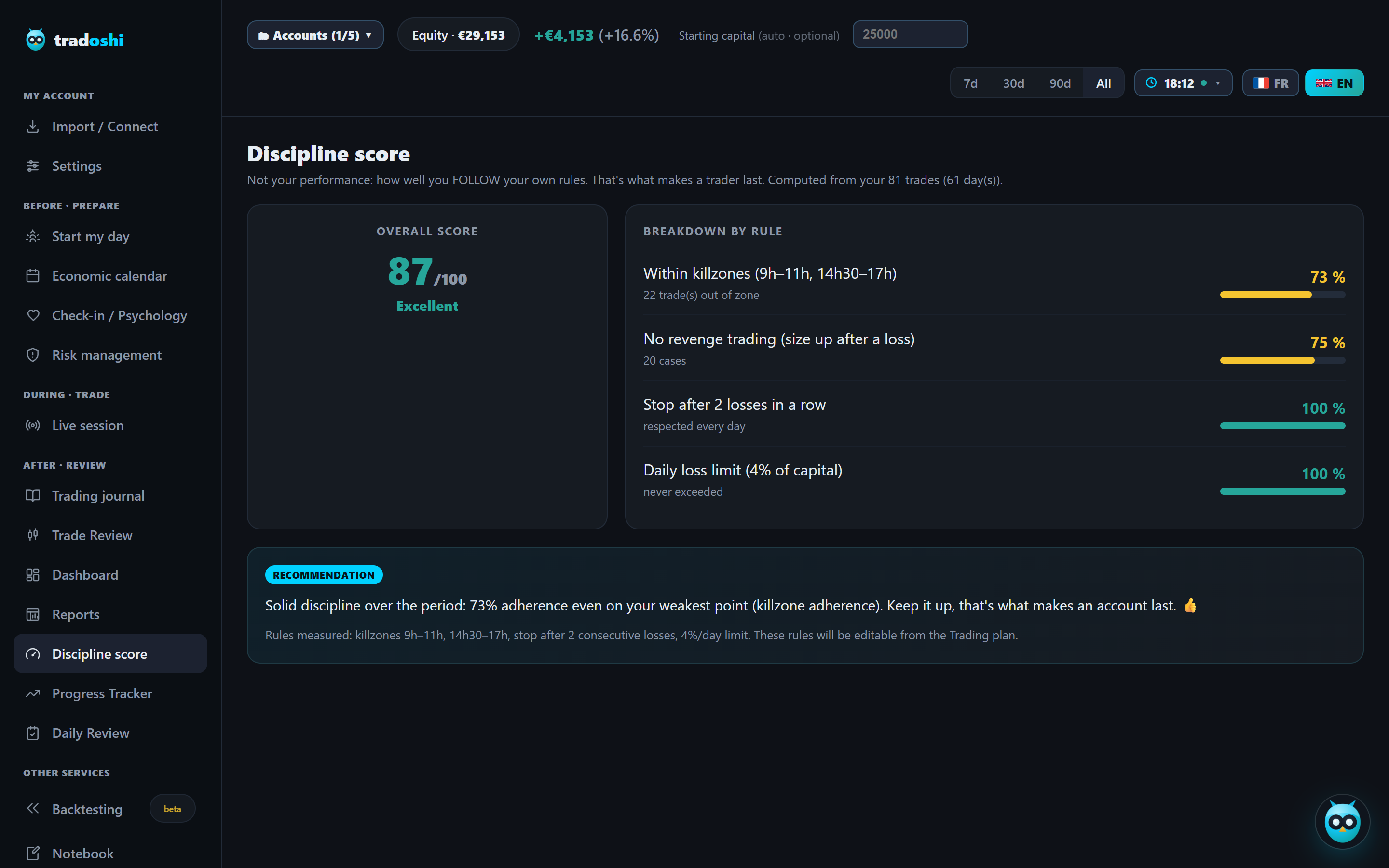
Tradoshi makes your impatience visible and measurable. By spotting your off-plan trades, your overtrading and your rushed exits, and crossing all of it with your performance, it proves what selective waiting earns you.
- Discipline score that measures your rule adherence, including overtrading and out-of-zone entries.
- Breakdowns by time and setup to see where your impatient trades destroy your performance.
- Emotional check-in to spot boredom and FOMO before they make you trade.
- Configurable rules (number of trades, killzones) that impose selectivity from the outside.
Frequently asked questions
Why is patience so important in trading?
Because the majority of costly mistakes come from impatience: forced entries before the setup is complete, rushed exits that truncate gains, boredom trades taken for no reason, overtrading. Added up, these small impatiences turn a winning system into a neutral or losing one without changing the strategy.
Is patience about doing nothing?
No. The trader's real patience is active: it's a selective waiting, a vigilance that refuses everything that isn't excellent to seize only what is. The patient trader is hunting, ready to act fast, but only when their precise conditions are met. They trade less out of excess of standards, not lack of desire.
How do I develop patience in trading?
Through rules, not willpower alone. Define a very precise, written setup (a trade that doesn't check all your boxes isn't a trade), limit your number of trades per day, impose a pause after each trade, set time windows. These guardrails impose selectivity from the outside, when your willpower is weakest.
Where does a trader's impatience come from?
From three roots: fear of missing out (FOMO), which makes it painful to see the market move without you; the need for action, since the brain tolerates inaction poorly; and the relationship to money, which makes every minute without a trade feel like a lost opportunity. You defuse impatience by tackling these causes, not by willpower alone.
How do I stop cutting my winners too early?
By letting your trade work according to the plan defined cold, knowing the market doesn't go in a straight line and fluctuations are normal. Intervening out of nervousness amounts to letting emotion rewrite a considered plan. Measuring how much your rushed exits cost you anchors this patience far more solidly than any advice.
How does social media feed impatience in trading?
By displaying other traders' gains without context or proof of consistency, it creates a social FOMO different from the market's own: fear of missing a displayed success rather than a price move. The best defense is limiting this content during your trading hours and remembering that a displayed result never shows the variance or the real number of attempts behind it.
Should I sometimes not trade at all for a day?
Yes, and it's a larger-scale form of patience often overlooked. A market with no clear setup, news blurring the picture, or a degraded personal state are legitimate reasons to stay completely on the sidelines. Knowing how to recognize an unfavorable environment and abstain protects your capital better than forcing mediocre trades to stay busy.