Drawdown is the drop in your capital from its peak. Every trader goes through it, including the best. What separates those who survive from those who crack isn't avoiding drawdown, it's knowing how to get through it without making it worse. The real danger is almost never the drop itself, it's your reaction to that drop.
- Drawdown is inevitable: even a winning system strings together losing streaks.
- The danger isn't the drop, it's the panic that pushes you to change plan or over-risk.
- Recovery is non-linear: the deeper the hole, the more the recovery effort explodes.
- Getting through a drawdown is prepared cold, with rules decided before it arrives.
If you trade long enough, you'll hit stretches where your account drops, session after session, without you doing anything wrong. That's drawdown, and it's as normal as breathing. The problem isn't that it exists, it's what it triggers in your head: doubt, the urge to change everything, the temptation to force it to win back.
Understanding drawdown means first accepting it's part of the game, then giving yourself the means to get through it without self-sabotage. This guide explains why it's inevitable, why recovery is harder than the fall, and how to set up the safeguards that stop you from turning a normal drop into a disaster. The number that captures this risk in a single value, your maximum drawdown, has its own guide.
What a drawdown really is
Drawdown measures the gap between the peak your capital reached and its current level. If your account rose to 12,000 then dropped to 10,800, your drawdown is 10%. We distinguish current drawdown (where you are now) from maximum drawdown (the worst dip ever reached). The latter is one of the most important numbers for judging a system: it tells you the worst pain it has already inflicted on you.
A drawdown isn't a failure, it's a statistic. Any strategy with a real edge goes through loss sequences, simply because winning and losing trades don't alternate cleanly: they come in clusters. A run of six losses in a row on a 50%-win system is nothing abnormal, it's actually expected sooner or later.
Why drawdown is inevitable
Many beginners believe a good system almost never loses several times in a row. That's a beginner's illusion. Randomness produces streaks. Flip a coin a hundred times and you'll regularly see five or six heads in a row. Your trades work the same: even with a statistical edge, losses cluster, and those clusters are exactly what we call a drawdown.
Accepting that changes everything. As long as you think a drawdown signals a problem, you'll react by changing your system at the worst moment, right before variance rebalances. When you understand a drawdown is the normal price of an edge, you can get through it without giving in to panic. Positive expectancy is paid for in temporary drawdowns.
Recovery is harder than the fall
Here's drawdown's cruelest property: you always have to gain a bigger percentage than the one you lost to get back to even. It's not an injustice, it's arithmetic: when you lose, you compute your loss on a larger capital, but you have to recover it on a now smaller capital.
| Drawdown taken | Gain needed to recover | Difficulty |
|---|---|---|
| -10% | +11% | Easy |
| -20% | +25% | Manageable |
| -33% | +50% | Serious |
| -50% | +100% | Very hard |
| -75% | +300% | Nearly impossible |
The lesson is crystal clear: it's infinitely better to prevent a big drawdown than to try to climb out of one. That's why risk management isn't a brake on performance, it's what makes it possible. Every point of drawdown avoided today is an exponential recovery effort you won't have to make tomorrow.
The real danger: your reaction
A normal drawdown becomes a disaster only when the trader reacts badly. The destructive reactions all look alike: increasing size to win back faster, abandoning a working system at the trough of its variance, multiplying trades to 'catch up', or conversely freezing and missing valid setups. Each turns a temporary drop into a lasting trend.
The market doesn't ruin traders with drawdowns. It ruins them with how they react to drawdowns.
The only reliable protection is having decided your conduct in advance, cold. When the drop comes and emotion rises, you don't improvise: you apply rules written while you were calm and clear-headed.
The drawdown survival plan
- Set a maximum acceptable drawdown (say -10%) beyond which you reduce size or take a break.
- Never increase position size during a drawdown: that's the reflex that kills.
- Keep applying your system identically as long as nothing proves it's broken.
- Distinguish a variance drawdown (normal) from a drift drawdown (you're no longer following your rules): only the second justifies stopping.
- Keep a journal during the drop: that's when your emotions most degrade your decisions, and seeing them written protects you.
Variance or drift: the key diagnosis
Not all drawdowns are equal. The variance drawdown happens while you follow your plan to the letter: it's the normal price of the edge, you get through it without changing anything. The drift drawdown comes from you: you've stopped honoring your rules, you take off-plan trades, you overtrade. That one is a real alarm that calls for stopping and correcting, not persevering.
Making that diagnosis by eye is hard because emotion blurs everything. That's precisely where an objective measure of your discipline becomes precious: it tells you whether your drawdown comes from bad luck or from your own breaches.
Drawdown in percentage or in duration
We always think of drawdown in depth (how many percent), but it has a second, equally grueling dimension: duration. A drawdown can be shallow yet last weeks, even months, before your capital reclaims its peak. That period, called the recovery time, is often harder psychologically than the drop itself: doubt sets in, weariness grows, and the temptation to change everything becomes huge as the days pass without a new high.
Understanding this time dimension changes how you live a drawdown. A perfectly healthy system can spend a large part of its time in drawdown, simply because new highs are by nature rare. Knowing in advance that your system spends, say, half its time below its high spares you from panicking every time you're not at your peak. A drawdown's duration isn't a sign of failure, it's a normal feature most traders ignore and that nonetheless pushes them to quit.
The effect of drawdown on your decisions
A drawdown doesn't only degrade your capital, it degrades the quality of your decisions, measurably. Under a prolonged drop, your brain shifts into survival mode: you become hypersensitive to losses, see threats everywhere, and your horizon shrinks to the immediate. You then make decisions you'd never make at breakeven: cutting a good trade out of fear, skipping a valid opportunity, or conversely forcing it to win back.
It's a particularly vicious circle, because the degradation of your decisions worsens the drawdown, which further degrades your decisions. The only way to break it is to recognize that your judgment isn't reliable in that state, and to lean more on your written rules than on your feeling of the moment. In a drawdown, your cold-decided rules are your best ally, precisely because they don't suffer the emotional degradation you do.
Reducing size to get through more calmly
There's a perfectly healthy defensive modification facing a hard drawdown: reducing your position size. By lowering your risk per trade during the drop, you mechanically reduce the scale of the potential following losses, which slows the digging of the hole and eases the emotional pressure. This voluntary reduction isn't fear, it's management: it lets you stay in the game and keep trading without each loss hurting more than the last.
The key is that this reduction be decided cold, as a rule, not improvised in panic. Set in advance a drawdown threshold beyond which you switch to reduced size, and a threshold for returning to normal once variance settles. This rule turns a drawdown from a suffered ordeal into a managed phase, where you adapt your exposure to your situation without ever falling into the opposite, deadly reflex of increasing your size to win back.
Account drawdown vs strategy drawdown: don't confuse them
There's a useful distinction many traders ignore: the drawdown of your actual account isn't necessarily identical to the theoretical drawdown of your strategy. Your account can be in drawdown while your strategy itself is doing fine, simply because you executed some trades poorly, took off-plan positions, or managed your risk inconsistently. Conversely, a strategy can go through a genuine statistical rough patch while, by luck on your small personal sample of trades, your account stays stable.
This distinction matters because it changes the diagnosis, and therefore the response. If your account's drawdown far exceeds what your strategy should produce on paper, the problem is probably not the strategy but its execution: it's a drift drawdown disguised as a variance drawdown. Regularly comparing your account's real performance to your strategy's theoretical performance, if you've backtested it, is one of the best ways to detect that the problem comes from you and not from the system.
Preparing mentally before the first trade
The best preparation for drawdown doesn't happen during the drop, it happens before you take your first trade with a new strategy or on a new account. Compute, or estimate from a backtest, the probable maximum drawdown of your method, and accept it mentally in advance as a normal scenario rather than a hypothetical disaster. A trader who knows a 15% drawdown is statistically normal for their strategy goes through it very differently than one who discovers that number in the middle of distress, without having anticipated it.
This upfront mental preparation turns drawdown from a traumatic event into an expected step of the plan. It's the exact same logic as a pilot rehearsing emergency procedures on the ground before living them in flight: the day the incident happens, they apply an already-trained response instead of improvising under panic. Prepare your drawdown scenario cold, before it arrives, and you'll get through the next one with a clarity most traders never have.
Getting out of drawdown: signs of a real recovery
After getting through a drawdown, a question often comes back: how do you know the recovery is real and not just a variance bounce before another leg down? There's no perfect signal, but a few clues help tell a real recovery from a false hope. A string of winning trades that scrupulously respects your plan, with no abnormal risk-taking or catch-up attempt, carries more weight than the same string obtained by forcing trades or switching methods along the way.
The best indicator remains your discipline during the climb-back, not just the rising balance. A recovery built on disciplined trades that follow your plan has a good chance of lasting, because it proves your edge still works and your execution has stabilized. A recovery obtained by taking more risk or straying from the method that produced the original drawdown is fragile: it can reverse as fast as it appeared, and often masks an underlying problem that was never actually fixed.
Tracking it with Tradoshi
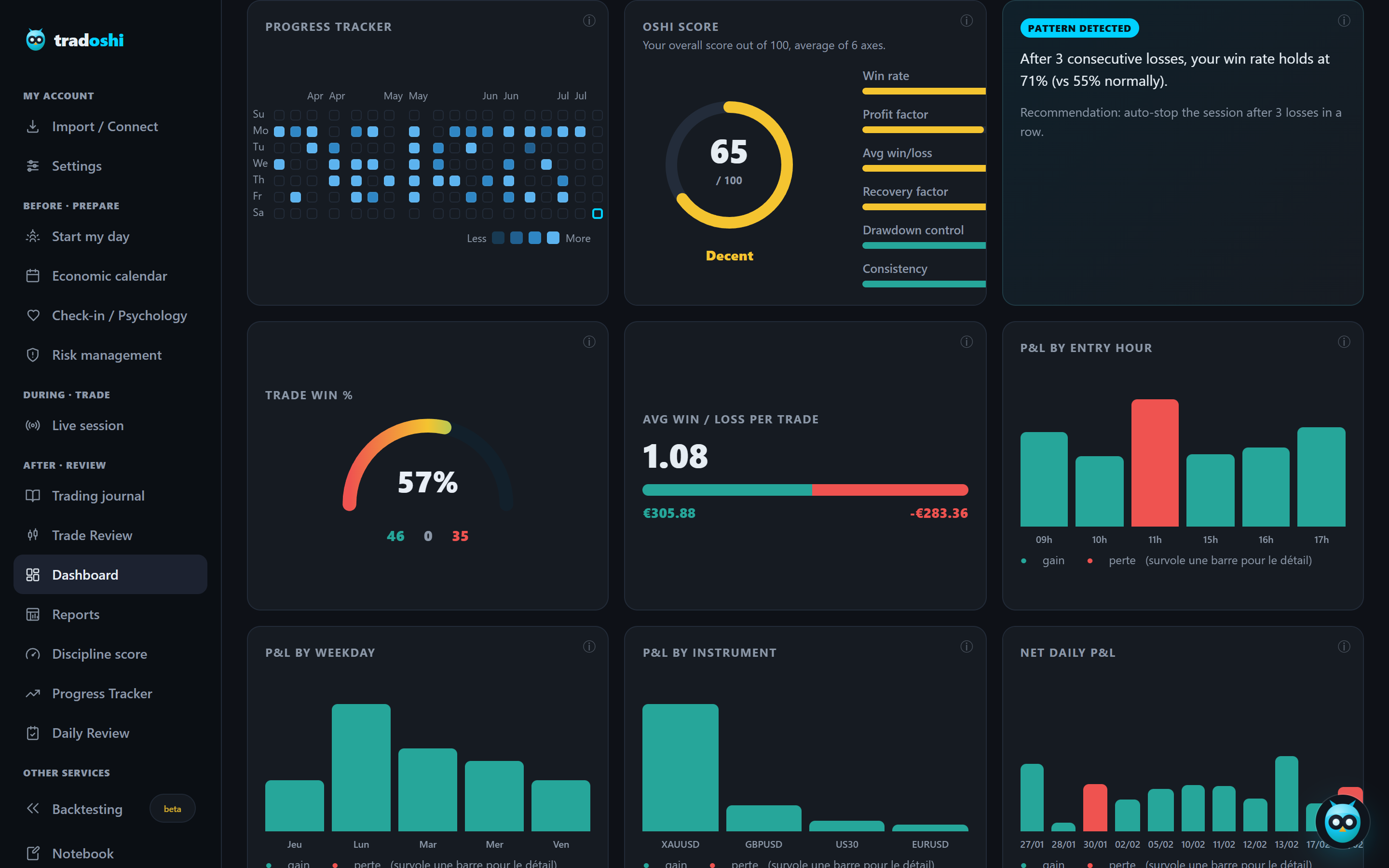
Tradoshi computes your drawdown continuously and rates your drawdown mastery as a full axis of your Oshi Score, so you see the dips coming and know whether they come from variance or from your conduct.
- Current and maximum drawdown: displayed continuously, your number-one health indicator.
- Drawdown mastery: an axis of the Oshi Score rates your ability to avoid digging big holes.
- Discipline score: it tells you whether your drop is variance or drift (rules not held).
- Emotion crossed with performance: you see how your drawdown days affect your decisions.
Frequently asked questions
What is a drawdown in trading?
It's the drop in your capital from its peak, expressed as a percentage. We distinguish current drawdown (where you are) from maximum drawdown (the worst dip ever reached). The latter is one of the best indicators of the pain a system can inflict, and a key number for judging its robustness.
Is a drawdown always a bad sign?
No. A variance drawdown happens even when you follow your plan perfectly: it's the normal price of an edge, since losses cluster. It only becomes an alarm if it's a drift drawdown, i.e. caused by your own breaches (off-plan trades, over-risk, overtrading).
Why do I have to gain more than I lost to recover?
Because the recovery gain is computed on a now smaller capital. After -50%, you have half your capital left, and doubling half requires +100%. It's arithmetic, not bad luck: the deeper the hole, the more the climb-back effort explodes non-linearly.
How do I survive a drawdown?
By deciding your conduct cold, before it arrives: a maximum acceptable drawdown, a ban on increasing size during the drop, and keeping your system as long as it isn't proven broken. The danger is never the drop itself, it's the emotional reaction that turns it into a disaster.
Should I change strategy during a drawdown?
Almost never at the trough of the drop. Changing systems right when variance is against you is the best way to miss the rebalancing that follows. Only change method after a cold diagnosis showing a real structural flaw, on a sufficient sample, not under the sting of a losing streak.
What maximum drawdown should I aim for?
It depends on your tolerance, but many traders set an alert around -10% and a hard threshold (size reduction or pause) around -15 to -20%. The key is having a number decided in advance: without a threshold, you'll let emotion decide when to stop, which means too late.
Is my account's drawdown always the same as my strategy's?
Not necessarily. Your account can be in drawdown while your strategy is fine, simply because you're executing it poorly (off-plan trades, inconsistent risk): that's a drift drawdown disguised as a variance drawdown. Regularly compare your real performance to your strategy's theoretical performance to know whether the problem is the system or you.
How do I prepare for a drawdown before it happens?
Estimate, ideally from a backtest, your strategy's probable maximum drawdown, and accept it mentally in advance as a normal scenario, not a hypothetical disaster. A trader who knows a 15% drawdown is statistically normal for their method goes through it very differently than one discovering it in the middle of distress, without having anticipated it.