A losing streak is the trader's ultimate psychological test. It isn't the loss itself that destroys accounts, it's how you react to it. Many traders survive isolated losses but collapse facing a streak, because it attacks their confidence and triggers the worst behaviors. Knowing how to get through an emotional drawdown is a skill in its own right.
- A losing streak is inevitable, even with an excellent system.
- It attacks your confidence and triggers revenge trading, over-risk or paralysis.
- Distinguishing it from normal variance versus real drift is the key.
- Getting through it is prepared cold, with rules decided before it arrives.
Every trader, even the best, hits losing streaks. It's a statistical certainty: over many trades, losses sometimes cluster into sequences of five, six, eight in a row, whatever your edge. The question is never 'will I suffer a losing streak?' but 'how will I react when it happens?'. And it's that reaction, far more than the streak itself, that decides your fate.
A losing streak is dangerous because it doesn't just hit your account, it hits your head. It erodes your confidence, sows doubt about your system, and triggers the urge to do something, anything, to stop the bleeding. It's precisely that 'do something' that turns a normal streak into a disaster. This guide explains why streaks are inevitable, how they attack you psychologically, and how to get through them without self-sabotage.
Why losing streaks are inevitable
Many traders experience a losing streak as a signal that something is wrong, when it's perfectly normal. Randomness produces sequences: flip a coin a hundred times and you'll regularly see streaks of five or six heads in a row. Your trades work the same. Even a 60%-win system produces, sooner or later, streaks of four, five, six consecutive losses. It isn't your system that's broken, it's variance expressing itself.
Understanding and accepting that radically changes how you live losses. As long as you think a streak signals a problem, you'll react by changing everything at the worst moment. When you understand a streak is the normal price of an edge, you can get through it calmly, knowing variance will eventually rebalance. A positive edge is always paid for in temporary losing streaks.
How a streak attacks you psychologically
A losing streak's real danger is mental. Loss after loss, your confidence erodes, doubt sets in, and growing stress alters your judgment. You're no longer the same trader you were at the start of the streak: you're more emotional, more impatient, more prone to bad decisions. It's a vicious circle, where each loss degrades the state you take the next one in.
| Destructive reaction | What it produces |
|---|---|
| Revenge trading | You force to win back, the streak worsens |
| Over-risk | You increase size, one loss becomes huge |
| Abandoning the system | You change everything right before the rebalancing |
| Paralysis | You no longer dare take the good setups |
| Overtrading | You multiply trades to 'catch up' |
Each of these reactions turns a normal streak into a spiral. They share one thing: they come from the need to do something to regain control. But in trading, in a losing streak, the best action is often to change nothing, even to stop. The reflex to 'do something' is precisely the enemy.
Variance or drift: the key diagnosis
Not all losing streaks are equal, and telling them apart is decisive. A variance streak happens while you follow your plan perfectly: your trades were good, they just lost, it's normal bad luck. You get through it without changing anything. A drift streak comes from you: you've stopped respecting your rules, you take off-plan trades, you overtrade. That one is a real alarm calling for stopping and correcting.
A variance streak is gotten through by changing nothing. A drift streak is gotten through by stopping. Confusing the two means breaking a good system or worsening a bad one.
Making that diagnosis by eye is hard, because emotion blurs everything: in a streak, you're the worst placed to judge objectively whether you're drifting or just had bad luck. That's exactly where an objective measure of your discipline becomes precious: it tells you whether your streak comes from variance (you respected your rules) or drift (you didn't).
How to get through a streak without self-sabotage
Getting through a losing streak is prepared cold, before it arrives, exactly like an emergency plan. When the streak strikes and emotion rises, you don't improvise, you apply rules written in calm times:
- Never increase your size during a streak: it's the reflex that turns a drawdown into a disaster.
- Apply your daily stop rule so as not to turn a bad day into a chasm.
- Diagnose: did you respect your rules? If yes, it's variance, continue identically.
- If you drifted, stop, resume your plan, and come back when you're disciplined again.
- Optionally reduce your size (never increase it) to get through the streak with less stress.
The only acceptable defensive modification is reducing your size during a hard streak, to lower emotional pressure and protect your capital while variance settles. Reduce, never increase: that's the golden rule of getting through.
Rebuilding confidence after the streak
Once the streak has passed, shaken confidence often remains. Rebuilding it doesn't come from a big trade that 'erases' the streak (that would be falling back into the trap), but from returning to consistency. String together disciplined days, even modest ones, to prove to your brain that you and your system still work. Confidence is rebuilt on consistency, not on a grand gesture.
It also helps to look at your data: a losing streak, placed in the context of hundreds of trades, appears for what it is, a normal and expected episode, not proof of failure. Seeing your long-term curve and your past streaks, all overcome, defuses the catastrophic narrative your mind manufactures in the heat of the streak.
The real probability of a long streak
Many traders panic facing a losing streak because they think it's abnormal, when it's mathematically expected. On a 50%-win system, the probability of experiencing a streak of six consecutive losses over a long career isn't low, it's near-certain. Even at 60% win rate, streaks of four or five losses occur regularly. Understanding these probabilities turns a losing streak from a frightening event into a banal, expected statistic.
This understanding has immense psychological value. When you know a six-loss streak is part of your system's normal functioning, you no longer experience it as a failure or a sign that 'it's not working anymore', but as the normal price of your edge, which you'd anticipated. Anticipating the inevitable means giving yourself the means to get through it without panicking. The trader who has absorbed that long losing streaks will happen, sooner or later, is far better prepared to take them than one who discovers them with dread each time.
The importance of support and perspective
Getting through a losing streak alone, shut in with your frustration, is the worst scenario, because isolation amplifies negative emotions and catastrophic thoughts. Stepping back, physically and mentally, is an essential part of getting through. Moving away from the screen, doing an activity that clears your head, talking to other traders who understand what you're going through: these simple gestures break the spiral of obsession that worsens the situation.
Perspective also lets you regain the right scale. In the heat of a losing streak, each loss seems huge and the situation seems hopeless. Seen from outside, placed in the context of hundreds of trades and months of trading, the same streak appears for what it is: a temporary, normal episode. A trader who can extract themselves from the moment to look at their situation from afar protects themselves from the desperate decisions the close, emotional view would have them make. Perspective isn't escape, it's a tool of clarity.
Turning a losing streak into learning
A losing streak, however painful, is also a chance to learn, provided you approach it cold once it's over. Rereading your trades from the streak tells you whether you respected your plan (variance) or drifted (drift), and in the latter case, which exact behaviors made you deviate. This post-streak analysis is often richer than that of winning periods, because difficulty reveals your fragilities better than success.
The key is to do this analysis cold, once the emotion has settled, not in the heat of the streak where judgment is degraded. By systematically turning your hard streaks into lessons, you make them useful instead of just suffering them: each drawdown gotten through and analyzed makes you a little sturdier for the next. Traders who last aren't those who avoid losing streaks, which is impossible, but those who come out of them grown, with better knowledge of themselves and their weak points to reinforce.
A worked example: the real cost of a streak
Imagine a trader risking 1% of their capital per trade on a 20,000 account. A streak of five consecutive losses, a statistically mundane scenario, costs them about 5% of their capital, or 1,000, provided they keep their risk constant. The math gets far more painful if they give in to the temptation of increasing their size to 'win it back' after the third loss: by doubling their risk on the last two trades of the streak, the total loss climbs to nearly 7%, for the exact same objective losing streak.
This worked example illustrates an essential truth: a losing streak managed with constant risk stays a manageable inconvenience, but the same streak, worsened by an emotional over-risk reaction, can turn into significant damage. The streak itself didn't change nature, the reaction multiplied its cost.
The trap of doubling down after a loss
A classic temptation during a losing streak is increasing your size after each loss, on the idea that a single winning trade will erase everything and even net a profit. That's the martingale principle, popularized at the casino, and it's mathematically seductive in theory but catastrophic in practice, because it assumes you have infinite capital to absorb an arbitrarily long streak.
In real trading, capital is finite and losing streaks, as we've seen, can reach six, seven, eight trades. Doubling your size on each loss in such a scenario leads to a final position wildly disproportionate to your remaining capital, and a single bad streak is enough to wipe out an entire account. The opposite rule, reducing (never increasing) your size during a losing streak, protects precisely against this mathematical trap that has destroyed countless accounts that looked logical on paper.
Planning a capital cushion before the streak
The best preparation for a losing streak doesn't happen during the streak, but well before, in how you size your overall risk. A trader risking 5% per trade ends up at -25% of their account after just five consecutive losses, a hole that then needs +33% to recover from. A trader risking 1% per trade goes through the same streak at -5%, a hole needing barely more than 5% to fill.
This simple sizing choice, decided coldly before any streak, determines whether a drawdown stays a manageable incident or becomes a crisis threatening the account's survival. Planning wide, keeping a modest risk per trade, gives you a capital cushion that naturally absorbs the inevitable streaks without ever putting the account in existential danger. It's the best defense against losing streaks: they never stop coming, but properly sized, they stop hurting.
How Tradoshi helps
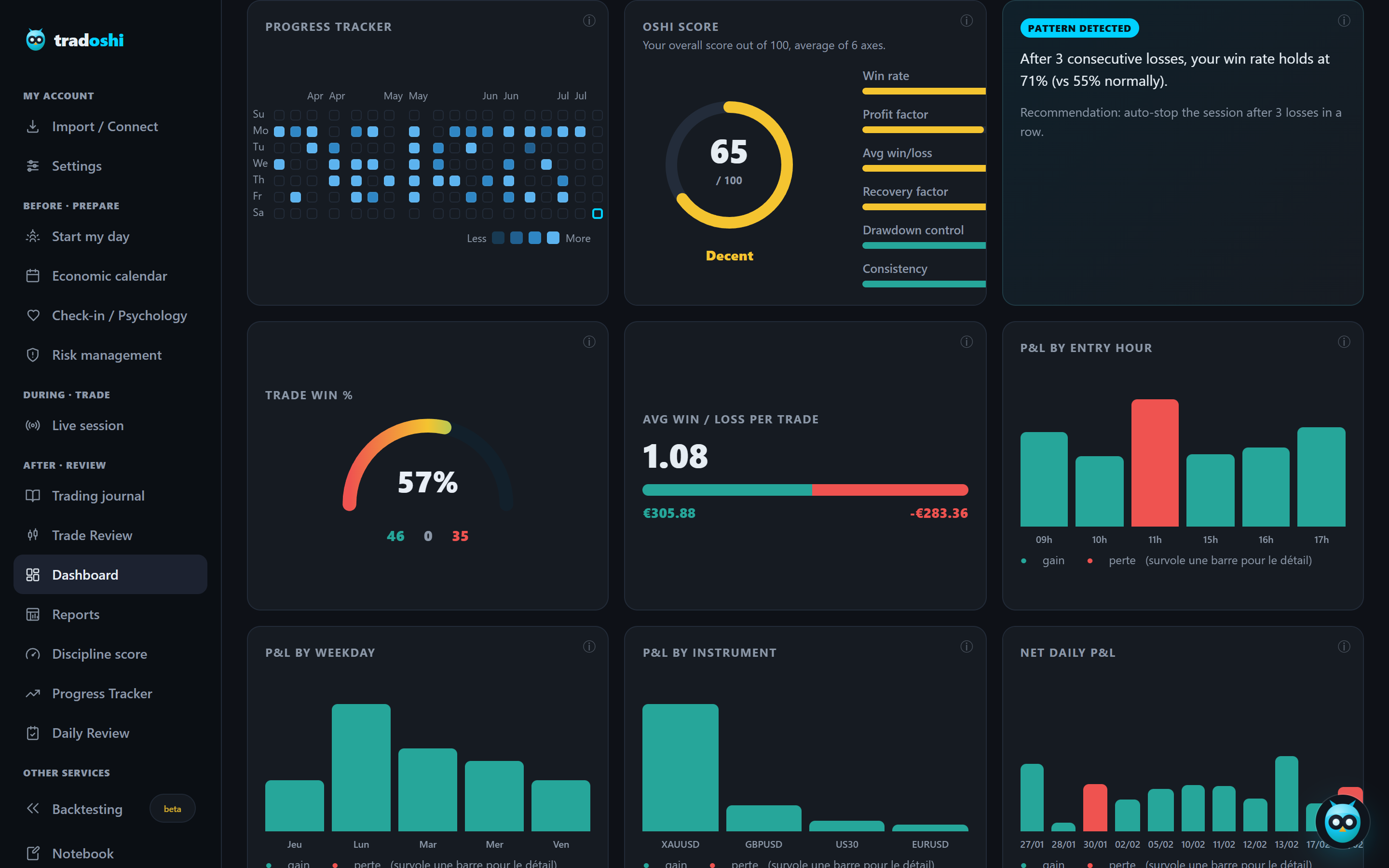
Tradoshi helps you make the right diagnosis during a losing streak and get through it without self-sabotage, by objectively measuring your discipline and drawdown.
- Discipline score: it tells you whether your streak comes from variance (rules held) or drift (rules broken).
- Drawdown tracked: your streak is placed in the context of your current and historical drawdown.
- Real risk: it immediately detects if you increase your size during the streak, the reflex to avoid.
- Emotional check-in: it helps you spot the degraded state that pushes toward destructive reactions.
Frequently asked questions
Is a losing streak normal?
Yes, it's statistically inevitable, even with an excellent system. Randomness produces sequences: even a 60%-win system generates, sooner or later, streaks of five or six losses in a row. It isn't your system that's broken, it's variance expressing itself. A positive edge is always paid for in temporary losing streaks.
Why is a losing streak so dangerous?
Because it doesn't just hit your account, it hits your head. Loss after loss, your confidence erodes, doubt sets in and stress alters your judgment. It then triggers the worst reactions: revenge trading, over-risk, abandoning the system, paralysis or overtrading. It's that reaction, far more than the streak itself, that turns normal variance into a disaster.
How do I know whether to stop or continue?
By diagnosing the streak's nature. If you respected your plan and rules, it's a variance streak: get through it without changing anything. If you drifted (off-plan trades, over-risk, overtrading), it's a drift streak: stop and correct. Confusing the two means breaking a good system or worsening a bad behavior.
Should I change strategy during a losing streak?
Almost never at the trough of the streak. Changing systems right when variance is against you is the best way to miss the rebalancing that follows. If you respected your rules, the streak is normal variance: continue identically. Only question your system cold, on a sufficient sample, never under the sting of emotion.
How do I get through a streak without self-sabotage?
Prepare your reaction cold, before it arrives. Never increase your size (that's the reflex that kills), apply your daily stop rule, diagnose variance or drift, and optionally reduce your size to lower pressure. The only acceptable modification is defensive: reduce, never increase. That's the golden rule of getting through.
How do I regain confidence after a losing streak?
Not through a big trade that 'erases' the streak (that would be falling back into the trap), but through returning to consistency: string together disciplined days, even modest ones, to prove you and your system still work. Looking at your data also helps: placed among hundreds of trades, a streak appears for what it is, a normal and expected episode.
What happens if I increase my size after each loss (martingale)?
It's mathematically seductive but catastrophic in practice, because it assumes infinite capital to absorb an arbitrarily long streak. In real trading, a streak of six or seven losses is enough to lead to a final position wildly disproportionate to your remaining capital, capable of wiping out an entire account. The opposite rule (reduce, never increase) protects against this trap.
How do I size my risk to survive losing streaks?
By keeping a modest risk per trade. At 5% per trade, five consecutive losses put you at -25%, a hole needing +33% to fill. At 1% per trade, the same streak leaves you at -5%, barely more than 5% to recover. This sizing choice, decided cold before any streak, determines whether a drawdown stays manageable or becomes a crisis.