Most trading goals aren't just unrealistic, they're outright counterproductive. Aiming for '10% a month' or 'double my account this year' doesn't motivate you, it pushes you to over-risk, force trades and betray your plan to reach a number the market doesn't owe you. Good trading goals aren't about money, they're about your behavior.
- A fixed profit goal pushes over-risk: you force it when the market gives nothing.
- The market doesn't deliver on demand: aiming for a set monthly amount is an illusion.
- Good goals are about the process, not the result you don't control.
- Behavior goals produce, as a knock-on effect, the financial results.
'I want to make 3,000 this month.' That goal seems reasonable, ambitious, motivating. It's actually toxic. Because the market doesn't work like a salary: it doesn't deliver a regular amount in exchange for regular effort. Some months it offers few opportunities; others, many. A fixed profit goal forces you to produce a result on a system you don't control, and that constraint mechanically pushes you to trade badly.
The problem isn't having goals, it's having the wrong ones. A good trading goal is about what you control (your behavior, your plan adherence, your discipline) and never about what you don't (the result, the money, the market). This guide explains why profit goals sabotage your trading, how to set process goals, and why they paradoxically produce better financial results.
Why profit goals sabotage your trading
A fixed profit goal creates constant pressure to produce a result, and that pressure is the enemy of good trading. When you're behind on your monthly goal, you no longer take trades with the required calm: you force mediocre entries to catch up, increase your size to go faster, hold losses hoping they'll reverse. The goal you thought motivating becomes the engine of your indiscipline.
The mechanism is perverse: the more you want to reach a number, the further you drift from the behavior that would let you make money. The trader obsessed with their monthly goal trades against themselves. They turn an activity requiring patience and selectivity into a race to produce, and the market always punishes those who try to wrench a result from it. This mechanism explains why some of the most technically skilled traders remain chronic losers: their skill is real, but their goal constantly sabotages it.
The market doesn't deliver on demand
The fundamental mistake of profit goals is treating the market like an employer paying a regular salary. But the market doesn't work that way. Your profitability comes from repeating a statistical edge over opportunities that arrive irregularly, not from constant effort constantly rewarded. There are weeks with no valid setup and weeks full of opportunities, and you don't decide which.
Setting a monthly profit goal is like setting a wave-count goal for a surfer. They don't create the waves, they wait for the good ones and take them well.
Your only room to maneuver is taking opportunities well when they appear and forcing nothing when they're absent. A goal demanding a fixed amount, regardless of what the market offers, directly contradicts that reality. It pushes you to act when you should wait, i.e. at the worst moment.
Process goals, the right approach
The solution is to shift your goals from result to process. Instead of aiming for an amount, aim for a behavior: what you fully control. Those goals are reachable every day, whatever the market's mood, and they build precisely the habits that produce profitability.
| Bad goal (result) | Good goal (process) |
|---|---|
| Make 3,000 this month | Respect my plan on 95% of my trades |
| Make 10% this month | Never exceed 1% risk per trade |
| Double my account this year | Hold my stop threshold every day |
| Stop losing | Keep my journal after every session |
| Win every day | Only take trades from my checklist |
Notice each goal on the right is under your total control and verifiable every day. You can fail on the result despite perfect behavior (due to variance), but you can't fail on the process if you decide to hold it. That difference is what makes process goals the only healthy ones.
Why process produces the result
The paradox is that by ceasing to aim for money and aiming for behavior, you make more money. Because profitability is only the consequence, over time, of good behavior repeated. A trader who respects their risk, holds their rules and never forces lets their edge express itself, and their edge produces the gains. Conversely, the trader who aims for money directly destroys their edge by chasing it.
It's the same principle as in elite sport: you don't focus on the score, you focus on the right move, and the score follows. In trading, your 'right move' is your discipline. Set discipline goals, measure them, and let the financial results emerge as their natural consequence rather than as a target you chase while sabotaging yourself.
How to set good goals
- Frame your goals in terms of behavior, never amount: 'respect my plan', not 'make X'.
- Make them verifiable every day, so you can see whether you hold them.
- Focus on one or two key habits at a time, not an impossible list.
- Judge your success on process adherence, independent of the period's result.
- Let financial goals exist as long-term markers, never as monthly targets.
Short, medium and long-term goals
Well-built goals span several horizons, each with its nature. In the short term (the day, the week), your goals should be purely behavioral: respect your plan, hold your risk, keep your journal. In the medium term (the quarter), you can aim for skill progress: improve your discipline score, reduce your breaches, better manage your exits. Only in the long term (the year, the years) do global financial markers make sense, like steadily growing your capital.
The classic mistake is inverting this logic, setting short-term financial goals ('make X this week') and neglecting behavioral goals. This inversion puts pressure exactly where it hurts and removes it where it would be useful. The right hierarchy puts behavior front and center in the short term, and lets financial results emerge as the long-term consequence of good behavior repeated. Each horizon has its type of goal, and confusing them is a major source of bad decisions.
Outcome goals and process goals
The fundamental distinction, borrowed from elite sport, opposes outcome goals (winning the medal) to process goals (executing the move perfectly). In trading, an outcome goal is 'make so much'; a process goal is 'take only my validated setups'. The first depends partly on luck and the market; the second depends entirely on you. And you only progress durably by setting goals on what you control.
The powerful paradox is that focusing on the process produces better results than aiming directly for the result. An athlete focused on their score tenses up and underperforms; one focused on their move lets the score follow. In trading, your 'move' is your execution discipline. By setting process goals and letting results come, you paradoxically get better results than the trader obsessed with their P&L, who sabotages themselves by frontally chasing what they don't control.
Revising your goals without getting discouraged
Goals are only useful if they stay alive, revised as you progress and learn to know yourself better. An overly ambitious goal, never reached, becomes a source of discouragement that eventually makes you abandon the very idea of setting goals. An overly easy goal doesn't pull you up. The right goal is slightly above your current level: reachable with effort, but not guaranteed.
Revise your goals cold, periodically, based on what your data shows. If you regularly reach a discipline goal, raise it a notch; if you're systematically far off, it may be unrealistic or badly framed. This regular revision turns your goals from a frozen declaration into a dynamic progress tool. And remember that failing an outcome goal doesn't matter as long as you hold your process goals: it's the behavior, not the isolated result, that measures your real progress. A good marker: if you reread your goals from six months ago and they now look too easy, that's the most reliable sign you've genuinely progressed.
The trap of goals copied from others
Social media has made this trap more dangerous than ever: you see screenshots of accounts exploding, promises of triple-digit returns, and you conclude, consciously or not, that your own goal should look like that. The problem is those displayed numbers almost never represent a trader's durable reality: they show an isolated peak, stripped of context, without the blown account that followed or the rough months that preceded it.
Setting a goal copied from what you see online means comparing yourself to an image, not a reality. Your goal should come from your own data: your edge, your account size, your available time, your risk tolerance. Two traders with the same strategy but different account sizes don't have the same realistic goals in absolute terms, and that's perfectly fine. Building your goals from what you observe in yourself, not in others, is the only way to get benchmarks that actually mean something.
A worked example: turning a vague goal into a process goal
Take a purely illustrative example. A trader aiming to 'make 2,000 this month' can reframe that goal as a measurable process goal: 'respect my 1% risk per trade on 100% of my trades' and 'only take setups from my checklist, no exceptions, over the next 20 sessions'. If their edge is real and they hold those two commitments, the financial result will follow at its own pace, whether that's 1,500 or 3,000 that month.
The crucial difference is that this trader can check every day whether they held their process goal, independent of the account balance. At month's end, even if the financial result disappoints because the market was stingy, they can objectively see they executed well, and adjust their confidence accordingly rather than judging themselves solely on a number the market largely decided for them.
Realistic goals and the learning curve
A realistic goal accounts for where you actually stand on your learning curve, not just what you'd like to achieve. A trader who's been in the markets for six months shouldn't set the same goals as one who's validated an edge over several hundred trades. In that first phase, the realistic goal isn't even profitability: it's clean execution, building a sample of trades large enough to honestly judge a strategy, and forming the habits that will make profitability possible later.
Trying to skip that stage by setting an aggressive profit goal in the first few months is one of the surest ways to sabotage your learning: the pressure pushes you to over-risk before you even have a validated edge, which makes the outcome even more random. Adapting your goals to your real phase, rather than to an abstract ambition, isn't underselling yourself, it's respecting the time any demanding skill takes to build. A trader who accepts this reality generally progresses faster than one who skips steps, precisely because they don't destroy their capital or their confidence before they've had time to learn.
How Tradoshi measures your real goals
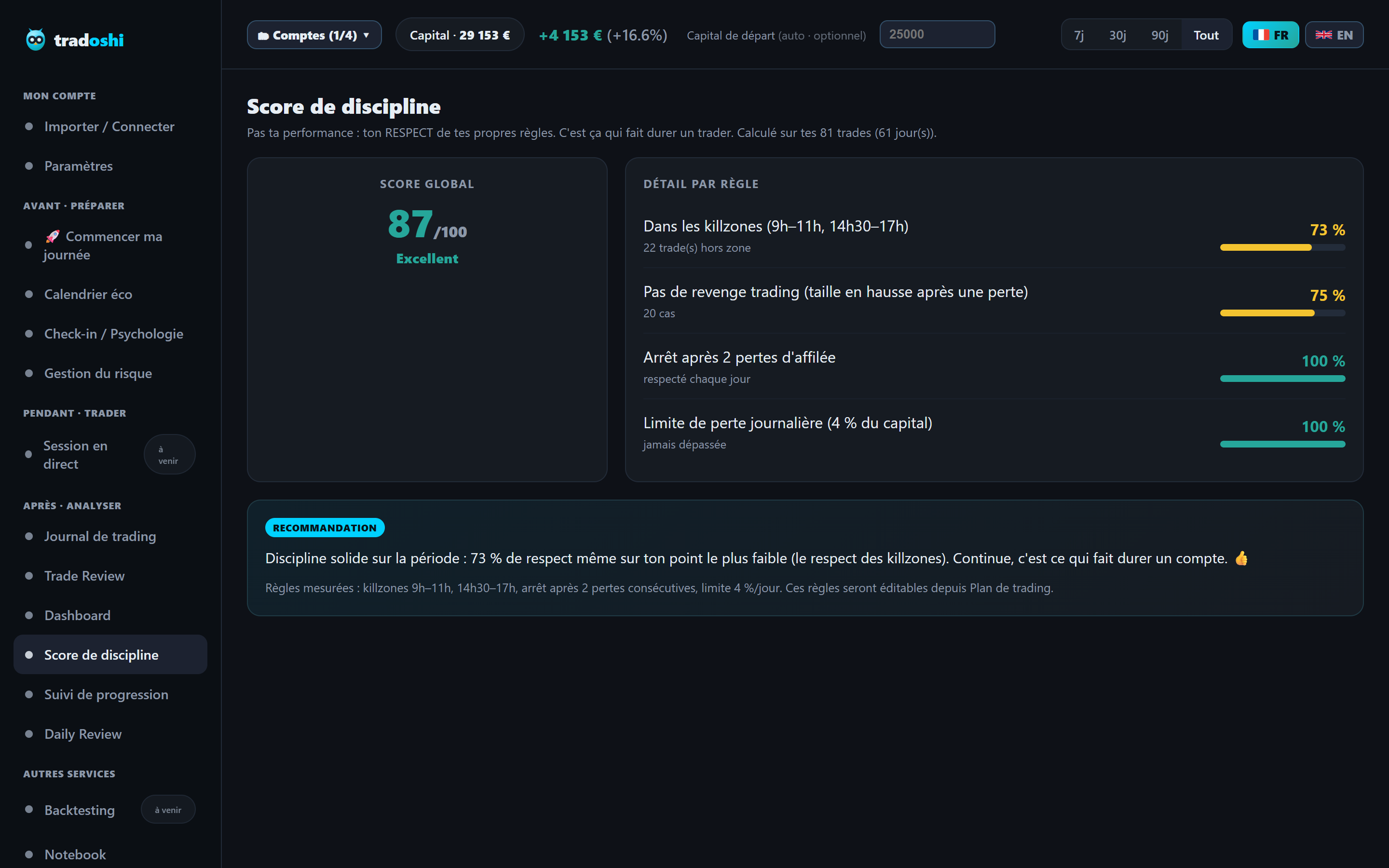
Tradoshi lets you track behavior goals rather than profit goals, by measuring your plan adherence on your real trades. Your progress is judged on your discipline, what you control, not on a number the market decides for you. Over weeks and months, this shifts the entire emotional tone of your trading: you stop dreading the monthly close and start looking forward to seeing whether your process held.
- Discipline score: your main behavior goal, measured every day on your real trades.
- Rule adherence: risk, killzones, stop threshold tracked to judge your process, not your result.
- Progress tracking: your streaks of disciplined days become visible and reinforce over time.
- Result in context: your gains are shown next to your discipline, as its consequence.
Frequently asked questions
Why not set a monthly profit goal?
Because a fixed profit goal pushes you to over-risk and force trades when the market gives nothing, to catch up a number it doesn't owe you. The market doesn't deliver a regular amount on demand: your profitability comes from irregular opportunities. A profit goal forces you to act when you should wait, i.e. at the worst moment.
What trading goals should I set?
Process goals, about your behavior: respect your plan on 95% of trades, never exceed 1% risk, hold your stop threshold every day, fill your journal after each session. These goals are under your total control and verifiable daily, unlike the result the market decides.
Does a behavior goal really make more money?
Yes, paradoxically. Profitability is only the consequence, over time, of good behavior repeated. By respecting your risk and rules, you let your edge express itself, and your edge produces the gains. The trader who aims for money directly destroys their edge by chasing it. Like in sport: aim for the right move, and the score follows.
How do I set a realistic trading goal?
Frame it in terms of behavior verifiable every day, never as an amount. Focus on one or two key habits at a time, and judge your success on process adherence, independent of the period's result. Financial goals can exist as long-term markers, but never as monthly targets to hit at any cost.
Can I have financial goals in trading?
Yes, but only as very long-term markers, never as short-term targets dictating your daily behavior. 'Grow my capital steadily over several years' is healthy; 'make 10% this month' is toxic. The difference is the horizon and above all never letting the number push you to betray your plan.
How do I know if I'm improving without a profit goal?
By measuring your discipline and plan adherence on your real trades. If your behavior improves (fewer breaches, risk held, stop threshold respected), you're improving, even if a given period is negative due to variance. The financial result then emerges as the natural consequence of a good process measured and held.
Should I compare my goals to other traders I see online?
No, that's a common and dangerous trap. Numbers shown on social media almost always show an isolated peak stripped of context, never the blown account that followed or the rough months that preceded it. Build your goals from your own data (your edge, your account size, your available time), not from an image you see online.
Should my goals change based on my experience level?
Yes. A beginning trader should aim for clean execution and building a sufficient sample of trades, not immediate profitability. Setting an aggressive profit goal before validating an edge pushes you to over-risk and sabotages your learning. Adapting your goals to your real phase respects the time any demanding skill takes to build. Trying to run before you can walk is one of the most common reasons ambitious beginners flame out within their first year.