'Be less emotional' is unusable advice: emotions don't switch off on command. The right question isn't how to erase them, but how to build a framework that stops them from driving your decisions. That framework has three stages, leans on the body as much as the head, and can be measured.
- You don't erase, you contain: the goal isn't to be a robot, but to stop emotion from deciding for you.
- Decide cold, execute hot: if the decision is already made, emotion has nothing to grab at the critical moment.
- The body before the head: breathing, breaks, sleep and environment regulate emotion faster than willpower.
- What isn't measured doesn't change: quantifying the cost of your states turns a hunch into an argument.
'Be less emotional' is the worst advice you can give a trader, because it's unusable. Emotions don't switch off on command. What works isn't erasing them, it's building a framework that stops them from driving your decisions.
This framework rests on a simple idea: emotion always attacks at the moment of decision. If you move your important decisions out of that moment, you take away emotion's point of entry. The rest is recognizing your states, regulating your body, arranging your environment, and measuring what all of it costs or earns you.
Emotions aren't the enemy
Before trying to manage your emotions, understand that they aren't your enemy. An emotion carries information: fear signals a risk, frustration signals a gap between expectation and reality. The problem is never the emotion itself, it's letting it take control of execution. So the goal isn't the absence of emotion, but the absence of decisions dictated by it.
This nuance changes everything, because it frees you from a battle you can't win. You're not going to become numb, and thankfully so. You'll just learn to feel without obeying, like a pilot who keeps composure not because they feel no fear, but because they have procedures that hold despite the fear.
The trader's main emotions
Each emotion pushes toward a typical mistake. Knowing them lets you spot which one is talking, which is already half the work.
- Fear makes you cut winners too early, hesitate to enter, tighten a stop excessively.
- Greed / euphoria makes you size up, hold a loser, aim too high.
- Anger / frustration triggers revenge trading and catch-up decisions.
- Boredom makes you trade for the sake of trading, off-setup, just for action.
- Hope keeps you in an invalidated trade, waiting for a return that doesn't come.
Recognize before regulating
The first skill is naming your state. You can't manage an emotion you don't see. Before each session, ask yourself honestly: am I calm, stressed, tired, trying to win it back, euphoric after a gain? Putting a word on it already reduces its grip, because naming an emotion reactivates the rational part of the brain.
This step seems trivial, but it's the one almost everyone skips. You open the app and trade without ever asking what state you're in. Yet the same setup played calm or played angry doesn't produce the same results, because it's not the setup that changes, it's your management of it.
Decide cold, execute hot
All your important decisions must be made when you're not under pressure: your risk, your rules, your loss limit, your entry and exit conditions. In-session, you only execute. Emotion always attacks at the moment of decision; if the decision is already made, it has nothing to grab. It's the most powerful principle in all of emotional management.
The three-stage protocol
- Before: check your state. If you're clearly degraded (anger, extreme fatigue), reduce your risk or don't trade.
- During: if you feel urgency or panic rising, stop for a minute before any click. Urgency is a warning signal, not an order.
- After: log your emotion of the day and tie it to your result. Over time, you see which states cost you money.
| Moment | Typical emotion | Right response |
|---|---|---|
| Before the session | Stress, fatigue, urge to win it back | Cut risk or don't trade |
| At the point of entry | Urgency, FOMO | Pause before clicking |
| After a loss | Anger, need to fix it | Apply the loss limit |
| After a gain | Euphoria, overconfidence | Keep position size stable |
| End of day | Relief or frustration | Log the emotion, tie it to the result |
The body before the head
We think we manage emotions with willpower, but willpower is exactly what gives way under pressure. The body is a more reliable and faster lever. A few slow breaths literally lower tension and restore judgment. Standing up, stepping away from the screen for thirty seconds, breaks an impulse's momentum. And upstream, sleep and physical state change everything: a tired trader makes worse decisions, whatever their rules.
These gestures seem trivial, but they act where thinking has no time to act. In the split second before an impulsive click, you don't have time to reason; you have time to breathe and stand up. Treating emotional regulation as a physical subject, and not only a mental one, is what makes it usable in real life.
Environment matters
Your trading environment amplifies or calms your emotions. A stream of notifications, a trading chat getting excited, feeds open all the time: all of it injects urgency and emotional noise into your decisions. Conversely, a calm space, free of distraction, with only what you need, mechanically reduces the emotional load. You can't control the market, but you fully control what surrounds you when you trade it.
Quantifying the cost of your emotions
As long as 'I trade badly when I'm stressed' stays a feeling, you won't change. When it becomes 'my losses are bigger on stressed days, with numbers to prove it', the argument becomes impossible to ignore. That's exactly what Tradoshi's emotional check-in does: it detects your state, dates it, and crosses it with your real performance to turn a hunch into data.
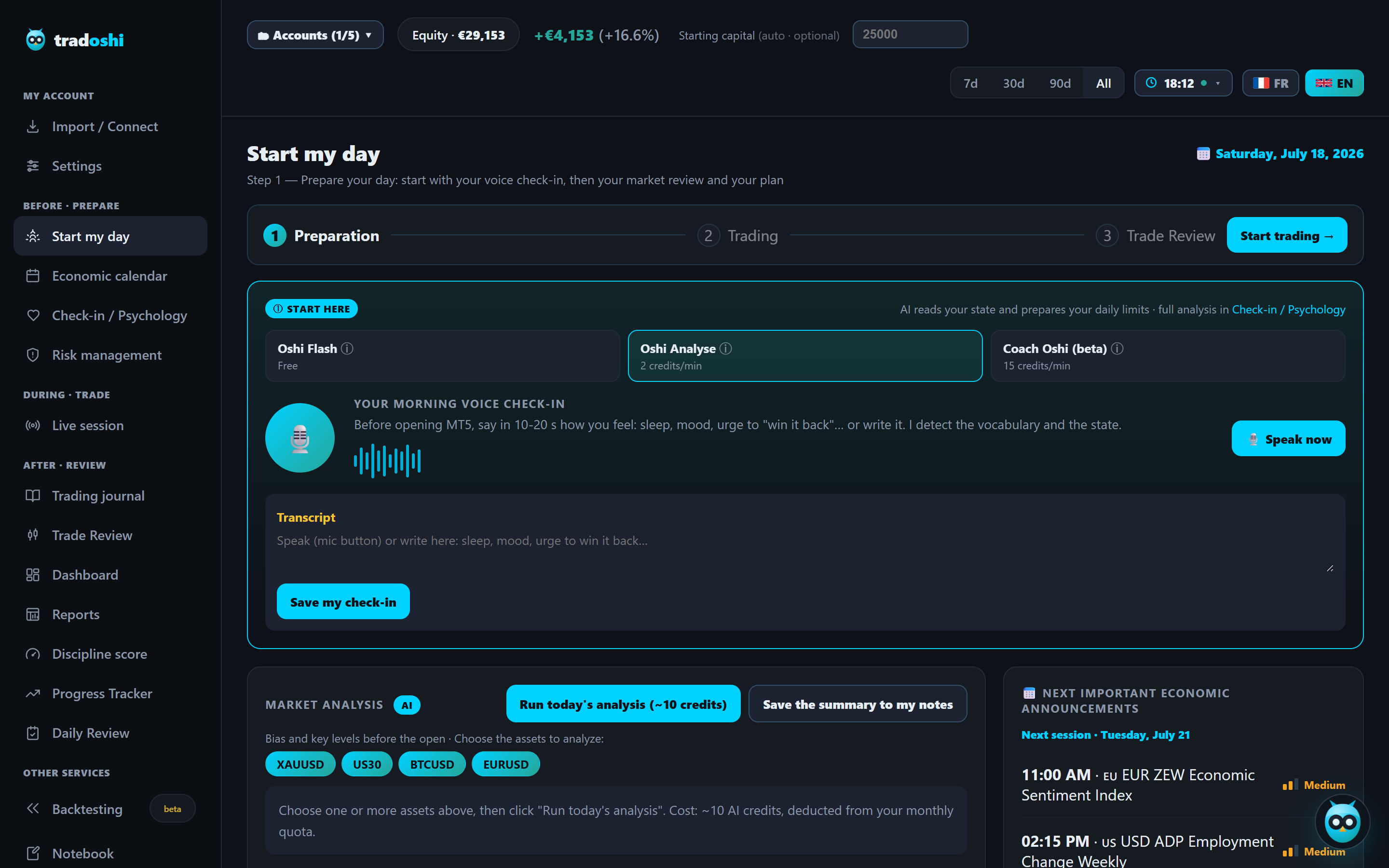
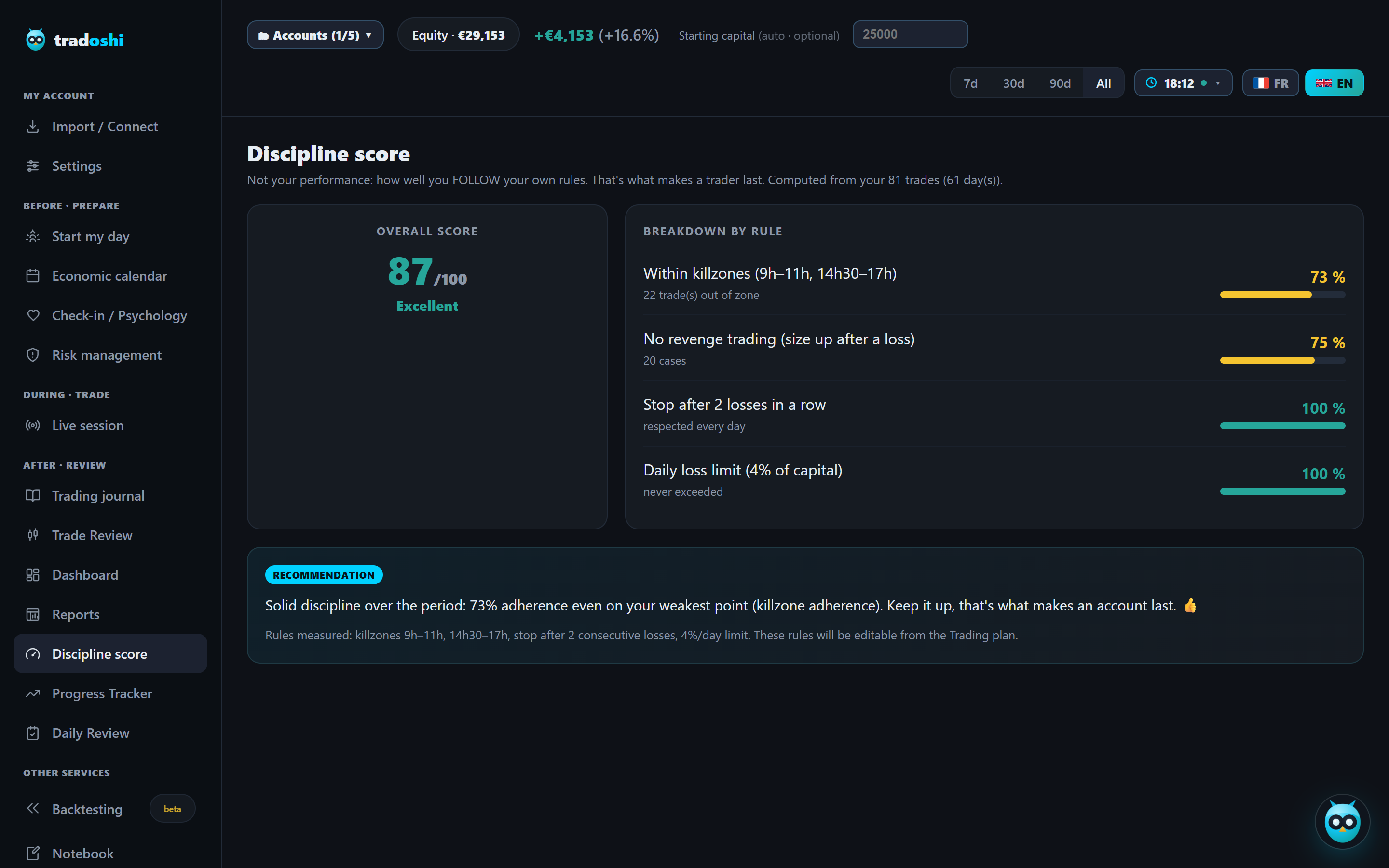
With a few weeks of data, stable patterns appear: one state precedes your worst days, another your best. You no longer fight a vague impression, you adjust your behavior from your own quantified history. It's the difference between 'I should watch out for stress' and 'I halve my risk on days I feel degraded, because the numbers justify it'.
A concrete example
Two days, the same trader, the same setup. Day 1: they slept well, did their check-in, feel calm; they execute their plan, take their −1% loss without flinching, and stop at the planned time. Day 2: short night, already a morning loss, no check-in; the same setup stresses them, they tighten their stop, get shaken out by noise, get angry and chain trades. The market was identical. What changed was the emotional state and the absence of a framework to contain it.
Emotion spreading from one trade to the next
One of the most dangerous properties of emotions in trading is that they spread from one trade to the next. A loss that generates frustration doesn't stay isolated: it colors your perception of the next trade, pushes you to win it back, degrades your judgment for the whole series. Likewise, a big gain that generates euphoria contaminates the following decisions by making you reckless. Emotions don't reset between trades, they accumulate and transmit, creating entire series marked by the same state.
That's why emotional management also involves the ability to cut this contagion. After an emotionally strong trade, winning or losing, a short pause to let the emotion settle before resuming stops it from spilling onto the next decision. Treating each trade as an independent event, without letting the previous one tint it, is a hard but decisive skill. A trader who knows how to interrupt emotional contagion turns a potential bad series into a succession of clean decisions, each made in a neutral state.
Building your emotional resilience
Emotional management isn't limited to containing your emotions in the moment, it's also built over time through a resilience that can be worked on. A resilient trader takes the hard knocks without collapsing, recovers fast from a bad patch, and holds their course despite turbulence. This sturdiness doesn't come from the absence of emotion, but from a healthy relationship to it: accepting that trading generates stress and frustration, and developing the means to get through these states without them dictating your acts.
Concretely, resilience feeds on elements beyond trading: a life balance, physical activity, quality sleep, a relationship to money that doesn't put your survival at stake on every trade. A trader whose identity and well-being don't depend entirely on their day's results is far more emotionally resistant than one for whom every loss is a personal indictment. Building this deep resilience is long-term work, but it's what lets you last in a craft where emotions are a constant.
Frequently asked questions
Can you really trade without emotion?
No, and that's not the goal. Trying to switch off all emotion is unrealistic and even counterproductive: emotions carry useful information. The goal is to recognize them and stop them from deciding for you, not to become numb.
Should you stop trading when stressed?
Not necessarily stop, but reduce. If your state is clearly degraded (anger, extreme fatigue, after a big loss), lower your risk or skip the session. A bad state doesn't forbid you from trading, it forces you to trade smaller and more carefully.
How do I name an emotion when I'm not sure what I feel?
You don't need a precise word, just a category: more calm or more agitated, more confident or more under pressure. Even rough, the exercise reactivates your distance. With practice, you refine it.
Does breathing really work in trading?
Yes, because it's not relaxation, it's regulation. A few slow breaths lower physiological tension and restore a few seconds of distance, right when the impulse was about to fire. It's a concrete tool, not a self-help trick.
Is euphoria after a gain as dangerous as anger?
Often more, because it doesn't look like danger. After a winning streak, you size up, loosen your criteria, feel invincible. Many big drawdowns start right after a nice run.
Does my trading environment really influence my emotions?
A lot. Notifications, trading chats, open social feeds inject urgency and noise. A calm, distraction-free space mechanically reduces the emotional load. You don't control the market, but you fully control what surrounds you when you trade it.
How fast does this protocol produce results?
The 'name it, regulate through the body and decide cold' part helps immediately. The 'quantify' part needs a few weeks of data to surface reliable patterns. That's exactly why you should start logging early, before you need the numbers.