In trading, the steady, average trader almost always beats the brilliant, erratic one. It's counterintuitive in a world that celebrates genius and grand gestures, but it's a mathematical truth: consistency compounds, irregularity cancels out. Talent can win you one trade; only consistency wins you a thousand.
- Consistency compounds, irregularity cancels out: big givebacks erase big gains.
- Talent handles a trade, consistency handles a career.
- A modest edge held long beats a brilliant edge applied in fits.
- Consistency isn't innate, it's built through discipline and measured.
Picture two traders. The first is brilliant: dazzling intuitions, occasional spectacular trades, understands the market better than anyone. But erratic: exceptional weeks alternate with collapses, they deviate from their plan whenever they 'feel it'. The second is unremarkable: a modest edge, no strokes of genius, but metronome discipline, day after day, year after year. Over ten years, the second ends up far ahead.
This story isn't a comforting moral for average traders, it's a mathematical reality. Trading gains compound, and compounding rewards consistency and brutally punishes irregularity. This guide explains why consistency beats talent, how the magic of compounding works, and why you should aim to become boring rather than brilliant.
The magic of compounding
Compounding is the fact that your gains in turn generate gains, on a growing base. It's a slow force at first, then explosive over time, but it has an absolute requirement: consistency. Compounding only works if you don't regularly destroy your base. A single big giveback, a catastrophic month, a burst of euphoria that surrenders several weeks of gains, and the compounding machine restarts from lower down.
That's why in trading, avoiding big holes is worth more than making big gains. A trader who steadily makes 2% a month without ever suffering a catastrophic month compounds beautifully. A trader who makes +20% one month then -25% the next has a flattering average return but poor compounding, because big givebacks break the cumulative effect. Consistency is the fuel of compounding.
Why irregularity cancels out
Irregularity has a hidden cost that average return masks. Because of percentage asymmetry, a big gain followed by a big giveback doesn't leave you at breakeven, it leaves you below. Gaining 50% then losing 50% doesn't bring you back to your starting point: it leaves you at -25%. That's the merciless mechanic that makes spectacular but erratic traders stagnate or slide despite their grand gestures.
| Sequence | Cumulative result | Verdict |
|---|---|---|
| +50% then -50% | -25% | The big giveback erases more than the gain |
| +10% then -10% | -1% | Small gap, limited damage |
| +2% × 12 months | ≈ +27% | Consistency compounds |
| +20%, -15%, +20%, -15% | ≈ +5% | Irregularity erodes everything |
The table is damning: the steady, modest sequence crushes the spectacular ones. Each big giveback doesn't just cancel the previous gain, it attacks the base everything else is built on. That's why a trader aiming for the exploit often condemns themselves to treading water, while the boring trader quietly moves forward.
Talent handles a trade, consistency handles a career
Talent isn't useless, but it's overrated. It can make you pull off a brilliant trade, read a move nobody else sees, seize a rare opportunity. But talent can't be controlled: it comes and goes, it depends on your form, your intuition of the day, circumstances you don't master. Counting on your talent means counting on something intermittent.
Talent wins trades. Discipline wins months. Consistency wins careers.
Consistency, on the other hand, can be controlled. It doesn't depend on your inspiration but on your system and your discipline. You can decide to be consistent every day, whatever your form, whereas you can't decide to be brilliant. It's precisely because it's under your control that consistency is a far more solid base than a talent you're subject to.
Aim to become boring
The best, most counterintuitive advice for an ambitious trader is to aim for boredom. Good trading is repetitive, almost monotonous: the same setups, the same risk, the same routines, day after day. There's no spectacular story to tell, no adrenaline, no stroke of genius. Just the patient, steady application of a modest edge. It's boring, and that's exactly what works.
The need for excitement, for thrills, for grand gestures is one of the trader's worst enemies. It pushes you to take needless risks just to feel something, to turn an activity that should be cold into an emotional rollercoaster. If you're bored while trading, that's probably a good sign. If you're living intense emotions, it's probably because you're taking too much risk.
Consistency is built and measured
The good news is that consistency isn't a birth gift, it's a skill that's built. It comes from discipline applied repeatedly: a clear plan, rules held, stable routines. And like any skill, it improves when measured. A trader who tracks their consistency (plan adherence, risk stability, streak of good days) turns a vague concept into concrete, visible progress.
Measuring your consistency also changes how you judge yourself. Instead of celebrating big gains and suffering big givebacks, you learn to value consistency itself: a long streak of disciplined days becomes a more solid source of pride than an isolated grand gesture. And it's that shifted pride, from result to behavior, that durably anchors consistency.
Why talent can be a handicap
Counterintuitively, talent can become an obstacle to success in trading. The talented trader, who has sharp intuitions and pulls off nice moves, is often tempted to lean on that gift rather than build a system and discipline. They improvise, trust their flair, and operate in brilliant fits. As long as their intuition works, all is well; but intuition comes and goes, and the day it fails them, they have no structure to fall back on.
The average trader doesn't have that luxury: knowing they can't count on a gift, they build a system, rules and discipline from the start. This apparent constraint becomes their strength, because it produces exactly what makes you last in trading. That's why you often see very gifted traders stagnate while ordinary but methodical traders progress steadily. Talent flatters the ego and discourages systematic effort; the absence of talent forces you to build the foundations that actually last.
Consistency makes performance predictable
One of the underrated benefits of consistency is that it makes your performance predictable, and therefore manageable. A steady trader knows their expectancy, their typical drawdown, their behavior in different conditions: they can anticipate, plan, size. An erratic trader, whose results swing between exceptional and catastrophic, can't anticipate anything, because their performance depends on an unstable variable, their inspiration of the moment.
This predictability has enormous value, especially if you want to one day live off trading or trade for a prop firm. Nobody can build on erratic results, even if their average is good: it's consistency that lets you make trading a reliable activity rather than a talented gamble. Consistency turns trading from a series of bets into a reproducible process, and it's that reproducibility, far more than grand gestures, that makes a trader's real value.
Building consistency day after day
Consistency isn't decreed, it's built through habits repeated until they become automatic. Concretely, that means a stable routine, rules held every day, a regular journal, and identical risk management from one trade to the next. Each of these habits, taken alone, seems trivial; together and repeated, they produce the regularity that makes the difference over years. Consistency is the sum of a large number of coherent small decisions.
The trap to avoid is seeking consistency through willpower alone, which depletes. Lasting consistency comes from systems more than determination: a routine that runs almost automatically, rules that apply without debate, safeguards that hold even on weak days. By building these systems, you make consistency possible without having to heroically want it every day. And since each steady day reinforces the habit, consistency becomes easier and easier as it settles in.
The trap of social comparison
Trading social media is packed with screenshots of exceptional trades, accounts that double in a month, strokes of genius recounted after the fact. This constant exposure to other people's grand gestures pushes you to underrate the value of consistency and to chase, yourself, the trade that will change everything. It's a trap, because these screenshots almost never show the irregularity surrounding them: accounts that doubled in a month were often halved the following month, but that part never gets posted.
Comparing yourself to these isolated grand gestures, without knowing the full trajectory around them, warps your judgment of what actually works. A trader who wins modestly but steadily looks dull next to a spectacular screenshot, even though they're probably far closer to lasting profitability than the author of that screenshot. Measuring your own consistency, rather than comparing it to other people's highlight reels, protects you from this distortion and brings you back to what truly matters over time.
Slip-ups and breaches: consistency isn't perfection
A common misunderstanding is believing consistency means never deviating, never having a bad day, never breaking a rule. That's an impossible definition to hold, and aiming for that perfection often leads to giving up at the first slip, with a 'I blew it, might as well quit' mindset. Real consistency isn't the absence of slips, it's the ability to get back on track quickly after one, without letting a bad day drag ten more down with it.
A consistent trader also has days of lesser discipline, trades they regret, moments of doubt. What sets them apart from the erratic trader isn't the total absence of incidents, it's that these incidents stay one-off exceptions rather than a repeating pattern. Forgiving yourself an isolated slip, while noting it so it doesn't become a habit, is an integral part of real consistency, far more realistic than chasing a permanent flawless record.
A ten-year worked example
To make compounding tangible, picture two traders starting with 20,000 each. The first aims for 1.5% net monthly return, never more, held with iron discipline. Over ten years, a hundred and twenty months, that modest pace compounds to roughly six times the starting capital, without a single spectacular month. The second chases the grand gesture: they string together +15% months with -12% months, for an arithmetic average close to the first trader's.
On paper, their average monthly returns look comparable. In reality, the second trader's compounding is wrecked by the negative months, which each eat into a base that's grown larger than the one the next gain will have to rebuild from. After ten years, it's common for this second profile to end up with barely more capital, sometimes less, than they started with, despite individual months far more impressive than the first trader's. This isn't an extreme example, it's simply the arithmetic of compounding applied over time.
Consistency as a competitive advantage
In an environment where most traders favor the thrill over the lasting result, the simple ability to be consistent becomes a real competitive advantage, almost an edge in itself. While other traders jump from one strategy to another at the slightest bad week, switching styles the moment a method goes through normal variance, the consistent trader accumulates data, refines their system, and progresses while the others keep starting over from zero.
This advantage widens over time, because consistency compounds not only financial results but learning itself. A trader who stays on the same system for two years understands its finest nuances, its best conditions, its usual traps. A trader who switches methods every two months never gets past the beginner stage on any of them. Consistency isn't just a psychological virtue then, it's a learning accelerator that restlessness structurally prevents.
How Tradoshi measures your consistency
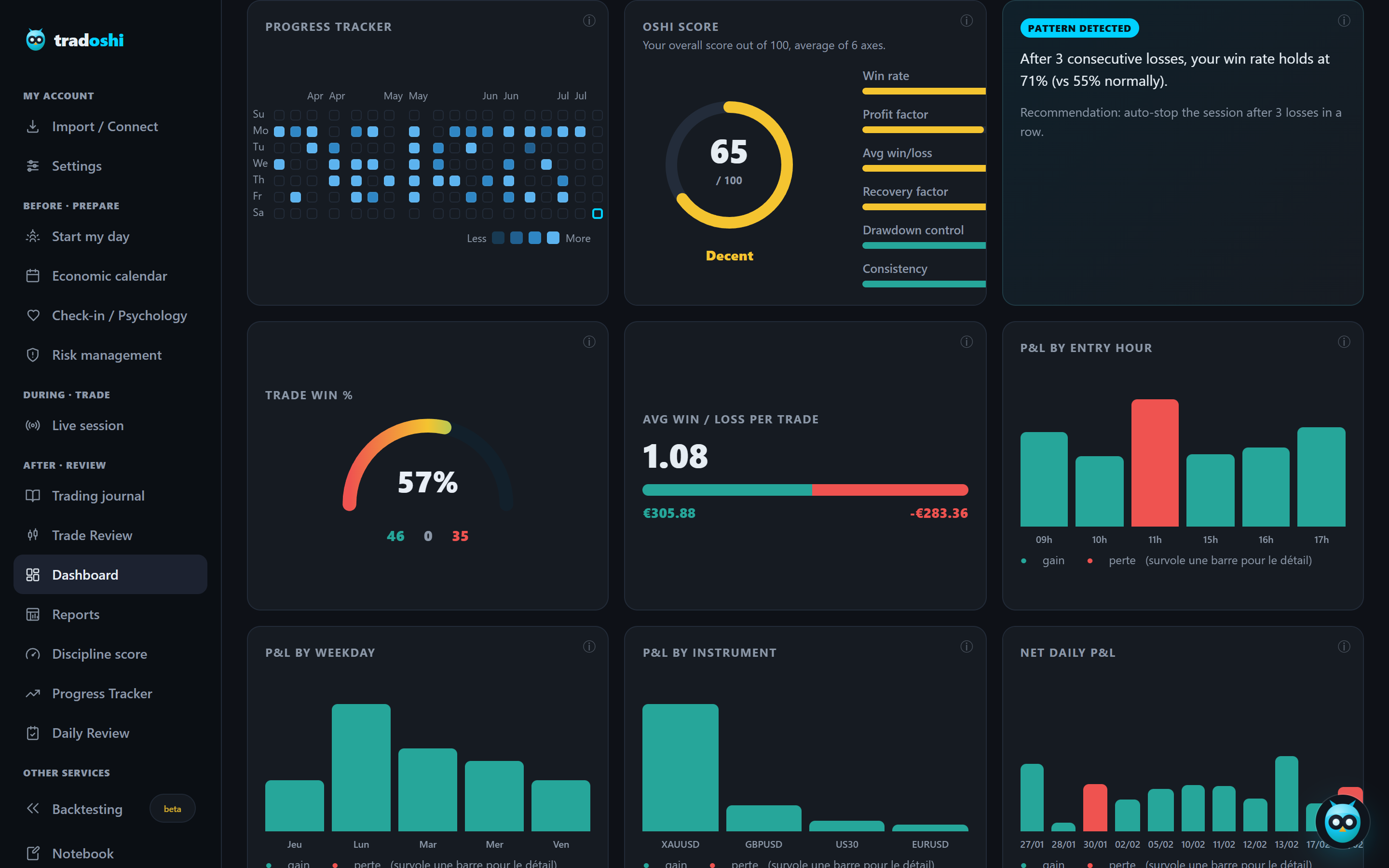
Tradoshi makes your consistency visible and measurable, so you improve on what truly matters: your behavioral consistency, more than your grand gestures. The discipline score and progress tracking turn consistency from a vague ideal into data you can improve.
- Discipline score: a daily grade measuring your behavioral consistency, day after day.
- Streaks of disciplined days: your consistency becomes a visible streak that reinforces.
- Risk stability: your average risk reveals whether your management is consistent or erratic.
- Consistency scored: an axis of the Oshi Score values the steadiness of your performance, not the fits.
Frequently asked questions
Why does consistency beat talent in trading?
Because gains compound, and compounding rewards consistency while punishing irregularity. A big giveback doesn't just erase the previous gain, it attacks the base everything is built on. A modest edge held steadily compounds beautifully, while a brilliant but erratic talent stagnates because big givebacks cancel big gains.
Why does a big gain then a big giveback set me back?
Because of percentage asymmetry. Gaining 50% then losing 50% doesn't bring you back to breakeven, it leaves you at -25%, because the loss applies to a bigger base than the gain. That's the merciless mechanic that makes spectacular but erratic traders stagnate despite their grand gestures: each big giveback attacks the cumulative capital.
Is talent useless in trading?
No, but it's overrated and above all uncontrollable. Talent can make you pull off a brilliant trade, but it comes and goes with your form and circumstances you don't master. Consistency, on the other hand, can be controlled: it depends on your system and discipline, not your inspiration. It's because it's under your control that it's a far more solid base.
Should I really aim to be 'boring'?
Yes, it's the best counterintuitive advice for a trader. Good trading is repetitive and monotonous: same setups, same risk, same routines. The need for excitement pushes you to take needless risks to feel something. If you're bored while trading, that's a good sign; if you're living intense emotions, it's probably because you're taking too much risk.
Is consistency innate or can it be developed?
It's developed. Consistency isn't a birth gift but a skill built through discipline applied repeatedly: a clear plan, rules held, stable routines. And like any skill, it improves when measured. A trader who tracks their consistency turns a vague concept into concrete progress.
How do I measure my consistency?
By tracking your plan adherence, your risk stability and your streaks of disciplined days, rather than your gains alone. A daily discipline score and a track of your steady streaks turn consistency from a vague ideal into data you can improve. It also shifts your pride from the isolated result to steady behavior, which durably anchors consistency.
Why do I feel dull next to traders posting their grand gestures?
Because those screenshots almost never show the irregularity surrounding them: an account that doubles in a month is often halved the next one, but that part never gets posted. Comparing yourself to isolated highlights, without knowing the full trajectory, warps your judgment. Measure your own consistency rather than other people's highlight reels.
Does consistency mean never slipping up?
No, that's a common misunderstanding. A consistent trader also has days of lesser discipline and trades they regret. What sets them apart is that these incidents stay one-off exceptions rather than a repeating pattern. Real consistency is getting back on track quickly after a slip, not chasing an impossible flawless record.