People talk about discipline as a character trait you either have or don't. That's false, and it's a belief that blocks thousands of traders. Mental discipline isn't a gift, it's a muscle: it's built through repetition, strengthened by small wins, and measured like any skill. Understanding that means ceasing to suffer your lack of discipline and starting to work on it.
- Discipline isn't innate, it's a skill built through repetition.
- It's strengthened by small wins: each rule held reinforces the next.
- Willpower is limited, habits and systems replace it effectively.
- What's measured gets stronger: tracking your discipline accelerates its progress.
'I lack discipline.' Most traders say this as a verdict, a fixed characteristic of their personality against which they can do nothing. It's the worst way to see things, because it's both false and paralyzing. Discipline isn't an immutable trait you'd possess or not at birth, it's a capacity that develops, exactly like a muscle or a skill.
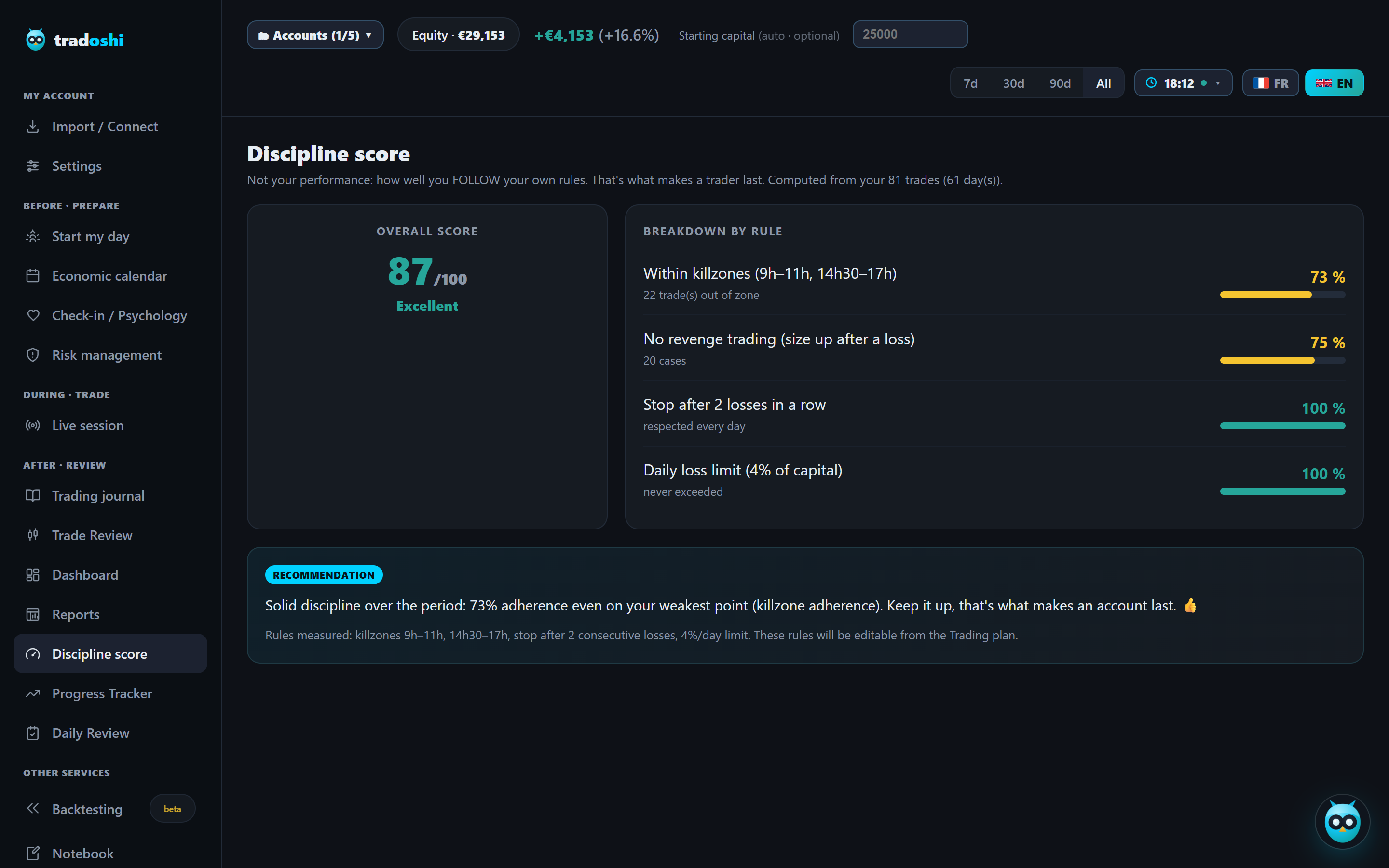
This distinction isn't a matter of vocabulary, it changes everything. If discipline is innate, you have no grip on it: you're disciplined or you're not, period. If discipline is a muscle, then your current lack is only a starting point, and every day is a chance to strengthen it. This guide explains why discipline is a skill, how it's built concretely, and why measuring it accelerates your progress. And like any skill, it improves faster when you can see it: that is what Tradoshi’s discipline tracking is for, scoring every trade against your own rules.
Discipline is a skill, not a trait
Nobody is born disciplined. What we take for a character trait in disciplined people is actually the result of years of practice, built habits and systems put in place. A disciplined athlete isn't so by nature, they became so through repetition, day after day, until disciplined behavior became automatic. The disciplined trader follows the same path: they build themselves, they don't discover themselves.
Seeing discipline as a skill has a liberating consequence: it's improvable. Your current level isn't a fate, it's a stage. As with any skill, you can progress with method and repetition. The trader who 'lacks discipline' isn't condemned, they're simply at the start of their training, and they have every power to progress if they go about it right.
How the muscle is built
A muscle is built through repeated effort, and discipline works the same way. Every time you hold a rule despite the urge to break it, you strengthen your discipline a notch. Every time you cave, you weaken it. Discipline is thus built trade after trade, decision after decision, through an accumulation of small wins that, together, create a solid habit.
Discipline isn't built in the great heroic moments, but in the thousand small ordinary decisions where you choose to hold your rule.
That's why it's better to start small. Wanting to become perfectly disciplined overnight, on all fronts, is the best way to fail and confirm your belief that you 'lack discipline'. Pick a single rule, hold it until it becomes automatic, then move to the next. Each anchored win strengthens your ability to hold the next: discipline compounds.
Willpower is limited, systems aren't
There's a trap to avoid: relying on willpower alone. Willpower is a limited resource, that depletes over the day and caves under pressure. A trader relying only on their strength of character to stay disciplined will eventually crack, precisely in the hard moments where they'd need it most. Lasting discipline doesn't rest on willpower, it rests on systems that replace it.
| Relying on willpower | Relying on systems |
|---|---|
| Limited resource, depletes | Doesn't deplete |
| Caves under pressure | Holds under pressure |
| Decision remade each time | Decision made once for all |
| Exhausting | Automatic once anchored |
Systems are your routines, your written rules, your cold-decided safeguards, your automatisms. They do discipline's work without drawing on your willpower. A stop placed in the market disciplines you effortlessly; an automatic stop rule protects you even when your willpower falters. Building your discipline is largely building systems that make disciplined behavior automatic, so you no longer depend on a failing willpower.
The small wins that compound
Discipline's progress follows a compounding logic, like interest. Every day you hold your rules doesn't count in isolation: it makes the next a little easier, because it reinforces the habit and your confidence in your ability to hold. A streak of disciplined days creates a self-sustaining dynamic, where discipline becomes more and more natural.
Conversely, every breach doesn't only cost the day it happens on: it weakens the habit and reopens the door to the next. That's why protecting your streaks of disciplined days has a value far greater than what they represent individually. You're not just building a good day, you're building the muscle that will make the next easier. Consistency is both the means and the result.
Why measuring accelerates progress
Like any training, discipline progresses far faster when measured. An athlete who tracks their performance progresses faster than one training on feel, because measurement shows them what works, what's stuck, and encourages them with visible progress. Mental discipline follows exactly the same logic: what's measured improves.
Measuring your discipline pulls it out of the fog where it escapes all control. As long as 'I lack discipline' stays a vague impression, you can't work on it. When it becomes a daily score telling you exactly which rule you hold, which you break, and how you progress over time, you turn a vague notion into concrete training with markers, goals and progress you can see.
Discipline is a muscle that tires
Like a physical muscle, discipline tires with use. Every decision requiring willpower (resisting a temptation, holding a rule despite the urge to break it) draws on a limited reserve that depletes over the day. That's why your last trading decisions are often your worst: late in the session, your discipline is tired, and breaches become easier. This phenomenon explains why so many traders crack after several hours at the screen.
Recognizing this discipline fatigue lets you manage it. Concentrate your trading sessions on the moments when your willpower is highest (often early in the day), limit how long you actively trade, and above all, lean on systems that consume no willpower (automatic stops, written rules, stop thresholds) to preserve your reserve. A trader who understands their discipline is a depletable resource spends it intelligently, instead of counting on it indefinitely until exhaustion.
Building discipline through environment
One of the most effective ways to strengthen discipline doesn't go through willpower, but through arranging your environment. By making good decisions easy and bad ones hard, you reduce the amount of willpower needed to behave well. Placing a real stop in the market rather than a mental stop, closing the platforms once your threshold is reached, removing from sight the temptations that make you overtrade: these are environment modifications that do the work for you.
This approach is far more reliable than strength of character alone, because it doesn't depend on your state of the moment. A well-designed environment disciplines you even on days when your willpower is weak, precisely when you need it most. Traders who succeed aren't those with the greatest mental strength, they're those who built around themselves an environment that makes indiscipline hard. Shaping your environment is often more effective than trying to shape your willpower.
The disciplined trader's identity
The ultimate stage of discipline is when it stops being an effort and becomes part of your identity. As long as you think 'I have to force myself to be disciplined', every decision is a battle. But when you start thinking 'I am a disciplined trader', disciplined behavior becomes natural, an expression of who you are rather than a constraint you suffer. This identity shift is the point where discipline becomes lasting and effortless.
This shift is built through the accumulation of evidence: each day you act with discipline reinforces the image you have of yourself as a disciplined trader, which makes the next day easier. It's a virtuous circle where behavior feeds identity, which in turn feeds behavior. Measuring and seeing your progress accelerates this process, because visible proof of your discipline consolidates the identity that makes it lasting. Becoming a disciplined trader isn't a matter of infinite willpower, it's a matter of accumulating enough evidence for it to simply be who you are.
Getting back up after a relapse
No progress in discipline is linear, and that's a reality to accept rather than fight. You'll have tilt days, breaches of your rules, broken streaks. What distinguishes a trader who progresses from one who stagnates isn't the absence of slips, but how they react to the slip. The classic trap is turning an isolated relapse into total abandonment: 'I cracked today, might as well keep going, the day's already lost anyway'. That reasoning turns a few-minute mistake into a several-hour catastrophe.
The right reaction to a relapse is to treat it as an isolated incident, not as proof that you're 'not cut out for discipline'. Stop the session as soon as you spot the breach, note it without dramatizing, and pick your rules back up from the very next decision, without waiting until tomorrow or next week to 'start fresh'. An athlete who misses a workout doesn't question their entire training plan, they simply move on to the next one. Discipline is also built through this ability to bounce back quickly after a slip, without letting one isolated relapse destroy weeks of accumulated progress.
There's also a useful distinction between a relapse and a pattern. One breach in a month, quickly recognized and contained, is simply the normal noise of being human under pressure. The same breach repeating every week, in the same circumstances, stops being noise and becomes a signal that a rule, a trigger, or a piece of your environment needs to change, not just your resolve. Treating every relapse as identical, whether it's the first in months or the fifth this week, wastes the information your own pattern of slips is trying to give you.
Surrounding yourself to hold more easily
Individual discipline builds more easily when it leans on a framework outside yourself. A trader alone in front of their screen, with no one to answer to, has to draw purely on willpower to hold their rules. A trader who shares their goals and results with someone, a mentor, a trading partner, or even a serious peer group, adds positive social pressure that makes every breach psychologically costlier, and therefore less tempting.
This external accountability doesn't replace the internal work, but it speeds it up. Knowing someone will see your results for the week pushes you to respect your rules even on days when willpower alone would have caved. The key is choosing a framework that encourages rigor without becoming a source of toxic pressure: the goal is to strengthen your discipline, not add extra anxiety that undermines it. A good accountability partner celebrates your streaks of disciplined days as much as they flag your slips, exactly like a good coach does with an athlete.
If you can't find a human accountability partner, a written commitment reviewed on a fixed schedule works almost as well. Writing your rules down where you'll see them again, and reviewing your adherence to them at a set time each week, creates a version of the same external structure without depending on anyone else's availability. What matters isn't the specific format, it's the existence of a checkpoint outside the heat of the moment, one that forces you to confront your actual behavior rather than your memory of it, which is almost always kinder to you than the facts deserve.
How Tradoshi builds your discipline
Tradoshi turns building your discipline into measured training: it scores your discipline on your real trades, highlights your small wins and makes your progress visible, so you build it like any skill.
- Discipline score: a daily grade measuring your discipline on your real trades.
- Small wins: your streaks of disciplined days become visible and reinforce.
- Weak point identified: the rule to work on first is highlighted.
- Visible progress: your tracking over time shows you your discipline is truly getting stronger.
Frequently asked questions
Is discipline in trading innate?
No, that's a false and paralyzing belief. Discipline isn't a character trait you'd possess or not at birth, it's a skill that develops through repetition, exactly like a muscle. What we take for a gift in disciplined people is the result of years of practice and systems. Your current lack is only a starting point, not a fate.
How do I develop my mental discipline?
Through repetition and small wins. Every time you hold a rule despite the urge to break it, you strengthen your discipline a notch. Start small: pick a single rule, hold it until it becomes automatic, then move to the next. Each anchored win strengthens the next. Discipline is built trade after trade, not all at once.
Should I rely on willpower to be disciplined?
No, it's a trap. Willpower is a limited resource that depletes and caves under pressure, precisely in the hard moments. Lasting discipline rests on systems that replace willpower: routines, written rules, cold-decided safeguards, automatisms. A stop placed in the market disciplines you effortlessly, even when your willpower falters.
Why start with a single rule?
Because wanting to become perfectly disciplined overnight, on all fronts, is the best way to fail and confirm your belief that you 'lack discipline'. By focusing on a single rule until it becomes automatic, you win a victory that strengthens your ability to hold the next. Discipline compounds, brick by brick.
Why does measuring my discipline help?
Because what's measured improves. As long as 'I lack discipline' stays a vague impression, you can't work on it. When it becomes a daily score telling you which rule you hold, which you break and how you progress, you turn a vague notion into concrete training with markers and visible progress, exactly like an athlete tracking their performance.
How long does building discipline take?
It isn't a switch but continuous training. By holding your safeguards each day, you build streaks of good days that reinforce by compounding: each disciplined day makes the next easier. Progress shows in weeks if you measure and proceed by small wins, not by seeking a total, immediate transformation.
What should I do after cracking and breaking my rules?
Treat the relapse as an isolated incident, not as proof you're not cut out for discipline. Stop the session as soon as you spot the breach, note it without dramatizing, and pick your rules back up from the very next decision. The trap is turning a few-minute slip into abandoning the whole day: that destroys far more progress than the relapse itself.
Does surrounding yourself with others really help discipline?
Yes. A trader who shares their goals and results with a mentor, a trading partner or a serious peer group adds external accountability that makes every breach psychologically costlier, and therefore less tempting. This positive social pressure doesn't replace the internal work, but it speeds it up, especially on days when willpower alone would have caved.