Most traders analyze each trade in the heat of the moment, but never step back on their whole week. That's a mistake, because the real patterns, the habits that make you win or lose, aren't visible trade by trade: they're visible at the scale of the week. The weekly review is the ritual that turns an accumulation of trades into real learning. This guide explains why it's so powerful and how to run it.
- The weekly review reveals patterns invisible at the scale of the isolated trade.
- It separates process from result: a good week can hide bad habits.
- It's done cold, on the weekend, when the emotion of trades has settled.
- It's the ritual that improves you faster than any new indicator.
Analyzing a trade right after taking it is useful, but insufficient. In the heat of the moment, you're still under emotion, and above all you only see one isolated point, not the trend. The behaviors that truly decide your success, your discipline, your weak moments, your profitable setups, only reveal themselves when you look at a whole week at a glance.
The weekly review is that moment of regular stepping back where you become your own analyst. It's a simple ritual, about thirty minutes a week, but it's probably the habit that will improve you fastest. This guide explains what it brings, what to look at, and how to make it a routine that lasts.
Why the week is the right scale
The isolated trade is too small to reveal a trend: a single result, winning or losing, says almost nothing about the quality of your trading. The month is too big: details drown, and you wait too long to correct. The week is the sweet spot, wide enough to surface patterns, short enough for correction to stay fast and actionable.
At the scale of the week, powerful questions become visible. Did you trade better at the start or the end of the week? Do your losses concentrate on a day, a time, an emotion? Did your rule adherence degrade after a bad session? These behavioral patterns, invisible trade by trade, jump out when you look at seven days together.
Separating process from result
The weekly review teaches you the most important lesson in trading: result and process are two different things. A winning week can hide catastrophic execution, saved by luck. A losing week can hide impeccable execution, victim of normal variance. Without a review, you confuse the two and draw the wrong conclusions.
A green week isn't necessarily a good week, and a red week isn't necessarily a bad one. What matters is the quality of your process, not the color of the result.
This distinction changes everything, because it prevents you from reinforcing bad habits just because they worked this time. The trader who judges their week on process, did they respect their rules, take the right trades, cut their losses, improves even when they lose. The one who only judges the result congratulates themselves for their mistakes when they pay and curses themselves for their good trades when they fail.
What to look at
An effective weekly review follows a stable checklist, to forget nothing and be able to compare from one week to the next. It starts with the underlying numbers: P&L, win rate, profit factor, average R for the week, compared to previous weeks. Then it goes into the behavioral: rule adherence, moments of weakness, dominant emotions.
| Review axis | Key question |
|---|---|
| Result | P&L, win rate, profit factor for the week |
| Discipline | Did I respect my rules? Where did I slip? |
| Best trades | What do my good trades have in common? |
| Worst trades | Were they in the plan or off-plan? |
| Emotions | Which state coincided with my losses? |
| Adjustment | One single thing to improve next week |
The classic mistake is wanting to fix everything at once. A good review ends with a single improvement goal for the following week, precise and measurable. A single change at a time, well applied, beats ten vague resolutions forgotten by Monday. The review only has value if it leads to concrete action.
Analyze your best trades too
Most traders only review their losses, as if learning only came from mistakes. That's an incomplete view. Your best trades have just as much to teach you: what do they have in common? Which setup, which time, which mindset? By identifying what characterizes your successes, you can consciously reproduce more of them.
This analysis of winners is often more profitable than the analysis of losers, because it tells you where to concentrate your efforts. Many traders discover, by reviewing their best weeks, that a huge share of their gains comes from a single type of setup. The conclusion is direct: do more of those trades, fewer of the others. The weekly review is where this realization happens.
Making it a ritual that lasts
The weekly review only has value if it's regular. A review done once then abandoned brings nothing; it's the repetition, week after week, that surfaces underlying trends and measures your progress. The secret to lasting is to make it simple, short and ritualized: same day, same time, same checklist.
The weekend is the ideal moment, when markets are closed and the emotion of trades has settled. Thirty minutes are enough if your data is well organized. The goal isn't perfection but consistency: an imperfect review done every week beats an exhaustive one done once a month. It's a discipline ritual, and like any discipline, its value comes from regularity.
The review feeds your plan
The weekly review isn't an isolated exercise: it loops with your trading plan. What you learn from one week becomes an adjustment for the next, and that adjustment is checked at the following review. It's this loop, review, adjust, verify, that creates continuous improvement, unlike the trader who repeats the same mistakes without ever noticing.
Over several months, this loop transforms your practice deeply. Each week adds a small correction, and the accumulation of these micro-adjustments, each validated by the facts, produces far more solid progress than any radical change. The weekly review is the quiet engine of this continuous improvement, the one that separates the trader who progresses from the one who stagnates.
A complete weekly review example
Take a concrete example. A trader closes their week at +320, over twelve trades, seven winners and five losers, a profit factor of 1.6. At first glance, a good week. Digging into their rule adherence, they discover that three of their five losing trades were off-setup, taken out of impatience late in the day, for a total of -280.
Without this review, they'd simply note a positive week and move to the next one without changing anything. With it, they identify a precise pattern, late-day impatience, that swallowed nearly all their potential profit. Their goal for the following week becomes concrete and measurable: no more trades after 4pm without verifying the setup checks every box. That's exactly the shift from general to specific that a good review produces.
The traps of the weekly review
The first trap is unproductive self-flagellation: spending thirty minutes beating yourself up over every mistake without drawing any concrete action from it. A review only has value if it leads to a precise adjustment; dwelling on a loss with no actionable conclusion improves nothing and simply erodes your confidence for the following week.
The second trap is reverse cherry-picking: only looking at trades that confirm what you already believe about yourself, whether positive or negative. A trader convinced they're disciplined will quickly gloss over their slips; a trader who doubts themselves will see negatives everywhere, even in a solid week. The review must stay as neutral as possible, anchored on the numbers rather than your mood of the moment.
Weekly review vs monthly review
The weekly review and the monthly review don't replace each other, they answer different questions. The week captures the behavioral heat of the moment, discipline patterns, emotions in real time. The month steps back to see the underlying trend: is your overall edge strengthening, is your consistency improving, how has your account evolved against your original goals.
The mistake is doing only one of the two. Without a weekly review, you lose the fast, reactive adjustments that keep a small problem from settling in. Without a monthly review, you risk staying focused on weekly details without ever measuring whether you're actually progressing over time. The two cadences are complementary, one corrects day to day, the other validates the trajectory.
Doing your review alone or with support
A weekly review conducted alone has a structural limit: you're analyzing your own decisions with the same brain that made them, which makes certain blind spots hard to see. Sharing your review with a mentor, a peer trader or a serious community, even occasionally, adds an outside perspective that often catches patterns you couldn't see yourself.
That doesn't mean the solo review is useless, quite the opposite: it's the essential base. But turning a solitary review into a shared one, even just once a month, by presenting your numbers and conclusions to someone who can challenge your reading, adds a layer of rigor that introspection alone doesn't always provide.
The weekly review on a prop firm account
On a prop-firm-funded account, the weekly review takes on an extra dimension: it must also check your progress against the program's specific rules, distance to the gain target, safety margin relative to the maximum daily and overall loss, adherence to the firm's trading rules. Ignoring this dimension is like flying without watching the gauges that determine whether your account stays active.
This prop-firm-oriented review answers one precise question each week: at this pace, how long until you reach your target, and how much margin do you have left before hitting a critical limit. It's a different reading from the classic review centered on continuous improvement, closer to a risk dashboard, but just as essential for a trader who depends on this type of funding.
What to do after a catastrophic week
A very negative week calls for a different, more careful review. The natural reflex is either to minimize it ('it was just bad luck') or to panic and question everything. Neither is useful. The right approach is to break it down coldly: how much of this loss comes from your system's normal variance, and how much comes from a genuine discipline slip.
If the loss is mostly explained by variance, with trades taken within the plan that simply didn't work out, the conclusion is to keep executing your system without questioning it, because that's exactly the kind of week a statistical edge goes through from time to time. If instead the loss is explained by several off-plan trades or clear tilt, the review must focus entirely on discipline, not the system, and the following week's goal becomes purely behavioral: cut size, tighten rules, or even force a pause before trading again.
This variance-versus-discipline distinction deserves to be written down in your review, not just thought through. A catastrophic week correctly diagnosed becomes valuable data for your long-term confidence: knowing your system survived a rough patch without needing to be changed is proof of robustness you can't get any other way.
How Tradoshi makes your weekly review easy
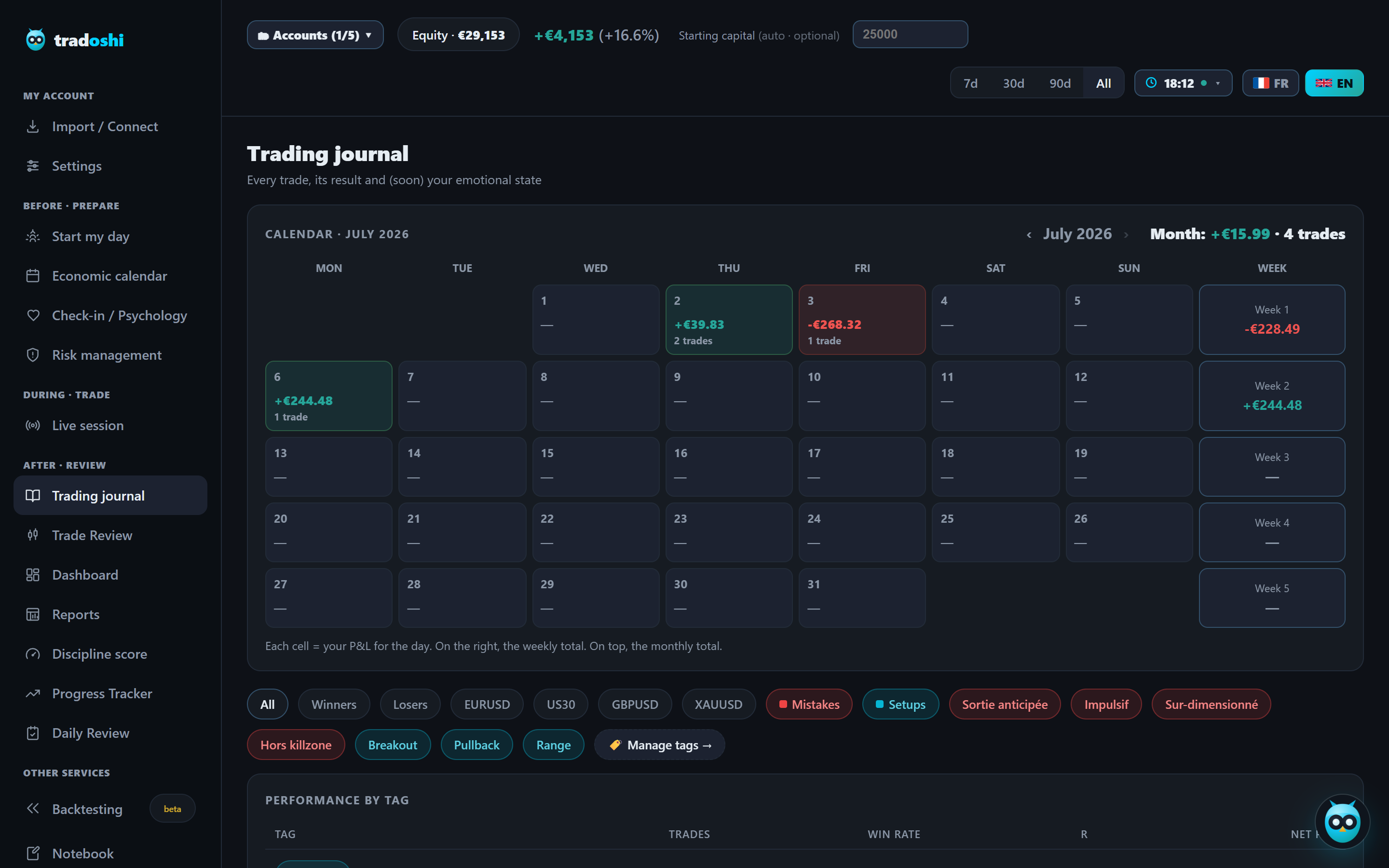
Tradoshi gathers in one place everything you need for your weekly review: your stats for the week, your P&L calendar, your discipline score and your emotions crossed with your performance. Your review goes from a scattered chore to a smooth thirty-minute ritual.
- Period stats filterable by week: P&L, win rate, profit factor, average R.
- P&L calendar to see at a glance where the week was decided.
- Discipline score to measure your rule adherence, not just your result.
- Emotion crossed with performance to link your losses to your state of the day.
Frequently asked questions
What is a weekly trading review?
It's a stepping-back ritual, about thirty minutes on the weekend, where you analyze your trading week as a whole rather than trade by trade. You look at your underlying numbers, your rule adherence, your best and worst trades, and your emotions, to draw a single improvement goal for the following week.
Why analyze the week rather than each trade?
Because the patterns that decide your success (discipline, weak moments, profitable setups) are invisible at the scale of the isolated trade and drown at the scale of the month. The week is the sweet spot: wide enough to surface trends, short enough for correction to stay fast and actionable.
What should I look at in a weekly review?
A stable checklist: underlying numbers (P&L, win rate, profit factor, average R compared to previous weeks), your rule adherence, what your best trades have in common, whether your worst trades were in the plan or off-plan, and which emotions coincided with your losses. End with a single improvement goal.
When should I do my weekly review?
The weekend is ideal: markets are closed and the emotion of trades has settled, letting you analyze cold. The most important thing is regularity: same day, same time, same checklist. An imperfect review done every week is far better than an exhaustive one done once a month.
Should I also analyze my winning trades?
Yes, absolutely. Your best trades have as much to teach you as your losses: by identifying what they have in common (setup, time, mindset), you can consciously reproduce more of them. Many traders discover that a huge share of their gains comes from a single type of setup, which tells them exactly where to focus their efforts.
What are common mistakes in a weekly review?
Unproductive self-flagellation, dwelling on mistakes without drawing a concrete adjustment from them, and reverse cherry-picking, only looking at what confirms what you already believe about yourself. A good review stays neutral, anchored on the numbers rather than your mood, and always leads to a precise action.
Should I do my weekly review alone or with someone?
The solo review is the essential base, but it has a limit: you're analyzing your decisions with the same brain that made them. Sharing your review with a mentor or peer trader, even once a month, adds an outside perspective that often catches patterns you couldn't see yourself.