Tilt is that moment when you're no longer trading, but the market is trading for you through your emotions. Borrowed from poker, the term describes that state of overheating where frustration, anger or euphoria takes control of your decisions. Tilt doesn't destroy accounts slowly: it drains them in a single session. This guide explains what tilt is, how to recognize it, and how to get out of it before it costs you dearly.
- Tilt is an emotional overheating where you trade on impulse, no longer to your plan.
- It often stems from a loss, but also from a big gain or accumulated frustration.
- Its signals are physical and mental: learn to spot them before the explosion.
- The only real way out is stopping: cut the session, don't try to win it back.
Every trader has known tilt, even if they didn't name it. It's that session where, after a loss, you take a trade you'd never have taken cold, then another to win it back, then another, until you turn a small loss into a disaster. Tilt is probably the most destructive mechanism in trader psychology, precisely because it acts fast and you rarely see it coming.
Understanding tilt means understanding how your brain tips you from rational decision to impulsive reaction. This guide breaks down the mechanism, its triggers, its warning signals, and above all the concrete strategies to interrupt it before it ravages your account.
What tilt is
The word tilt comes from poker, where it describes the state of a player who, under the sway of emotion, starts playing recklessly, often after a bad beat. In trading, it's exactly the same: tilt is that switch where you stop following your plan to react to your inner state. You no longer make decisions, you react to an emotion that has taken the controls.
What makes tilt so dangerous is that it makes you believe you're still rational. In the moment, every impulsive trade seems justified: you see an opportunity, you have a reason. But those justifications are fabricated after the fact by your brain to dress up an emotional impulse. Tilt doesn't feel like madness, it feels like clarity, and that's precisely what makes it a trap.
What triggers tilt
The most classic trigger of tilt is loss, especially the loss that hits the ego. A stop that gets hit just before the market turns back your way, a beautiful setup that fails, a silly mistake: these events create a frustration that seeks to discharge, and the discharge takes the form of a revenge trade. That's revenge trading, the most common form of tilt.
But tilt doesn't only have negative triggers. A big gain can also tip you over: euphoria makes you invincible, you increase your size, you take risks you'd never have taken cold, and you give back the whole gain in a few trades. Frustration accumulated over several dull days, boredom, or even an annoyance outside trading can light the fuse. The common thread: a strong emotion spilling onto your decisions.
The different faces of tilt
Tilt doesn't always show up in the same shape, and recognizing its variants helps you react faster. Revenge tilt, the best known, follows a loss and pushes you to immediately re-enter a position to erase the pain. Euphoria tilt does the opposite, following a strong winning run: confidence turns into overconfidence, size grows with no plan, and the trader feels temporarily invincible, until the market brutally calls them back to order.
There are also quieter forms. Boredom tilt hits the trader who, lacking a valid setup, forces a trade just to 'do something', especially during a quiet session. Fatigue tilt sets in late in the day, as judgment erodes without the trader noticing, and they keep trading long after they should have stopped. Finally, external tilt occurs when an annoyance unrelated to trading, an argument, bad news, contaminates the day's decisions. Each of these faces calls for the same response: recognize the signal and cut before the emotion takes the controls.
A concrete example of the spiral
Take an illustrative example. A trader who risks 1% of their capital per trade takes a loss on their first trade of the morning. They immediately open a second trade, bigger, with no clear setup, 'to win it back fast'. That trade also loses, doubling the day's loss to around 3%. Frustrated, they take a third, even bigger, this time on an instrument they don't even usually trade. Within an hour, the day's loss has gone from 1% to over 8%, damage that would have taken weeks to accumulate while respecting the plan.
This scenario illustrates tilt's exact mechanics: each impulsive trade is bigger and less thought through than the last, because emotion, not the plan, dictates size and trade choice. What should have been a normal, isolated 1% loss becomes, within a few minutes, a deep wound to the account. It's this acceleration, unique to tilt, that makes it so much more dangerous than a simple series of bad decisions made coldly.
The mistakes that make tilt worse
Many traders think they can manage tilt by staying at the screen and trying to calm down on the spot, for example with a few deep breaths. That's a common mistake: as long as the platform stays open and the finger stays on the mouse, the temptation to re-enter stays within reach. Giving yourself the illusion of managing tilt without physically stepping away from the market is one of the surest ways to end up cracking.
Another classic mistake is wanting to analyze your failed trades in the heat of the moment, while still emotional, thinking it will help you understand and therefore calm down. In reality, analysis done mid-tilt is biased by frustration and often leads to bad conclusions, or even to a new risk taken to 'verify' a theory. Good analysis waits until calm has truly returned, never before.
Coming back to the table after a tilt
Returning to trading after a tilt episode deserves as much attention as the exit itself. Going back to trading the very next day with your usual size, with no transition, exposes you to falling into the same trap again if a new trade turns bad. The return works better gently: a reduced size for a few sessions, time to rebuild confidence on well-executed decisions rather than on an amount to make up.
This gradual return also has diagnostic value. By resuming calmly, you can identify what preceded the tilt: accumulated fatigue, an outside annoyance, a losing streak poorly digested. Understanding the precise trigger lets you adjust your guardrails for next time, turning a costly episode into better knowledge of your own weak points.
Recognizing the warning signals
Tilt always announces itself, provided you know how to listen. The signals are first physical: the racing heart, the clenched jaw, the shallow breathing, tension in the shoulders. Your body reacts to the emotion before your mind has even named it, and these bodily signals are your most reliable alarm system.
| Signal | What it announces |
|---|---|
| Urgent need to win it back | Imminent revenge trading |
| Trade with no clear setup | You're no longer following your plan |
| Sudden size increase | Emotion is driving your risk |
| Physical tension, racing heart | Your body is already tilting |
| 'Just one last trade' | The classic before disaster |
The mental signals are just as telling: the urge to recover the lost money immediately, the thought 'just one last trade', the feeling that the market owes you something, or the sudden and absolute certainty about a direction. As soon as you notice one of these signals, consider yourself at the door of tilt, and act before you cross it. The more you train yourself to spot these signals early, the shorter the gap between the trigger and the decision to stop, which limits the damage even when tilt does occur.
Why winning it back is a trap
The instinct that accompanies tilt is always the same: win it back. After a loss, your brain wants to erase the pain by recovering the money, right now. It's an absolute trap, because the attempt to win it back pushes you to take more risk at the worst moment, when your judgment is most degraded. You dig the hole believing you're filling it.
The market will still be there tomorrow. Your capital, if you tilt, maybe not. The best decision mid-tilt is almost always to do nothing at all.
The hard truth to accept is that a loss is a loss: it's past, and no impulsive trade will undo it. Wanting to win it back in the same session means letting an emotion decide your risk management, which is the very definition of what a trader must avoid. Accepting the day's loss and stopping is an act of strength, not weakness.
Getting out of tilt: cut
There's only one reliable way out of tilt: the physical stop. When you recognize the signals, the only good decision is to cut the session, step away from the screen, do something else. No breathing technique replaces removing the very possibility of trading. As long as the platform is open, the impulse will find a way.
That's why the best traders give themselves automatic stop rules, decided cold: stop after a certain number of consecutive losses, or after reaching a maximum daily loss. These rules don't depend on your willpower at the critical moment, precisely when it's weakest. They turn getting out of tilt into a decision already made, which you simply apply.
Preventing tilt cold
The best tilt management happens before the session, not during. A trader who has defined their limits cold, who knows exactly how many consecutive losses trigger a pause and what daily loss closes their day, is far better armed than a trader counting on their composure in the moment. Preventing tilt is a matter of rules, not character.
Keeping a journal that links your emotional states to your results is the other pillar of prevention. By seeing, with the numbers to prove it, how much your tilt sessions cost you, you emotionally anchor the stop rule. The trader who knows their losses are three times bigger when degraded applies their rule far more easily: it's no longer an abstract constraint, but a protection they measured themselves.
Tilt on a prop firm account
Tilt takes on a particular dimension on a funded or evaluation account with a prop firm, because the penalty isn't only financial, it's structural. A maximum daily loss or a drawdown breached because of a tilt episode doesn't just reduce your balance, it ends the challenge or the account itself, sometimes over just a few minutes of chained trades.
This extra dimension should make prop firm day traders even more vigilant about tilt, not less. Paradoxically, the pressure of the external rule (daily limit, maximum drawdown) pushes some traders to attempt a forced move right before the close to 'save' a day that's going badly, which is exactly the scenario where tilt hits hardest. Knowing your firm's rules precisely and keeping them in mind at the critical moment is an integral part of managing tilt in this context.
How Tradoshi helps you against tilt
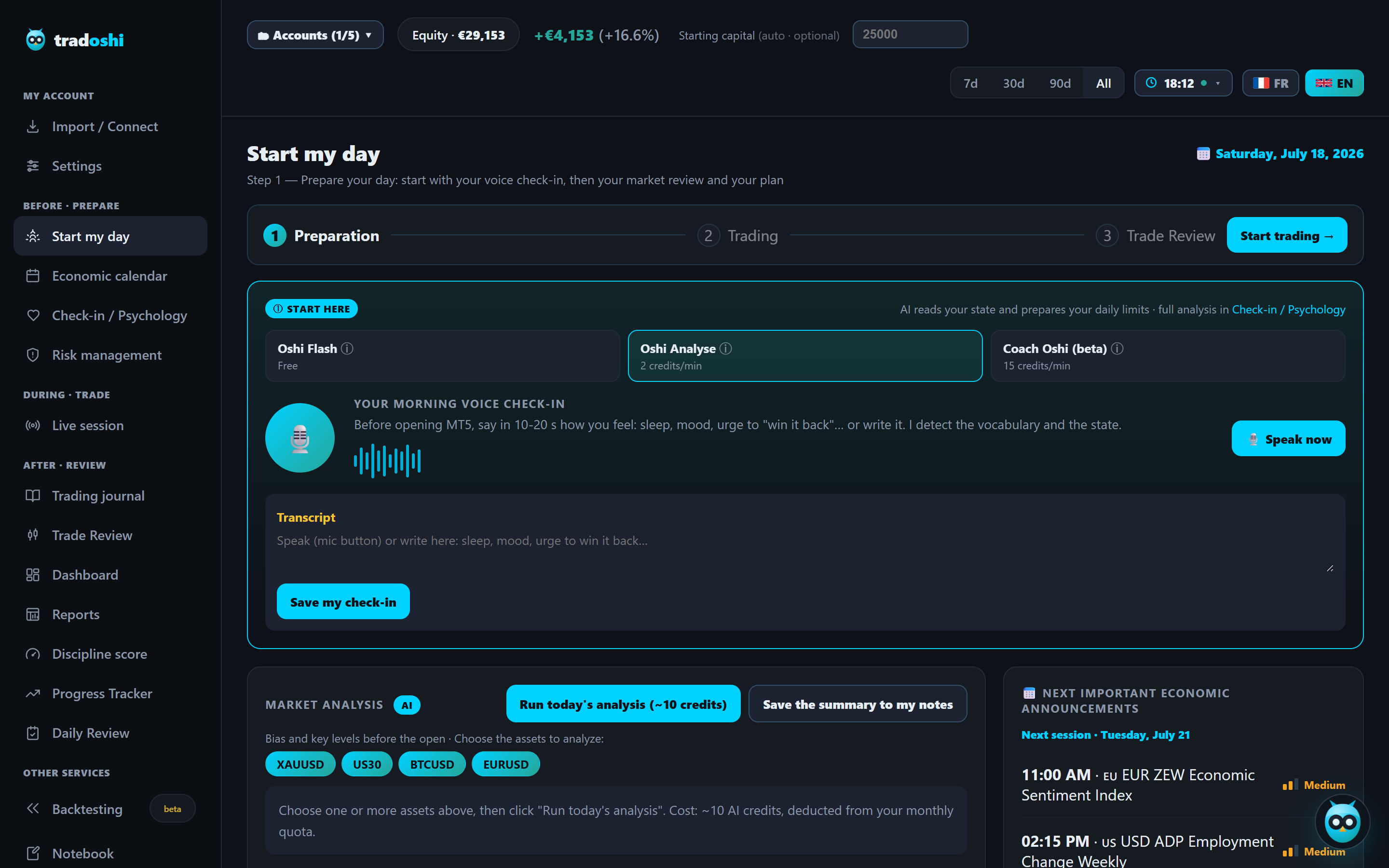
Tradoshi helps you spot and prevent tilt by crossing your emotional state and your trades. The pre-session check-in makes you name your state, the discipline score quantifies your slips, and automatic stop rules protect you when your willpower is weakest.
- Emotional check-in at the top of the day: name your state before it decides for you.
- At-risk combo detection: degraded state + losing streak = alert.
- Configurable stop rules: pause after N losses, daily loss limit.
- Emotion crossed with your performance to prove, with numbers, what tilt costs you.
Frequently asked questions
What is tilt in trading?
Tilt, a term borrowed from poker, describes a state of emotional overheating where you stop following your plan to react to your inner state. You no longer make rational decisions, you react to an emotion (frustration, anger, euphoria) that has taken control. Tilt drains an account in one session, not slowly.
What triggers tilt?
Most often a loss that hits the ego, pushing toward revenge trading. But also a big gain (euphoria, sense of invincibility), frustration accumulated over several dull sessions, boredom, or even an annoyance outside trading. The common thread is a strong emotion spilling onto your decisions.
How do I recognize that I'm tilting?
By physical signals (racing heart, clenched jaw, tension) and mental ones (urgent need to win it back, trade with no clear setup, sudden size increase, 'just one last trade' thought). Your body often reacts before your mind: these bodily signals are your most reliable alarm system.
How do I get out of tilt?
The only reliable way is the physical stop: cut the session, step away from the screen, remove the very possibility of trading. No breathing technique replaces that while the platform stays open. Wanting to win it back in the same session is a trap that makes you take more risk at the worst moment.
How do I avoid tilt in advance?
By defining your limits cold: number of consecutive losses that trigger a pause, maximum daily loss that closes your day. These rules don't depend on your willpower at the critical moment. Keeping a journal that shows how much tilt costs you emotionally anchors these rules and makes you respect them.
Are there different types of tilt?
Yes. Revenge tilt follows a loss, euphoria tilt follows a strong winning run, boredom tilt pushes you to force a trade with no setup during a quiet session, fatigue tilt sets in late in the day, and external tilt comes from an annoyance unrelated to trading. Each calls for the same response: recognize the signal and cut before the emotion takes the controls.
Can I manage tilt without leaving the screen?
No, that's a common mistake. As long as the platform stays open, the temptation to re-enter stays within reach, even with breathing exercises. The only reliable way to manage tilt is physically stepping away from the screen, not trying to calm down on the spot.