Trading looks simple: buy, sell, cash in. The concepts are learned in a few weeks, execution takes a few clicks. And yet, it's one of the activities with the highest failure rate. This contradiction baffles every beginner. This guide explains why trading is really so hard, not technically, but because it attacks head-on the way your brain is wired.
- Trading is simple to understand, hard to execute: the real obstacle isn't technical.
- It goes against your instincts: your brain is built to survive, not to trade.
- Feedback is misleading: a good decision can lose, a bad one can win.
- It requires acting in uncertainty, which humans hate above all.
Many beginners come to trading thinking the difficulty is technical: finding the right strategy, the right indicator, the right timing. They spend months chasing the technical grail, and fail anyway. The reason is that they've got the wrong enemy: trading isn't hard because of its complexity, it's hard because of us.
Trading is probably one of the rare activities where your natural reflexes, the ones that have served you your whole life, become your worst enemies. Understanding why it's so hard isn't discouraging, it's liberating: it tells you where the real battle is, and therefore where to focus your efforts. This guide breaks down the deep reasons for this difficulty.
Simple to understand, hard to do
The first source of confusion is the huge gap between the apparent simplicity of trading and the real difficulty of practicing it successfully. The basic rules, cut your losses, let your gains run, manage your risk, fit in a few sentences. Anyone can understand them in an hour. It's this ease of understanding that traps, because it makes you believe execution will be just as easy.
But understanding a rule and applying it under pressure are two different worlds. Knowing you must cut your losses is trivial; doing it when your money is at stake, your ego resists admitting the mistake, and hope whispers to wait a little longer, is extraordinarily hard. Trading is a domain where knowledge is easy and execution nearly impossible, the exact opposite of what most people are used to.
It goes against your instincts
The deep reason for this execution difficulty is that trading demands behaviors contrary to your deepest instincts. Your brain was shaped by evolution to make you survive, not to make you trade, and these two goals constantly conflict. What's good for survival is often catastrophic for trading.
Take the pain of loss: evolution made you far more sensitive to losses than gains, because avoiding danger mattered more than seizing an opportunity. In trading, this asymmetry makes you cut your winners too early (secure fast) and keep your losers too long (avoid the pain of realizing the loss), exactly the opposite of what you should do. Trading constantly asks you to act against what your body screams at you to do.
Feedback is misleading
In most domains, a good decision produces a good result, and you learn by observing the consequences of your actions. Trading breaks this link. Because of the randomness that rules in the short term, an excellent decision can end in a loss, and a stupid one in a gain. The immediate feedback, the one your brain learns on, is therefore systematically polluted.
In trading, the market sometimes rewards you for your mistakes and punishes you for your good decisions. It's the worst possible environment for learning by experience.
This dissociation between the quality of the decision and the immediate result is vicious, because it reinforces bad behaviors when they pay off by luck, and destroys confidence in the good ones when they fail by bad luck. A trader who judges on short-term results learns the wrong lessons. That's why you must reason over large samples and over process, an abstraction the human brain does very badly.
Acting in uncertainty
Trading forces you to make decisions and commit money without ever knowing what will happen. Every trade is a bet on an unknown future, and this permanent uncertainty is a stress humans tolerate very poorly. Our brain seeks certainty, hates ambiguity, and will do anything to reduce it, including stupid things like convincing itself it knows what the market will do.
Accepting to trade in uncertainty means accepting to be right about the process while being wrong about many individual trades. It means giving up the need for control and the need to be right, two fundamental human needs. Trading demands a counterintuitive form of letting go: acting with conviction on your method while fully accepting that each trade can fail. Few people manage it naturally.
The difficulty is good news
Realizing that trading is hard for psychological reasons is actually excellent news. First because it pulls you out of the endless quest for the technical grail, that costly illusion that keeps beginners going in circles for years. If the problem is human, the energy you put into indicators can go where it truly counts.
Second because the psychological difficulty can be worked on, provided you name it. The trader who knows they're fighting their instincts, misleading feedback and their need for certainty can put in place adapted guardrails: written rules, a rigorous process, an objective measure of their discipline. They turn a losing battle against their nature into a system that protects them from their own reflexes. That's where trading, from mysteriously hard, becomes simply demanding.
What sets apart those who succeed
Traders who last aren't those who conquered their human nature, no one does, but those who built a system to compensate for its flaws. They don't count on their composure, they impose it through rules. They don't judge on the result of one trade, they follow their process over hundreds. They don't seek certainty, they manage probabilities.
What sets them apart isn't a gift, it's a lucidity: they accepted that the real opponent is themselves, and they organize accordingly. This shift, from strategy-seeker to manager of one's own behavior, is the true passage to profitability. It explains why trading is so hard, and why it becomes much simpler once you attack the right problem.
Social comparison, an added trap
Another factor that makes trading psychologically grueling, rarely mentioned, is constant social comparison. Social feeds overflow with screenshots of gains, accounts that explode in a few weeks, traders projecting flawless confidence. This constant exposure to curated wins (nobody posts their losses) distorts your sense of what's normal and pushes you to take more risk to catch up to a pace of progress that, in reality, doesn't exist for the vast majority.
This comparative pressure amplifies every bias already covered: it makes uncertainty even more unbearable, because you experience it while measuring yourself against an unreal image of instant success, and it pushes you to ignore your own process to copy behaviors you don't understand. Protecting yourself from this comparison, by limiting exposure or consciously putting it in perspective, is as much a part of trading's psychological management as risk management itself.
Why most people quit too early or too late
Trading's psychological difficulty produces a cruel timing paradox: many traders quit too early, before letting their process play out over a sufficient sample, and many others cling too long to a method that clearly doesn't work, out of ego or sunk cost. Both mistakes share the same root: judging on impressions rather than data. Without an objective measure, it's impossible to know whether you're in a normal losing streak or facing a structural problem.
Take an illustrative example: a trader who loses on their first ten trades with an otherwise solid system might quit out of discouragement, when ten trades say almost nothing statistically. Conversely, a trader who clings for two hundred losing trades to a method that was never profitable confuses persistence with blindness. The right call, in both cases, depends on data only rigorous tracking can provide, not on how you feel in the moment.
The role of the body in the psychological difficulty
Trading's difficulty isn't only mental, it's also physiological. The stress tied to uncertainty and money at stake triggers a real response from your nervous system, releasing cortisol and adrenaline, exactly as it would facing a physical danger. This activation concretely degrades your judgment: under high stress, your brain favors fast, instinctive reactions over calm analysis, which explains why you make worse decisions precisely at the moments when the stakes are highest.
Recognizing this physiological dimension changes how you handle tough moments. Insufficient sleep, poor lifestyle habits or accumulated fatigue lower your stress tolerance threshold and make you more vulnerable to impulsive mistakes, regardless of your technical skill. Taking care of your physical state isn't a side note to trading, it's one of the baseline conditions for giving your brain a fair chance to function properly in an environment already hostile by nature.
Boredom, an underrated opponent
Trading's difficulty is often associated with intense emotions, fear, anger, euphoria. But a quieter, equally destructive opponent is boredom. Markets don't produce opportunities continuously: long periods of mediocre conditions, with no clear signal, are the norm, not the exception. Yet humans tolerate prolonged inaction very poorly, especially in front of a screen where action seems a click away at any moment.
This boredom pushes you to manufacture opportunities where none exist, to force mediocre trades just to break the monotony. It's one of the most underrated sources of losses, because it doesn't look like an obvious mistake in the moment: it disguises itself as initiative, as proactivity, when it's really just a reaction to psychological discomfort. Learning to stay inactive when the market offers nothing interesting, to treat 'doing nothing' as a skill in its own right rather than an absence of action, is one of trading's most counterintuitive and most profitable lessons.
The illusion of control
One last, even subtler source of difficulty is the illusion of control: the human tendency to overestimate one's ability to influence events that are actually largely random. Faced with a moving chart, your brain hunts for patterns and gives you a false sense of being able to predict what comes next, a bit like a dice player who believes they influence the outcome by how they throw. This illusion pushes you to over-analyze, overtrade, and underestimate the real share of chance in each individual trade.
Recognizing this illusion doesn't mean giving up on analysis, but honestly accepting the limits of what your analysis can predict. The real control you have isn't over the result of an individual trade, unpredictable by nature, but over your process: your selectivity, your risk management, your execution discipline. Shifting your sense of control from the outcome to the process is one of the most liberating mental adjustments a trader can make, because it finally makes the game playable on the ground that's actually yours.
Why experience alone isn't enough
In most disciplines, experience alone eventually produces progress: the more you practice a musical instrument or a sport, the more you improve, almost mechanically. Trading is an exception to this reassuring rule. Repeating trades without structure or measurement guarantees no improvement, and can even engrave bad automatisms more deeply if every repetition reinforces a behavior that was never corrected.
This exception is explained by everything covered so far: misleading feedback that doesn't always teach the right lesson, execution that stays hard even once knowledge is acquired, an environment that doesn't forgive unstructured repetition the way simple physical training would. That's why raw experience, counted in years or number of trades, doesn't predict success in trading: only deliberate practice, measured and actively corrected, turns repetition into real progress.
How Tradoshi makes trading less hard
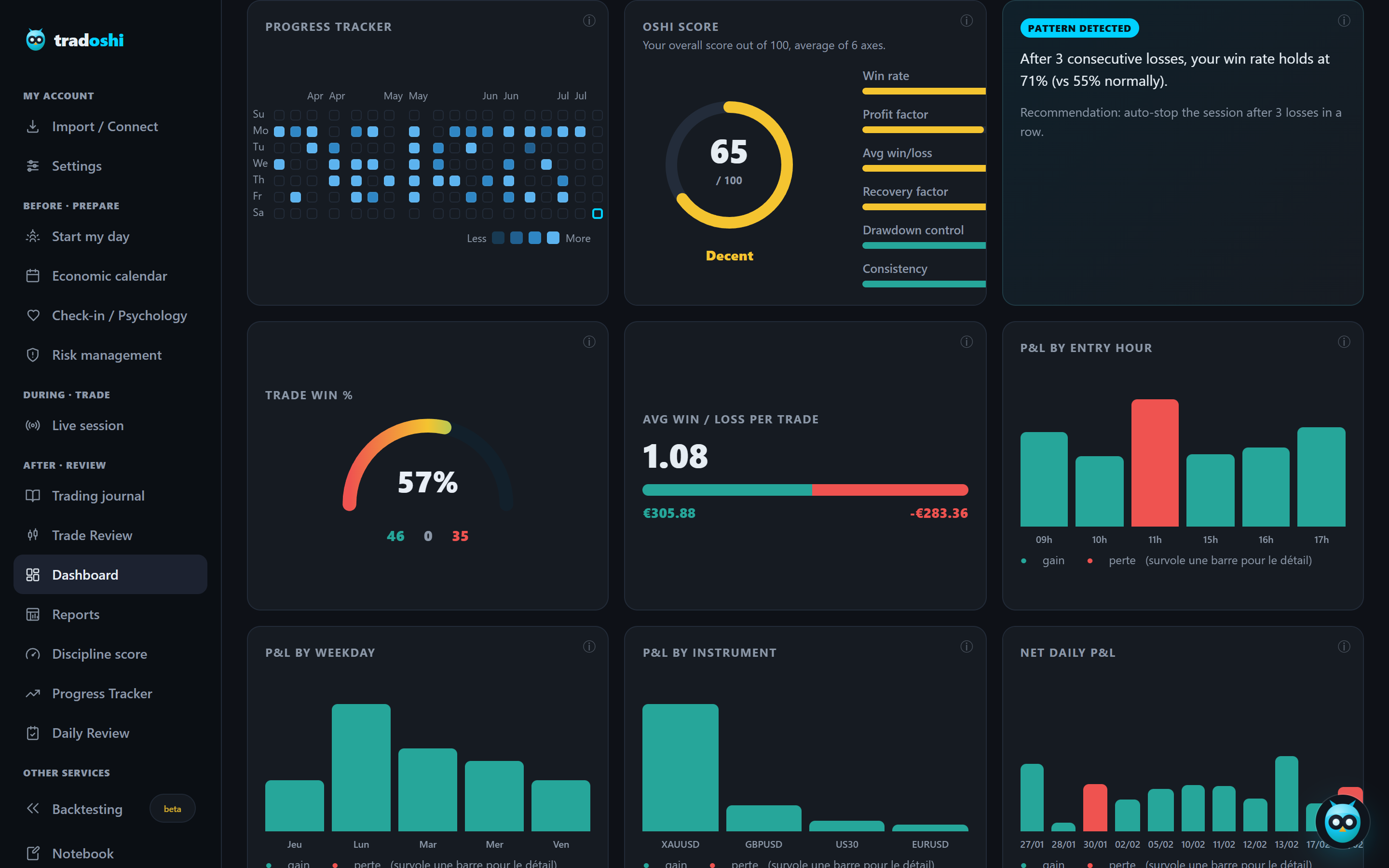
Tradoshi tackles the real difficulty of trading, psychology and discipline, by making them measurable. Where your brain deceives you, the numbers bring you back to reality.
- Large-sample statistics to judge your process, not the result of an isolated trade.
- Discipline score that measures your rule adherence, where your instincts push you to break them.
- Emotion crossed with performance to see when your human wiring makes you lose.
- Configurable rules that impose the right behaviors from the outside, without relying on your willpower.
Frequently asked questions
Why is trading so difficult?
Because the real obstacle isn't technical but human. Trading is simple to understand but hard to execute: it goes against your instincts (your brain is made to survive, not trade), its feedback is misleading (a good decision can lose by chance), and it forces you to act in permanent uncertainty, which humans hate.
Is trading technically hard?
No, that's exactly the trap. The basic concepts (cut your losses, let your gains run, manage your risk) are learned in a few hours. The difficulty isn't understanding the rules, but applying them under pressure, when your money is at stake and your instincts push you in the opposite direction.
Why do my instincts make me lose in trading?
Because your brain was shaped for survival, not trading. Loss aversion, for example, makes you more sensitive to losses than gains: you cut your winners too early and keep your losers too long, the opposite of what you should do. Trading constantly demands acting against what your body screams at you to do.
Why can a good trading decision lose?
Because of the randomness that rules in the short term. An excellent decision can end in a loss and a stupid one in a gain. Immediate feedback is therefore polluted: it reinforces bad behaviors when they pay off by luck and destroys confidence in good ones when they fail by bad luck. You must judge on process and large samples, not the immediate result.
How do I make trading easier?
By accepting that the difficulty is psychological and building a system to compensate for your human flaws: written rules that impose the right behaviors, judgment on process rather than the result of one trade, and an objective measure of your discipline. Traders who last didn't conquer their nature, they organized against it.
Why does social media make trading harder?
Because it mostly exposes curated wins (nobody posts their losses), which distorts your sense of what's normal and pushes you to take more risk to catch up to an unrealistic pace of progress. This social comparison amplifies uncertainty and pushes you to copy poorly-understood behaviors. Protecting yourself from it is part of trading's psychological management.
Does physical stress affect my trading decisions?
Yes, directly. Stress tied to uncertainty triggers cortisol and adrenaline, exactly as it would facing a physical danger, and degrades your judgment in favor of instinctive reactions. Insufficient sleep or accumulated fatigue lower your stress tolerance threshold and make you more vulnerable to impulsive mistakes, regardless of your technical skill.