We talk a lot about discipline in losses, rarely in gains. That's a mistake, because profit is a psychological poison just as dangerous as loss. After a nice streak, euphoria pushes you to load up, neglect your rules, give back in one session what took you weeks to build. Staying disciplined when you win is one of the most underrated tests in trading.
- Profit distorts judgment as much as loss, but more insidiously.
- Euphoria pushes you to over-risk: you feel invincible right before giving it all back.
- Your rules don't change when you win: same risk, same limits, same plan.
- Consistency beats grand gestures: protecting your gains beats doubling them out of ego.
Everyone intuitively understands that losing distorts the mind. But winning does too, and it's far more treacherous, because nobody is wary of success. After three, four, five winning trades in a row, a feeling of invincibility sets in. You start thinking you've 'figured out' the market, that you can afford to risk more, skip checks, take that borderline trade 'since you're on form'. That's exactly where the account turns around.
Profit is a slow poison. It doesn't hurt, on the contrary it flatters, and that's what makes it dangerous. This guide explains why a good streak degrades your judgment, what behaviors euphoria triggers, and how to keep exactly the same discipline in gains as in losses, because that's the only way to keep what you've won. It is precisely in those stretches that tracking your discipline on your real trades stops you giving back in one session what took a month to build.
Why profit distorts judgment
A streak of gains produces a surge of confidence and excitement in the brain that alters risk perception. Under that euphoria, you overestimate your skills and underestimate the danger. You attribute your recent gains to your talent (when some always comes from favorable variance) and conclude you can afford more. It's the exact mirror of what happens after a loss, but in the other direction.
The trap is that this degradation of judgment is pleasant. Nobody thinks 'careful, I'm winning, I'm in danger'. You savor it, congratulate yourself, drop your guard. Success lulls vigilance precisely when it should be reinforced, because after a good streak comes, statistically, sooner or later, a return to the mean.
The behaviors euphoria triggers
Overconfidence doesn't show as a single error, but as a series of small relaxations that, together, destroy your edge. Here are the most common:
| Euphoric behavior | Consequence |
|---|---|
| Increasing size 'since it's working' | One loss erases several gains |
| Skipping checklist checks | Off-plan, lower-quality trades |
| Taking borderline setups | Win rate and ratio drop |
| Trading more often (overtrading) | More fees and errors |
| Ignoring the stop threshold | A bad session becomes uncontrolled |
Each of these behaviors seems harmless in the moment, justified by good form. But their common thread is relaxing precisely the safeguards that let you win. You attribute your success to your boldness when it comes from your discipline, and you abandon that discipline at just the wrong time.
Your rules don't change when you win
The survival principle is simple and non-negotiable: your rules are identical in gains and losses. Same risk percentage per trade, same entry criteria, same stop threshold, same plan. The market doesn't know you're on a good streak, it owes you nothing, and the next loss will be as real as if it came after a losing streak.
The market doesn't reward your confidence, it rewards your consistency. Winning entitles you to nothing more than losing.
Concretely, that means resisting the temptation to increase your size because 'you're hot', to skip a check because 'you feel it', to take a borderline trade because 'you can afford it'. Those permissions you grant yourself in winning periods are exactly the ones that will make you give back your gains. Discipline in profit means treating every trade as if it were the first of the day.
Consistency beats grand gestures
The trader's ego loves grand gestures: the big day, the trade that triples the account, the story to tell. But lasting success in trading isn't built on grand gestures, it's built on consistency. A trader who wins modestly but steadily, without ever giving back their gains in a burst of euphoria, ends up far ahead of one who alternates big gains and big givebacks.
Protecting your gains almost always beats trying to double them out of ego. After a good streak, the best decision isn't to load up to turn a great week into a legendary one, it's to continue exactly as before, preserving what you've built. Compound growth rewards consistency, not heroic bets.
How to keep a cool head in gains
- Treat each trade independently: your winning streak has no influence on the next trade.
- Never adjust your position size upward under the sting of a good streak.
- Keep doing your emotional check: euphoria is a state to watch as much as frustration.
- Keep your stop threshold active even when you win: a good day can turn around fast.
- Measure your discipline in your winning phases, not just in the hard ones.
House money: the accounting trap
There's a precise psychological bias that strikes after a good streak: treating your recent gains as 'house money' you can afford to play with, as opposed to your 'real' capital. This mental accounting is a dangerous illusion: once a gain is realized, it's yours, exactly like the rest of your capital, and losing it hurts just as much. Yet the euphoric trader unconsciously thinks 'it's only what I just won' and takes risks they'd never take on their starting capital.
This bias explains why so many traders give back precisely their fastest gains. They don't protect what they just won because they don't yet feel it as truly theirs. The counter is both accounting and mental: as soon as a gain is realized, treat it as an integral part of your capital, subject to exactly the same risk rules. There's no house money, there's only your money, and it deserves the same protection whether it comes from yesterday's gain or a deposit from a year ago.
Regression to the mean after a peak
Statistically, an exceptional streak is almost always followed by a return toward average performance. It isn't bad luck, it's the nature of random sequences: extremes don't last. The problem is that the trader interprets their exceptional streak as the new norm ('I've moved up a level') instead of a temporary favorable deviation, and calibrates their behavior on this non-repeatable peak.
Understanding regression to the mean vaccinates you against overconfidence. When you string together a remarkable streak, the healthy reading isn't 'I've become better' but 'I'm benefiting from favorable variance that will normalize'. That clarity keeps you cautious at the top, precisely when euphoria would make you load up. The trader who understands that their peaks and troughs are both temporary keeps a stable size and discipline, and escapes the trap of taking their biggest risks right before the average reasserts itself. This doesn't mean dismissing genuine improvement, some of a streak really does come from better execution, but it means you can only tell the two apart with enough trades and enough time, never in the middle of the streak itself.
Celebrating without losing focus
Staying disciplined in profit doesn't mean never enjoying your gains: the question is knowing how to celebrate without letting the celebration contaminate your trading. The danger isn't the satisfaction itself, it's letting it turn into a feeling of invincibility that relaxes your vigilance on the following trades. A good practice is to clearly separate the celebration moment from the trading moment: rejoice after the session, not during, when you still have decisions to make.
It's also useful to celebrate good behavior rather than the result alone. Congratulating yourself on perfectly respecting your plan is far healthier than congratulating yourself on the amount won, because it reinforces discipline rather than the lure of gain. A trader who learns to draw satisfaction from the quality of their execution, not the size of their gains, builds a lasting motivation that never pushes them to betray their rules for the thrill of a big gain. The real reward is consistency, not the grand gesture.
The mistake of changing style mid-streak
A good streak often pushes a trader to change their style without realizing it, not just to increase their size. After several wins on their usual setup, the temptation to widen the field is strong: trying a new instrument they don't know well, testing a setup they've never backtested, or improvising trades outside their plan because 'the intuition is good right now'. This drift is insidious because it happens gradually, one small deviation at a time, never all at once.
The implicit reasoning is always the same: since it's working, my decisions must be good, so I can widen my playing field. It's a classic confusion between correlation and skill: the recent streak may well come from favorable variance on your usual edge, saying nothing about your ability to perform on new ground. Widening your style in full euphoria means testing an unproven skill with money earned from a proven one.
The simple rule to avoid this trap is to strictly separate experimenting with new setups or instruments from your periods of high confidence. Test novelties at small size, in a neutral state, never right after a winning streak that makes you feel infallible.
A worked example: the euphoria spiral that erases a month of gains
To visualize the mechanics, imagine a trader who ends a month with 3,000 in gains on a 20,000 capital, systematically risking 1% per trade. Riding that success, they decide on a whim to double their risk to 2% for the following month, convinced their method is now proven. The first three days confirm their feeling: they win again, capital reaches 24,500.
Then comes a tougher market stretch, statistically unremarkable but amplified by the doubled risk: four consecutive losses at 2% risk erase nearly 8% of capital in three sessions, versus 4% had they kept their original risk. Frustrated by that fast drop, they try to win it back by taking two off-plan trades at an even bigger size, lose again, and end the month below their starting balance, despite having begun with a comfortable month's head start.
This example, built to illustrate the mechanism rather than report a specific case, shows how far euphoria can turn an excellent month into a negative one in just a few sessions. The capital lost in the spiral far exceeds the extra gain hoped for by doubling the risk, which illustrates why discipline in profit protects more than it costs.
After a big win, the pause matters too
We often recommend taking a break after a big loss to regain composure, but forget that a break after a big win can be just as useful. A striking gain generates a rush of adrenaline and satisfaction that, like anger after a loss, can cloud your judgment on the following trades. Immediately chaining into other positions in that excited state amounts to trading under the influence, with the same distorted risk-taking as a trader tilted by frustration.
A short break after an exceptional gain, a few minutes or the rest of the session depending on the trade's size, lets that excitement settle before resuming composed decisions. It isn't wasted time: it's protection for the capital you just won. The trader who applies the same break rule after their biggest wins and their biggest losses treats emotion for what it is, a risk factor to manage, regardless of whether it looks positive or negative on the surface.
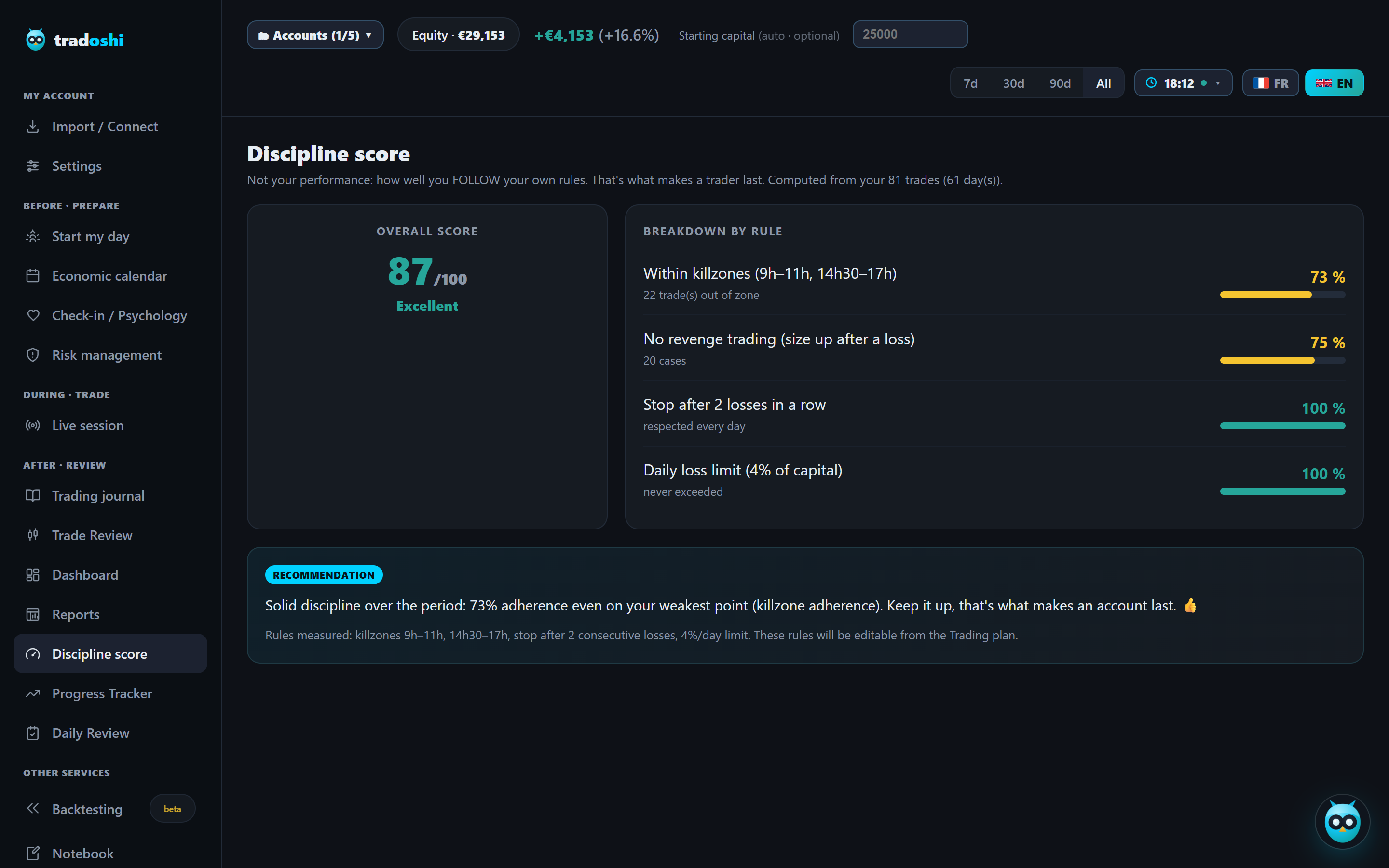
How Tradoshi watches your discipline in profit
Tradoshi doesn't measure your discipline only when things go badly: it tracks it continuously, including in your good streaks, where relaxation is most discreet. It spots the over-risk and breaches that set in when euphoria takes over.
- Continuous discipline: your score is computed every day, in gains as in losses.
- Over-risk detected: size increases after a good streak stand out immediately.
- Emotional check-in: it also detects the euphoric state, not just stress.
- Emotion crossed with performance: you see whether your overconfident days cost you money.
Frequently asked questions
Why does discipline matter when I'm winning?
Because profit distorts judgment as much as loss, but more insidiously: nobody is wary of success. After a good streak, euphoria pushes you to over-risk, neglect your rules and take borderline trades, exactly the behaviors that will make you give back your gains. Staying disciplined in gains is a test as crucial as in losses.
Why do I give back my gains after a good streak?
Because a streak of gains produces a surge of confidence that alters your risk perception: you overestimate your skills, attribute your gains to talent rather than a share of favorable variance, and relax the safeguards that made you win. You abandon your discipline just when a return to the mean becomes likely.
Should I increase my size when I'm on form?
No, it's one of the most costly traps. The market doesn't know you're on a good streak and owes you nothing. Increasing your size because 'it's working' means one loss will erase several gains. Your rules must stay identical in gains and losses: same risk, same limits, same plan.
What is overconfidence in trading?
It's the state where a streak of gains makes you believe you've 'figured out' the market and can afford more. It shows as relaxations: increased size, skipped checks, borderline setups, overtrading, ignored stop threshold. Each seems harmless, but together they destroy the edge that made you win.
How do I keep a cool head when I win?
Treat each trade independently of your streak, never adjust your size upward under euphoria, keep doing your emotional check (euphoria is a state to watch), keep your stop threshold active, and measure your discipline in your winning phases. The key is to treat every trade as if it were the first of the day.
Is it better to protect gains or grow them?
Protecting your gains almost always beats trying to double them out of ego. Lasting success is built on consistency, not grand gestures. A trader who wins modestly but steadily ends up far ahead of one who alternates big gains and big givebacks. Compound growth rewards consistency, not heroic bets.
Why shouldn't I try new setups during a good streak?
Because the recent streak may come from favorable variance on your usual edge, saying nothing about your ability to perform on new ground. Widening your style in full euphoria means testing an unproven skill with money earned from a proven one. Test novelties at small size, in a neutral state, never right after a winning streak.
Should I take a break after a very big win?
Yes, just like after a big loss. A striking gain generates a rush of adrenaline that can cloud your judgment on the following trades, exactly like frustration after a loss. A short break, a few minutes or the rest of the session, lets that excitement settle before resuming composed decisions and protects the capital you just won.