A big loss doesn't just hurt your account, it hurts your confidence, and it's often this second injury that does the most damage. What happens in the days following a major loss determines your future as a trader far more than the loss itself. This guide explains how to take a big loss without it triggering a spiral, how to rebuild your confidence, and how to turn the event into progress.
- The real danger of a big loss is behavioral, not financial: the spiral that follows.
- The first 24 hours are decisive: not trading to win it back is the golden rule.
- Rebuilding goes through size: cut hard to regain calm before the amount.
- An analyzed loss becomes a lesson; a buried loss becomes a trauma.
Every trading career includes big losses. They're inevitable, even for the best. What sets apart traders who last isn't avoiding big losses, it's how they react when they happen. The same loss can be the start of a collapse for one, and a mere accident quickly digested for another.
The problem is that the human brain reacts very badly to a large loss: it seeks to erase the pain, fast, which pushes toward exactly the behaviors that make everything worse. This guide gives you a concrete protocol to get through a big loss without letting it destroy either your account or your confidence.
The real cost of a big loss
When we talk about a big loss, we first think of the amount. But the amount is often the least of the damage. The real cost is what it does to your head: the doubt that settles in, the confidence that collapses, and above all the irrepressible urge to recover the money immediately. It's this second, psychological damage that triggers the truly ruinous behaviors.
Most traders aren't destroyed by the big loss itself, but by what they do in the hours and days that follow. The initial loss is an event; the spiral that follows is a process, and it's the process that drains accounts. Understanding this distinction is the first step to getting through a big loss without it carrying you away, and it's often the single most useful mental shift a trader can make after a rough day.
The first 24 hours
The most important rule after a big loss fits in one sentence: don't trade to win it back. In the hours that follow, your brain is under the sway of emotion, your judgment is degraded, and any trading decision made in that state has a strong chance of being bad. The best action is to close the platform and step away.
A big loss isn't repaired in the hour that follows. It's repaired in the weeks that follow, through a disciplined return, not a revenge trade.
Stopping isn't weakness, it's the strongest and most profitable decision you can make at that moment. The market will still be open tomorrow, when your calm has returned. Nothing you'd do in the emotional state following a big loss is worth the risk of turning a bad day into a catastrophe. The first step of rebuilding is to break nothing more, and that alone is often harder than it sounds when every part of you wants to act.
Accept instead of bury
Many traders handle a big loss by trying to forget it as fast as possible, to turn the page without looking at it. That's a mistake: a buried loss doesn't disappear, it turns into a diffuse fear that contaminates your next trades. You start hesitating, cutting your winners too early, avoiding good trades, without understanding why.
The only healthy way to digest a big loss is to accept it fully, to face it. Accepting isn't self-flagellation, it's recognizing that loss is part of the job, that it happened, and that it's now behind you. This lucid acceptance frees you from the emotional burden far more effectively than avoidance, which only postpones the problem, often at a much higher cost than facing it early would have been.
Analyze without judging yourself
Once calm has returned, the big loss becomes a valuable learning opportunity, provided you analyze it coldly. Was it a normal loss, within the limits of your system, or the result of a discipline error? The distinction is crucial, because the two call for opposite responses and are easily confused in the heat of emotion.
If the loss came from a trade perfectly within the rules that simply went wrong, there's nothing to correct: it's the normal cost of trading, and wanting to change your method would be a mistake. If it came from a breach of your rules, too big a risk or an impulsive trade, then the lesson is clear and valuable. Analyzing without judging yourself means separating bad luck from error, to correct only what needs correcting.
Rebuild through size
Rebuilding after a big loss doesn't go through a big winning trade, but through a series of controlled small trades. The most powerful tool for this is size reduction. By strongly cutting your risk per trade during your rebuilding phase, you remove the pressure and focus on clean execution rather than on the amount to recover.
This reduction has a double effect. First, it protects your capital during the period when you're most psychologically fragile. Second, and above all, it lets you accumulate well-executed trades without crushing emotional stakes, which gradually rebuilds your confidence on real foundations. You raise your size again only when your calm and discipline have returned, not before. Confidence precedes the amount, never the other way around, and trying to skip this order is exactly how a first big loss turns into a second one.
Regain confidence through the numbers
After a big loss, your feelings lie to you: a single memorable loss weighs in your memory far more than weeks of decent trading. It's a classic cognitive bias, and it makes you overestimate the severity of the situation. The best antidote is to confront your real numbers rather than your feelings.
Looking at your equity curve over several months puts the big loss back in its true place: often, an accident in a broadly healthy trajectory. Seeing that your underlying statistics, your expectancy, your profit factor, remain solid despite the event is the most effective cure for doubt. Numbers don't dramatize, they contextualize, and that's exactly what you need when emotion amplifies everything, especially in the first days when every instinct pushes you toward the opposite conclusion.
The mistakes that make a big loss worse
The most destructive mistake is already covered: wanting to win it back immediately. But there are other equally common traps. Announcing the loss in the heat of the moment on social media or in a trader group, while still emotional, often pushes toward dramatizing the event or, conversely, minimizing it to save face, which prevents an honest analysis. It's better to let a few days pass before talking about it publicly, giving the emotion time to settle and the account of it time to become faithful to the facts.
A second common mistake is questioning your entire system after a single memorable event, switching strategy, market or method overnight. An isolated big loss says almost nothing about the quality of a system tested over hundreds of trades; using it as a pretext to throw everything out confuses a statistical accident with proof. A third mistake is stopping trading altogether out of fear, which prevents exactly the gradual rebuilding of confidence a trader needs after a shock.
Two traders, two reactions to the same loss
Take an illustrative example. Two traders suffer the same 8% loss on their account on the same day, under the same market conditions. The first closes their platform, notes the event in their journal without analyzing it in the heat of the moment, and comes back the next day with size cut in half. Within a month, they've returned to normal size, with confidence rebuilt trade by trade, and their account has largely exceeded its pre-loss level.
The second trader, in the same situation, tries to win it back within the hour, loses another 4%, then spends the following week hesitating on every trade, cutting winners too early out of fear of another disaster. Two months later, their account is still below its pre-loss level, not because of that initial loss, but because of the cascade of bad decisions it triggered. The starting loss was identical; it's the reaction that changed everything.
A big loss on a prop firm account
On a funded or evaluation account, a big loss takes on an extra dimension, because it potentially moves you closer to the firm's limits (daily loss, maximum drawdown). The urge for revenge is even more dangerous there, because it can not only worsen the financial loss but also end the account itself. On this type of account, the first 24 hours after a big loss deserve doubled vigilance.
If the loss crossed a limit and ended the account, rebuilding takes a different shape: it means coldly analyzing what led to the failure before attempting another evaluation, rather than immediately restarting a new challenge in the same emotional state. Jumping back into a new evaluation too fast, without having digested the previous failure, exposes you to the same pattern that caused the first elimination.
Time, an underrated ingredient of rebuilding
Rebuilding after a big loss rarely follows a straight line, and you should be wary of the urge to rush the process. Time plays an active role: it lets the event's emotional intensity fade naturally, which makes analysis clearer and subsequent decisions more level-headed. Wanting to 'turn the page' within a few days, before that time has done its work, often amounts to burying the loss rather than truly accepting it.
This delay doesn't need to be long: a few days to a few weeks is generally enough, provided you use them to analyze, cut size and observe your own emotional evolution rather than to ruminate endlessly. Rebuilding is measured less in days than in well-executed trades accumulated after the event, a counter that moves at its own pace and is best not forced.
When the big loss hides a deeper problem
You must distinguish the accidental big loss from the symptom big loss. If you regularly suffer big losses, it's no longer bad luck: it's the sign of a structural problem in your risk management. A trader whose risk per trade is well calibrated should almost never suffer a loss capable of threatening their account.
In that case, the real work isn't psychological but methodological. A recurring big loss often betrays too high a risk per trade, an absence of a stop, or a size that swells under emotion. The solution is to overhaul your risk management deeply, so that a single bad decision can never again endanger your account. The best way to recover from a big loss is to make big losses structurally impossible, rather than getting better and better at recovering from ones that keep happening.
How Tradoshi helps you bounce back
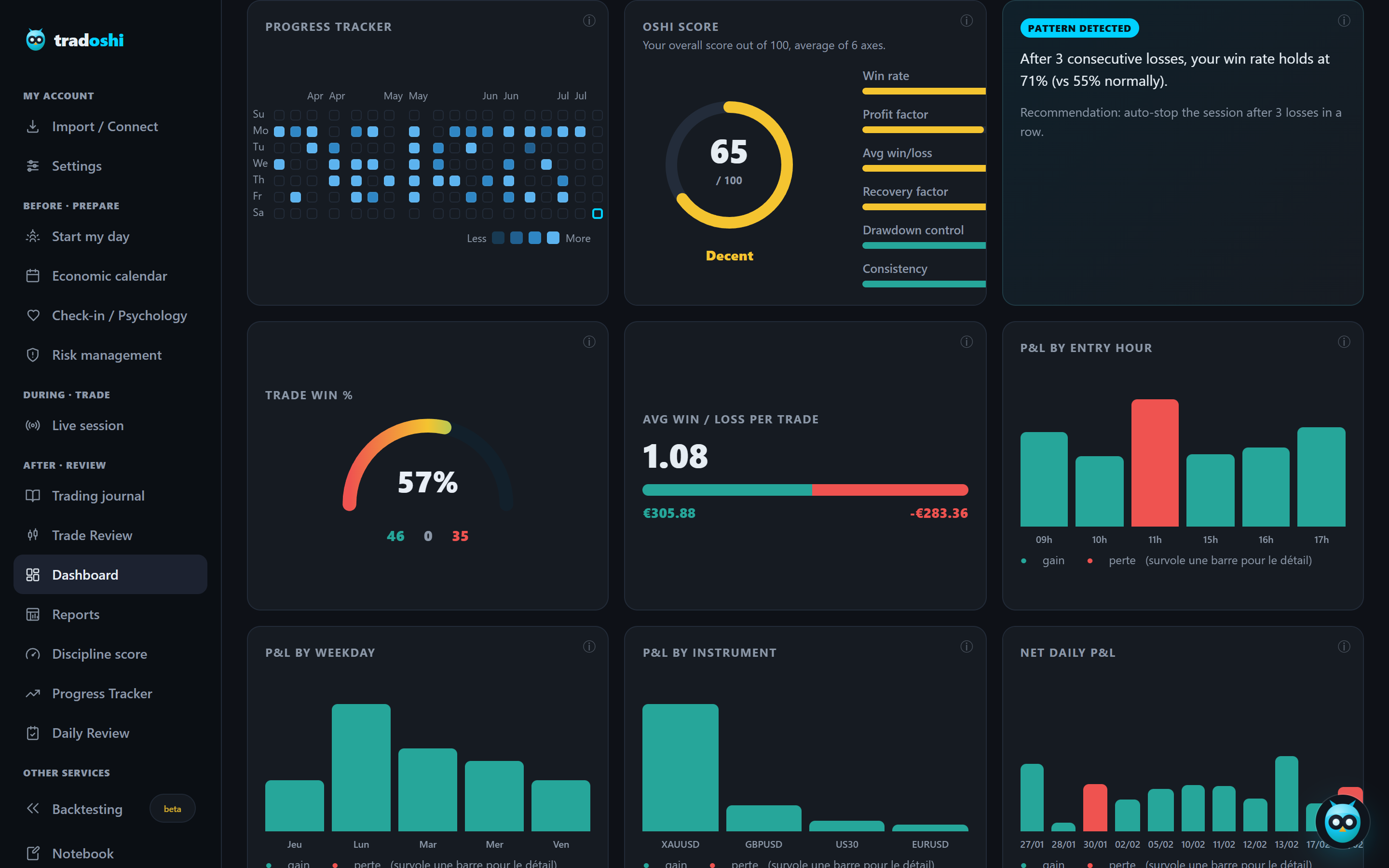
Tradoshi helps you get through a big loss by putting it back in context and securing your return. You see the event within your overall trajectory, you analyze whether it comes from an error or bad luck, and the risk module helps you restart on a measured size.
- Equity curve and underlying statistics to put the loss back in its true place.
- Per-trade analysis to distinguish a normal loss from a discipline error.
- Dynamic risk that cuts your size after a loss, to rebuild without pressure.
- Emotional check-in to avoid re-trading until your state has returned.
Frequently asked questions
How do I recover from a big loss in trading?
First, don't trade to win it back: in the first 24 hours your judgment is degraded, cut the platform. Then accept the loss instead of burying it, coldly analyze whether it came from an error or bad luck, then rebuild with a strongly reduced size to regain calm before the amount. Confidence precedes the return to normal size.
Should I try to recover a big loss right away?
No, it's the most dangerous trap. Wanting to win it back immediately pushes you to take more risk when your judgment is most degraded, which turns a bad day into a catastrophe. A big loss is repaired in the following weeks through a disciplined return, not in the hour through a revenge trade.
How do I regain confidence after a big loss?
By rebuilding through size (strongly cut your risk to accumulate well-executed trades without pressure) and by confronting your real numbers. Your feelings exaggerate the severity; your equity curve over several months and your underlying statistics put the loss back in its place and prove your edge still holds.
Is a big loss always a mistake?
No. A loss perfectly within the rules that goes wrong is the normal cost of trading, nothing to correct. A loss due to a rule breach, too big a risk or an impulsive trade is a mistake to correct. Analyzing without judging yourself means separating bad luck from error to change only what needs changing.
What if I often suffer big losses?
It's no longer bad luck but a deeper problem in your risk management. A well-calibrated risk per trade should almost never produce a loss capable of threatening your account. The real work is methodological: cut your risk per trade, place systematic stops, prevent your size from swelling under emotion.
Should I talk about my big loss on social media or in a trader group?
Not right away. Talking about it in the heat of the moment often pushes toward dramatizing or minimizing to save face, which prevents an honest analysis. Let a few days pass so the emotion settles and your account of it becomes faithful to the facts before discussing it publicly.
How long does it take to recover from a big loss?
There's no fixed timeline, but a few days to a few weeks is generally enough if that time is used to analyze, cut size and observe your emotional evolution rather than to ruminate. Rebuilding is measured mainly in well-executed trades accumulated after the event, not in days on a calendar.