Your trading performance is the result of your habits, good and bad, repeated day after day. But you can only improve what you track. Tracking your trading habits means measuring not your results, but your behaviors: do you respect your rules, prepare your sessions, cut your losses? This guide explains why tracking your habits changes everything, which habits to track, and how to do it concretely.
- Your results are the consequence of your habits, not luck: track habits, not just P&L.
- You only improve what you measure: an untracked habit stays invisible and uncontrollable.
- Tracking the habit motivates better than tracking the result, because the habit is under your control.
- Consistency is built through a streak of respected days, visible and rewarding.
Most traders track only one thing: their P&L. It's understandable, but insufficient, because the P&L is a result, largely influenced by short-term randomness, and over which you have no direct grip. Focusing on it means judging what you don't control, which leads to euphoria and discouragement depending on results.
What you control are your behaviors: your preparation, your rule adherence, your risk management, your discipline. It's your habits that, repeated, produce your results. Tracking these habits rather than the P&L alone shifts your attention to what's truly under your control, and it's the most powerful lever of progress. What your P&L really measures is worth knowing before you decide to look past it. This guide shows you how.
Habits produce results
The first principle to internalize is that your results aren't the fruit of chance, but the consequence of your repeated habits. A good habit, like cutting your losses fast, produces over hundreds of trades a positive result; a bad one, like overtrading after a loss, produces a negative one. The P&L is just the long-term sum of your behaviors.
This perspective changes how you work. Instead of chasing the result, you work on its causes: your habits. It's more effective, because the causes are under your control while the immediate result isn't. A trader who improves their habits mechanically improves their results over time, even if they can't control the outcome of a given trade. Tracking habits means acting at the root rather than on the symptoms, which is slower to feel at first but far more durable over months of trading.
You only improve what you measure
A habit that isn't tracked stays invisible, and what's invisible is uncontrollable. You can have the firm intention of respecting your killzones or not overtrading, but without measurement, you have no objective feedback on your actual success. You live in impression, and impression is misleading: most traders greatly overestimate their own discipline, sometimes by a wide margin they only discover once they start measuring.
Ask a trader if they respect their rules, they'll say yes. Measure it, and the number is almost always lower than they thought. That's the first value of tracking: the truth.
Measuring a habit makes it visible, and therefore steerable. Tracking your rule-adherence rate over time gives you objective feedback that replaces impression with fact. You see precisely where you crack, how often, and whether you're improving. This visibility is the starting point of all improvement: as long as a habit stays in the shadows, it escapes your control; as soon as it's measured, you can act on it.
Which habits to track
Not all habits are equal, and it's better to track a few that count than to track too many. The most useful revolve around discipline and risk: respecting your trading hours, the absence of revenge trading, respecting your daily loss limit, stopping after a losing streak, having a stop on every trade.
| Habit to track | What it measures |
|---|---|
| Respecting hours | Trading in your zones, not out of boredom |
| No revenge trade | Not increasing size after a loss |
| Daily loss limit | Stopping before the blow-up |
| Stop on every trade | Risk defined in advance |
| Session preparation | Approaching the market with a plan |
These habits have one thing in common: they're under your direct control and they protect your capital. They aren't results, but behaviors you can decide to apply each day. By tracking them, you build a dashboard of your discipline that tells you, independent of your gains and losses, whether you trade well. It's this behavioral information, invisible in the P&L alone, that drives your progress.
Tracking the habit motivates better
Tracking your habits has a major psychological advantage over tracking the P&L alone: it gives you a sense of control and progress even in tough periods. A day can be losing due to chance, but if you respected all your rules, it's a good trading day. Tracking the habit lets you recognize this behavioral success, invisible in a red P&L.
This dissociation between the quality of your discipline and the day's result is liberating. It protects you from discouragement in well-executed losing streaks, and from overconfidence in poorly-executed winning streaks. By rewarding you for your good behaviors rather than your good results, habit tracking reinforces exactly what, repeated, will end up producing good results. It's a virtuous circle that tracking P&L alone never creates, and one that keeps paying off long after the motivation of a single good or bad day has faded.
Building a streak
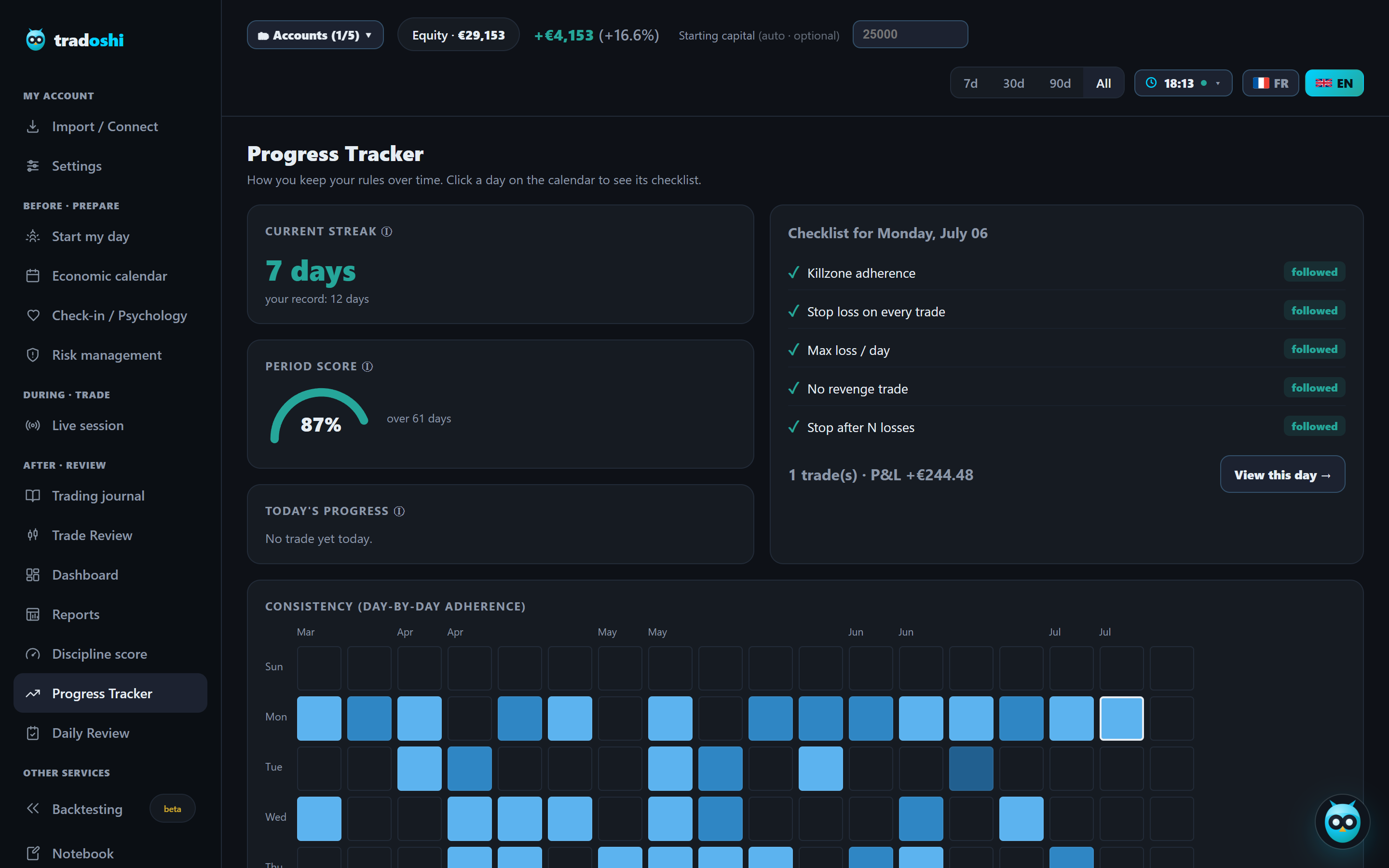
One of the most powerful engines of habit tracking is the streak: the number of consecutive days you've respected your rules. Watching this streak grow becomes a source of motivation in itself, and the will not to break it helps you hold your good habits even on tough days. It's a simple but formidably effective mechanism, used by all habit-tracking apps.
The streak turns discipline, which is abstract and without immediate reward, into a concrete, rewarding goal. Each respected day lengthens the streak, each slip resets it, which creates a clear daily stake. It's no longer 'I must be disciplined in general', but 'I don't want to break my twelve-day streak'. This shift from a vague principle to a tangible goal is what makes habit tracking so powerful for durably installing good behaviors.
Mistakes to avoid when tracking habits
The first mistake is wanting to track everything at once. Jumping into tracking fifteen habits from day one scatters your attention and makes the dashboard unreadable; it's better to track three or four truly priority habits, stabilize them, then progressively add more. An overly ambitious tracking setup from the start is one of the main reasons traders give up on habit tracking after a few weeks.
A second mistake is tracking vanity metrics, habits that are easy to respect but have no real impact on performance, rather than the truly structural habits like risk adherence or the absence of revenge trading. A third, subtler mistake is self-deception: self-reporting a habit as respected when it was only half-followed, which empties the tracking of its value. That's exactly why tracking based on your real trades, rather than on your own declaration, is far more reliable.
A concrete example: tracking a single habit for a month
Take an illustrative example. A trader decides to track a single habit for a month: never increasing size after a loss. At the start of the month, they respect this rule 60% of the time, a figure that surprises them, since they thought they respected it almost always. By documenting every slip, they notice a clear pattern: the breaches happen almost exclusively late in the session, as fatigue builds up.
Armed with this observation, they adjust their routine to shorten their sessions, specifically to avoid the time window where they crack the most. By the end of the month, their adherence rate for this habit has climbed to 90%, and their net result over the period far exceeds the previous month's. It wasn't willpower that produced this change, it was tracking that revealed a pattern invisible to the naked eye, enabling a targeted, effective correction.
Trading habits and life habits
Trading habits don't live in a vacuum, they're deeply tied to your broader life habits. A trader who sleeps poorly, skips meals or gets no physical exercise will statistically struggle more to hold their trading rules, because discipline draws from the same reserve of self-control as the rest of the day. Neglecting your life outside trading always ends up showing in your trading statistics.
Tracking a few basic life habits, like a regular bedtime or a pause before the market open, alongside your trading habits, often delivers results disproportionate to the effort. It's no coincidence that the most consistent traders generally also have the most stable life routines: trading discipline is often just the reflection, in one specific area, of a broader discipline already installed elsewhere.
When breaking your streak isn't a big deal
The streak of respected days is a formidable motivation engine, but it carries a risk: all-or-nothing thinking. Some traders, after breaking a long streak, abandon tracking altogether, discouraged, as if a single slip erased all the accumulated progress. This reaction is disproportionate and counterproductive, turning a simple hiccup into total abandonment.
The right way to see a broken streak is as one data point among others, not as a failure that wipes out everything else. A trader who maintains an 85% adherence rate over the year, with a few broken streaks along the way, progresses far better than a trader obsessed with a perfect streak who abandons tracking at the first crack. Getting back up immediately after a broken streak, without making a drama of it, is itself a habit worth cultivating, just as important as the ones you're tracking.
From tracking to improvement
Tracking your habits is only the first step; the goal is to improve them. Once you precisely see your adherence rate for each rule, you can target the weakest and work on it first, rather than scattering your efforts. Tracking gives you a clear map of your behavioral strengths and weaknesses, which guides your work efficiently.
This loop, measure, target the weak point, work on it, re-measure, is the engine of continuous improvement. It turns the vague resolution to be more disciplined into a concrete, verifiable action plan. Over several months, by systematically attacking your worst habit then the next, you build solid discipline, brick by brick, each laid on an objective measure rather than a good intention.
Trading habits on a prop firm account
On a prop firm account, habit tracking takes on particular importance, because the firm's rules (daily loss, maximum drawdown) turn every discipline slip into a direct risk for the account's survival. A trader tracking their rule adherence on a personal account can afford a few slips without immediate consequence; on a funded account, the same slip can cost the entire account.
That's why the highest-priority habits to track under a prop firm are precisely the ones that protect against the firm's limits: respecting the daily loss, stopping after a losing streak, not increasing size under emotion. Tracking these habits with the same rigor as the firm's own rules, rather than treating them as secondary, is what separates traders who pass an evaluation from those who fail for avoidable reasons.
How Tradoshi tracks your habits
Tradoshi automatically tracks your trading habits from your real trades, without you having to check anything. The discipline score and progress tracking measure your adherence to each of your rules and your consistency over time.
- Discipline score that measures adherence to each rule (hours, revenge, limit, stops) on your real trades.
- Progress tracking with your streak of respected days and your record, habit-tracker style.
- Adherence rate per rule to target your weak point and work on it first.
- Measured effect of each habit on your performance, to prove discipline pays.
Frequently asked questions
Why track habits rather than P&L?
Because the P&L is a result, largely influenced by short-term randomness and out of your direct control, whereas your habits (preparation, rule adherence, risk management) are under your control and produce your results. Tracking habits shifts your attention to what you truly control, which motivates better and drives faster progress.
Which trading habits should I track?
A few that count, around discipline and risk: respecting your trading hours, the absence of revenge trading, respecting your daily loss limit, stopping after a losing streak, and having a stop on every trade. All are under your direct control and protect your capital.
How do I know if I really respect my rules?
By measuring them, not trusting your impression. Most traders greatly overestimate their own discipline: ask them if they respect their rules, they'll say yes; measure it, and the number is almost always lower. Tracking your adherence rate over time replaces the misleading impression with an objective fact.
What's the point of a streak of respected days?
To turn discipline, abstract and without immediate reward, into a concrete, rewarding goal. Each day you respect your rules lengthens your streak, each slip resets it. The will not to break a twelve-day streak helps you hold your good habits even on tough days, far better than a vague resolution.
How do I improve my trading habits?
By following a loop: measure your adherence rate for each rule, target the weakest, work on it first, then re-measure. Tracking gives you a clear map of your behavioral strengths and weaknesses. By systematically attacking your worst habit then the next, you build solid discipline, brick by brick, on objective measures.
How many trading habits should I track at once?
Few at first, three or four truly priority ones rather than fifteen scattered habits. An overly ambitious tracking setup from the start is one of the main reasons traders give up after a few weeks. Stabilize a few key habits, then progressively add more once they're well anchored.
What should I do when I break a long streak of respected days?
Get back up immediately, without making a drama of it. A broken streak is just one data point among others, not a failure that wipes out all your accumulated progress. A trader who maintains a high adherence rate over the year, with a few broken streaks, progresses far better than one obsessed with perfection who abandons tracking at the first crack.