Psychology decides a trader's success more than their strategy, and yet it's the least-worked-on part. A handful of books, written by traders and researchers, have profoundly shaped how we understand the trader's mind. This guide presents the reference works on trading psychology, what each brings you, and for which profile, without jargon and without flattery.
- Trading psychology has its classics, written by recognized traders and psychologists.
- Each book covers an angle: mental discipline, cognitive biases, self-management, method.
- Reading isn't enough: these books only have value if you apply and measure.
- The best for you depends on your current difficulty, not the absolute ranking.
The literature on trading is immense, but a small handful of books stand out on psychology, the most decisive and least understood part. These works won't give you a strategy, they'll give you something rarer: an understanding of why you sabotage your own decisions, and how to remedy it.
This guide isn't a list of covers, it's a commented selection, honest about what each book really brings and to whom it speaks. The goal is to help you choose the one matching your current difficulty, because the best book is the one that answers the problem you're facing now.
Why read on psychology rather than strategy
Most beginner traders devour strategy and technique books, seeking the right system. It's an allocation mistake, because the system is almost never the limiting factor. What blocks the vast majority of traders isn't their method, it's their inability to apply it consistently, and that's precisely what psychology books address.
Investing in understanding your own psychology has a far higher return, because it's the real bottleneck. A trader who understands why they move their stops, why they overtrade after a loss, why they cut their winners, holds the keys to their progress. The best trading psychology books are therefore, paradoxically, the most profitable books a trader can read.
Trading in the Zone, by Mark Douglas
It's probably the most cited book on trading psychology, and for good reason. Mark Douglas develops a central idea: trading is a game of probabilities, and the source of most mistakes is the refusal to accept uncertainty. He shows how the need to be right and the fear of being wrong sabotage decisions, and how thinking in probabilities frees the trader.
Its major contribution is dissociating the quality of a decision from its result, and getting the trader to accept they can be right about the process while losing on a given trade. It's a foundational book, sometimes repetitive, but whose central ideas have become the bedrock of modern trading psychology. Read it if your difficulty is accepting loss and uncertainty.
Brett Steenbarger's work
Brett Steenbarger is a psychologist who has coached many professional traders. His approach is pragmatic and performance-oriented: he treats the trader as a high-level athlete, with routines, preparation, energy and emotion management. His works are full of concrete exercises to improve consistency and discipline.
What sets his work apart is the refusal of magic recipes in favor of methodical work on oneself. He insists on the importance of regular review, knowledge of one's own patterns, and continuous adjustment. It's the ideal approach if you're seeking not a theory, but a method for working on your mind and habits, applied day after day.
Van Tharp and the place of money management
Van Tharp popularized an essential idea: psychology and money management matter far more than the entry system. He shows, notably through the concepts of expectancy and position sizing, that two traders with the same system obtain radically different results depending on their risk management and psychology.
His contribution is connecting psychology to concrete measures: thinking in R, computing your expectancy, sizing your positions to a goal. It's a valuable bridge between the mental and the numbers, avoiding falling into a purely introspective psychology. Read it if you want to understand why position size and risk management are, in practice, as much a psychological question as a mathematical one.
Thinking Fast and Slow, by Daniel Kahneman
It's not a trading book, but it may be the most important one for a trader to read. Daniel Kahneman, Nobel laureate in economics, lays out decades of research on how the human mind makes decisions, and on the systematic cognitive biases that lead us astray. Loss aversion, overconfidence, confirmation bias are dissected in depth.
For a trader, it's a revelation: most of the mistakes they think are personal are in fact universal, predictable biases. Understanding these mechanisms means being able to anticipate and protect against them. The book is demanding, but it's the scientific foundation of everything trading psychology books later popularize. Read it to understand, at the source, why your brain deceives you.
The Disciplined Trader, the book that came before Trading in the Zone
Before Trading in the Zone, Mark Douglas had already laid the groundwork for his thinking in The Disciplined Trader, published a decade earlier. The book starts from a blunt observation: the market never hurts anyone directly, it's our own beliefs and expectations that hurt us by refusing what the market is showing us. Douglas explores in depth why the human mind, built to seek certainty, is structurally ill-equipped for an environment as uncertain as the market.
This first book is denser and more demanding than its successor, but it digs deeper into the underlying psychological mechanisms rather than focusing on their practical application. It's the natural companion to Trading in the Zone for anyone who wants to understand not just what to do, but why their mind resists doing it so much. Best saved for a second pass, once Douglas's core ideas have already been digested.
Reminiscences of a Stock Operator, wisdom through story
This book, published in 1923 by Edwin Lefèvre, tells the fictionalized life of a speculator inspired by Jesse Livermore. It's neither a manual nor an academic psychology treatise, but a story, and it's precisely this narrative form that makes it a unique learning tool. Through the character's ups and downs, you see the same psychological mistakes repeat, century after century: overconfidence after a streak of gains, refusal to accept a loss, inability to let a winner run.
What strikes you while reading is how the traps described a century ago are exactly the ones a trader faces today, despite completely different markets. It's powerful evidence, almost more convincing than a theoretical book, that trading psychology is timeless: technology changes, human nature facing risk and uncertainty doesn't. Read it the way you'd read a novel, for the experience as much as for the lesson.
Choosing your book based on your current difficulty
| Your current difficulty | Book to prioritize |
|---|---|
| Accepting loss and uncertainty | Trading in the Zone, Mark Douglas |
| Understanding the mechanisms behind your resistance | The Disciplined Trader, Mark Douglas |
| Building a method for working on yourself | Brett Steenbarger's books |
| Connecting psychology and risk management | Van Tharp |
| Understanding your cognitive biases at the root | Thinking Fast and Slow, Kahneman |
| Recognizing yourself in timeless mistakes | Reminiscences of a Stock Operator, Lefèvre |
This table isn't a mandatory reading order, it's a compass. Rather than starting with the most famous or most recommended book, honestly identify your main difficulty right now, and pick the book that addresses it directly. A trader with no issue accepting uncertainty doesn't need to go back to Trading in the Zone; they'll gain more from exploring Kahneman or Steenbarger, depending on whether their problem is cognitive or behavioral.
Two more reads that round out the list
The Mental Game of Trading, by Jared Tendler, brings a dimension the older classics touch on less: precisely diagnosing your own error patterns, with structured exercises to map and correct them one by one. Tendler, a former sports psychologist turned trading coach, applies methods borrowed from elite athletic performance to trading, which makes it an excellent practical companion to Douglas's more conceptual ideas.
Market Wizards, by Jack Schwager, takes a different form: a series of interviews with exceptional traders of radically different profiles and styles. Its value isn't in a single thesis but in the repetition of a pattern across dozens of testimonials: whatever the market, style or era, traders who last share rigorous risk management and a healthy relationship with being wrong. Seeing this pattern confirmed interview after interview carries a persuasive power that theory alone can't provide.
A concrete example of application
Take one precise principle: Kahneman's loss aversion, the idea that the pain of losing is felt roughly twice as intensely as the pleasure of winning an equivalent amount. A trader who reads this idea without checking it stays in the abstract. A trader who opens their journal and compares the average duration of their winning trades to their losing ones turns the idea into a personal diagnosis.
Imagine this trader discovers their winners last an average of twelve minutes, against forty-five minutes for their losers. The reading then becomes obvious: they cut their gains out of fear of watching them shrink, and let their losses linger out of refusal to accept failure, exactly the mechanism Kahneman describes. This personal diagnosis, drawn from their own numbers, carries far more persuasive power than the same idea read in a book, however well written.
The trap of reading as escape
There's a flip side to this reading list: piling up books can become a sophisticated form of procrastination. Reading about discipline is more comfortable than facing your own trade log, and some traders build an impressive library without ever changing a single real behavior. Reading then becomes a substitute for action rather than preparation for it.
The warning sign is simple: if you've read more than three trading psychology books this year and your statistics haven't moved, the problem is no longer a lack of knowledge, it's a lack of application. In that case, the right decision isn't to buy a fourth book, but to close the books for a month and put into practice, measurably, a single idea you've already read.
Keep an applied reading card
The best way not to lose the thread between a book and your practice is to keep a short card per book: three lines maximum on the central idea, one precise principle to test, and where to check it in your journal. This card doesn't need to be long, it needs to be actionable, and to stay in view rather than buried in a forgotten notebook.
Rereading this card before each weekly review creates a natural bridge between your reading and your continuous improvement. Without this bridge, a finished book joins a shelf and leaves your mind within a few weeks; with it, the central idea keeps coming back to confront your real trades, until it becomes a reflex rather than a reading memory.
How to read these books so they help
The reading trap is the illusion of progress: you read, you nod, you feel stronger, and nothing changes in your trades. These books only have value if you turn their reading into action. The right method is to take only one or two principles per book, those touching your current difficulty, and apply them concretely to your practice.
A trading psychology book read and forgotten is worth nothing. The same book, whose single principle you apply and measure, can change your equity curve.
Above all, these principles must be verified on your own data. Douglas tells you to think in probabilities: measure your expectancy to live it concretely. Kahneman explains loss aversion: check your journal to see if you cut your winners too early. Van Tharp talks about position sizing: verify your real risk per trade. It's this back-and-forth between reading and your numbers that turns an idea into a skill.
How Tradoshi extends these readings
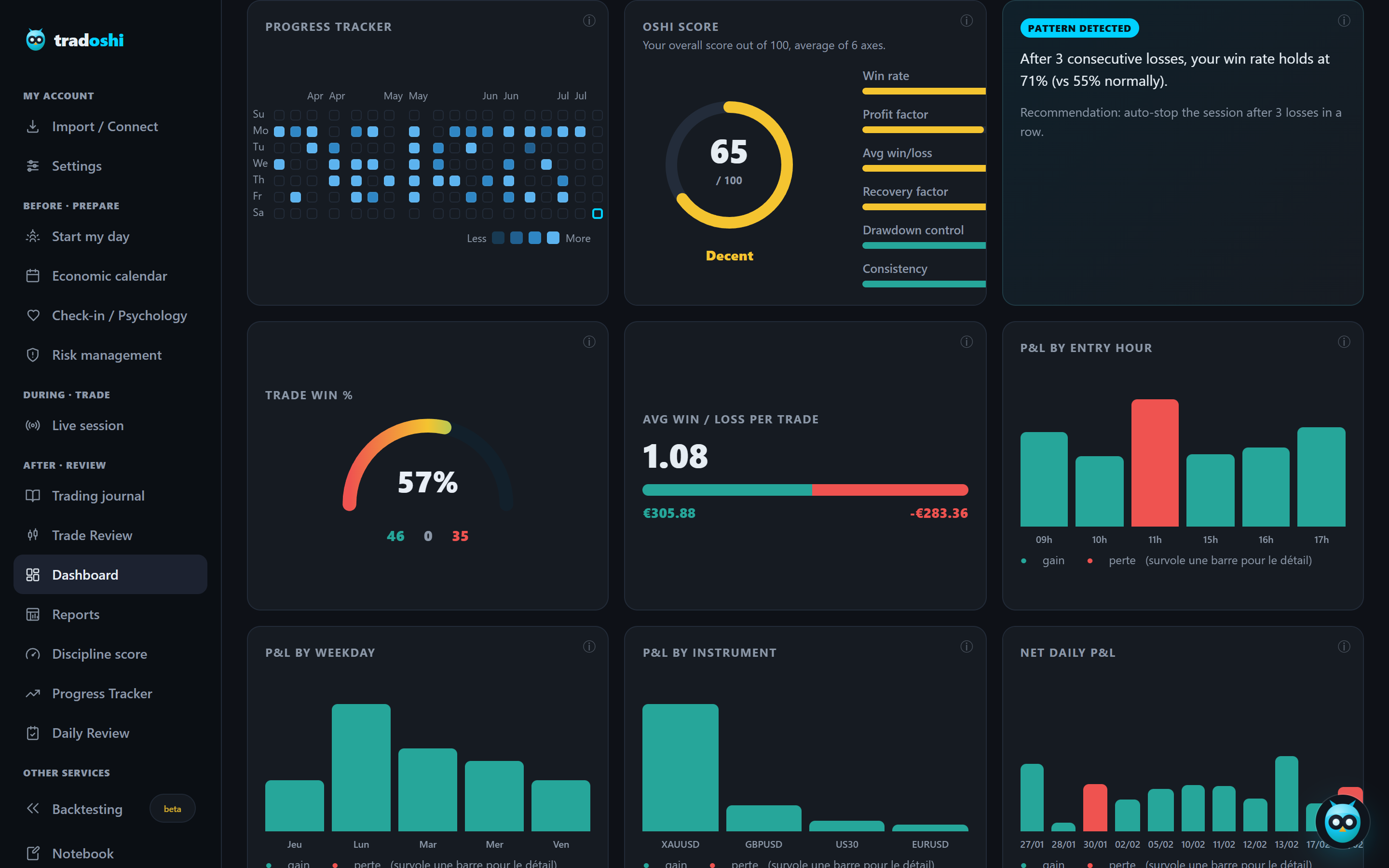
Tradoshi turns the principles of these books into measurable data on your real trades. Where the books explain biases and discipline, Tradoshi shows you where they appear in you and what they cost you.
- Expectancy and probabilistic thinking (Douglas, Van Tharp) computed automatically on your trades.
- Discipline score to apply Steenbarger's methodical approach on your real data.
- Bias detection (revenge trading, rushed exits) that makes Kahneman's mechanisms concrete.
- Emotion crossed with performance to verify, with numbers, what you read about the mind.
Frequently asked questions
What is the best book on trading psychology?
Trading in the Zone by Mark Douglas is the most cited, for its central idea of thinking in probabilities and accepting uncertainty. But the best for you depends on your current difficulty: Steenbarger for a method of working on yourself, Van Tharp to connect psychology and money management, Kahneman to understand cognitive biases at the source.
Should I read on psychology or strategy?
On psychology first, because it's the real bottleneck. The system is almost never the limiting factor: what blocks most traders is their inability to apply their method consistently. Investing in understanding your own psychology has a far higher return than searching for a better strategy.
Can a non-trading book help a trader?
Yes. Thinking Fast and Slow by Daniel Kahneman isn't a trading book but perhaps the most important for a trader: it lays out the cognitive biases (loss aversion, overconfidence, confirmation bias) that are at the root of most trading mistakes. It's the scientific foundation of what trading books popularize.
How do I read a trading psychology book effectively?
By keeping only one or two principles per book, those touching your current difficulty, and applying them concretely to your practice. The trap is the illusion of progress: reading, nodding, and changing nothing. Verify each principle on your own data to turn it from an idea into a skill.
Is reading enough to improve my trading psychology?
No. A book read and forgotten is worth nothing. These works only have value if you turn their reading into measured action: apply a principle, then check your journal to see if it changes your numbers. It's this back-and-forth between theory and your real data that drives progress, not the mere accumulation of readings.
The Disciplined Trader or Trading in the Zone, which first?
Trading in the Zone, more accessible and application-oriented. The Disciplined Trader, published ten years earlier by the same author, digs deeper into the underlying psychological mechanisms and is more demanding. It's a good companion once Douglas's core ideas are already digested, not a starting point.
Is Reminiscences of a Stock Operator still worth reading today?
Yes. This 1923 fictionalized account, inspired by Jesse Livermore, shows psychological mistakes (overconfidence, refusal to accept loss, inability to let a winner run) identical to today's despite completely different markets. It's proof that trading psychology is timeless, worth reading as a novel as much as a lesson.
The Mental Game of Trading or Market Wizards, which should I pick?
They serve different needs. The Disciplined Trader and Trading in the Zone lay out the theory; The Mental Game of Trading by Jared Tendler gives concrete exercises to diagnose your own error patterns; Market Wizards by Jack Schwager, through interviews with exceptional traders, shows that rigorous risk management and a healthy relationship with error recur regardless of trading style.
How long does it take to read and digest these books?
Think months rather than weeks if you actually want to digest them. A trading psychology book reads in a few hours, but applying it, checking it against your journal, adjusting your behavior, takes dozens of trades. It's better to take one book at a time, pull one principle from it, put it to the test over several weeks, before moving to the next.