Options are financial instruments that grant the right, but never the obligation, to buy or sell an asset at a price fixed in advance, before a certain date. They have a reputation as a shortcut to fast gains, but the reality is harsher: options are among the most complex instruments to master, and most beginners who venture into them too early lose their stake within a few weeks. This guide explains the basics without unnecessary jargon, and why caution is essential before taking the risk.
- An option is a right, not an obligation: you pay a premium to reserve that right.
- Only two types: the call (right to buy) and the put (right to sell).
- Time works against the buyer: an option loses value every day that passes, even if the price doesn't move.
- Not a beginner instrument: the complexity and speed of possible losses far exceed those of a stock.
There's a reason options are so fascinating: with a modest starting stake, they promise multiplied gains. That's true in theory, and it's exactly what draws poorly prepared beginners toward an instrument whose mechanics and traps they don't understand. An option losing 100% of its value happens regularly, far more often than a stock falling to zero. Plain stock trading is a far gentler place to start.
This guide starts from the basics: what an option is, how its price is made up, why time works against the buyer, and what options are really used for, before frankly addressing why most beginner traders should stay away from them at first.
What an option is
An option is a contract that gives its buyer the right, but not the obligation, to buy or sell an underlying asset (a stock, an index, a commodity) at a predetermined price, called the strike price, before or on a given expiration date. In exchange for that right, the buyer pays an amount called the premium to the option's seller, who commits to honoring the transaction if the buyer decides to exercise their right.
This asymmetry between buyer and seller is the core of the mechanism: the buyer has a right, never an obligation, and their maximum risk is theoretically limited to the premium paid. The seller, on the other hand, has an obligation if assigned, and their risk can be far greater, potentially unlimited depending on the strategy used. This distinction between the buyer's and the seller's risk profile is the first thing to absorb before touching options.
Calls and puts: the two types of options
There are only two types of options, and everything else is just a combination of the two. A call gives the right to buy the underlying asset at the strike price: you buy a call when you think the price will rise, because you'll then be able to buy at a price fixed in advance, below the market price. A put gives the right to sell the underlying asset at the strike price: you buy a put when you think the price will fall, because you'll be able to sell at a price fixed in advance, above the market price.
Every option also has a seller on the other side of the buyer: selling a call means betting the price won't rise above the strike; selling a put means betting the price won't fall below it. An option is said to be 'in the money' when exercising it would be immediately profitable, and 'out of the money' otherwise. This basic vocabulary comes up constantly whenever options are discussed, and it's worth memorizing before going further.
Where an option's price comes from: the premium
An option's price, the premium, breaks down into two elements. Intrinsic value corresponds to what the option would be worth if exercised immediately: it only exists if the option is in the money, otherwise it's zero. Time value represents everything else: it reflects the probability that the option becomes, or stays, profitable before expiration, and depends notably on the time remaining and the anticipated volatility of the underlying asset.
Without going into the mathematical formulas used to precisely calculate these values, the essential idea to remember is this: the more time remains before expiration and the more volatile the asset, the higher the time value, and therefore the more expensive the premium. Conversely, as expiration approaches, time value melts away, a central phenomenon for understanding why options behave so differently from a plain stock.
| Price component | What it represents | How it evolves |
|---|---|---|
| Intrinsic value | Gain if exercised immediately | Follows the underlying's price |
| Time value | Probability of becoming profitable | Decreases as time passes |
| Implied volatility | Market's expectation of future moves | Increases time value when it rises |
Why time works against the buyer
This is probably the most misunderstood concept for beginners: an option loses value every day that passes, even if the underlying asset's price doesn't move at all. This phenomenon, called time decay, accelerates as expiration approaches. An option bought three months before its expiry loses its time value slowly at first, then faster and faster in its final weeks of life.
Concretely, this means an option buyer doesn't just need to be right about price direction, they also need to be right about timing. A trader who buys a call anticipating a rise may see the price climb as expected, but too slowly, and find that time decay has eaten more value than the rise created. It's this double requirement, direction and timing, that makes options structurally harder to play well than a plain stock.
Assignment risk
Selling an option (rather than buying one) exposes you to a particular risk called assignment risk: if the option's buyer decides to exercise it, the seller is obligated to honor the transaction, ready or not. Selling a call without holding the underlying asset, a strategy called a naked call, exposes you to having to buy the asset at market price to deliver it at the strike, with a theoretically unlimited loss risk if the price surges.
This assignment risk is one reason selling naked options is generally discouraged for beginners, and even simply forbidden by some brokers without a specific authorization level. Even more conservative selling strategies, where the sold option is covered by an existing position in the underlying asset, require a solid understanding of the mechanism before being used seriously.
Hedging vs speculation
Options weren't invented for pure speculation: their historical and most solid use is hedging, meaning protecting an existing portfolio against an adverse move. An investor holding a stock portfolio can buy puts to protect against a decline, somewhat like insurance: if the market drops, the put's value rises and offsets part of the loss on the stocks.
The other use, speculation, consists of using options to bet on a price direction with significant leverage, since a relatively small premium lets you control a much larger exposure than buying the asset directly. It's this speculative use that draws most beginners, lured by the promise of multiplied gains, without always grasping that leverage cuts both ways and that time decay works against them continuously.
An illustrative example
Imagine a trader who buys a call on a stock trading at 100, with a strike of 105 and expiration in thirty days, for a premium of 2. If the stock doesn't move at all for twenty days, then rises to 103 in the last ten days, the call can still lose value: the stock stays below the strike, so no intrinsic value appears, and the time value has collapsed as expiration approached. The trader was right about direction (the stock rose), but wrong about magnitude and timing, and the option expires worthless.
This illustrative example shows the fundamental difference with a plain stock purchase: on a stock, being right about direction is generally enough to generate a profit, even a modest one. On an option, being right about direction isn't enough: the move also needs to be large enough and fast enough to offset the erosion of time value. It's this extra requirement that explains why so many options expire worthless, even when their buyer's directional call turned out to be correct.
Why beginners should be wary
Options combine several sources of complexity rarely present together in other markets: a direction to predict, a timing to respect, a time decay that works against the buyer continuously, and for the seller, an assignment risk that can far exceed the premium collected. Each of these elements needs to be understood separately before they can be intelligently combined into a coherent strategy.
That's why most experienced traders recommend not starting with options. Learning first to master a simpler market, like stocks or forex, while building solid risk management discipline and a rigorous trading journal, gives you a much safer foundation before venturing into an instrument where a single bad timing estimate can lose 100% of the stake within a few days.
On a stock, being wrong usually costs you dearly. On a poorly understood option, being wrong can cost you everything, and fast.
How Tradoshi helps if you trade options
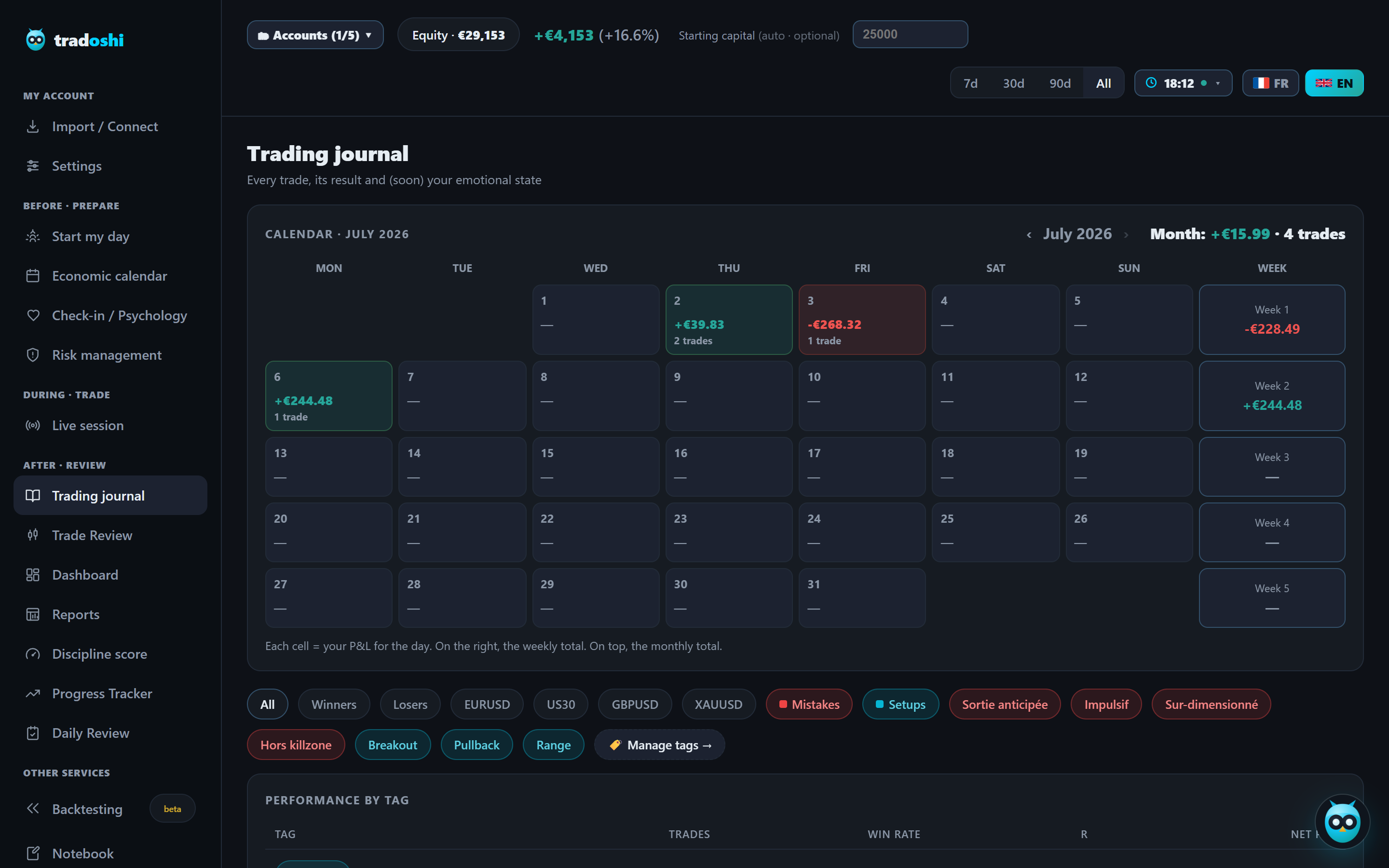
If you're already comfortable with other markets and exploring options, Tradoshi lets you journal these trades with the same rigor as your other positions, so you can see clearly whether this instrument is actually paying off or quietly eating into your capital.
- Unified trading journal that accepts your options trades alongside your other markets.
- Per-instrument statistics to honestly compare your performance on options versus everything else.
- R-multiple and expectancy computed automatically to judge your edge without relying on a feeling.
- Emotional check-in to spot whether the speed of options moves amplifies your stress or impulsivity.
Frequently asked questions
What is an option in trading?
An option is a contract that gives the right, but never the obligation, to buy (call) or sell (put) an asset at a price fixed in advance (the strike), before an expiration date, in exchange for paying a premium. The buyer has a right, the seller has an obligation if assigned.
What's the difference between a call and a put?
A call gives the right to buy the asset at the strike, and is bought when anticipating a rise. A put gives the right to sell the asset at the strike, and is bought when anticipating a fall. Every option has a seller on the other side, betting the opposite of the buyer.
Why does an option lose value even if the price doesn't move?
Because of time decay: part of an option's price, its time value, reflects the probability it becomes profitable before expiration. That value decreases every day that passes, and accelerates as expiration approaches, regardless of the underlying's movement.
What is assignment risk?
It's the risk, for an option seller, of being obligated to honor the transaction if the buyer exercises their right. Selling a call without holding the underlying asset exposes you to a potentially unlimited loss risk, which is why some options selling strategies are reserved for experienced traders.
Are options only used for speculation?
No. Their most solid historical use is hedging: protecting an existing portfolio against a decline, somewhat like insurance. Speculation, which uses the leverage of options to bet on a price direction, is another use, riskier and more demanding.
Why shouldn't beginners start with options?
Because options combine several difficulties at once: predicting a direction, respecting a precise timing, enduring continuous time decay, and for a seller, potentially significant assignment risk. These stacked requirements make options far more complex than a market like stocks or forex to start with.