Most beginners who blow up their account don't fail because they had a bad strategy. They fail because they had no method at all: no defined risk, no journal, no written plan, and a position size decided on instinct. A brilliant strategy on top of a bad method loses money just as surely as a bad strategy. Here are 10 concrete tips to lay the right foundations before your first real trade, and to avoid repeating the mistakes nearly every beginner makes.
- Method matters more than strategy in the early months: risk, journal and plan come first.
- Start small and stay small until you prove, with numbers, that you can execute your plan correctly.
- One market learned deeply beats five markets skimmed superficially.
- Comparing yourself to others' success is the surest way to sabotage your own progress.
Trading is deceptive in that it gives the illusion of being accessible: opening an account takes five minutes, placing an order takes ten seconds. That ease of access hides a far more demanding reality, one where most beginners lose their capital, not for lack of good trade ideas, but for lack of a method to execute them cleanly over time. The best traders aren't distinguished by miraculous entries, they're distinguished by discipline built one tip at a time, one habit at a time.
This pillar guide gathers 10 concrete tips, proven by the experience of thousands of traders who came before today's beginners, to lay the right foundations before your first real trade. Each one is developed in detail below, with the reasoning behind it and how to put it into practice starting now.
The 10 tips at a glance
Before detailing each tip, here's the full list, in the order that makes the most sense for a beginner starting from zero. Each point is developed in a dedicated section below, with concrete examples and the logic behind it.
- Start on demo or minimum size, never with capital you can't afford to lose.
- Define your risk per trade before even choosing your entry strategy.
- Keep a journal from your very first trade, not once you're 'serious'.
- Pick a single market or instrument and learn it deeply before diversifying.
- Write a complete trading plan before placing your first live order.
- Track and log your emotional state before, during and after each session.
- Accept that losses are the normal cost of the business, not proof of failure.
- Avoid revenge trading: a loss never calls for a vengeance trade.
- Do a weekly review, not just a trade-by-trade analysis.
- Never compare your month 1 to someone else's year 5 on social media.
This list can look obvious on paper, and that's exactly the trap: every tip is easy to understand intellectually, but hard to apply under the real pressure of the market. The rest of this guide explains why each one matters, and how to turn it into a habit rather than just an intention.
1. Start on demo or minimum size
The demo account exists for a specific reason: to let you validate your understanding of order mechanics, the platform and your strategy before real money enters the picture. Many beginners skip this step out of impatience, convinced they'll learn faster 'for real'. That's a costly bet: mechanical errors (wrong order, wrong size, wrong execution timing) cost money live and nothing on demo.
Once you move to live trading, size should stay minimal for an extended period, often much longer than impatience would want. The goal of this phase isn't to make money, it's to prove you can execute your plan with real money on the line, which changes the psychology deeply compared to demo. Increasing size before you have that proof means increasing risk before you have the skill to manage it.
2. Define your risk before your strategy
The order in which a beginner builds their approach to trading says a lot about their odds of survival. Most start by searching for the perfect strategy: which indicator, which setup, which candlestick pattern. That's the reverse of what protects an account. Risk per trade, expressed as a percentage of your capital, must be set before you even know which strategy you'll use, because it's what determines whether you can survive a normal losing streak.
A brilliant strategy with poorly calibrated risk per trade eventually blows up an account, while a mediocre strategy with well calibrated risk simply lets you lose slowly while you learn. Defining your risk before your strategy means accepting that risk management outranks the search for the 'best' entry, a hierarchy that most profitable traders share, regardless of their analysis method.
3. Keep a journal from trade one
The classic mistake is putting off the journal until 'later', once you're 'serious' or have a 'real system'. That's exactly backwards: the journal should start from your very first trade, precisely because those first weeks teach you the most about yourself, your biases and your recurring mistakes. Without data from the start, you lose track of your own progress curve.
A useful journal isn't limited to the trade's dollar result. It captures the context (why you entered), the execution (did you follow your plan), and your emotional state at the moment of the decision. That combination is what lets you spot, weeks later, patterns invisible trade by trade: for example that your heaviest losses almost always happen in the afternoon, or after an undigested previous loss.
4. Pick ONE market and learn it deeply
The temptation to follow everything, forex, indices, crypto, stocks, commodities, all at once, is strong for a curious beginner. Yet it's one of the surest ways to master nothing properly. Every market has its own dynamics, active hours, behavior around economic announcements. Jumping between markets prevents you from building the fine intuition about its behavior, the familiarity that distinguishes an experienced trader from a beginner recognizing generic patterns.
Choosing a single market doesn't mean locking yourself into it forever, it means building a solid base before diversifying, if you ever do. A trader who knows one instrument inside out, its active hours, typical volatility, reactions to announcements, has a real edge over a trader spreading attention across five markets without knowing any of them deeply.
5. Write a plan before trading live
A written trading plan forces a clarity that thinking alone doesn't produce. It should contain, at minimum: the markets you trade, your precise entry criteria, your risk per trade and per day, your exit rules (win and loss), and the conditions under which you stop trading for the day. Without this document, every decision gets made in the moment, under pressure, precisely the worst time to decide well.
The plan doesn't need to be perfect from the start, it needs to exist and be followed. An imperfect plan that's respected is worth infinitely more than a sophisticated one that gets abandoned at the first surprise. The point of a written plan isn't to predict the market, it's to give you a stable reference to compare your actual behavior against, to see where you deviate and why.
6. Track your emotional state
Trading is as much an emotional discipline as a technical one, and yet most beginners only track their financial results, never their inner state. Yet your state before a session, fatigue, outside stress, the urge to win back yesterday's loss, directly influences the quality of your decisions. Logging that state, even briefly, before each session, lets you spot over time the conditions under which you trade best and worst.
This practice isn't esoteric, it's measurement applied to a factor with a statistically observable impact on your results. A trader who discovers, journal in hand, that their worst losses systematically happen when trading tired or frustrated has concrete, actionable information: avoid trading under those conditions, rather than keep hoping 'this time will be different'.
7. Accept that losses are a cost of the business
No trader, not even the most experienced, wins on every trade. Losses aren't an anomaly to eliminate, they're a structural cost of the business, like rent for a shopkeeper. This shift in perspective is fundamental: as long as a beginner perceives every loss as a personal failure or proof they 'aren't cut out for this', they're reacting emotionally to a perfectly normal event, which opens the door to revenge trading and overreaction.
What separates a trader who lasts from one who quits isn't the absence of losses, it's the relationship they have with them. A loss taken within your plan, with risk calibrated ahead of time, isn't a failure, it's the normal execution of a strategy that wins on average, not systematically. Accepting this principle frees you from the pressure of 'never losing', a pressure that, paradoxically, increases losses rather than reducing them.
8. Avoid revenge trading
Revenge trading, the urge to re-enter immediately after a loss to 'win it back', is probably the most destructive behavior for a beginner. It turns a normal, isolated loss into a series of bigger losses, taken with judgment degraded by frustration. The trap is that revenge trading gives the illusion of taking action, when in reality it's an emotional reaction disguised as a trading decision.
The most reliable defense isn't to 'reason with yourself' in the moment, it's to define a simple rule cold: after a loss, take a pause before re-entering, or stop after a certain number of consecutive losses in the day. This rule, decided outside of emotion, protects you precisely when your willpower is weakest to respect it on its own.
9. Do a weekly review, not just a daily one
The daily review, useful for adjusting tomorrow's session, isn't enough to see trends that only reveal themselves at the scale of several days. A weekly review, usually done on the weekend, steps back over the whole set of your sessions: which setups worked well, which days your discipline cracked, which rules deserve adjusting. It's at this scale that patterns like 'I perform badly on Mondays' or 'my discipline erodes toward the end of the week' become visible.
Without this weekly step back, you stay stuck in the detail of each day without ever seeing the overall trajectory, which deprives you of adjustments the daily review alone can't produce. Scheduling this moment into your calendar, like a fixed appointment, guarantees it won't be sacrificed when the week gets busy.
10. Don't compare your month 1 to someone else's year 5
Social media constantly showcases other people's best results, never their worst months, never the years it took to get there. A beginner comparing their first, inevitably clumsy months to the screenshots of a trader with years of experience behind them sets an impossible standard, which feeds frustration and pushes them to take disproportionate risks to 'catch up' on a gap that never actually existed.
The only comparison that matters is between you and yourself, month after month: are you improving in execution, in discipline, in the consistency of your plan? It's this personal trajectory, measured by your own journal, that determines your long-term success, not an imagined ranking against strangers whose real path and real capital you never actually know.
How Tradoshi helps you start right
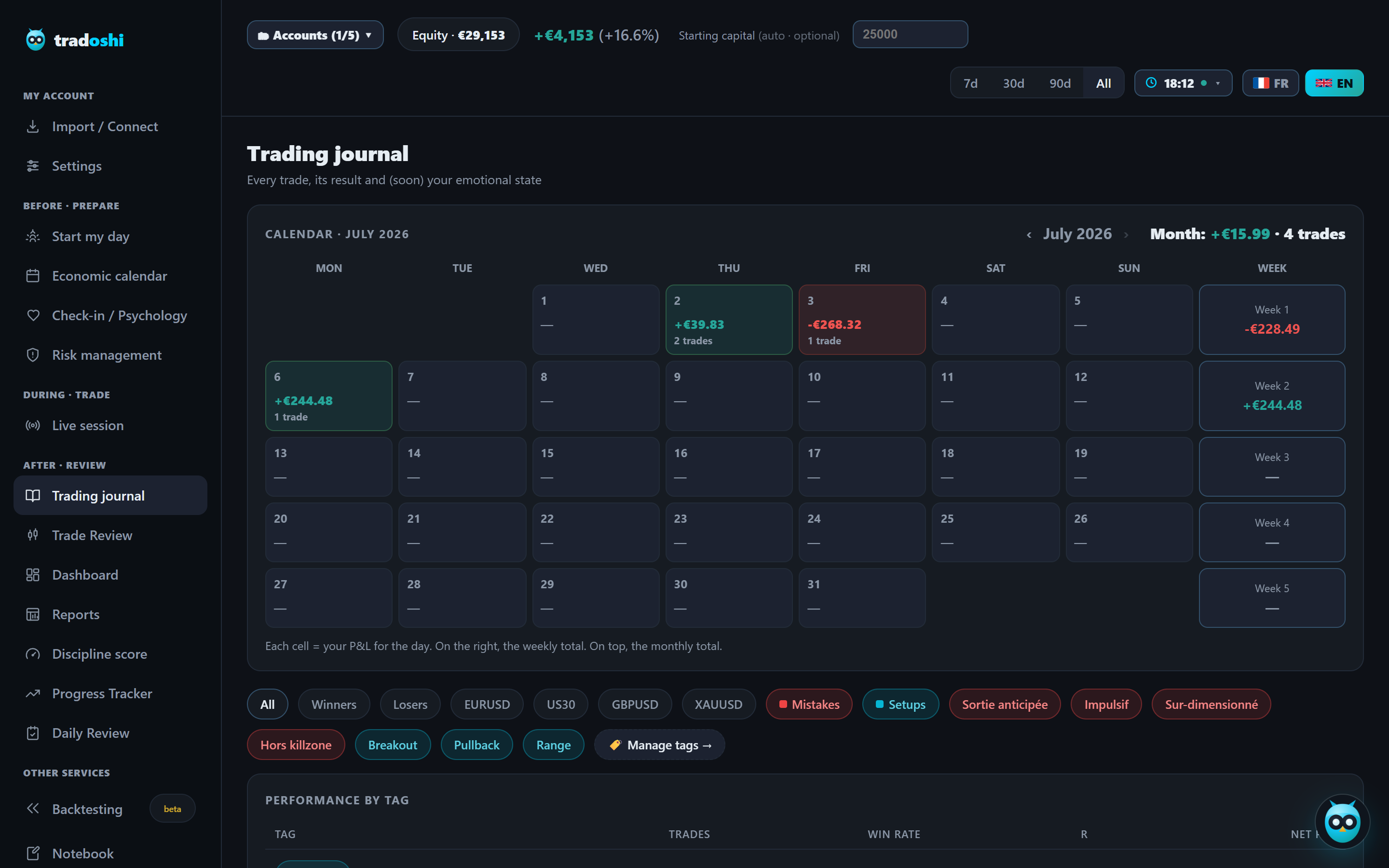
Tradoshi was built with these 10 tips in mind, precisely because most beginners don't apply them for lack of a tool to make them concrete. Rather than asking for abstract discipline, the app turns each tip into a usable feature from your very first trade, so the right method becomes the easiest path, not the most constraining one.
- Automatic journal from the first trade, synced with your broker or imported via CSV.
- Risk calculator that sets your position size before you even choose your setup.
- Emotional check-in before each session to track your state, not just your result.
- Built-in weekly review that steps back over the whole set of your sessions, not trade by trade.
Frequently asked questions
What should a beginner focus on first in trading?
Method, not strategy: open a demo account or trade minimum size, define your risk per trade before searching for the 'best' entry, and keep a journal from your very first trade. Most beginners lose their capital for lack of these foundations, not for lack of good trade ideas.
Do I really need to journal from the very start?
Yes, precisely because those first weeks teach you the most about yourself. Putting off the journal until 'later' makes you lose track of your own progress and prevents you from spotting the patterns that explain your recurring losses, like a specific time of day or emotional state.
How many markets should a beginner follow?
One, learned deeply, beats several skimmed superficially. Every market has its own dynamics, active hours, behavior around announcements. Diversifying too early prevents you from building the fine intuition that distinguishes an experienced trader from a beginner recognizing generic patterns.
How do I avoid revenge trading as a beginner?
By defining a simple rule cold, before you even trade: a mandatory pause after a loss, or a stop after a certain number of consecutive losses in the day. This rule, decided outside of emotion, protects you precisely at the moment your willpower is weakest to respect it on its own.
Why shouldn't I compare myself to other traders?
Because social media shows other people's best results, never their worst months or the years it took to get there. Comparing your month 1 to someone else's year 5 sets an impossible standard and pushes you to take disproportionate risks to catch up on a gap that never existed.
Isn't a daily review enough?
No, it's useful but not enough on its own. The weekly review reveals trends that only appear at the scale of several days, like discipline eroding toward the end of the week. Without that step back, you stay stuck in the detail of each day without ever seeing your overall trajectory.