Not all prop firms are equal, and choosing the wrong one can fail you before you even trade. Behind enticing capital promises hide tricky rules, vague payout conditions and sometimes business models that bet on your failure. Reading beyond the marketing is the first skill to have before paying for any challenge.
- The advertised capital matters less than the rules: read the drawdown, daily limit, conditions.
- Hidden rules cause failure: minimum days, no overnight holding, consistency targets.
- Check payout reliability, not just the advertised split.
- A good firm wants you to succeed; beware those that live off your failures.
The prop firm market has exploded, and with it aggressive marketing: '100,000 in capital', '90% of profits for you', 'paid in 24h'. These promises attract, but they say nothing about the essential: the rules you'll have to respect not to lose the account, and the firm's real reliability when it's time to be paid. Choosing on advertised capital alone is like choosing a contract without reading the clauses.
A prop firm is a business partner, and like any partner, it has its interests. Some make money by genuinely funding you and sharing your gains; others make money mainly by selling challenges that most candidates fail. This guide explains which criteria truly matter, which tricky rules to spot, and how to tell a partner firm from one betting on your failure.
Advertised capital isn't the real criterion
The candidate's first reflex is to compare prop firms on offered capital: 'this one offers 100,000, that one 200,000'. It's the wrong angle. Capital only has value if the rules genuinely let you trade it and draw gains from it. Large capital with a tiny drawdown and stifling rules is worth far less than modest capital with livable rules.
What truly counts is the profit target / loss margin pairing. A firm asking 10% gain while granting only 5% total drawdown puts you in a far tighter spot than one asking 8% with 10% margin. Always look at these numbers together: their ratio defines the real difficulty, not the capital amount displayed in big letters on the homepage.
The rules that truly matter
Before paying for a challenge, you must know by heart the rules that will decide your success or failure. Here are the essential criteria to compare:
| Criterion | Question to ask yourself |
|---|---|
| Profit target | What percentage, in how much time? |
| Total loss (drawdown) | Fixed or trailing? On balance or equity? |
| Daily loss | What amount, computed how? |
| Minimum days | How many trading days required? |
| Position holding | Can you hold overnight, over weekends? |
| Consistency rule | Is there a required steadiness target? |
Each of these rules can fail you regardless of your performance. Trailing drawdown, for instance, follows your high and tightens as you win, a classic trap. Minimum days stop you from finishing too fast. The consistency rule forbids a single big day from making up too large a share of your gains. Ignoring just one of these rules can invalidate a perfectly profitable account.
The tricky rules to spot
Some rules are designed, deliberately or not, to fail a large share of candidates. They aren't necessarily dishonest, but they're counterintuitive, and a trader who hasn't anticipated them gets trapped. Trailing drawdown on the equity high is the most fearsome: it rises with your floating gains, so a mere pullback after a good trade can knock you out.
A rule you discover after failing was written in black and white before you paid. Reading the rules isn't optional, it's the first step of the challenge.
Beware too of bans on holding positions overnight or over weekends (which exclude some strategies), overly strict consistency targets, and vague rules on 'trading behavior' that leave the firm room to refuse a payout. Rule clarity is itself a quality criterion: a serious firm writes its rules in black and white, with no gray zones.
Payout reliability, the decisive criterion
Everything else is useless if the firm doesn't pay you when you succeed. It's the most important and most neglected point. A 90% split is worthless if payouts are delayed, disputed, or subject to conditions that appear at the last moment. Before choosing, look for real proof of paid-out payouts: verifiable testimonials, the firm's history, its longevity in the market.
A young firm with spectacular promises and no payout history is a risky bet. An established firm, with years of existence and documented payouts, even with a slightly less generous split, is a far safer partner. The best split in the world on a firm that doesn't pay is worth exactly zero.
Partner firm or firm betting on your failure
There are two prop firm business models, and it helps to understand which you're facing. The first makes money by funding real traders and sharing their gains: this firm has an interest in your success. The second makes money mainly by selling challenges to candidates who fail en masse: this firm has an interest in you paying again and again. Tricky rules are often the sign of the second model.
You can't always know with certainty which model you're dealing with, but some signals help: clear, livable rules, documented payouts, honest communication about success rates lean toward the partner model. Opaque rules, changing conditions and marketing focused solely on capital and split lean toward the other. Choose knowingly.
Profit split and its schedule
Beyond the displayed split percentage, two details determine what you'll actually receive: the payout frequency and the conditions to qualify. A firm can display a generous split but only allow a first withdrawal after a long delay, a minimum number of trading days, or reaching a certain profit. Others require a consistency that forbids a single big day from making up too large a share of your gains. Read these conditions as carefully as the drawdown: they decide the timing and real amount of what you cash in.
The payout schedule also impacts your cash flow and motivation. A short withdrawal cycle lets you materialize your gains regularly, which is psychologically important when you trade for a living. A long cycle ties up your profits and exposes you longer to the risk of losing everything before you could withdraw. So compare firms not only on how much they share, but on when and under what conditions, because a nice distant percentage is worth less than a decent one accessible quickly.
One or several accounts with the same firm
Some firms allow one funded account per trader, others let you stack several, or even grow them in tiers as you succeed (scaling plan). This policy matters, because it determines your growth potential. A firm with a good scaling plan lets you increase your funded capital as your performance grows, turning a small starting account into a much larger allocation without repaying a challenge each time.
Conversely, a firm that caps capital or multiplies fees for each new account limits your potential or makes your growth more expensive. If your goal is to make funded trading a serious, lasting activity, the scaling and multi-account policy is a major criterion, often more important than the split. A good progression plan rewards you over time for your consistency, which is exactly the incentive of a partner firm aligned with your success.
The real cost of a challenge
A challenge's displayed price isn't its real cost. You must relate it to your probability of passing and the number of attempts you risk paying for. A cheap challenge with stifling rules that fail most candidates actually costs a lot, because you'll repay it several times. A slightly more expensive challenge but with livable rules and a good pass rate can be far more economical in the end.
Many firms offer a refund of the challenge price on the first withdrawal from the funded account: it's an interesting signal, because it aligns their interests with your success. Also look at the ancillary fees (monthly fees, reset fees, data fees) that sometimes inflate the real cost. The right calculation is never the displayed price alone, but the price related to your chance of passing and keeping the account, fees included. It's that calculation, not the label, that tells you how much a challenge will really cost you.
Simulated account or real account: what it changes
Most of the 'funded accounts' offered by prop firms don't actually route your orders to the market. In the vast majority of cases, you're trading a simulated account, with virtual money, and the firm pays you a share of what that simulated account would have earned had the money been real. That's not necessarily a problem, but it's a distinction every candidate should understand before paying, rather than believing they're directly steering firm funds on the market.
This setup has concrete consequences. First, the firm doesn't need to hedge every position you take, which explains why it can afford to offer large capital for a modest challenge price. Second, payout reliability depends entirely on the firm's financial health, since the money it pays you comes from its revenue (mainly the challenge fees of candidates who fail), not from real gains on the market. That's one more reason why a firm's solidity and longevity matter more than its marketing: you don't depend on a market, you depend on a company's cash flow.
A minority of firms do route at least part of client flow to a real broker or liquidity provider once an account is funded, which is worth asking about directly if it matters to you. Either way, this doesn't change what you should evaluate: the rules, the payout track record, and the terms in the contract you accept when you pay for the challenge. Read the fine print on dispute resolution too. Some firms reserve broad discretion to void a payout over vaguely defined 'abnormal trading behavior', which sounds reasonable until you realize it can also be used to avoid paying a trader who simply had a good run. A firm that defines its rules narrowly and specifically, rather than with catch-all clauses, is signaling that it doesn't need that discretion to stay profitable.
How to compare several firms before deciding
Faced with dozens of prop firms that look alike on the surface, a structured comparison method beats a gut-feel choice. Start by listing the essential rules (drawdown, daily limit, minimum days, consistency) for three or four firms you're interested in, in a simple table. This step alone often eliminates half the candidates, because their rules turn out incompatible with your trading style once written down in black and white.
Next, actively look for recent, detailed reviews, not just the testimonials showcased on the firm's own site. Trader forums, specialized groups and real feedback on payout speed and consistency are more reliable than a page of hand-picked testimonials. Finally, if budget allows, test the firm that seems most serious to you on its cheapest challenge before committing to a bigger account: this real-world trial, even a modest one, will teach you more about the firm's seriousness and support responsiveness than a month of reading reviews online.
Support responsiveness deserves its own line in your comparison, because it's the criterion candidates check last and regret not checking first. Send a specific, slightly technical question to each firm's support before you pay anything, about a rule that's genuinely unclear to you, and time how long a substantive answer takes. A firm that answers within hours, in plain language, with a specific answer rather than a copy-pasted link to generic terms, is signaling an operational seriousness that tends to correlate with how it handles disputes later, when real money is on the line and you need a real answer fast.
How Tradoshi helps with your prop firm
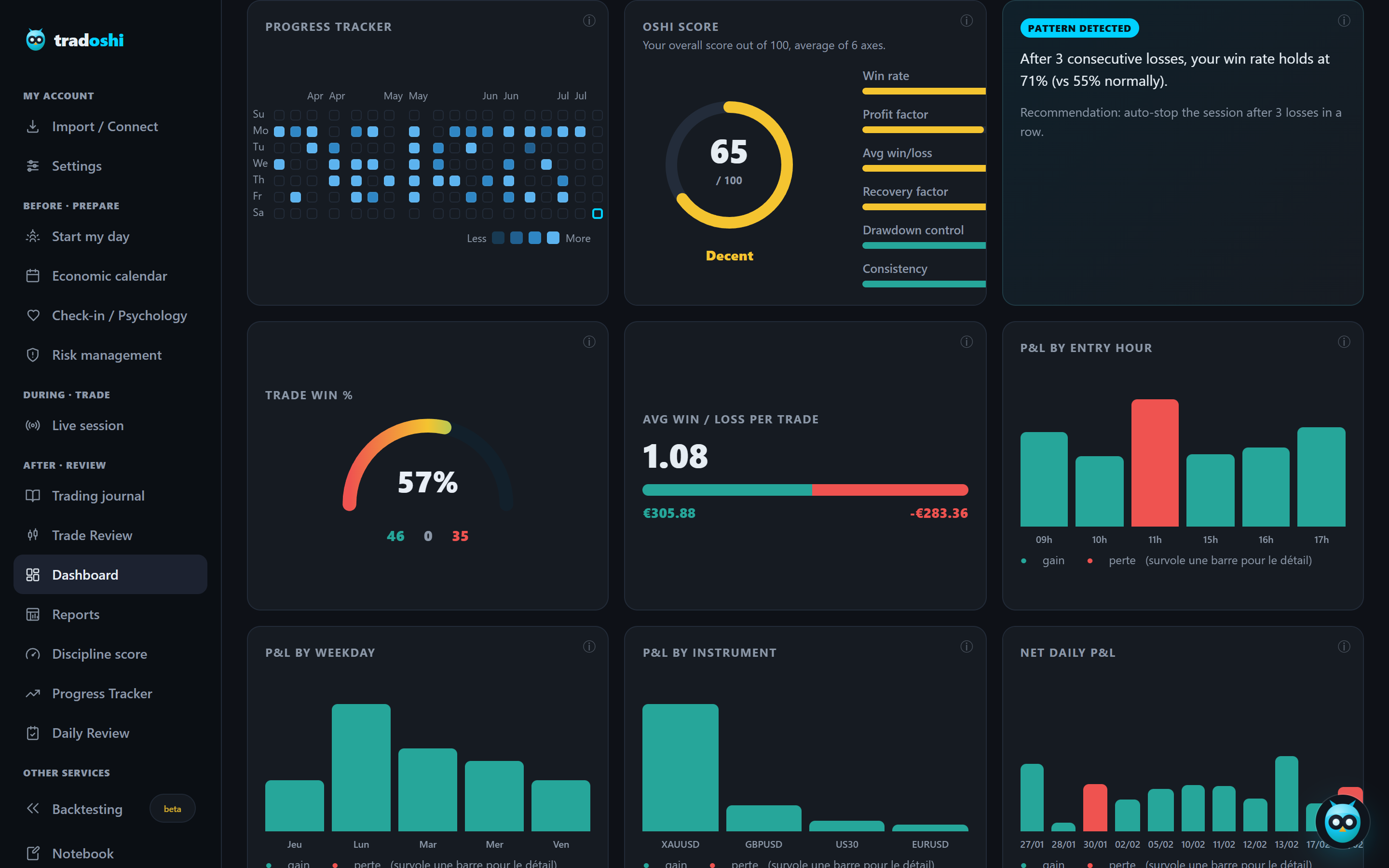
Once your firm is chosen, Tradoshi helps you respect its rules by tracking them in real time on your connected account, so you never lose a funded account over a forgotten rule.
- Rules tracked: total drawdown, daily limit and target tracked against your real performance.
- Multi-account: you can track several prop firm accounts with their own rules.
- Real-time drawdown: your loss margin is computed continuously, floating P&L included.
- Discipline: your adherence to your personal limits is measured to avoid breaches.
Frequently asked questions
How do I choose a good prop firm?
Don't choose on advertised capital but on the rules: the profit target / loss margin pairing, the drawdown type (fixed or trailing), the daily limit, minimum days, position-holding conditions and any consistency rule. And above all, check the real reliability of payouts, not just the advertised split.
Is the offered capital the right criterion?
No, it's the worst angle. Capital only has value if the rules genuinely let you trade it and draw gains from it. Large capital with a tiny drawdown and stifling rules is worth less than modest capital with livable rules. Look at the profit target / loss margin ratio, not the amount displayed in big letters.
Which tricky rules should I spot?
Trailing drawdown on the equity high (which rises with your floating gains and knocks you out on a mere pullback), bans on overnight or weekend holding, overly strict consistency targets, and vague 'behavior' rules that leave the firm room to refuse a payout. Rule clarity is itself a quality criterion.
How do I verify a prop firm actually pays?
Look for real proof of paid-out payouts: verifiable testimonials, the firm's history and longevity in the market. A young firm with spectacular promises and no payout history is a risky bet. An established firm with documented payouts, even with a slightly less generous split, is far safer. A 90% split on a firm that doesn't pay is worth zero.
What is a trailing drawdown?
It's a drawdown that follows your high instead of staying fixed: as your capital rises, the loss limit rises too, tightening on your gains. A mere pullback after a good trade can then breach the limit. It's one of the trickiest rules: always check whether your firm's drawdown is fixed or trailing, and whether it's computed on balance or equity.
Do all prop firms want me to succeed?
No. There are two models: one that profits by funding real traders and sharing their gains (interest in your success), and one that profits mainly by selling challenges to candidates who fail en masse (interest in you paying again). Clear rules and documented payouts lean toward the first; opaque rules and capital-focused marketing lean toward the second.
Is a funded account real money on the market?
In the vast majority of cases, no: you trade a simulated account with virtual money, and the firm pays you a share of what that account would have earned had the money been real. That's not necessarily a problem, but it means payout reliability depends on the firm's cash flow, not a market: one more reason to check its longevity and payout track record.
How do I compare several prop firms effectively?
Build a table of the essential rules (drawdown, daily limit, minimum days, consistency) for the firms you're interested in: this step often eliminates half the candidates. Then look for recent reviews on trader forums rather than just the testimonials on the firm's site. If budget allows, test the firm that seems most serious on its cheapest challenge before committing to a bigger one.