 By Benjamin Roure L'Hermitte
You've probably heard the pitch: trade with someone else's capital, keep most of the profits, and finally escape the limitations of a small personal account. Prop firms promise exactly this. It's more nuanced than that.
- The opportunity is real: funded traders access 25,000 to 200,000+ in capital they didn't have to save.
- The rules are strict: daily loss limits, drawdown caps and consistency requirements filter out most participants.
- Data-driven traders succeed: knowing your stats (win rate, drawdown patterns, best setups) gives you a concrete edge in evaluations.
The numbers are sobering. Industry estimates suggest 80-90% of traders never pass their first prop firm evaluation. The culprit? Broken risk management rules, emotional decision-making, and the inability to document what's actually working in their trading.
This guide breaks down exactly how prop firm trading works, what separates funded traders from those who fail, and how to build the documented track record that makes the difference. Tradoshi connects to your evaluation account (MetaTrader 4/5) and syncs every trade: you see real-time drawdown tracking, daily P&L against your limits, and you can tag trades with your mental state. Instead of manually calculating whether you're approaching your max daily loss, you see exactly where you stand at any moment.
What is prop firm trading?
Prop firm trading is a funding model where traders demonstrate their skills to a proprietary trading firm through an evaluation process, then trade the firm's capital while keeping 70-90% of profits. Unlike traditional retail trading where you risk your own money, prop firms absorb the downside risk in exchange for a share of your gains. The model has democratized access to significant trading capital for skilled traders who lack the personal funds to trade meaningfully.
The industry has evolved dramatically since 2020. Traditional prop firms required traders to work in physical offices. Today's online prop firms let you trade from anywhere, with evaluations conducted through demo accounts that simulate real market conditions. The barrier to entry dropped from six-figure minimums to evaluation fees starting around 100.
Tradoshi integrates directly with the platforms prop firms use most. When you connect your evaluation account, every trade automatically syncs to your journal: real-time drawdown tracking, daily P&L against your limits, and notes on your mental state. Instead of manually calculating whether you're approaching your max daily loss, you see where you stand at a glance.
Why prop firm trading is worth considering
Access to capital without personal risk
The math of trading with a 500 account is brutal. Even as a skilled trader pulling 10% monthly, that's 50. After a few months, you're still nowhere close to trading for a living. The frustration of having strategy but no capital drives traders to take excessive risks, which usually ends in blown accounts.
Prop firms flip this equation entirely. A 100,000 funded account with the same 10% return produces 10,000 in profit. Keep 80%, and you've made 8,000. The opportunity cost of personal capital disappears because you're trading someone else's money.
Proof of skill that opens doors
A verified track record from a prop firm is proof of competence that goes beyond just that firm's capital. It's a record you can share with mentors, communities, and potential investors. But you have to document it properly, which most traders neglect.
A framework that imposes discipline
Trading alone is psychologically brutal. Without external accountability, it's easy to bend your own rules, skip journal entries when you lose, and convince yourself that this time is different. Prop firm rules impose the discipline most traders struggle to maintain on their own. Daily loss limits create guardrails: you can't revenge trade after a bad morning, the rules physically stop you. Many traders perform better under these constraints than with complete freedom.
How it works, step by step
The path is simple on paper: prove your skills, get funded, trade profitably, keep most of the money. But the details matter enormously.
Stage 1: the evaluation
Most prop firms require one or two evaluation phases before funding you. You pay a fee (often 100 to 500 depending on account size), receive a demo account with simulated capital, and must hit a profit target while respecting strict risk rules. Tradoshi tracks your progress toward the target, your daily and total drawdown, and surfaces the trading patterns that cause problems.
Stage 2: managing the funded account
Once you pass, you receive a funded account (still technically a demo, but your profits become real payouts). The risk rules stay identical, sometimes stricter. Managing a funded account requires different psychology than passing the evaluation: the pressure shifts from hitting a target to protecting capital.
- Loss aversion intensifies: real money on the line changes behavior even if it's the firm's capital.
- The risk of playing it too safe: some become so cautious they can't generate anything.
- Rule fatigue: holding discipline over months, with no evaluation deadline, is harder than passing the evaluation itself.
Stage 3: scaling and multiple accounts
Successful prop traders rarely stop at one account. The standard strategy is running multiple funded accounts across different firms, to diversify allocation and protect against any single firm's payout issues. Managing five or more accounts manually is a nightmare: each firm has its rules, its platforms, its payout schedules. One oversight can cost months of work. Tradoshi consolidates everything into a single dashboard, with unified analytics and per-account notes to remember each firm's specific rules.
Major prop firms compared
The right choice depends on your style, capital goals and risk tolerance. Here's how the major players stack up (indicative values for a 100k account, verify with each firm, they change often):
| Prop firm | Eval. fee (100k) | Profit split | Max daily loss | Max total loss | Payout |
|---|---|---|---|---|---|
| FTMO | ~540 | 80-90% | 5% | 10% | Bi-weekly |
| The Funded Trader | ~499 | 80-90% | 5% | 10% | Bi-weekly |
| Topstep | ~165/mo | 90% | Varies | Combine rules | Weekly |
| Apex Trader Funding | ~167 | 90% | Trailing DD | Trailing DD | Twice monthly |
| MyFundedFX | ~499 | 80% | 5% | 8% | Bi-weekly |
By tagging each account by firm in Tradoshi, you see performance broken down by firm. Over time, this reveals which rules best suit your style, data that helps you decide where to focus future evaluations.
Best practices for passing evaluations
Trade smaller than you think you should
Most failures come from sizing set to the profit target rather than the loss limit. You're not trying to make as much as possible, you're trying to not lose too much while hitting your target. Size to survive your worst reasonable losing streak. If your daily limit is 500 and you see 3-4 losers in a row during drawdowns, each loss should cost no more than 100-125.
Practice under evaluation conditions first
Don't attempt a paid evaluation before passing a mock one on your own terms. Trade a demo with identical rules for 2-4 weeks, tracking everything in Tradoshi as if it were real, then review ruthlessly: did you stay within your daily limit every single day? Did you hit the target in the allotted time?
Trade your proven best time windows
Not every hour suits your style. Tradoshi's time-based performance reports show when you trade best: maybe 72% win rate between 9-11am and 45% in the afternoon. Prop firm rules don't require you to trade all day: a focused 2-hour session on your best setups beats an 8-hour grind through marginal opportunities.
Document every trade
Traders who pass evaluations share one habit: they document obsessively. Not just entry and exit, but why they took the trade, what they were thinking, how they felt. When you fail, this documentation tells you exactly why: instead of a vague 'I need more discipline', you have specific data ('I violated my plan 14 times during news, losing 1,847 on off-playbook trades').
Mistakes that kill evaluations
Ignoring the daily loss limit until it's too late
The most common killer isn't a bad strategy, it's losing track of your daily drawdown. A morning loss feels recoverable, so you size up to 'make it back'. Two more losses, and you've breached your limit before lunch. Game over. Real-time tracking keeps your exposure visible at all times.
Trading outside your documented strategy
The urgency of evaluations tempts you into 'opportunity' trades outside your edge. These improvised trades have a statistically lower win rate than planned trades. Strategy reports prove it with your own data: trades tagged 'playbook' versus 'discretionary' show dramatically different outcomes.
Failing to adapt rules across firms
Each prop firm has quirks: some restrict trading during news, some have specific size limits, some compute drawdown differently than you expect. Traders pass one firm's evaluation and fail another's, not from skill but from rule misunderstandings. Managing multiple accounts in Tradoshi, note each firm's restrictions and re-read them before trading.
How Tradoshi helps, concretely
- Automated journaling: every trade on your evaluation or funded account syncs on its own (MetaTrader 4/5), fees included.
- Real-time drawdown tracking: your position against your daily limit and maximum drawdown, reconstructed and aligned with your prop firm.
- Stats by setup, time and instrument: to trade your best windows and best setups.
- Multi-account tracking: all your funded accounts in a single dashboard, with each firm's rules in notes.
- Discipline score: it pinpoints exactly when and why your discipline slips, the real cause of failures.
Frequently asked questions
What is prop firm trading and how does it work?
You trade a company's capital after passing an evaluation, keeping 70-90% of profits. The typical path: choose a firm and plan (accounts from 10k to 200k+ in simulated capital), pass the evaluation (hit the target without breaching loss limits), get funded (trade real capital under the same rules), then scale (some firms raise your allocation as you show consistency). Most charge a one-time evaluation fee (50 to 500+ depending on size).
How much money do you need to start?
As little as 50 to 200 for smaller evaluation accounts. Rough ranges: 10k account → 50-150, 25-50k account → 150-300, 100k+ account → 300-500+. Budget for 2-3 attempts: most don't pass on the first try.
Why do most traders fail evaluations?
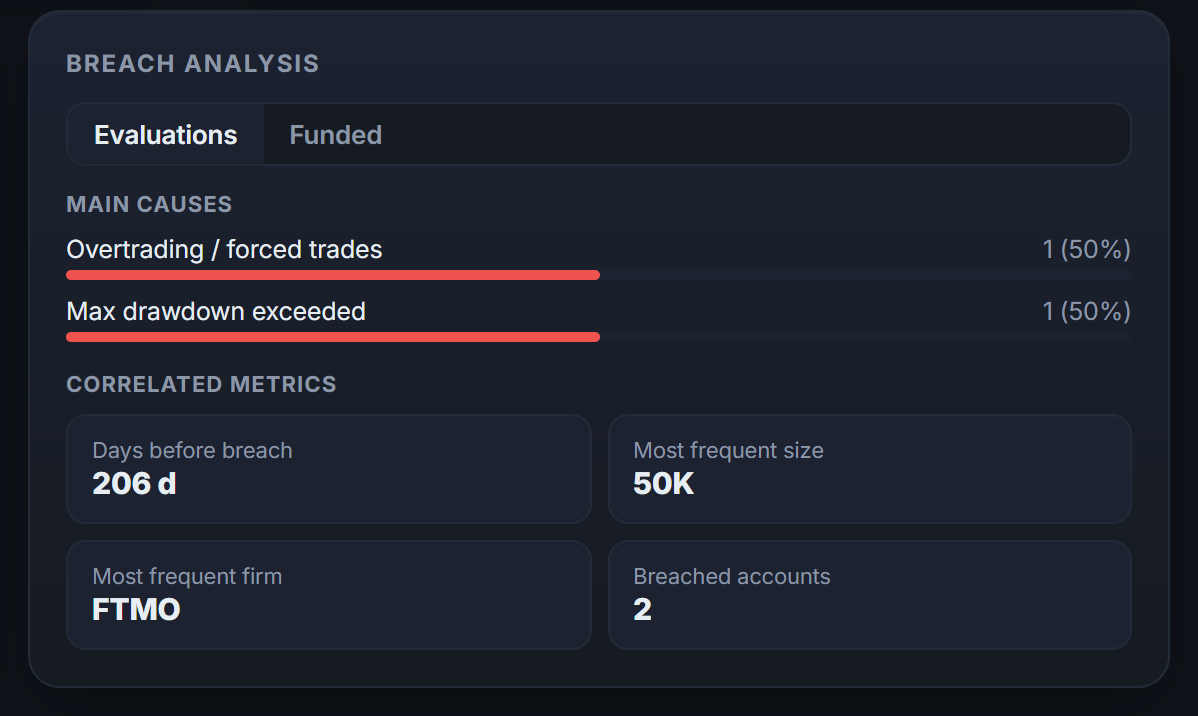
Mostly because they violate risk rules, not for lack of a profitable strategy. Common causes: breaching the daily loss limit (one day of revenge trading is enough), overtrading to hit the target faster, moving stops under pressure, and not tracking drawdown in real time. Automated drawdown tracking is essential.
What's the difference between evaluation and instant funding?
Evaluation firms require passing 1-2 phases before funding: lower fees, higher split (80-90%), but you must prove consistency. Instant funding gives capital immediately, no evaluation: higher fees, lower initial split (50-70%), but faster access. For most, evaluation offers better value if you can pass.
Can you trade multiple prop firm accounts at once?
Yes, many pros run 5-10 funded accounts in parallel. Beware: each account has its own rules, and taking the same trade everywhere multiplies your risk instead of diversifying it (a single loss can blow up several accounts). Consolidated tracking of all accounts is essential to avoid blind spots.
How do prop firms make money?
Mainly through evaluation fees (from the 80-90% of candidates who don't pass), profit sharing (they keep 10-30% of successful traders' gains), reset fees, and add-on services. The model works because most fees cover payouts to the minority of successful traders.
What happens if you violate a rule on a funded account?
Usually immediate termination and loss of that account's balance. Unlike an evaluation, a funded account cannot be reset: the capital is gone. That's why automated rule tracking and real-time alerts are essential once funded.