Most traders who fail at prop firms don't do so from a lack of skill, but from a handful of avoidable mistakes that come back again and again. Trading too big to hit the target fast, ignoring a rule they didn't read, revenge trading after a loss: these mistakes are predictable, and therefore avoidable. Knowing them in advance is already half the battle.
- Trading too big to hit the target fast is mistake number one.
- Ignoring an unread rule fails perfectly profitable accounts.
- Revenge trading after a loss turns a bad day into account failure.
- Treating the challenge as a sprint rather than a marathon leads straight to failure.
Prop firms rarely publish their success rates, but we know a large majority of candidates fail. The reflex is to think those traders lacked technical skill. That's false in most cases: they fail on identical behavioral mistakes, repeated from one candidate to the next, that have nothing to do with their ability to read a chart.
The good news is that these mistakes are a finite, well-known catalog. They stem not from bad luck but from haste, ignorance of the rules and emotional indiscipline. This guide reviews the mistakes that fail the most traders at prop firms, explains why each is so common, and gives you the concrete antidote for each.
Mistake #1: trading too big
It's by far the most common and most fatal mistake. Rushing to reach the profit target, the candidate increases their position size to go faster. They risk 3, 5, sometimes 10% per trade, telling themselves a good streak will pass the challenge. The problem is that variance gives no gifts: a few normal losses, at that size, are enough to blow past the loss limit.
The antidote is simple but demanding: trade small, even if it seems slow. Risking 0.5 to 1% per trade shields you from losing streaks and gives you time to reach the target without ever grazing the limits. The prop firm paradox is that trading small increases your chances of success, while trading big to go fast destroys them. Slowness is your ally.
Mistake #2: ignoring a rule
Many perfectly profitable accounts are invalidated over a simple rule the candidate hadn't read or understood. A trailing drawdown thought to be fixed, a daily limit computed on equity rather than balance, a ban on holding a position during an announcement, an unmet minimum number of days: each of these rules can fail a trader who was winning.
Losing a funded account over a rule you hadn't read is the stupidest, and most common, failure in prop firm trading.
The antidote is obvious yet neglected: read the rules in detail before paying, and know them by heart before trading. Note the exact numbers (drawdown, daily limit, minimum days) and check how each is computed. Five minutes of careful reading can save you weeks of work lost over a clause you didn't know about.
Mistake #3: revenge trading
After a loss, the urge to immediately recover the lost money takes over. You take a trade you'd never have taken cold, bigger, to win it back in one shot. In a prop firm, this spiral is even more dangerous than in a personal account, because the daily loss limit is a guillotine: revenge trading rushes you toward it in minutes, and the account is lost.
The antidote is the stop rule: after a defined number of losses or a daily loss reached, you stop, no negotiation. That rule, decided cold, is your protection against your in-the-moment emotional self. In a prop firm, it isn't a comfort, it's a survival necessity: the day you don't stop is often the account's last.
Mistake #4: treating the challenge as a sprint
Many candidates approach the evaluation as a race: reach the target as fast as possible, in a few days. An evaluation account rewards the exact opposite. That sprint mentality is a trap, because it pushes you toward everything that causes failure: trading big, overtrading, forcing entries, taking needless risks. Most prop firms actually impose no strict time limit, or a wide one: nothing forces you to hurry.
| Sprint mentality | Marathon mentality |
|---|---|
| Reach the target in a few days | Take the time it takes |
| Trade big to go fast | Trade small and steady |
| Force trades | Wait for good setups |
| Aim for the big day | Aim for consistency |
| Graze the limits | Stay far from the limits |
The antidote is to treat the challenge as a marathon: your only mission is to trade as you normally would, with discipline, letting the target come at its own pace. A steady trader risking 1% per trade almost always reaches the target without stress, simply by being patient. Speed is the enemy; consistency is the friend.
Mistake #5: neglecting emotion management
The prop firm context adds pressure a personal account doesn't have: you paid for the challenge, you have a target to hit, and failure has a concrete cost. That pressure amplifies every emotion and therefore every mistake. A trader who manages their personal account very well can collapse in a prop firm simply because they didn't anticipate that extra emotional load.
The antidote is to treat your psychology as part of the challenge, not a detail. Do your emotional check before each session, spot the days when pressure makes you deviate, and remember that a failed account can be retaken, but an account lost to panic mainly teaches you to manage better next time. Emotional discipline is a prop firm skill in its own right.
Mistake #6: copying someone else's strategy
Many candidates approach a challenge with a strategy they haven't tested themselves, copied from a coach or influencer, without knowing whether it suits them or works in current conditions. Trading a method you don't master, in the tense context of an evaluation, is a recipe for failure: at the first normal drawdown, you doubt, deviate, abandon, because you lack the confidence that comes from an edge proven on your own data.
The right approach is to only take a challenge with a strategy you've already tested and that has proven itself on your own history. The evaluation isn't the time to learn to trade or try a new method: it's the time to execute, with discipline, an edge you're already sure of. If you don't yet have that certainty, first practice on a personal or demo account until you have the numbered proof that your method works, then only pay the challenge.
Mistake #7: mismanaging the funded phase
A classic mistake isn't made during the evaluation but right after: relaxing your discipline once the funded account is obtained. The relief of passing the challenge, combined with the feeling of trading 'the firm's money', pushes many traders to take more risk than they did to pass. They then lose the account a few weeks after landing it, betraying precisely the discipline that let them succeed.
The funded account isn't a reward to spend, it's a responsibility to preserve. The rules there are the same as during the evaluation, and often the pressure is greater, because now there are real payouts at stake. The right mindset is to continue exactly as during the challenge: trade small, respect the rules, aim for consistency. Those who keep their funded account over time are those who change nothing after getting it, unlike those who lose it thinking they've arrived.
The mistake behind all mistakes: impatience
If you look for the common root of most prop firm mistakes, you almost always land on impatience. Trading too big to go fast, forcing entries to reach the target, revenge trading to immediately recover a loss, skipping checks out of haste: all these mistakes are variants of the same flaw, the refusal to let time do its work. Impatience is the number-one enemy of the prop firm candidate.
The remedy is a mindset shift: accepting that passing an evaluation, then keeping a funded account, is a marathon played out over weeks and months, not a sprint won in a few days. The patient trader, who trades small and lets the target come at its own pace, almost always succeeds; the impatient one, who wants everything now, almost always fails. Cultivating patience isn't a secondary quality in prop firms, it's the central skill that conditions all the others.
Mistake #8: trading several accounts without a method
Once a first funded account is secured, many traders chain through challenges to stack several accounts, without adapting their method to that new scale. The most common mistake is replicating the same trades across all accounts without shrinking size on each, which mechanically multiplies the real risk on every idea expressed. A trader who thought they were prudently risking 1% ends up risking 1% times the number of accounts on a single market idea, without realizing it, until the day that idea goes wrong everywhere at once.
The antidote is to treat your whole set of accounts as a single portfolio at the risk level, and to keep a centralized view of each firm's own rules, rather than relying on memory mid-session. Adding an account should always come with a simple question: can I track it properly without degrading the management quality of the ones I already have? If the answer is no, it's better to consolidate what you have before adding another.
Mistake #9: ignoring the time factor of the evaluation
Some candidates underestimate a simple but decisive factor: the time they can realistically devote to the challenge each week. Starting an evaluation hoping to spend several hours a day on it, then ending up with twenty available minutes because of work or personal life, pushes you to force trades to 'catch up' on lost time rather than patiently waiting for good setups. This self-inflicted time pressure is as real a cause of failure as sizing mistakes, even though it's rarely mentioned.
The antidote is to be honest with yourself before paying for a challenge: how much time can you realistically and sustainably devote to it each week? A strategy that requires being at the screen several hours a day isn't suited to a trader who only has their lunch breaks. Choosing an approach compatible with your real available time, rather than the time you wish you had, avoids artificially creating the rush that fails so many candidates.
Mistake #10: not preparing for failure
Many candidates approach their first challenge only picturing the success scenario, without having thought through what they'll do if the account fails. This lack of mental preparation has a real cost: when failure arrives, often on a normal losing streak, it's experienced as a catastrophic, unforeseen event rather than a known possibility, which pushes toward impulsive decisions, like immediately retaking a challenge without having analyzed what led to the failure.
The antidote is to decide, before you even start, how you'll react to a failure: you'll take time to review your trades, identify whether the failure came from a poorly followed rule or a normal losing streak, and only retake a new challenge once that analysis is done, not within the hour out of frustration. Mentally preparing for failure isn't pessimism, it's what keeps you rational the day it happens, and lets you draw a real lesson from it instead of an emotional reaction.
The mental dashboard of a candidate who succeeds
Beyond the list of mistakes to avoid, it's worth describing what the mindset of a candidate who regularly passes their evaluations actually looks like. They approach each session with no specific profit target for the day, only the goal of executing their plan correctly. They don't frantically check the progress counter toward the challenge target, because they know that repeated checking feeds impatience rather than discipline. They treat every trade-free day as proof of selectivity, not as wasted time.
This candidate also has a different relationship with failure: they know an account can fail without their method being at fault, and they've already decided in advance how they'll react if it happens. This mental preparation, combined with a position size that's always small and a perfect knowledge of the rules, forms a coherent whole far more powerful than any single isolated trick. Reproducing this mindset, more than any specific trading technique, is what separates the minority who succeed from the majority who fail.
How Tradoshi keeps you from these mistakes
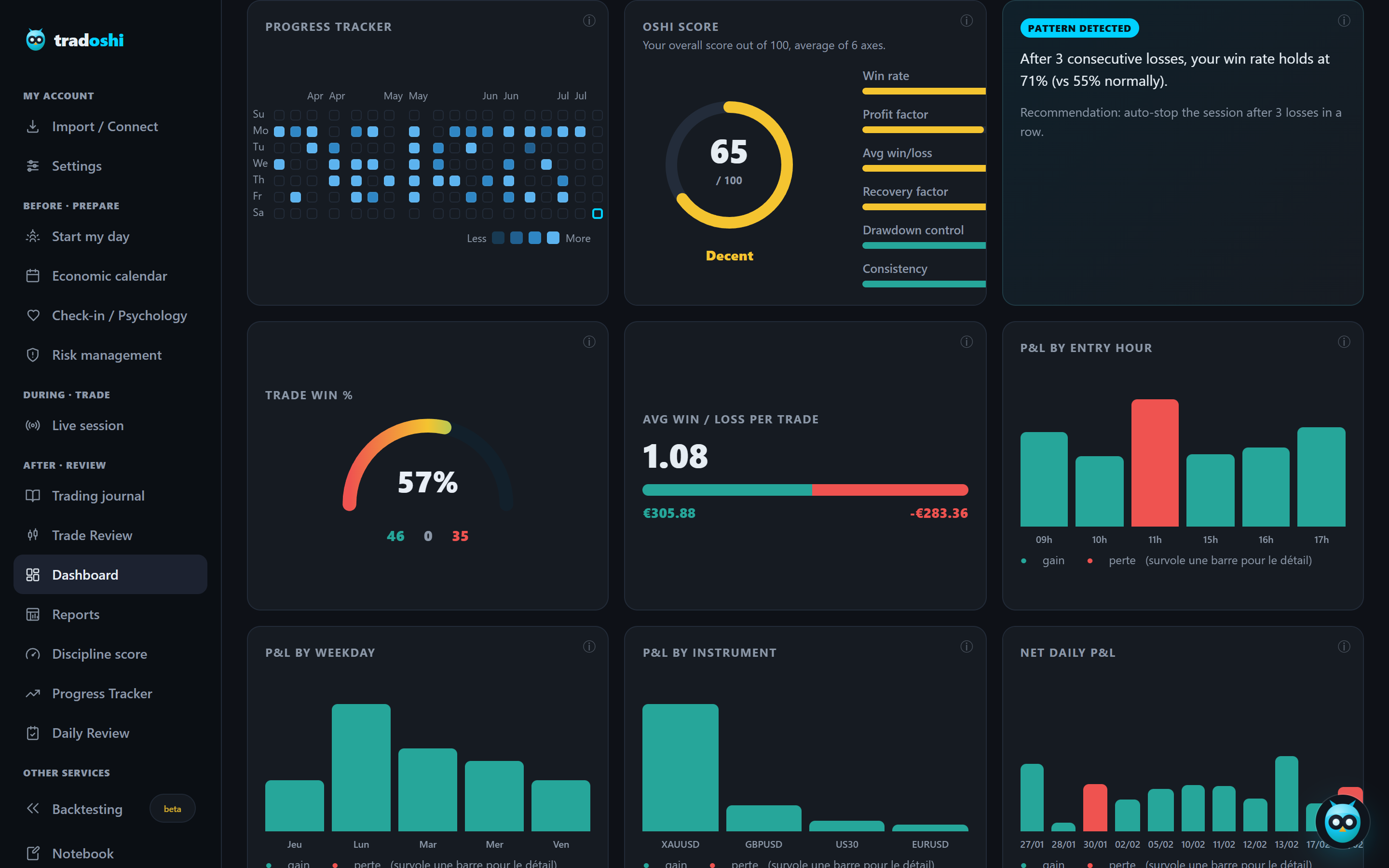
Tradoshi tracks your funded accounts' rules in real time and measures your discipline, to stop you from making the mistakes that fail most candidates.
- Rules tracked: drawdown, daily limit and target tracked against your real performance.
- Real risk per trade: over-sizing (mistake #1) stands out immediately.
- Discipline score: revenge trading and overtrading are detected and measured.
- Emotional check-in: it helps you spot pressure before it makes you deviate.
Frequently asked questions
Why do most traders fail at prop firms?
Not from a lack of technical skill, but from a handful of avoidable behavioral mistakes: trading too big to go fast, ignoring an unread rule, revenge trading, and treating the challenge as a sprint. These mistakes repeat from one candidate to the next and have nothing to do with the ability to read a chart.
What's the number one mistake in a prop firm?
Trading too big. Rushing to hit the target, the candidate increases size and risks 3 to 10% per trade, thinking a good streak will suffice. But a few normal losses at that size blow past the loss limit. The antidote is trading small (0.5 to 1% per trade): it's slower, but it genuinely increases your chances of success.
How do I avoid failing on a rule?
Read the rules in detail before paying and know them by heart before trading. Note the exact numbers (drawdown, daily limit, minimum days) and check how each is computed (balance or equity, fixed or trailing). Many profitable accounts are invalidated over a simple unread rule: five minutes of careful reading saves weeks of work.
Why is revenge trading so dangerous in a prop firm?
Because the daily loss limit is a guillotine: after a loss, the urge to win back pushes you to take a big impulsive trade, and that spiral can breach the limit in minutes, failing the account. The antidote is a strict stop rule: after a defined number of losses, you stop with no negotiation. In a prop firm, it's a survival necessity.
Should I hit the target as fast as possible?
No, it's a trap. The sprint mentality pushes you to trade big, overtrade and force entries, exactly what causes failure. Most firms impose no strict time limit: nothing forces you to hurry. Treat the challenge as a marathon, trade as usual with discipline, and let the target come at its own pace.
Does psychology matter more in a prop firm?
Yes, because the context adds pressure a personal account doesn't have: you paid, you have a target, failure has a cost. That pressure amplifies every emotion and therefore every mistake. A good personal-account trader can collapse in a prop firm for lack of anticipating that load. Treat emotion management as a prop firm skill in its own right.
What mistake do traders make managing several prop firm accounts?
Replicating the same trades across all accounts without shrinking size, which multiplies the real risk on a single market idea without them noticing. Treat your whole set of accounts as a single portfolio at the risk level, and keep a centralized view of each firm's rules rather than relying on memory.
Can a lack of time cause a challenge to fail?
Yes, indirectly but surely. Underestimating your realistically available time pushes you to force trades to 'catch up' on lost time rather than waiting for good setups. Be honest before paying for a challenge about how much time you can truly devote each week, and choose an approach compatible with that real time.