Managing several prop firm accounts in parallel is a powerful way to multiply your trading capital, but it's also a trap if you go about it wrong. Different rules per firm, risk that stacks without you seeing it, a mental load that explodes: without organization, several accounts become several ways to fail at once. Here's how to do it cleanly.
- Several accounts multiply your capital, but also your risk if you stack it without seeing it.
- Each firm has its rules: mixing the limits in your head leads to error.
- Trading the same thing on several accounts concentrates risk instead of spreading it.
- The key is a unified view that tracks each account with its own rules.
Once you've passed a first challenge, the temptation to multiply them is strong: more funded accounts means more capital, and therefore more potential gains. The logic is sound, and many professional traders do manage several accounts. But going from one account to five isn't done by simply changing a number: it changes the nature of the problem.
Each account brings its own rules, its own drawdown, its own daily limit, and above all its own traps. Managed without method, several accounts become an unmanageable mental load where you end up confusing rules, stacking risks and scattering your attention. This guide explains the real advantages of multi-account trading, the specific traps to avoid, and how to keep a clear view of the whole.
Why manage several accounts
The main benefit of multi-account is obvious: multiplying the capital you can trade without tying up more of your own money. With five funded accounts of 50,000, you trade on 250,000 of capital, and your gains are computed on that expanded base. For a steady, profitable trader, it's a considerable growth lever, far faster than growing a single account.
There's also a resilience benefit: spreading your activity across several accounts and firms reduces your dependence on any one. If an account fails on a bad patch, the others continue. And diversifying across several firms protects you from the risk that a given firm changes its rules, slows its payouts or disappears. Multi-account is as much a growth strategy as a safety strategy.
The stacked-risk trap
The number-one danger of multi-account is risk stacking without you seeing it. If you take the same trade on five accounts at once, you don't risk 1%: you risk 1% five times on the same idea. A loss on that trade hits you simultaneously on all accounts, and what looked like prudent management line by line becomes massive exposure at the scale of your activity.
Trading the same thing on five accounts isn't diversifying, it's repeating the same bet five times while thinking you're protected.
It's exactly the correlation problem, applied to your accounts. Replicating your trades across several accounts concentrates your risk instead of spreading it. The counter is to think in aggregate risk across all your accounts: if you take an idea on several of them, reduce the size on each so the total risk stays controlled, or accept treating your accounts as one big account at the risk level.
The different-rules trap
Each firm has its own rules, and they often differ on subtle points: fixed drawdown here, trailing there; a daily limit on balance on one side, on equity on the other; different minimum days, variable position-holding conditions. Managing all that from memory, across several accounts, is a recipe for error: sooner or later, you apply one account's rule to another and breach a limit without noticing.
| What varies between firms | Why it's tricky |
|---|---|
| Drawdown type (fixed/trailing) | The real margin differs per account |
| Daily limit base | Balance or equity changes the calculation |
| Minimum trading days | One account may require more than another |
| Overnight / weekend holding | Allowed here, banned there |
The only reliable way to manage this is to keep nothing in your head and track everything in a unified view that knows each account's own rules. Relying on your memory to juggle five different rule sets, mid-session, under pressure, is the best way to lose an account over an avoidable confusion.
Mental load and scattering
Beyond risk and rules, multi-account adds a real mental load. Watching five accounts, each with its performance, limits and drawdown, can quickly become so absorbing it degrades the quality of your trading. The trader scattered across too many accounts makes poorer decisions on each, because their attention is fragmented.
The solution isn't necessarily to reduce the number, but to simplify your management: trade the same strategy across all your accounts rather than juggling several approaches, and rely on a tool that centralizes the view. When your accounts are managed uniformly and tracked in one place, the mental load becomes bearable again and your attention stays on what matters: the quality of your trading decisions.
How to keep a clear view
- Trade the same strategy across all your accounts, so as not to fragment your attention.
- Note each firm's specific rules in a single reference, never from memory.
- Think in aggregate risk: if you replicate an idea, reduce the size per account.
- Track each account with its own rules in a centralized view.
- Treat an account's failure as a normal event, without letting panic contaminate the others.
Copying your trades or diversifying approaches
A strategic question arises fast in multi-account: should you replicate exactly the same trades across all your accounts, or vary approaches? Replicating simplifies management but concentrates risk, because all your accounts win and lose together. Varying approaches spreads risk better but multiplies the mental load, because you must track several strategies in parallel. There's no universal answer, only a trade-off between simplicity and diversification that depends on your management capacity.
For most traders, the best option is to trade the same strategy across all accounts, but accounting for aggregate risk. You keep the simplicity of a single approach while being aware your accounts move together, which forces you to reason about your overall exposure. Trying to manage several different strategies at once is reserved for very experienced traders, because attention-scattering generally degrades performance more than any diversification improves it.
Multi-account and the rule-tracking load
Each account adds not only risk, but also a compliance load: you must know and respect each firm's specific rules, which often differ on tricky details. With one account, you can keep its rules in your head; with five accounts across three different firms, it's impossible to do reliably. The risk is no longer just trading badly, but inadvertently violating one account's rule by applying another's.
The only robust solution is to keep nothing in memory and centralize the tracking of each account's rules in a single tool. Relying on your attention to juggle several rule sets mid-session, under pressure, is the best way to lose a perfectly profitable account over a simple confusion. The more accounts you have, the more systematic, centralized tracking becomes indispensable, because the compliance load grows faster than the number of accounts.
Knowing when to stop adding accounts
Adding accounts is tempting, because each promises more capital and therefore more gains. But there's a point beyond which an additional account degrades your overall management instead of improving it. That point arrives when the mental load of tracking all your accounts starts to deteriorate the quality of your decisions on each. A trader scattered across too many accounts makes less over the whole than a trader focused on a reasonable number, even if the theoretical capital is lower.
The right number of accounts is the one you can manage without your attention and discipline suffering. Better to run three accounts perfectly than manage ten poorly. Before adding an account, honestly ask yourself whether you have the mental bandwidth to track it without degrading the others. Growth in multi-account should be gradual and controlled, matched to your real management capacity, not to the mere desire to have more funded capital.
A numeric example of stacked risk
To make the stacked-risk trap concrete, take a purely illustrative example. Imagine a trader with four accounts of 25,000 each, so 100,000 of total traded capital. They spot a setup on gold and open it on all four accounts at once, risking 1% on each, so 250. On the surface, every account respects its rule. In reality, this trader just risked 1,000 on a single market idea, which is 1% of their total capital in isolation, but concentrated on one scenario: if gold moves against them, all four accounts absorb the loss at the same time, and one account's failure sharply raises the odds of the other three failing too.
This isn't a problem of poor individual execution, each account was managed 'correctly' by its own rules. The problem is that the account-by-account view hides the big picture. Had this same trader reasoned in aggregate risk, they'd have known that expressing this idea across four accounts at once required shrinking the size on each, say to 0.25%, so total risk stayed comparable to what they'd accept on a single account. That shift in perspective, from isolated account to portfolio of accounts, is what separates a genuinely cautious multi-account trader from one who only thinks they are.
Choosing your firms to spread structural risk
Beyond market risk, multi-account carries a structural risk specific to prop firms themselves: a firm can change its rules unilaterally, slow its payouts, or in the worst cases, cease operating. Concentrating all your accounts at a single firm exposes you entirely to that risk, even if your trading is flawless on every one of them. Spreading your accounts across two or three established firms, with a demonstrated payout track record, reduces that dependence without changing anything about how you trade.
This choice shouldn't be made at random: it's worth comparing withdrawal terms, reputation within the trading community, and each firm's apparent financial stability before entrusting it with several accounts. A trader with five accounts at one fragile firm is more exposed than a trader with five accounts spread across two solid firms, even with identical total traded capital. Diversifying across firms is as important a part of multi-account management as diversifying across market ideas, and it's often overlooked because it doesn't show up in trading statistics.
Growth pace: adding one account at a time
A practical question comes up often: at what pace should you add new accounts once you've mastered the first? The safest answer is to add one account at a time, and let enough time pass to verify your management stays solid with the new account before considering another. Adding three or four accounts at once, as soon as a first challenge is passed, leaves no room to adjust your method if the load turns out heavier than expected.
This gradual pace also lets you test, under real conditions, your ability to track several rule sets without confusion, before the financial stakes get too large. A trader who adds one account, watches a month of clean management, then adds another, builds a solid foundation. A trader who adds five accounts in a week because funding seems easy to get takes on a structural risk they only measure after the fact, often the moment several accounts fail at once for the same management reason.
Documenting your accounts like a real reference sheet
A simple but rarely adopted practice is keeping a single, up-to-date document listing each of your accounts with its exact rules: firm name, account size, drawdown type, daily limit calculation base, minimum number of days, withdrawal conditions. This document becomes your single reference before any tricky decision, rather than relying on memory or reopening each firm's terms mid-session.
This documentation habit feels tedious at first, but it quickly becomes a net time saver: instead of hunting for a rule at the critical moment, you check it in seconds. It also makes your entire multi-account exposure visible at a glance: how much total capital you're trading, across how many firms, with what renewal or verification deadlines. A trader managing five accounts without this document is navigating blind; one who keeps it current stays in control even as the account count grows.
How Tradoshi handles your multiple accounts
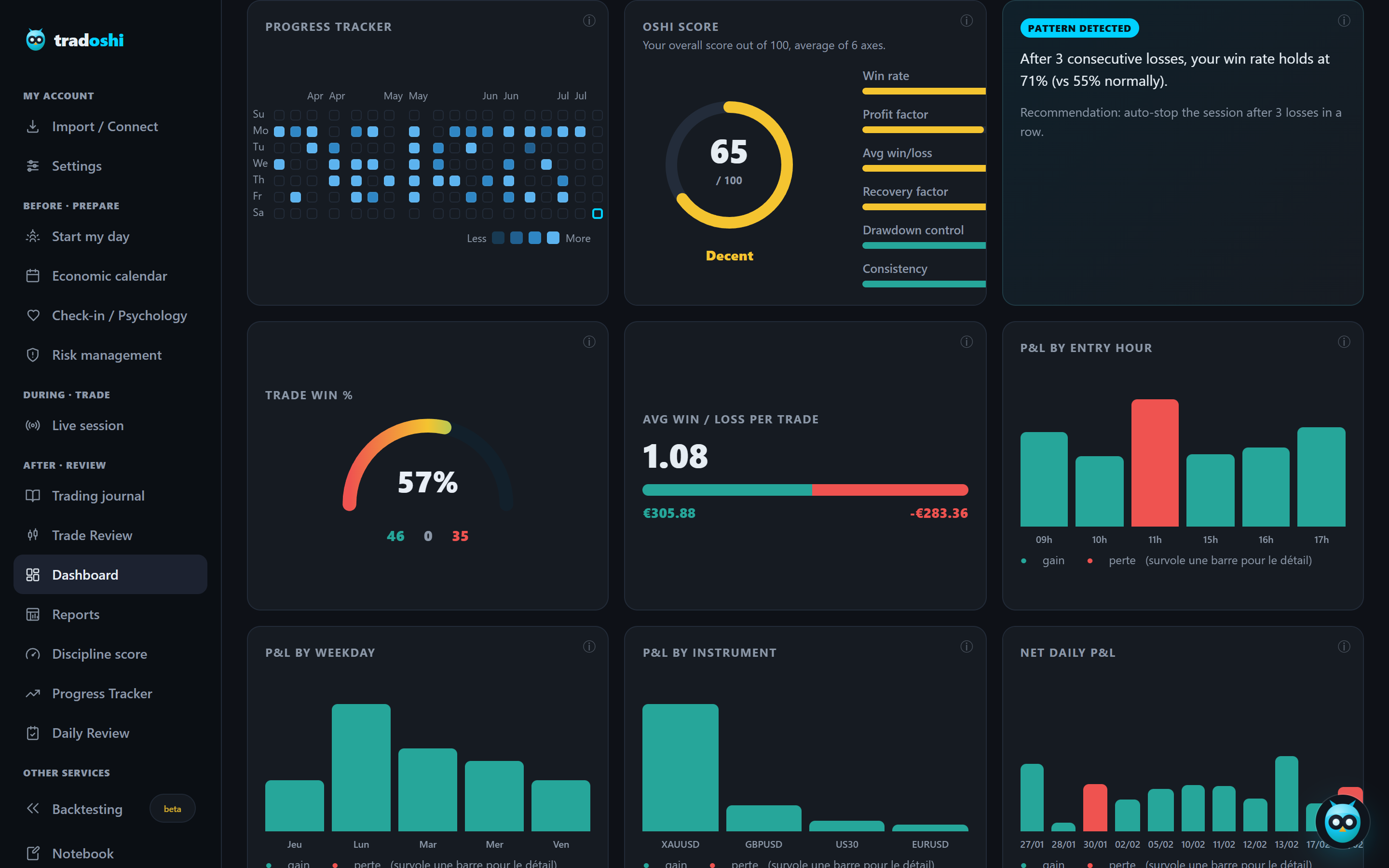
Tradoshi is built for multi-account: it tracks each account with its own rules, computes each one's drawdown in real time, and gives you the unified view that makes several accounts manageable instead of unmanageable.
- Native multi-account: each prop firm account is tracked separately with its specific rules.
- Rules per account: drawdown, daily limit and target specific to each firm.
- Real-time drawdown: each account's margin is computed continuously, floating P&L included.
- Big picture: your accounts are centralized in one place to reduce mental load.
Frequently asked questions
Why manage several prop firm accounts?
To multiply the capital you can trade without tying up more of your own money: five accounts of 50,000 is 250,000 of traded capital. It's a fast growth lever for a steady trader. It also brings resilience: spreading across several accounts and firms reduces your dependence on one and protects you if a firm changes its rules or disappears.
What's the main danger of multi-account?
Stacked risk without you seeing it. If you take the same trade on five accounts, you don't risk 1% but 1% five times on the same idea: a loss hits you simultaneously everywhere. Trading the same thing on several accounts concentrates risk instead of spreading it. The counter is to think in aggregate risk and reduce the size per account if you replicate an idea.
Is trading the same thing on several accounts diversifying?
No, it's the opposite. Replicating your trades across several accounts means repeating the same bet several times, which concentrates your risk instead of spreading it. A single loss hits you on all accounts at once. If you want to express an idea across several accounts, reduce the size on each so the total risk stays controlled.
How do I manage different rules per firm?
Never keep the rules in your head: note them in a single reference and track each account with its own rules in a centralized view. Firms differ on subtle points (fixed or trailing drawdown, limit on balance or equity, minimum days, overnight holding). Relying on memory to juggle several rule sets mid-session is the best way to lose an account over an avoidable confusion.
Does multi-account increase the mental load?
Yes, watching several accounts each with its performance, limits and drawdown can become so absorbing it degrades your decisions. The solution isn't necessarily to reduce the number, but to simplify: trade the same strategy on all, and centralize tracking in one tool. Uniform management makes the load bearable and keeps your attention on the quality of your trades.
What should I do when an account fails?
Treat it as a normal event, not a disaster. An account can fail on a bad patch without your strategy being at fault. The key is not to let panic contaminate your other accounts: don't change your behavior everywhere over an isolated failure. The resilience of multi-account comes precisely from the others continuing while one account is retaken.
Should I spread my accounts across several firms?
Yes, it's recommended. Beyond market risk, each firm carries its own structural risk (rule changes, slower payouts, even shutting down). Concentrating all your accounts at one firm exposes you entirely to that risk. Spreading across two or three established firms with a demonstrated payout track record reduces that dependence without changing how you trade.
How do I concretely measure my stacked risk across several accounts?
Add up the currency risk of every position expressing the same idea across all your accounts, then compare that total to your total traded capital. Four accounts of 25,000 each risking 1% on the same setup is 1,000 on a single idea: shrink the size per account so that total stays within the limit you'd accept on one large account.