The trailing drawdown is the number-one trap of prop firm accounts, the one that makes profitable traders fail. Unlike a fixed drawdown, it follows your highest balance and rises with it, which can cost you your account even while you're in profit. This guide explains exactly how the trailing drawdown works, why it's so tricky, and how to manage it to survive an evaluation.
- The trailing drawdown follows your highest balance, it rises with your gains.
- It can fail you while in profit, if you give back part of your gains.
- It often locks at the initial capital once a threshold is reached: know the exact rules.
- It forces you to protect your gains, not just avoid losses.
Many traders approach a prop firm challenge thinking it's enough not to lose too much. They understand the concept of maximum loss, but ignore the precise mechanics of the trailing drawdown, and get eliminated without understanding what happened. It's one of the most frequent causes of failure, and one of the most avoidable once you understand the mechanism.
The trailing drawdown isn't complicated, but it's counterintuitive, because it turns your gains into a level to protect. This guide breaks down how it works, its variants, and above all the concrete strategies to avoid getting trapped, whether during the evaluation or on a funded account.
Fixed vs trailing drawdown
To understand the trailing drawdown, you first have to compare it to the fixed drawdown. A fixed drawdown is an immobile loss threshold, computed once and for all from your starting capital: if you start at 100,000 with a 10% drawdown, you fail if your balance drops below 90,000, whatever your path. It's simple and predictable.
The trailing drawdown, on the other hand, is mobile: it's computed not from your starting capital, but from your highest balance reached. The threshold follows you upward as you win, which means the distance separating you from failure is calculated from your peak, not from your starting point. It's this mobility that makes it so different and so tricky.
Why it can fail you in profit
The central trap of the trailing drawdown is that it can eliminate you while you're still in overall profit. Imagine you raise your account from 100,000 to 105,000, then drop back to 96,000. With a 5% trailing drawdown, your threshold followed up to 105,000 and thus sits at 99,750; dropping back to 96,000, you're below the threshold and you fail, even though you're still above your starting capital. This outcome feels deeply unfair the first time it happens, precisely because nothing about your account balance looks like a failure from the outside.
The trailing drawdown doesn't only punish your losses, it punishes giving back your gains. An unprotected peak becomes a new red line under your feet.
This is what baffles so many traders: they see they're in profit and think they're safe, while the trailing drawdown has moved the red line under them. Each new high you reach raises the threshold, turning your gains into a level you must never let slip entirely. Understanding this completely changes how you manage an account: it's no longer just avoiding losses, it's protecting each gain.
Trailing on balance or on equity
A crucial distinction between prop firms is whether the trailing drawdown follows your closed balance or your real-time equity. If it follows the balance, only the result of your closed trades raises the threshold, leaving you room to maneuver on your open positions. If it follows equity, then even the unrealized profits of your open positions raise the threshold, which is far more constraining.
This difference has huge practical consequences. With trailing on equity, an unrealized profit that rises then falls back can raise your threshold without you having banked anything, bringing you closer to failure for a gain you never realized. Knowing precisely whether your firm applies trailing on balance or on equity is indispensable, because it completely changes how you must manage your open positions.
Locking at the initial capital
Many prop firms apply an important rule that softens the trailing drawdown: once your balance has risen by a certain amount, often the equivalent of the drawdown itself, the threshold stops following and locks at the initial capital. Concretely, from that point, you can no longer fail as long as you stay above your starting capital, which gives you back a safety margin.
This rule changes the early-account strategy. As long as the threshold still follows, you're in the most dangerous phase, where the slightest pullback after a peak can eliminate you. Once the lock is reached, you breathe. A smart tactical goal is therefore often to first aim to reach this locking point, trading cautiously, to turn a threatening trailing drawdown into a simple floor at the starting capital. Knowing your firm's locking threshold is essential to plan your evaluation.
Protect your gains, not just avoid losses
The big strategic lesson of the trailing drawdown is that it forces you to think in terms of protecting gains. Each time you reach a new high, you move your own red line, and letting a gain slip entirely amounts to bringing you closer to failure. This imposes active management: securing part of your gains, avoiding giving back big peaks, and not overtrading after a nice advance.
Concretely, this means avoiding violent round trips. A trader who rises hard then gives it all back is far more in danger under a trailing drawdown than a trader who progresses steadily without big peaks. Consistency, already valuable in trading, becomes vital under a trailing drawdown, because it avoids creating unprotected peaks that raise the threshold above your starting capital. Trading a trailing-drawdown account means managing your gains as much as your losses.
The mistakes that fail trailing-drawdown accounts
The first and most common mistake is not knowing your prop firm's exact rules before you start trading. Many traders discover they've been eliminated without understanding why, simply because they never checked whether the trailing followed balance or equity, or at what level it locked. Reading your firm's rules document in full before your first trade isn't optional, it's an absolute prerequisite under a trailing drawdown.
The second classic mistake is aiming for a big quick gain early in the account, taking disproportionate risk to reach the lock threshold fast. This strategy is tricky: a peak reached too fast with high risk creates a trailing threshold very close to the current balance, leaving a tiny margin going forward. A third mistake is trading relentlessly after a big peak out of overconfidence, precisely when protecting your gains should become the absolute priority.
A full worked example
Take a complete illustrative example. A trader starts a 50,000 account with a 10% trailing drawdown, or 5,000. They gradually raise their balance to 58,000: their trailing threshold follows and now sits at 52,200 (58,000 minus 5,000). If they drop back to 53,000 after a few losing trades, they stay above the threshold and continue their evaluation, but their margin has shrunk to 800, far less comfortable than at the start.
If their firm applies a lock once the balance has risen by the equivalent of the drawdown (here, from 55,000), and our trader crossed that threshold before dropping back, then their threshold would have locked at 50,000, their starting capital, rather than at 52,200. They would then have a margin of 3,000 instead of 800 at that same balance level. This example shows how much knowing your firm's exact locking mechanism changes the real safety margin you have at any given moment.
Trailing calculated intraday or at close
Another often-overlooked technical distinction is whether the trailing drawdown is computed from the intraday high or only at end-of-day close. Some prop firms only account for the closing balance to determine the new threshold, meaning a peak reached and lost within the same day doesn't raise the trailing. Others calculate continuously, including intraday, which is significantly stricter.
This difference has a huge impact on how you manage gains during a session. Under a close-based calculation, you can let an intraday gain run without immediate concern for your trailing, as long as you close the day below your historical closing high. Under an intraday calculation, every new high, even a fleeting one, raises your threshold on the spot, which forces much more active management of your open positions and partial profit-taking.
Choosing your prop firm based on its trailing drawdown
Not all prop firms apply the trailing drawdown the same way, and this mechanic should weigh heavily in your choice of firm, on par with fees or profit split. A trader with a more volatile style, with pronounced peaks and dips, is better served by a firm with a close-based trailing and a fast lock, which forgives round trips more. A very consistent trader, without big peaks, can afford a stricter firm without suffering as much.
Before committing to an evaluation, precisely compare the trailing drawdown rules between several firms: the percentage, the calculation method (balance or equity, close or intraday), and the lock threshold. This comparison, often neglected in favor of just the evaluation's price, can make the difference between an account that survives a normal losing streak and one eliminated for a purely mechanical reason.
Track your drawdown in real time
The worst situation is discovering your drawdown level after the fact, when it's too late. On a trailing-drawdown account, you must know at all times where your current threshold sits and how much room you have left before reaching it. This permanent awareness is your best protection, because it prevents you from taking one trade too many at the wrong moment, when your margin is thin.
Tracking your drawdown in real time turns an invisible trap into a concrete, manageable limit. When you know you have little room left before your trailing threshold, you naturally reduce your size or stop, protecting your account. When you don't know where you stand, you navigate blind and get trapped. Good drawdown tracking is therefore the prop firm trader's number-one defensive skill, before even the quality of their strategy.
Trailing drawdown and emotional management
The trailing drawdown has a particular psychological effect: it makes you experience the approach of your threshold as a constant threat, even when your account remains well in profit. This constant pressure can push toward tense, overly cautious management, where every small pullback after a peak triggers anxiety disproportionate to the real risk. Recognizing this pressure as a normal feature of the trailing drawdown, rather than a sign that something is wrong, helps you keep a clear judgment.
Conversely, some traders react to this pressure with denial, refusing to closely track their threshold to avoid the anxiety, which is just as dangerous, since it amounts to navigating blind. The right balance is knowing precisely where you stand relative to the threshold without turning it into a minute-by-minute obsession, a bit like checking a fuel gauge without staring at it constantly. This emotional mastery of the trailing drawdown is an integral part of succeeding at an evaluation or holding a funded account over time.
How Tradoshi helps you manage the trailing drawdown
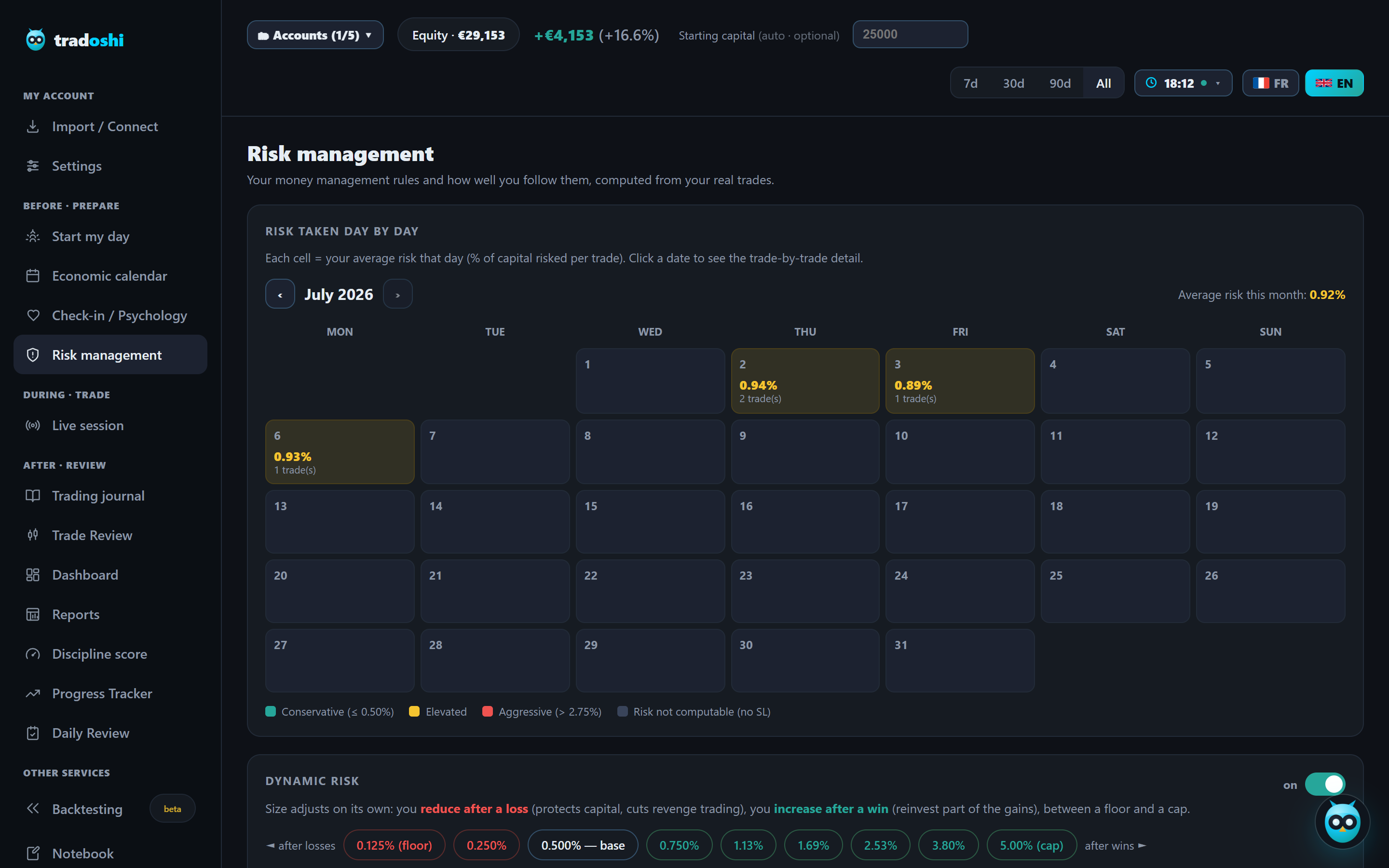
Tradoshi helps you track your drawdown and respect your prop firm's limits. By connecting your account, you see your trajectory, your maximum drawdown, and your risk rules, to never get eliminated by surprise.
- Maximum drawdown tracking on your equity curve to see your pullbacks after each peak.
- Configurable prop firm rules (daily loss, max loss) to frame your risk to your firm's.
- Risk alerts when you approach your daily limits.
- Consistency statistics to favor progress without dangerous big peaks.
Frequently asked questions
What is the trailing drawdown in a prop firm?
It's a mobile maximum loss that follows your highest balance reached, instead of being computed once on your starting capital. As you win, the threshold rises with you, so the distance separating you from failure is measured from your peak, not from your starting point.
Can you fail a trailing drawdown while in profit?
Yes, that's its main trap. If you rise to a peak then give back part of your gains, you can drop below your trailing threshold (which followed up to the peak) while staying above your starting capital. Each new high moves the red line under your feet: the trailing punishes giving back your gains, not just your losses.
Trailing on balance or on equity, what's the difference?
If it follows the closed balance, only the result of your closed trades raises the threshold, leaving you room on your open positions. If it follows real-time equity, even unrealized profits of your open positions raise the threshold, which is far more constraining. Knowing which applies is indispensable to manage your positions.
Does the trailing drawdown lock?
Often, yes. Many prop firms lock the threshold at the initial capital once your balance has risen by a certain amount (often the equivalent of the drawdown). From that point, you can no longer fail as long as you stay above your starting capital. Reaching this lock by trading cautiously is often a good tactical early-account goal.
How do I manage a trailing-drawdown account?
By protecting your gains, not just avoiding losses: secure part of your profits, avoid violent round trips (rise hard then give it all back), and favor steady progress without big unprotected peaks. Above all, track your drawdown in real time to always know how much room you have left before your threshold.
Is the trailing drawdown calculated intraday or at close?
It depends on the firm. Some only account for the closing balance, meaning a peak reached and lost within the same day doesn't raise the threshold. Others calculate continuously, including intraday, which is far stricter and forces active management of your open positions and profit-taking.
How do I choose a prop firm based on the trailing drawdown?
By precisely comparing the percentage, the calculation method (balance or equity, close or intraday) and the lock threshold across several firms, not just the evaluation's price. A trader with a volatile style is better served by a firm with a close-based trailing and fast lock; a very consistent trader can afford a stricter firm.