Trading at a prop firm isn't like trading your own account, and confusing the two is the main reason for failure. At a prop firm, you're not just trading the market, you're also trading a set of rules. The right mindset isn't 'how do I win the most', it's 'how do I respect the rules while letting my edge express itself'. It's a complete shift in mentality.
- At a prop firm, you trade the rules as much as the market: respecting them comes before the gain.
- The winning mindset is defensive: not losing the account beats winning fast.
- The rules aren't enemies, they're the conditions of the game you agreed to.
- Discipline is worth more than talent: the firm funds reliable traders, not gamblers.
A trader who succeeds on their personal account can fail miserably at a prop firm, and vice versa. The difference isn't technical, it's mental. On your account, you have one opponent: the market. At a prop firm, you have two: the market and the set of rules you must respect to keep the right to trade. Ignoring that second opponent means losing for sure.
Adopting the right mindset radically changes your behavior. You stop asking 'how much can I win' and start asking 'how do I stay within the lines while letting my edge produce'. This guide explains how the prop firm mindset differs from the personal-account one, why respecting the rules must come before the gain, and how to adopt the defensive mentality that makes lasting funded traders.
Two opponents instead of one
On your own account, your only constraint is the market: as long as you don't ruin yourself, you can trade how you want, for as long as you want. At a prop firm, a second constraint is added, just as real: the set of rules. The profit target, total loss limit, daily limit, minimum days, position-holding conditions: each can make you lose the right to trade, regardless of your performance.
That second opponent is actually more dangerous than the market, because it's absolute. The market makes you lose gradually; a broken rule makes you lose everything at once. A winning trader can fail by crossing a limit by a cent. Absorbing that reality means understanding that at a prop firm, respecting the rules isn't a secondary constraint, it's the first condition of your survival.
The defensive mindset, the key
On your personal account, you can afford an offensive mindset: hunting gains, seizing opportunities aggressively. At a prop firm, that mindset kills you. The right mindset is defensive: your absolute priority isn't to win, it's to not lose the account. The gain comes after, as a consequence of survival, not as a goal pursued head-on.
On your account, you play to win. At a prop firm, you play first to not be eliminated. The gain rewards those who survive.
Concretely, the defensive trader asks before each trade: 'what do I risk losing, and does it bring me closer to a limit?' rather than 'how much can I win?'. They trade small, stay far from the limits, and accept missing opportunities to preserve the account. That's not timidity, it's recognizing that the greatest danger at a prop firm isn't missing a gain, it's losing the right to trade.
The rules aren't your enemies
Many traders experience the prop firm's rules as unfair constraints, arbitrary obstacles between them and their gains. That resentment is counterproductive: it pushes you to bend the rules, test them, dangerously approach them out of defiance. The right mindset is the opposite: the rules are the conditions of the game you chose to play, and respecting them isn't submission, it's the very skill the firm measures.
In a sense, the prop firm's rules are a service: they impose the discipline you should have anyway. A daily loss limit is nothing but a mandatory stop rule, exactly what every good trader should impose on themselves. Seeing the rules as safeguards aligned with your interest, rather than as traps, transforms your relationship with the challenge and makes you far more consistent.
Discipline is worth more than talent
The prop firm isn't looking for the most brilliant trader, it's looking for the most reliable one. It entrusts capital, and it wants to entrust it to someone who won't blow up the account in a fit of emotion. That's why discipline counts more than talent at a prop firm: an average but steady trader, who scrupulously respects the rules, is a far better candidate than a brilliant but unpredictable one.
| What the firm doesn't want | What the firm wants |
|---|---|
| The unpredictable big shot | Predictable consistency |
| Unstable talent | Constant discipline |
| Trader who grazes the limits | Trader who keeps their margins |
| The sprint to the target | The controlled marathon |
That requirement aligns perfectly with what makes a good trader in general. The prop firm mindset isn't an artificial constraint, it's an accelerator of good habits: it forces you to become the disciplined, steady trader you should be aiming to be anyway. Many traders progress more in a few challenges than in years of personal-account trading, precisely because the rules force discipline.
Managing money that isn't yours
Trading a firm's capital rather than your own creates a particular psychological relationship to money, which can cut both ways. For some, knowing it's 'not their money' frees them from excessive fear and lets them execute more calmly. For others, that same distance makes them reckless, as if playing with worthless chips. Recognizing which way you lean is important, because one helps and the other hurts.
The right posture is to treat the funded capital with the same seriousness as if it were yours, while using the emotional distance to stay clear-headed. The firm's account isn't a game: it's a real opportunity, with real rules and real gains at stake. The trader who respects the capital entrusted to them as if it were their own, without suffering the paralyzing fear, is in the ideal disposition. They combine the owner's seriousness and the composure of someone not gambling their survival on every trade.
The funded trader's long-term mindset
The real goal in a prop firm isn't to pass a challenge, it's to build a lasting relationship with one or more firms that entrust you capital and pay you a share of your gains, over years. This long-term framing changes everything: each decision is made not to maximize this month, but to preserve a source of income that can last. The trader who thinks this way never takes a risk that could kill their relationship with the firm for a short-term gain.
This long-term vision aligns perfectly with the defensive mindset: preserving the account comes above all, because the account is the goose that lays the golden eggs. A mature funded trader behaves like a prudent business partner, not a gambler: they protect the asset that supports them, aim for the consistency that reassures the firm, and build a reputation for reliability that can open larger allocations. Funded trading rewards those who think in years, not in sessions.
When the rules seem counterproductive
Sometimes certain prop firm rules seem to go against good trading: a daily limit that takes you out just before a reversal, a consistency rule that stops you from letting a big winner run. In those moments, the temptation is strong to consider the rule absurd and circumvent it. It's a perspective error: even an imperfect rule is part of the contract, and respecting it is the very skill the firm measures.
The right reflex is to adapt your trading to the rules rather than fight them. If a firm forbids certain practices, choose an approach compatible with its constraints, or choose another firm whose rules suit your style. What you can't do is play with a rule set while refusing to respect it: that only leads to failure. The best firms have rules that, well understood, align with good trading; and even constraining rules impose a discipline you'll come out better for.
The mindset mistakes that make a challenge fail
Most prop firm failures don't come from a lack of technical skill, but from a poorly calibrated mindset. The first classic mistake is rushing the challenge: seeing the profit target as a race against the clock, increasing position size to 'get it done fast', when most firms impose no strict time limit at all. That rush turns a careful trader into a gambler taking risks they'd never take on their own account.
The second mistake is trading differently depending on the distance to the target. As the profit threshold approaches, many traders become overly cautious and stop following their plan out of fear of losing everything right before the finish line, which often makes them stall or drop out from excess timidity. Conversely, after a loss that brings them closer to the drawdown limit, the revenge-trading instinct becomes stronger than ever, exactly when the mistake would be most costly.
The third mistake is ignoring consistency rules or risk distribution across days, often seen as secondary to the profit target. A trader can perfectly respect their total loss limit and still fail because a single day represents a disproportionate share of their result. Knowing the entire rulebook, not just the loss limits, is an integral part of the defensive mindset.
A concrete example: two traders, two mindsets
To illustrate the difference, imagine two traders who receive the same 100,000 funded account with an 8% profit target and a 10% total loss limit. The first, offensive mindset, aims for the target in two weeks: they risk 2% per trade, chain positions, and reach 6% profit in five days. Riding the momentum, they double their size to finish faster, a trade turns against them, and they lose 4% in a single session. Now back at 2% profit, with the loss limit dangerously close and confidence shaken.
The second trader, defensive mindset, risks 0.5% per trade, accepts taking six weeks to reach the target, and never deviates from their usual size even when close to the threshold. They end up passing the challenge without ever having approached their loss limit by more than 3%. It's not that the first trader lacked technical skill: their mindset pushed them to take growing risks as the pressure mounted, exactly the opposite of what survival at a prop firm requires.
This deliberately simplified example illustrates a reality observed among many funded traders: how fast you reach the target matters far less than how consistently you do it.
After the challenge: the funded account mindset day to day
Many traders concentrate all their discipline on the challenge phase, then let the pressure off once the funded account is obtained, as if the goal were reached and vigilance no longer needed. It's a mindset mistake nearly as common as failing the challenge itself. The funded account has its own drawdown and payout rules, often just as strict as the challenge's, and losing an account after funding is a far bigger loss than a failed challenge: the loss of an income relationship that could have lasted years.
The right mindset for the funded trader day to day stays exactly the same as during the challenge: defensive, disciplined, focused on preserving the account before the gain. The difference is that the pressure changes nature. During the challenge, the pressure comes from the target to reach. Once funded, it comes from the will to never lose what's been earned, and to grow the relationship with the firm toward larger allocations. Traders who last across multiple payout cycles are the ones who treat every day of funded trading with the same rigor as day one of the challenge, never letting the comfort of success erode their discipline.
How Tradoshi anchors this mindset
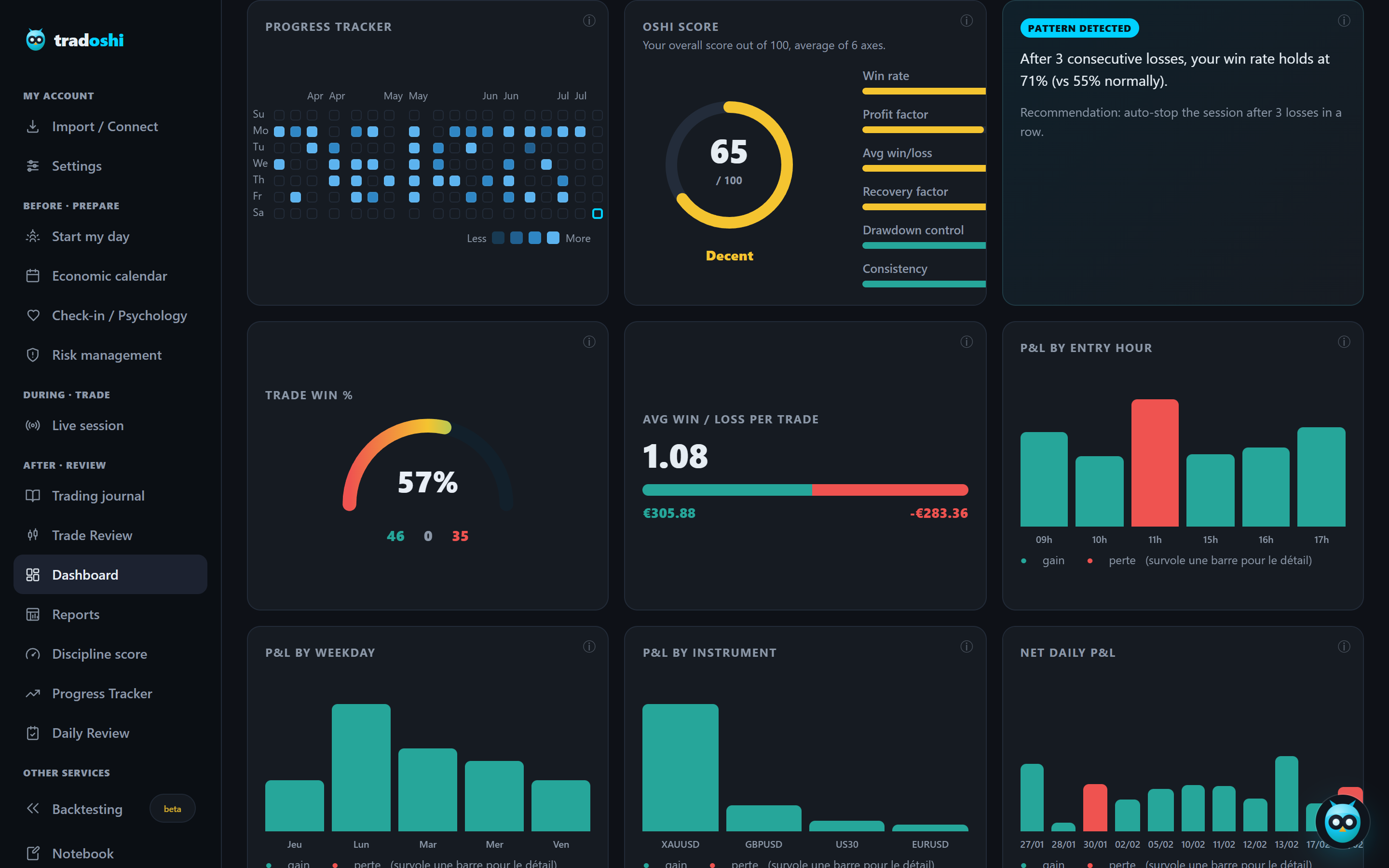
Tradoshi makes the defensive mindset concrete by tracking your rules in real time and measuring your discipline, so 'respecting the rules' stops being an intention and becomes data you see and improve.
- Rules in real time: drawdown, daily limit and target tracked to stay far from the limits.
- Discipline score: your behavioral consistency measured, the quality the firm seeks.
- Defensive risk: your real risk per trade tracked to keep your safety margins.
- Emotional check-in: it helps you keep a cool head under the funded account's pressure.
Frequently asked questions
How does the prop firm mindset differ from a personal account?
On your personal account, your only opponent is the market. At a prop firm, you have two: the market and the set of rules you must respect to keep the right to trade. That second opponent is more dangerous because it's absolute: a broken rule makes you lose everything at once, even if you were winning. So respecting the rules comes before the gain.
What is a defensive mindset in trading?
It's a mindset where your absolute priority isn't to win but to not lose the account. Before each trade, you ask what you risk losing and whether it brings you closer to a limit, rather than how much you can win. You trade small, stay far from the limits, and accept missing opportunities to preserve the account. The gain comes as a consequence of survival.
Should I see the prop firm's rules as enemies?
No, it's counterproductive. The rules are the conditions of the game you chose to play, and respecting them is the very skill the firm measures. In a sense, they're a service: a daily loss limit is nothing but a mandatory stop rule, exactly what every good trader should impose. See them as safeguards aligned with your interest.
Why does discipline matter more than talent at a prop firm?
Because the firm entrusts capital and wants to entrust it to someone reliable, not a brilliant but unpredictable gambler. An average but steady trader, who scrupulously respects the rules, is a better candidate than a talented but unstable one. The firm funds reliability, not grand gestures.
Does the prop firm mindset help me become a better trader?
Yes, enormously. The prop firm mindset isn't an artificial constraint, it's an accelerator of good habits: it forces you to become the disciplined, steady trader you should be aiming to be anyway. Many traders progress more in a few challenges than in years of personal-account trading, precisely because the rules force discipline.
How do I keep a cool head under the funded account's pressure?
By treating your psychology as part of the game. Do an emotional check before each session, keep a defensive mindset (not losing the account above all), and remember that the greatest danger isn't missing a gain but losing the right to trade. Tracking your rules and discipline in real time turns pressure into concrete markers rather than diffuse anxiety.
Should I rush to pass a challenge quickly?
No, it's the most common mindset mistake. Most firms impose no strict time limit to reach the profit target, but many traders treat the challenge as a race, increase their size to go faster, and fail by taking risks they'd never take on their own account. Speed matters far less than consistency.
Should I keep the same discipline once I get a funded account?
Yes, absolutely. Many traders let the pressure off once funded, as if the goal were reached. That's a mistake: the funded account has its own drawdown rules, often just as strict as the challenge, and losing it is a far bigger loss, that of an income relationship that could have lasted years. The defensive mindset must stay identical, before and after funding.