Passing a prop firm evaluation and getting a funded account isn't a matter of luck or genius, it's a matter of method. The vast majority of candidates fail because they approach the challenge as a speed game, when it's a discipline test in disguise. Here's the concrete, step-by-step approach to turn an evaluation into a lasting funded account.
- The challenge tests your discipline, not your ability to pull off a big shot.
- Trading small and steady is the winning strategy, not trading big to go fast.
- Knowing the rules by heart is a prerequisite, not an option.
- Getting the account is only the start: keeping it takes the same discipline, over time.
A prop firm evaluation resembles an exam: there are precise criteria to meet (a profit target) and rules not to break (loss limits). Most candidates focus on the first and underestimate the second, when it's almost always on the loss rules that they fail. Succeeding requires reversing that priority: first don't lose, then win.
The counterintuitive truth is that an evaluation is passed by trading boringly and prudently, not by chasing the exploit. This guide gives you the complete method: the mindset to adopt, the risk strategy that maximizes your chances, the concrete steps to pass the challenge, and above all how to keep the account once funded, which is the real goal.
The right mindset before starting
Even before paying for a challenge, you must adopt the right mental frame, because it will decide almost everything. An evaluation isn't a chance to prove you can double an account: it's a test verifying you can trade with discipline and manage your risk. The firm isn't looking for gamblers, it's looking for steady traders it can entrust its capital to without fear. Understanding that changes your whole approach.
Concretely, it means abandoning the idea of speed. You're not in a hurry. Most firms set no strict time limit, and even when they do, it's wide enough for a patient trader. Your goal isn't to finish fast, it's to finish without ever approaching the loss limits. A candidate who thinks 'marathon' succeeds; one who thinks 'sprint' fails. That difference in tempo shows from the first few days: the marathon trader takes their usual trades without worrying about the calendar, the sprint trader is already changing their behavior on day one to 'get ahead'.
The winning risk strategy
The mechanical key to success lies in a single number: your risk per trade. By risking small, you give yourself a huge margin against the loss limits, and you can get through a normal losing streak without ever endangering the account. By risking big to go fast, you do the opposite: you reduce your margin and mere bad luck is enough to fail you.
| Risk per trade | Margin against a 5% limit | Verdict |
|---|---|---|
| 0.5% | 10 possible losses | Very safe |
| 1% | 5 possible losses | Safe, recommended |
| 2% | 2-3 possible losses | Tight |
| 5% | 1 possible loss | Failure nearly certain |
The table is damning: at 0.5-1% per trade, you can string together several losses without ever grazing the daily limit, leaving your edge all the time it needs to produce the target. At 5%, a single bad day knocks you out. The winning strategy is nothing spectacular: trade as you would on an account you want to protect at all costs, because that's exactly what it is.
The concrete steps to pass
Beyond mindset and risk, here's the concrete, step-by-step approach to maximize your chances of passing an evaluation:
- Read and note all the firm's rules (target, drawdown, daily limit, minimum days) before paying.
- Set your risk at 0.5-1% per trade and your personal daily loss well below the official limit.
- Translate the target into small steps: how many good trades per week suffice, without forcing.
- Trade only your best setups: in an evaluation, selectivity beats frequency.
- Apply a strict stop rule every day, to never turn a loss into a spiral.
- Repeat the same behavior each day, without accelerating even when you're near the target.
The last-mile mistake
A specific trap lurks near the target: the final relaxation. A few percent from the goal, many candidates change their behavior. Some freeze, become overly cautious and no longer dare take their setups; others, conversely, load up to 'get it over with' and rush the final stretch by over-risking. Both fail accounts that were almost passed.
Most evaluations aren't lost at the start, they're lost near the finish, when the candidate stops trading the way they did until then.
The antidote is to change nothing. Continue exactly as you started: same risk, same setups, same discipline, until the target is exceeded and confirmed. The last trade before passing should look like the first. It's consistency to the end, not the final acceleration, that turns an evaluation into a funded account.
Getting the account is only the start
Passing the evaluation brings immense relief, but it's a trap to think the hard part is done. The real challenge begins with the funded account: you have to keep it, session after session, respecting exactly the same rules, but now with real capital at stake and the pressure to generate payouts. Many traders pass the evaluation then lose the funded account a few weeks later, for lack of maintaining their discipline.
The lesson is clear: the evaluation isn't a one-off exam, it's the start of a lasting way of trading. The same principles that got you through (trade small, know the rules, aim for consistency, hold your safeguards) are exactly the ones that will make you keep the account. If you approach the evaluation as training for how you'll trade forever, you pass and you keep. If you treat it as an isolated sprint, you sometimes pass, but you never keep. So the question to ask yourself before you even start isn't 'how do I pass the evaluation', but 'could I trade like this indefinitely'.
Choosing the right prop firm before you sign up
Passing an evaluation starts before the first trade: it starts with choosing the firm. Not all prop firms are equal, and a bad choice can fail you before you've even traded badly. Check first for rule clarity (are they written in black and white, with no ambiguity about how drawdown and the daily limit are computed?), the withdrawal terms once funded, and the firm's reputation from independent reviews, not just its own featured testimonials.
Watch out especially for rules hidden in the fine print: some firms ban trading during high-impact macro announcements, others impose restrictions on weekend holding or on trading robots, others still add a consistency rule that invalidates performance too concentrated on a single day. Reading these terms before you pay spares you from discovering, mid-challenge, a rule you broke without knowing it.
A worked example: how many trades do you need to pass
Take a purely illustrative example to make the target concrete. On a 100,000 account with an 8% target, you need to generate 8,000 net profit. If your historical edge produces an average risk/reward ratio of 1:2 with a 45% win rate, and you risk 1% (1,000) per trade, each winning trade brings in 2,000 and each losing trade costs 1,000. Over 20 trades with that profile (roughly 9 winners, 11 losers), the expected result lands around 7,000 net, close to the target.
This calculation, purely illustrative of course and entirely dependent on your real edge, shows the value of the method: instead of setting a vague 'I need to make money', you can estimate, from your own past statistics, how many trades at your usual profile are enough to reasonably reach the target. It turns an abstract number into a concrete trajectory, measurable session after session, and lets you know whether you're ahead, behind, or on the expected pace.
Breaking the target into small steps
A profit target of 8 or 10% looks intimidating seen as a whole, and that impression pushes you to trade too big to reach it fast. The counter is to break it into small daily or weekly steps. Reaching 8% in a month of trading amounts to gaining about 0.4% per business day, a far more modest and reassuring figure, perfectly compatible with 1% risk per trade. Seen this way, the target stops being a mountain and becomes a succession of small, climbable hills.
This breakdown completely changes your relationship with the challenge. Instead of waking each morning with the pressure of a big distant number, you focus on a small daily progress, reachable without forcing. And if one day you don't reach it, no big deal: you have the whole month to smooth it out. This small-step approach is exactly what lets you stay in a marathon mindset rather than a sprint, and let your edge produce the target calmly, without ever endangering your account to go faster.
The role of minimum days and consistency
Many firms impose a minimum number of trading days, precisely to prevent candidates from passing a challenge on one or two strokes of luck. This rule is actually your ally: it forces you to demonstrate consistency, which is exactly what you should be aiming for anyway. Don't experience it as a constraint to circumvent, but as a reminder that the evaluation tests your steadiness, not your ability to make a big shot.
The consistency rule, when it exists, goes in the same direction: it forbids a single day from making up too large a share of your total gains. Concretely, it forces you to spread your performance over several steady days rather than betting everything on one exceptional day. Far from being a trap, this rule imposes the way of trading that makes lasting funded traders: steady, without fits, without depending on an isolated grand gesture. By accepting it rather than suffering it, you naturally adopt the behavior that will also make you keep the account.
Managing the pressure of the evaluation
The evaluation adds a layer of pressure a personal account doesn't have: you paid, there's a target, failure has a concrete cost. This pressure amplifies your emotions and therefore your mistakes, and managing it is an integral part of success. The first key is to reduce the perceived stake: treat the challenge price as a training cost already spent, not a sum to absolutely recover, which frees you from the fear that degrades your decisions.
The second key is staying connected to your process rather than the result. As long as you focus on executing each trade well per your plan, you're doing what's needed, regardless of the distance to the target. It's when you obsessively watch your balance and the target that pressure makes you deviate. An emotional check before each session, a modest size that makes each loss painless, and a focus on behavior rather than the number: that's what lets you trade the evaluation with the composure needed to pass it.
Failing an evaluation isn't the end
Failing an evaluation, even after several attempts, says nothing definitive about your ability to become a funded trader. Most traders who succeed eventually get there after failing at least once, precisely because failure is what reveals the exact flaw in their behavior: too much risk, poor emotional management, misreading the rules. A failure analyzed honestly is worth far more than a success achieved by luck without understanding why.
The real question after a failure isn't 'should I try again', it's 'what exactly broke this time'. Go back over your trades, pinpoint the precise moment you deviated from your risk strategy or your plan, and specifically fix that point before paying for another challenge. Repeating the same evaluation without changing what broke is hoping for a different result with identical behavior, which almost never happens.
How Tradoshi supports you
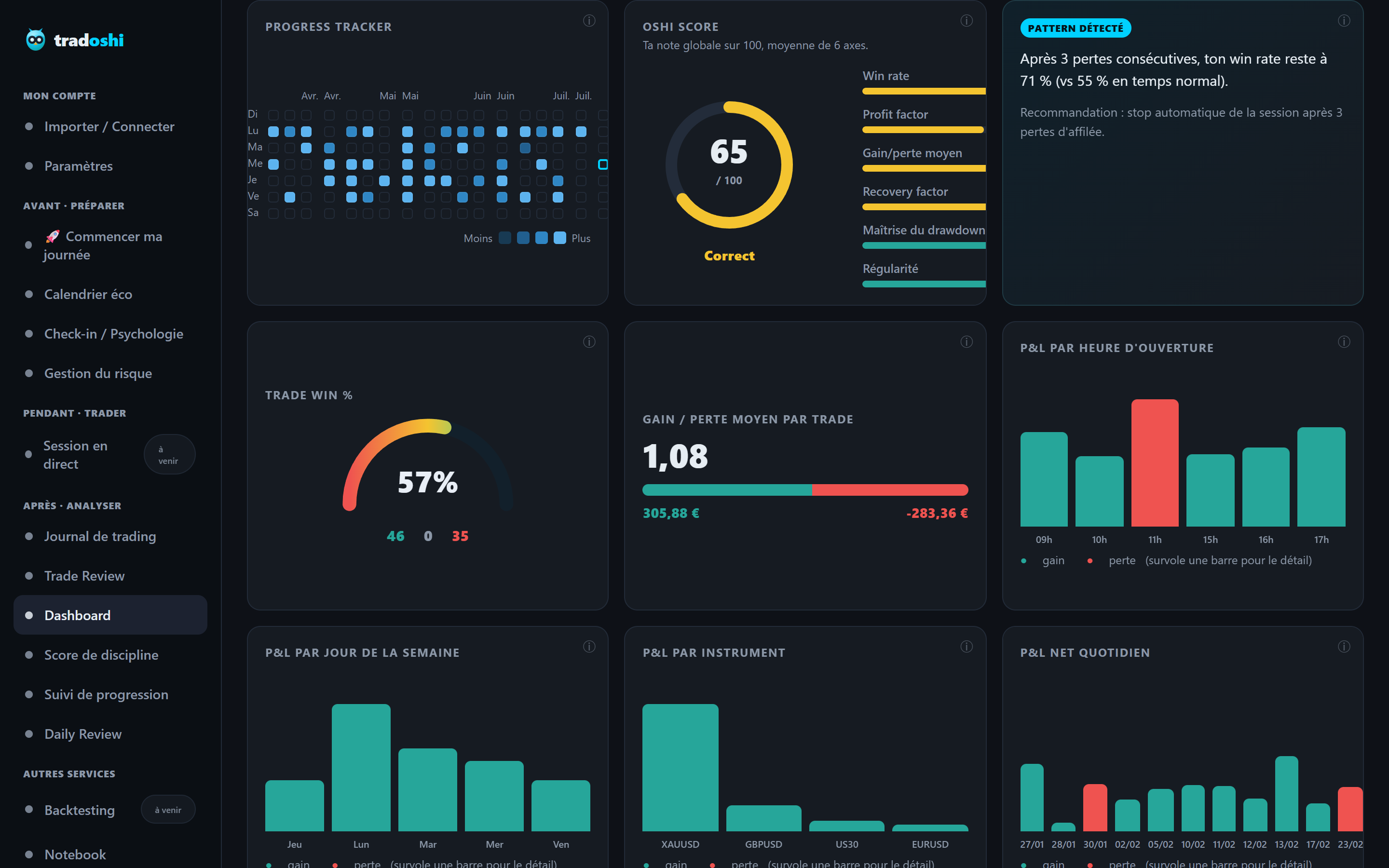
Tradoshi tracks your evaluation or funded account's rules in real time and measures your discipline, to help you pass the challenge then keep the account for the long term.
- Rules tracked: target, drawdown and daily limit tracked against your real performance.
- Real risk per trade: checks you're holding your small-risk strategy, the key to success.
- Discipline score: your behavioral consistency measured day after day, during and after the evaluation.
- Multi-account: track your evaluation account and your funded account with their own rules.
Frequently asked questions
How do I pass a prop firm evaluation?
By treating it as a discipline test, not a speed test. Read and note all the rules before paying, risk small (0.5-1% per trade), set a safety margin below the limits, take only your best setups, apply a strict stop rule, and repeat the same behavior each day without accelerating near the target.
What risk per trade to pass a challenge?
0.5 to 1% per trade. At that level, you can string together several losses without ever grazing the daily limit, leaving your edge time to produce the target. At 5% per trade, a single bad day knocks you out. Trading small genuinely increases your chances, while trading big to go fast destroys them.
Should I reach the target quickly?
No. Most firms set no strict time limit, and even when they do, it's wide enough for a patient trader. Your goal isn't to finish fast but to finish without ever approaching the loss limits. Thinking 'marathon' leads to success; thinking 'sprint' pushes you to trade big and fail.
Why do I fail near the target?
Because of the final relaxation. Near the goal, many candidates change behavior: either they freeze and no longer dare take their setups, or they load up to get it over with by over-risking. Both fail almost-passed accounts. The antidote is to change nothing: same risk, same setups, same discipline, until the target is exceeded and confirmed.
What happens after passing the evaluation?
The real challenge begins. Getting the funded account is only the start: you have to keep it, session after session, respecting the same rules but with real capital and payout pressure. Many pass then lose the account a few weeks later for lack of discipline. The principles that got you through are exactly the ones that will make you keep it.
How long do you keep a funded account?
As long as you respect the rules and stay profitable, potentially for years. But it requires maintaining the same discipline as during the evaluation, indefinitely: trade small, hold your safeguards, aim for consistency. A funded account isn't a secured gain, it's an ongoing responsibility. Approach the evaluation as training for how you'll trade forever.
How do I choose the right prop firm before paying for a challenge?
Check first for rule clarity (drawdown and daily limit computation written without ambiguity), the withdrawal terms once funded, and the firm's reputation from independent reviews. Watch out for rules hidden in the fine print: restrictions on macro announcements, weekend holding, trading robots, or a consistency rule that invalidates performance too concentrated on one day.
How many trades do I need to pass an evaluation?
It depends entirely on your real edge, but you can estimate it from your past statistics: average risk/reward ratio, win rate, risk per trade. This calculation turns an abstract target into a concrete, measurable trajectory, and lets you know whether you're ahead, behind, or on the expected pace through your evaluation.