Everyone analyzes their losing trades, almost nobody analyzes their winners. That's a mistake, because a gain isn't necessarily a good trade, and a good trade doesn't always end in a gain. Analyzing your winners reveals whether you win thanks to your system or thanks to luck, and that distinction is perhaps the most important in your progress.
- A gain isn't necessarily a good trade: you can win by violating your plan.
- Analyzing your winners reveals whether you win by system or by luck.
- Gains by luck are dangerous: they reinforce bad habits.
- Judge your trades on the process, not just the result.
The trader's universal reflex is to dissect their losses and celebrate their gains without looking at them. You tell yourself there's nothing to learn from a trade that worked: it's a success, move to the next. It's exactly the opposite you should do. Your winning trades contain precious and often uncomfortable information: they tell you whether your success comes from your method or a mere stroke of luck.
This distinction is crucial, because a gain obtained by luck, by violating your plan, is a poison disguised as a reward. It reinforces the bad behavior that, repeated, will eventually ruin you. This guide explains why a gain doesn't mean a good trade, how to analyze your winners to tell merit from luck, and why judging your trades on the process rather than the result transforms your progress.
A gain isn't necessarily a good trade
A trade's result and its quality are two different things. A good trade is one taken according to your plan, with a valid setup, controlled risk and clean execution, whatever its result. A gain is only a favorable outcome, which can come from a good trade or from a rotten trade that got lucky. Confusing the two means judging your trading on the wrong dimension.
| Process | Result | Verdict |
|---|---|---|
| Plan followed | Gain | Good trade (to repeat) |
| Plan followed | Loss | Good trade (bad luck, to repeat) |
| Plan violated | Gain | Bad trade (dangerous luck) |
| Plan violated | Loss | Bad trade (to correct) |
This four-cell table is one of the most important in trading. The two left cells (plan followed) are your good trades, to repeat, whether the result is a gain or a loss. The two right cells (plan violated) are your bad trades, to correct, even when they end in a gain. The trickiest cell is 'plan violated + gain': a bad trade disguised as a success, that pushes you to do it again.
Why gains by luck are dangerous
A gain obtained by violating your plan is far more dangerous than a loss. Why? Because it rewards the bad behavior. Your brain records 'I violated my plan and won, so violating my plan pays', and it'll push you to do it again. The gain by luck anchors a bad habit by making it look like a good decision. It's the exact mechanism by which traders learn to sabotage themselves.
A loss teaches you a lesson. A gain by luck teaches you a bad lesson, and the bad lesson costs far more in the long run.
The worst part is that these gains by luck always end up reversing. The impulsive trade that paid off today will make you lose big tomorrow, precisely because you'll have repeated it one time too many, wrongly believing it was a good approach. Analyzing your winners to spot those that were only disguised luck lets you cut these habits before they cost you dearly.
Analyzing your winners: the right questions
Analyzing a winning trade means putting it through the sieve of the process, not the result. Here are the questions to ask about each of your gains:
- Did this trade respect my plan and my entry criteria, or did I take it off-setup?
- Was my risk controlled, or did I win because I over-risked?
- Did I manage the exit per my plan, or did the gain come by chance despite poor management?
- Would I take exactly this trade again in the same conditions, knowing it could have lost?
- Is this gain reproducible, or did it depend on an uncontrollable stroke of luck?
If you answer honestly, you'll discover that some of your gains were real good trades to repeat, and others mere strokes of luck never to reproduce. This distinction, invisible as long as you only look at P&L, is what lets you reinforce what really works and eliminate what only paid off by chance.
Learning from your best real trades
Once you've sorted your gains by luck from your real good trades, your real good trades become a goldmine of learning. They embody your edge at its best: the good setup, the good management, the good execution. By studying them, you understand precisely what works in your trading, and you can seek to reproduce it more often.
Ask the inverse question to the one for losses: what did I do well, exactly, on my best trades? What market conditions, what type of setup, what emotional state produced them? Often, you'll discover patterns: your best trades happen in certain precise conditions, at certain times, in certain states. Identifying those conditions lets you focus on what genuinely works for you.
Judge on the process, not the result
The conclusion of all this is a fundamental mindset shift: judging your trades on the process, not the result. A trade is good if it was well taken, even if it lost; it's bad if it was poorly taken, even if it won. On a single trade, the result is dominated by luck; over many trades, it's the process that decides. By rewarding good process regardless of result, you build the habits that pay over time.
This shift is liberating: it detaches you from the obsession with the immediate result, which activates fear and greed, and focuses you on what you control, your behavior. You stop feeling good when you win by luck and bad when you lose with a good trade. You judge what really matters, and that's exactly what distinguishes traders who progress from those who stagnate despite years of practice.
Identifying the conditions of your best trades
Once you've sorted your real good trades from your strokes of luck, the next step is identifying the conditions that produced them. Go back over your best trades and look for common points: what times of day do they happen? On which instruments? In what market context (strong trend, range, volatility)? What emotional state were you in? These patterns, invisible trade by trade, emerge when you group your best successes.
This identification work has direct value: it tells you where to concentrate your energy. If your best trades almost all happen in a certain context, you can actively seek those conditions and ignore the rest. Many traders scatter their attention across all sorts of configurations when their real edge concentrates on a small number of precise situations. Analyzing your winners lets you discover your true specialty and focus on it, which is often the fastest path to better profitability.
The danger of learning the wrong lessons
Analyzing your winners carries a risk: drawing the wrong lessons if you don't tell merit from luck. A gain obtained by violating your plan but ending positive can make you wrongly conclude that violating your plan is a good idea. That's how traders learn their worst habits: a destructive behavior rewarded by luck once is perceived as a success to repeat, until it ruins you.
To avoid this trap, always separate process analysis from result analysis. The question is never 'did this trade win?' but 'was this trade good, regardless of its result?'. A gain from a bad process is an alarm disguised as a success, not a lesson to reproduce. By systematically judging the quality of your decisions rather than their outcome, you learn the right lessons from your winners and avoid anchoring the bad habits luck temporarily rewarded.
Reproducing excellence, not just correcting errors
Most traders spend all their time correcting their errors and none reproducing their successes. It's a costly imbalance. Correcting your leaks eliminates what makes you lose, but analyzing and reproducing your best trades amplifies what makes you win. Both are necessary, and the second is often neglected when it has just as much improvement potential.
Studying your best real trades lets you understand what your edge looks like when it fully expresses itself: the good setup, the good management, the good execution, the good mindset. By making explicit what, in your best trades, was right, you can seek to reproduce it consciously instead of relying on chance for it to happen again. A trader who knows exactly what their excellence looks like can aim for it deliberately, while one who has never analyzed it can only hope for it.
A numbers example: two winning trades, two different verdicts
Take two fictional trades to illustrate the difference between a gain and a good trade. Trade A: you spot your usual setup, you risk 1% of your capital as your plan calls for, your stop is placed according to your rules, and the trade closes for a gain of 2 R. Trade B: you spot an opportunity outside your usual criteria, you double your size out of excitement, you have no clearly defined stop before entering, and the trade also closes for a gain, say 3 R, even bigger than the first.
On P&L alone, trade B looks better: it paid more. But analyzed on process, trade A is the only good trade of the two. Trade B won despite an uncontrolled size and no defined stop, two breaches that, repeated, will statistically end up producing a loss far bigger than this 3 R gain, the day the market doesn't cooperate. If you only logged the result, you'd conclude that 'taking off-setup trades with a big size works', exactly the wrong lesson that will eventually lead you toward a loss that wipes out several accumulated gains. It's this example, repeated dozens of times in a real journal, that separates a trader who progresses from one who unknowingly repeats their worst habits.
The weekly review of your best trades
Analyzing your winners shouldn't be a one-off exercise done once then forgotten, but a regular routine. The weekly review is the most effective format: at the end of each week, isolate your three or four best trades and put them through the process questions. This rhythm is frequent enough to keep the lessons fresh and actionable the following week, and spaced out enough to give you a sufficient sample of trades to analyze, rather than judging each trade in isolation in the heat of the moment.
If you can share this review with another trader or a mentor, do it: explaining out loud why a trade was good forces you to clearly formulate what you'd otherwise only vaguely sense alone. But even solo, simply blocking a recurring moment for this review, rather than relying on informal, sporadic analysis, turns analyzing your winners into a structuring habit. What isn't repeated regularly eventually disappears from your practice, even good ideas; the weekly review guarantees that analyzing your winners stays alive.
How Tradoshi helps
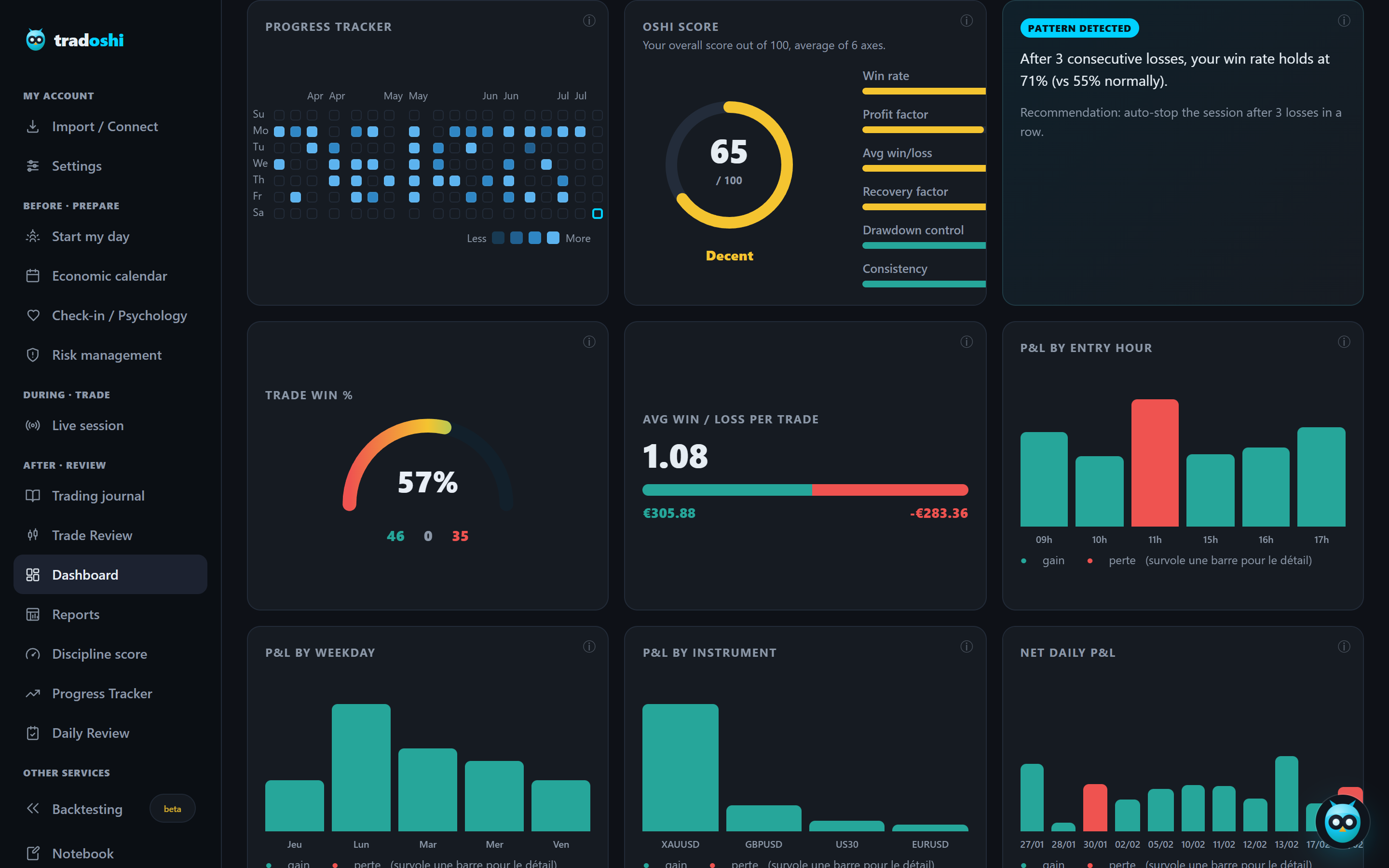
Tradoshi helps you judge your trades on the process as much as the result, by measuring your discipline and plan adherence on each trade, winner and loser alike.
- Discipline score: it assesses whether your trades followed your rules, regardless of their result.
- Emotion and setup tagged: you can link your best trades to their conditions to reproduce them.
- Gains vs discipline: you see whether your gains come from your system or from breaches that got lucky.
- Daily analysis: the daily synthesis links your behavior to your real performance.
Frequently asked questions
Why analyze my winning trades?
Because a gain isn't necessarily a good trade: you can win by violating your plan, by luck. Analyzing your winners reveals whether you win thanks to your system or thanks to chance, a crucial distinction. Gains by luck reinforce bad habits that, repeated, will eventually ruin you. Everyone analyzes their losses, almost nobody their gains, and that's a mistake.
Is a gain always a good trade?
No. A good trade is one taken according to your plan, with a valid setup and controlled risk, whatever its result. A gain is only a favorable outcome, which can come from a good trade or a bad trade that got lucky. The trickiest cell is 'plan violated + gain': a bad trade disguised as a success that pushes you to do it again.
Why are gains by luck dangerous?
Because they reward the bad behavior. Your brain records 'I violated my plan and won, so it pays', and pushes you to do it again. The gain by luck anchors a bad habit by making it look like a good decision. And these gains always end up reversing: the impulsive trade that pays today will make you lose big tomorrow.
How do I analyze a winning trade?
By putting it through the sieve of the process, not the result. Ask: did this trade respect my plan? Was my risk controlled? Did I manage the exit per my plan? Would I take exactly this trade again knowing it could have lost? Is it reproducible or did it depend on luck? These questions separate your real good trades from your disguised strokes of luck.
What should I do with my best trades?
Study them like a goldmine. Once sorted from your gains by luck, your real good trades embody your edge at its best. Ask what you did well exactly: what market conditions, what setup, what emotional state produced them. You'll often discover patterns, and identifying those conditions lets you focus on what genuinely works for you.
Should I judge a trade on the result or the process?
On the process. A trade is good if it was well taken, even if it lost; bad if it was poorly taken, even if it won. On a single trade, the result is dominated by luck; over many trades, the process decides. By rewarding good process regardless of result, you build the habits that pay over time.
How often should I analyze my winning trades?
Ideally every week, isolating your three or four best trades to put them through the process questions. This rhythm keeps the lessons fresh and actionable while giving you a sufficient sample to analyze. Blocking a recurring moment for this review, rather than relying on sporadic analysis, turns analyzing your winners into a lasting habit.
Is a bigger gain always a better trade?
No. A trade taken off-setup, with uncontrolled size and no defined stop, can produce a bigger gain than a disciplined trade without being any better. Judged on process, only the trade that respects your rules is good to repeat: the other just got lucky, and repeated, it will eventually produce a loss that wipes out several accumulated gains.