What's the best trading journal in 2026? Here's our top 10, compared objectively: Tradoshi, TradeZella, TradesViz, Tradervue, TraderWaves, TraderSync, Trademetria, Edgewonk, Myfxbook, and the essential free options. Each has its 'best for', with a head-to-head comparison of the top 3 to help you decide.
- Our #1, Tradoshi, is the only one to combine automatic sync and voice emotion analysis.
- On pure analytics, TradeZella, Tradervue and TradesViz are excellent.
- The most decisive and most neglected criterion remains psychology and emotion.
- The best journal depends on your profile: each tool in this top has its ideal use case.
When you search 'best trading journal', the same names come up: TradeZella, Tradervue, TradesViz, TraderWaves, TraderSync, Edgewonk, not to mention the free options Excel and Notion. If you take the spreadsheet route, start from a free trading journal Excel template rather than an empty grid. All have real qualities, and this ranking doesn't aim to tear down the others to sell one. It compares honestly, on the criteria that matter, and gives each the trader profile it's the best choice for.
A note of honesty upfront: Tradoshi is our product, and we rank it first. Not for show, but because it addresses the real problem of most traders, the one almost all other journals ignore: behavior and emotion. On pure statistical analysis, several competitors in this top are excellent, and we say so clearly. Judge for yourself based on your need. Two detailed head-to-heads are there if you want figures rather than opinions: Tradoshi compared with Edgewonk and Tradoshi compared with JournalPlus, plan by plan and price by price.
The criteria of a good trading journal
Before the ranking, the framework. Here are the criteria we judge each tool on, so you can form your own opinion instead of trusting the marketing.
| Criterion | Why it matters |
|---|---|
| Broker sync | Automating entry = keeping the journal over time |
| Depth of statistics | Expectancy, profit factor, drawdown, R-multiple |
| Emotional tracking | Linking your state to performance, the crux |
| Discipline measurement | Seeing where you drift (revenge, over-risk) |
| Prop firm support | Real-time rule and drawdown tracking |
| Price and accessibility | Free to start, paid when it becomes a profession |
Note that half these criteria aren't about raw numbers but about behavior. That's the point most comparisons miss, and it's exactly where the ranking is decided.
The top 10 best trading journals in 2026
1. Tradoshi — best for discipline and psychology
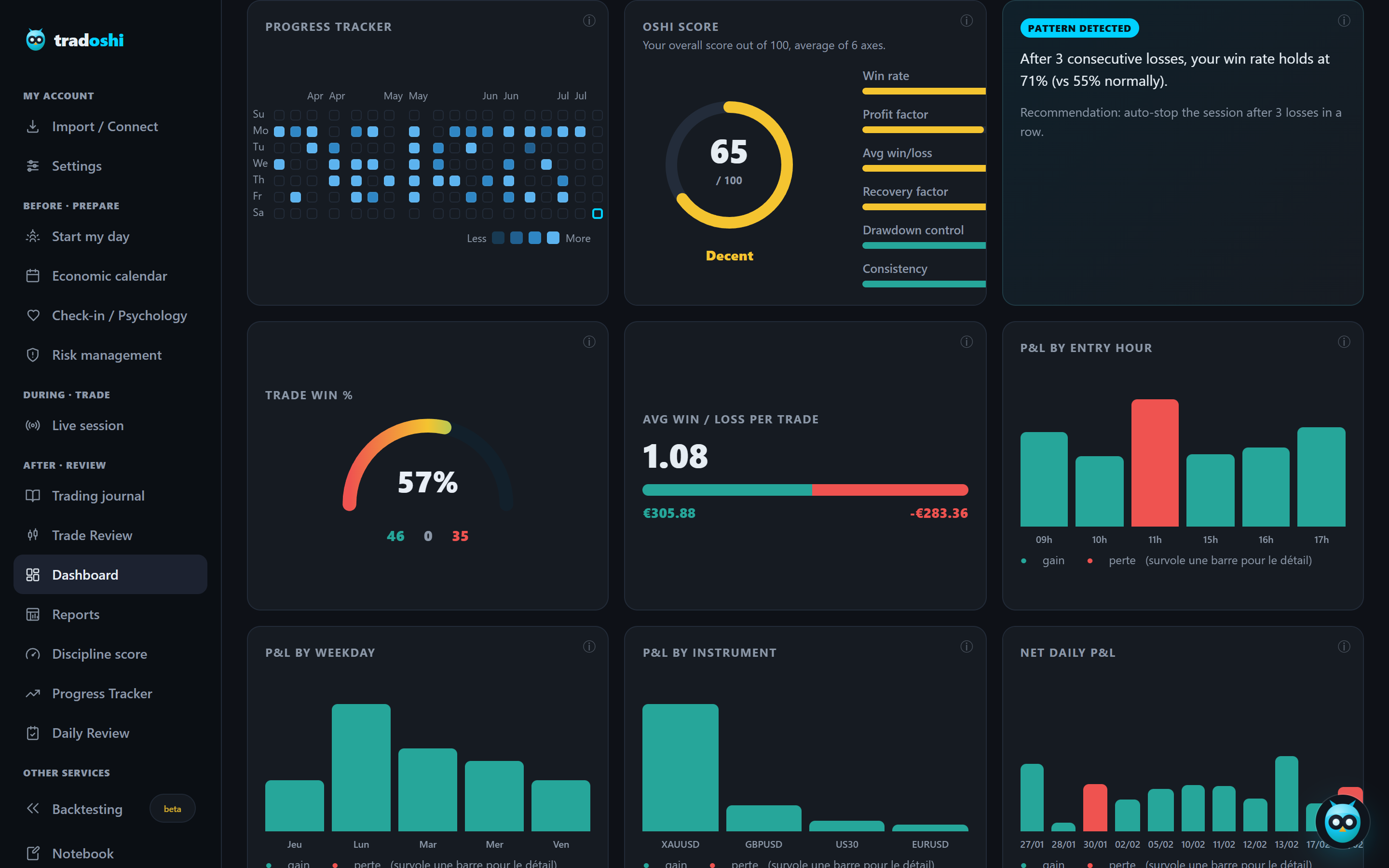
Tradoshi connects automatically to 2,000+ MT4/MT5 brokers (zero entry), generates over 500 reports on your trades (including crossings nobody else has: your emotional state, the market session, your execution rating), then adds the layer almost nobody has: the Oshi Score that rates your discipline across six axes, a voice check-in that analyzes your emotional state before the session, and the emotion-performance crossing that proves which states cost you money. It also covers the rest of the craft: built-in backtesting (candle-by-candle replay, no future leak), a live session with real-time guardrails (email + Telegram alert the moment you break one of YOUR rules), mentoring where your mentor follows you for free, and real-time prop firm rule tracking. Its strength: being the only one to unite the heavyweights' automatic sync AND a real discipline/psychology coach. Its limit: not the best choice for a complete beginner with no budget. Best for: the trader with a decent strategy who self-sabotages, and the prop-firm trader.
2. TradeZella — best all-in-one analytics
TradeZella is modern, complete and very popular, rightly so. It shines on deep statistics, the notebook, backtesting and trade analysis. If your primary need is to dissect your performance with a polished, pleasant tool, it's a benchmark. Its limit: it addresses little of the psychology and daily discipline measurement. Best for: the trader who wants the most accomplished all-in-one analytics.
3. TradesViz — best for data lovers
TradesViz impresses with the richness of its charts and the amount of data it lets you cross, often at an accessible price and with automatic import. For a trader who loves diving into the numbers from every angle, it's a fantastic playground. The trade-off: this richness can be dense, almost intimidating. Best for: the analytical trader who wants maximum data and visualizations.
4. Tradervue — the solid analytics veteran
Tradervue is one of the oldest dedicated journals, known for the depth of its analytics and its sharing features, useful for being followed by a mentor. It has proven itself and remains a reliable choice on statistics. Its more classic interface shows its age a bit against the newcomers. Best for: the trader who wants proven analytics and sharing options.
5. TraderWaves — all-in-one charts and journal
TraderWaves positions itself as a complete platform bringing charts, journal and tools together in one place, with a freemium offer and several languages. No longer juggling several tools is appealing. Like other platforms, it puts its strength mainly on analysis and features, the psychology layer staying secondary. Best for: the trader who wants to combine charts and journal in a single environment.
6. TraderSync — analytics with mistake tracking
TraderSync is an established journal that combines sync, detailed statistics and a particular focus on tracking your mistakes and setups. It's a good compromise for those who want automation and a structured analysis of what works and what doesn't. The emotional dimension and discipline measurement stay secondary. Best for: the trader who wants automated analysis focused on their recurring mistakes.
7. Trademetria — the simple, reliable analytics journal
Trademetria is a quiet veteran, appreciated for its simplicity and reliability on journaling and portfolio tracking. Without frills, it does the basic statistical work cleanly, which suits a trader who wants a sober, direct tool. In return, it's less rich than recent platforms and doesn't address psychology. Best for: the trader who wants a simple analytics journal, no overload.
8. Edgewonk — the most mindset-focused
Edgewonk is one of the rare tools historically built around psychology, with deep emotional tagging and custom analytics. It's an excellent approach to the real problem, and it deserves its reputation among traders who take their mindset seriously. Its limit is automation: entry remains largely manual, which weighs on consistency. Best for: the trader willing to enter data by hand for in-depth mindset tracking.
9. Myfxbook — the verified forex track record
Myfxbook is a reference among forex traders, best known for the verification and public sharing of track records, with automatic analysis of MT4/MT5 accounts and a community dimension. It's more an analysis and performance-proof tool than a complete journal focused on progress. Best for: the forex trader who wants a verified, public track record.
10. Excel & Notion — the best free options to start
Almost everyone's starting point. A spreadsheet (Excel, Google Sheets) is free, flexible and enough to learn the basics; Notion is appealing for writing reflections. Their limits come fast: 100% manual entry (often abandoned), no sync, no emotional tracking, limited calculation. No shame in starting there, it's even advisable. Best for: the complete beginner with no budget who wants to learn to keep a journal.
Head-to-head of the top 3: Tradoshi vs TradeZella vs TradesViz
The top three of the ranking deserve a close head-to-head. Here's how they separate on the points that truly make the difference, objectively:
| Criterion | Tradoshi | TradeZella | TradesViz |
|---|---|---|---|
| Main approach | Discipline & psychology | Analytics + backtesting | Data & visualizations |
| Automatic sync | Yes (2,000+ brokers) | Yes (500+ brokers) | Yes (200+ brokers) |
| Reports & statistics | 500+ reports (incl. emotion, session, execution) | 300+ reports | 600+ stats and visualizations |
| Backtesting | Yes, built-in (candle-by-candle replay) | Yes | Yes (30,000+ symbols) |
| Discipline tracking | Yes (Oshi Score) | Partial (Zella Score, rules) | No |
| Voice emotion analysis | Yes, unique | No | No |
| Live alerts during the session | Yes (email + Telegram when you break your rules) | No | Not published |
| Mentoring | Yes, free for the mentor | Yes (the mentor must subscribe too) | Not published |
| Real-time prop firm | Yes | Yes (PropFirm Sync, dedicated) | No (import, manual calc) |
| Ideal for | The trader who self-sabotages | All-in-one analysis | The data lover |
The verdict, in all honesty: on the number of synced brokers, TradeZella keeps the lead (500+, with a dedicated prop firm section), and TradesViz wins on raw data volume (600+ statistics). But the gap has closed: Tradoshi now ships its own backtesting (candle-by-candle replay, real execution costs) and over 500 reports, including crossings neither of them has (emotion, market session, execution rating). And it pulls ahead on two points neither addresses: voice emotion analysis, and the live session that alerts you by email or Telegram the moment you break one of your rules, not at night while rereading your journal. If your block is yourself, your behavior and your emotions, that's where Tradoshi brings something unique.
The top 10 summary table
The summary on the criteria that matter. The goal isn't to say a tool is bad (all have their qualities), but to show where each puts its strength.
| Journal | Auto sync | Stats | Psychology / discipline | Prop firm |
|---|---|---|---|---|
| 1. Tradoshi | Yes (2 000+) | 500+ reports | Native: Oshi Score + voice analysis | Real-time tracking |
| 2. TradeZella | Yes (500+) | Excellent | Rule-based score (Zella) + AI | Dedicated, real-time |
| 3. TradesViz | Yes (200+) | Very rich | Limited | Import, no rule tracking |
| 4. Tradervue | Yes (80+) | Excellent | Limited | Manual / CSV |
| 5. TraderWaves | Yes | Complete | Limited | No dedicated module |
| 6. TraderSync | Yes (700+) | Detailed | Limited | Futures via CSV |
| 7. Trademetria | Import | Decent (multi-account) | None | Manual |
| 8. Edgewonk | Manual (.htm) | Custom | Strong (emotion) | Limited |
| 9. Myfxbook | Yes (MT4/5, free) | Verified track record | None | Limited |
| 10. Excel / Notion | None | DIY | None | None |
Read this table column by column. On statistics, the big names are excellent. The real difference appears on the psychology/discipline column: that's where almost all the tools are 'limited' or 'manual', and it's exactly the niche Tradoshi is built to excel in, without sacrificing automation.
Why Tradoshi comes first
Let's be factual: on pure statistical analysis, heavyweights like TradeZella or Tradervue do remarkable work, and Tradoshi doesn't claim to outclass them on every chart. What puts Tradoshi at the top of this ranking is that it tackles the trader's real problem. Most traders don't lose because of a bad strategy, but because of their psychology: uncontrolled risk, revenge trading, decisions under emotion. That's precisely the dimension other journals address the least.
The other journals tell you what you did. Tradoshi tells you why you sabotage yourself, and proves it with your numbers.
The most concrete differentiator is voice emotion analysis: before the session, you talk for a few seconds and Tradoshi detects your state (stress, FOMO, fatigue, calm), then links it to your real performance. No other journal in this ranking analyzes your voice to warn you on the days you shouldn't trade. Only one other tool, Edgewonk, goes as deep on emotional tracking, but only with manual entry, no sync. Conversely, TradeZella automates everything but doesn't address emotion. Tradoshi is the only one to unite both: automatic sync AND emotional and voice analysis. That, and only that, is where it pulls ahead of the others.
- Automatic sync: your trades imported from 2,000+ brokers, zero manual entry.
- 500+ reports: expectancy, profit factor, drawdown, R-multiple, MFE/MAE, crossed by hour, session, strategy and emotion.
- Oshi Score: your discipline scored across six axes, destructive behaviors detected.
- Voice emotion analysis: unique in this top, it flags the risky days before you trade.
- Built-in backtesting: replay the market candle by candle, with spread, slippage and commissions, without lying to yourself.
- Live session: real-time guardrails while you trade, email + Telegram alerts the moment a rule breaks.
- Mentoring: invite your mentor for free; they see your stats and comment your trades, no subscription needed.
- Prop firm and multi-account: rules and drawdown tracked in real time.
Which journal for which profile
The best journal depends entirely on who you are. Here are the most useful matches:
| Your profile | The journal that suits you |
|---|---|
| Complete beginner, small budget | Excel or Notion |
| Data and charts enthusiast | TradesViz or Tradervue |
| Trader wanting all-in-one analytics | TradeZella |
| Trader wanting charts + journal combined | TraderWaves |
| Forex trader wanting a verified track record | Myfxbook |
| Trader who self-sabotages (emotion, discipline) | Tradoshi |
| Trader followed by a mentor or trading school | Tradoshi (free for the mentor) |
| Prop-firm / multi-account trader | Tradoshi |
The logic is simple: if your problem is better analyzing your numbers, the analytics heavyweights will do the job very well. If your problem is that you sabotage yourself despite a decent strategy, which is the case for the vast majority of traders, then the psychology and discipline layer will make the difference, and that's Tradoshi's turf.
Free or paid: when to move to a dedicated tool
A free journal (Excel, Notion) is perfectly enough to start. The question isn't free versus paid, but knowing when free costs you more than it saves. The signal to move to a paid tool is clear: it's when manual entry makes you abandon the journal, or when you need automatic sync, emotional tracking, discipline measurement or prop-firm rules.
At that stage, a modest subscription pays for itself fast: a single destructive behavior corrected thanks to this data is worth far more than the tool's price. And since most dedicated solutions in this ranking offer a free trial, the best move is to test before deciding: Tradoshi offers 7 days to make up your own mind, no commitment.
Methodology and sources
This comparison is based on features published by each vendor and on independent comparisons, verified in July 2026. Features and prices change fast, so always check the up-to-date information on each tool's official website before choosing.
- TradeZella — list of supported brokers (500+): help.tradezella.com
- TradeZella — PropFirm Sync (dedicated prop firm tracking): tradezella.com/prop-firm-sync
- TradesViz — automatic sync (200+): tradesviz.com
- Broker comparison (TraderSync 700+, Tradervue 80+): lunefi.com
- Edgewonk — supported platforms (manual import): edgewonk.com/import
- Myfxbook — journal & free MT4/MT5 sync: forexmechanics.com
Frequently asked questions
What's the best trading journal in 2026?
It depends on your need. Our #1 is Tradoshi, because it's the only one to combine automatic sync and a discipline/psychology coach, which addresses the real problem of most traders. For pure statistical analysis, TradeZella, Tradervue and TradesViz are excellent. To start for free, Excel or Notion suffice.
What's the best TradeZella alternative?
TradeZella is excellent on analytics, but light on psychology and discipline. If you're looking for an alternative that adds that layer (discipline measurement, voice emotion analysis, emotion-performance crossing) while keeping automatic sync, Tradoshi is built exactly for that. Tradervue, TradesViz and TraderSync are other solid alternatives on the statistics side.
Tradoshi or TradeZella: which to choose?
TradeZella if you want the most established analytics ecosystem and the largest number of synced brokers. Tradoshi if your real block is behavioral: it adds a discipline and psychology coach (Oshi Score, voice emotion analysis, real-time alerts when you break your rules) that TradeZella doesn't offer, while now covering backtesting, 500+ reports, mentoring free for the mentor, automatic sync and real-time prop firm tracking. Many traders lose because of their psychology, not their analysis.
Is a free trading journal like Excel enough?
To start, yes: Excel or Google Sheets are perfect to learn to log your trades and understand your first statistics. Their limits come fast (tedious entry, no sync, no emotional tracking). The signal to move to a dedicated tool is when manual entry makes you abandon the journal.
Which trading journal for a prop firm?
A journal able to track your prop firm's specific rules (daily loss limit, total drawdown) in real time, ideally with multi-account management. On this point, an app like Tradoshi, which tracks your drawdown live to keep you from burning a funded account on a forgotten rule, far surpasses a spreadsheet or a purely analytical journal.
What makes a good trading journal?
A good journal is easy to keep (ideally automatic), computes the statistics that matter (expectancy, profit factor, drawdown, R-multiple), captures your emotional state and links it to your performance, measures your discipline, and rereads easily. The most neglected criterion by most tools, yet decisive, is psychological tracking, because that's where profitability is decided.
Do I need an automatic trading journal?
Beyond learning the basics, yes. The leading cause of a journal's failure isn't its quality but its abandonment, and manual entry almost always ends up beating your consistency. A journal that syncs automatically with your broker removes that chore and guarantees you'll keep it over time.
Can a trading journal also be used for backtesting?
The best ones, yes. Tradoshi ships a backtesting module that replays the market candle by candle, with no future leak, real execution costs (spread, slippage, commission), and computes your backtest session statistics with the same formulas as your real journal. TradeZella and TradesViz also offer backtesting; Tradervue has none.