Backtesting is supposed to tell you whether your strategy works, but in practice, most backtests are exercises in self-persuasion. Without a rigorous method, you don't test your strategy, you manufacture the proof you wanted to find. Backtesting without kidding yourself requires knowing the traps that turn a good backtest into a comforting, costly illusion.
- A poorly done backtest proves what you want, not what's true.
- Hindsight bias makes you see obvious signals that weren't obvious live.
- Over-optimization creates a strategy perfect on the past, useless on the future.
- An honest backtest follows strict rules: sufficient sample, realistic data, no cheating.
Backtesting is a wonderful tool: it lets you test an idea on historical data before risking a cent. But it's also one of the easiest tools to rig, often without even realizing it. The human brain is a machine for finding patterns and convincing itself, and a poorly framed backtest becomes a mirror that reflects back the conclusion you hoped for.
A backtest that 'proves' your strategy is brilliant is worthless if it's tainted by bias. Worse, it's dangerous, because it gives you unjustified confidence that will make you risk real money on an illusion. This guide explains the classic backtest traps, how to avoid them, and how to run a test honest enough to tell you the truth, even when it's not the one you wanted to hear.
Why most backtests lie
The fundamental problem of backtesting is that it pits your desire to validate your strategy against the rigor needed to test it honestly. When you want a strategy to work, your brain collaborates: it interprets the data favorably, minimizes the bad trades, unconsciously adjusts the rules to improve the results. You don't lie deliberately, but you deceive yourself, which amounts to the same.
That's why a positive backtest should always be viewed with suspicion: the question isn't 'did my strategy perform well?' but 'was my test honest?'. A brilliant result from a biased test is more dangerous than a mediocre result from a rigorous test, because the first makes you risk real money on thin air, while the second at least told you the truth.
Hindsight bias
The most insidious trap is hindsight bias: when you look at a chart of the past, everything seems obvious. The top was clearly there, the break was clean, the entry was obvious. But live, at the right edge of the chart, nothing was obvious: you didn't know if the top would hold, if the break was real, if the signal was valid. The visual backtest makes you believe you'd have taken those perfect trades, when in reality you'd have doubted, hesitated, executed poorly.
On a chart of the past, every trader is a genius. The truth reveals itself at the right edge, where the future is still unknown.
The counter to hindsight bias is testing by advancing bar by bar, without seeing the future, as in real conditions. A market replay that hides what's coming forces you to make your decisions in uncertainty, exactly as live. It's far harder, and far more honest, than a backtest where you contemplate a complete chart already knowing how it ends.
Over-optimization
The second big trap is over-optimization, or overfitting. It consists of tweaking your parameters until the strategy is perfect on the historical data: the best threshold, the best period, the best filter. The result is spectacular on the past and catastrophic on the future, because you've fitted your strategy to the specific noise of your test data, not to a reproducible market reality.
| Robust strategy | Overfitted strategy |
|---|---|
| Few simple parameters | Many precise parameters |
| Good across varied markets | Perfect on a single history |
| Holds out of sample | Collapses on new data |
| Clear logic | Arbitrary opaque settings |
The rule for avoiding overfitting is simplicity and out-of-sample validation. A robust strategy rests on few parameters, with clear logic, and works across several markets and periods. Always test your strategy on data that wasn't used to optimize it: if it holds on that new data, it has a chance of being real; if it collapses, you were just fitting noise.
Realistic data
A backtest is only honest if its conditions resemble reality. Many backtests ignore the spread, commissions, slippage (the gap between expected and obtained price), or assume perfect executions impossible in practice. Over a large number of trades, these ignored costs can turn an apparently winning strategy into a losing one. A backtest without realistic fees is a backtest that lies by omission.
You also need quality data and a sufficient sample. Testing on thirty trades proves nothing: variance dominates, and you can get a brilliant or catastrophic result by pure chance. A credible backtest rests on hundreds of trades, across varied market conditions (trend, range, high and low volatility), to verify the strategy holds in different environments and not just the one that suited it.
From backtest to reality
Even a perfectly honest backtest guarantees nothing, because it only tests the strategy, not the trader. In real conditions, you add a variable the backtest ignores: you. Your ability to execute the strategy without deviating, to hold your stops, not to panic in a drawdown, not to overtrade. An excellent strategy in backtest can become a loser in your hands if you don't execute it as planned.
That's why the real test of a strategy is confronting your backtest with your real results. If your real performance is far below your honest backtest, the problem isn't the strategy, it's your execution. Measuring your real trades and comparing them to what the strategy promised is the only way to tell a strategy problem from a discipline problem.
Backtest, forward test and live account
An honest backtest is only the first step of a three-stage validation. After the backtest (test on past data) comes the forward test (test on new data, in real time but without money), then going live with a small size. Each stage filters illusions the previous one didn't reveal: the forward test eliminates overfitting to the past, and the live account reveals the gap between theory and your emotional execution.
Skipping stages is a costly mistake. Going directly from a nice backtest to a big live account means risking discovering live, with money, that your strategy was overfitted or that you can't execute it. Prudent progression (backtest, then forward test, then live at small size, then gradual increase) protects you by validating your strategy at each stage before committing more. Each level confirms or refutes what the previous suggested, and it's that accumulation of evidence that gives you justified confidence, not a mere flattering backtest.
What a backtest can't capture
Even perfectly done, a backtest has structural limits you must know. It doesn't capture your psychology: on a chart of the past, you didn't feel the fear of loss nor the temptation to cut too early. It also doesn't capture real execution conditions (variable slippage, unfilled orders, delays), nor the exceptional events that weren't in your historical data. A backtest tests a strategy in an idealized world, not the real one.
That's why a good backtest is necessary but never sufficient. It tells you whether your strategy has a chance of working, but it doesn't tell you whether you, with your emotions and in real conditions, can make it work. Keeping these limits in mind spares you the dangerous overconfidence that comes from a brilliant backtest. A strategy's real validation is never entirely done on the past, it's done on your ability to reproduce it in reality, which only real, measured trading can confirm.
Backtesting your behavior, not just your strategy
We almost always backtest a strategy (the entry and exit rules), but forget to backtest the most important variable: yourself. Two traders with the same backtest get opposite real results, because one executes the strategy faithfully and the other deviates. The real 'backtest' that counts is therefore the comparison between what your strategy promised and what you actually got, once passed through the filter of your execution.
This comparison is the most instructive of all. If your real result is close to your honest backtest, your strategy and your execution are aligned. If it's clearly lower, the problem isn't the strategy, it's you: you don't follow it as planned, and it's your discipline to work on, not your method. Measuring this gap between theoretical and real is the only way to know where to focus your efforts, and it almost always reveals that the main improvement lever is behavioral, not technical.
The tools for backtesting seriously
Two broad families of tools exist for backtesting, and they don't replace each other. Manual backtesting means scrolling through a chart bar by bar, noting every trade you'd have taken according to your rules. It's slow, but it's the method that confronts you best with real uncertainty, because you never see the future as you advance. It's irreplaceable for discretionary strategies, based on a visual read of the market, that no code can perfectly capture.
Automated backtesting means coding your rules in a language like Pine Script and letting an engine test them across years of data in seconds. It's incomparably faster and lets you test on huge samples, which solves the sample-size problem discussed earlier. Its limit is that it can only test perfectly objective rules: as soon as your strategy includes a discretionary judgment ('this looks like a good setup'), code can't reproduce it faithfully. The right instinct is often to combine both: automate what's objective in your strategy to validate the statistical core on a large sample, then manually backtest the discretionary nuances on a smaller but realistic sample.
A third option worth knowing about sits between the two: market replay, where you step through historical price action tick by tick or bar by bar inside a simulator that hides the future but still lets you place real orders and manage them as if live. It combines the speed advantage of not having to wait for real time to pass with the honesty advantage of never seeing ahead. For strategies that mix objective entry rules with discretionary trade management, replay is often the most realistic middle ground between a manual chart review and a fully coded engine.
How much time to spend backtesting before going live
There's no universal rule, but here's a useful benchmark: your backtest should cover enough trades and different market conditions for you to trust your statistics, without becoming an excuse to endlessly postpone going live. Some traders backtest for months, endlessly tweaking, which is also a trap: at some point, the only way to learn what a backtest can't capture (your psychology, your real execution) is to start trading, even small.
A pragmatic benchmark is to aim for a backtest of at least a hundred trades covering several market types (trend, range, high and low volatility), then move to forward testing once that threshold is reached and results are stable. The time gained polishing a backtest beyond that threshold is usually less valuable than the time spent observing how you actually execute the strategy under live conditions, on a small account. The backtest tells you whether the idea is good; only real trading, rigorously measured, tells you whether you're capable of executing it.
One practical way to know you've backtested enough is to notice whether new trades keep changing your conclusions. Early on, each additional batch of trades will shift your expectancy and profit factor noticeably, sometimes swinging a strategy from apparently great to merely decent. Once your numbers stop moving much as you add more trades, your sample has become large enough to trust, and further backtesting mostly just delays the moment where you find out how you personally handle the strategy under real pressure.
How Tradoshi confronts your results with reality
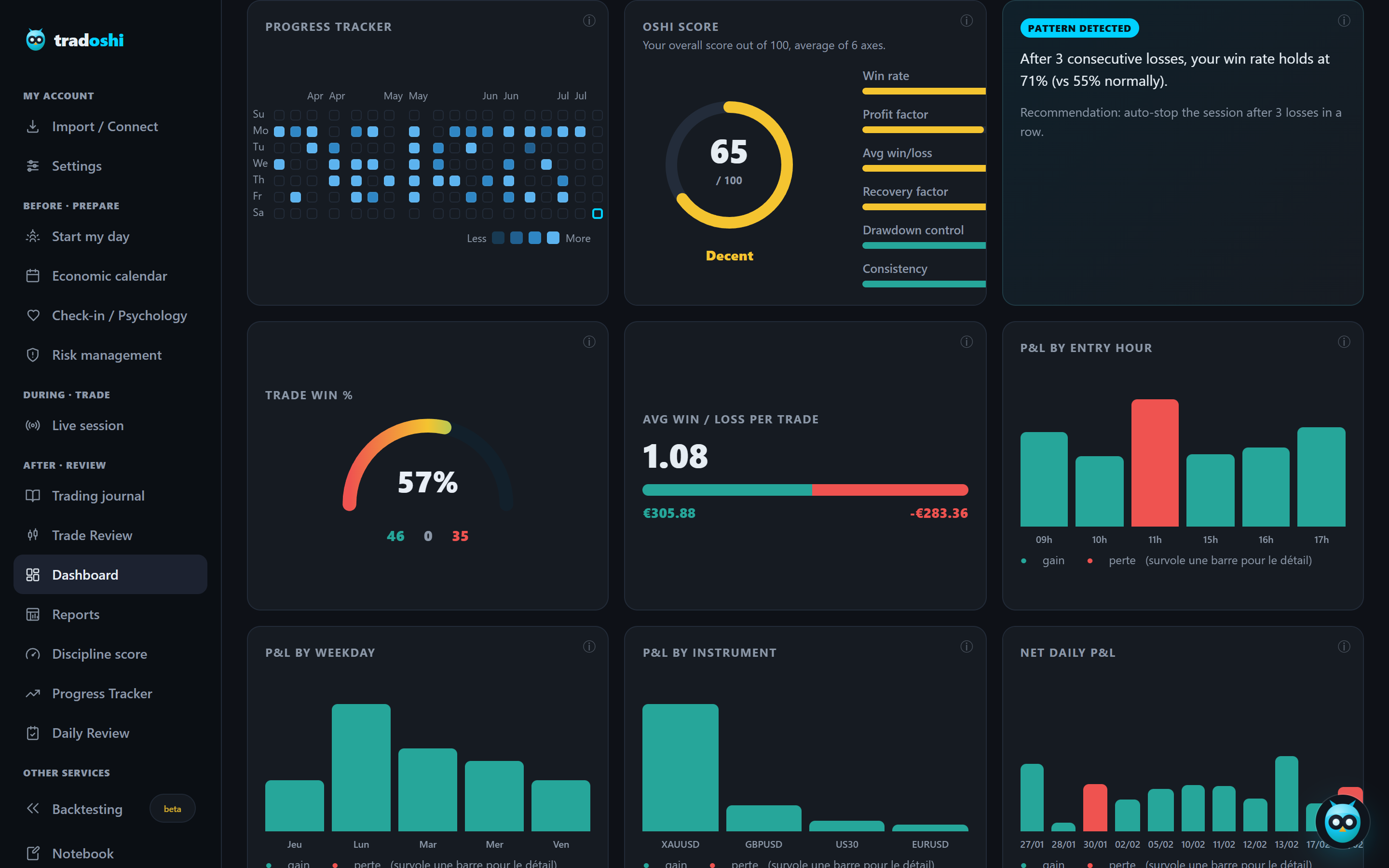
Tradoshi doesn't do the backtest for you, but it gives you your real statistics to confront what your strategy promised with what you actually get, and tell a strategy problem from an execution problem.
- Real stats: expectancy, profit factor and average R computed on your real trades, not an optimistic backtest.
- Backtest / real gap: compare what you expected with your real performance to spot execution problems.
- Discipline score: it tells you whether your underperformance comes from the strategy or your breaches.
- Sufficient sample: your stats are placed in the context of your number of trades to stay credible.
Frequently asked questions
Why are most backtests misleading?
Because without a rigorous method, your brain collaborates with your desire to validate the strategy: it interprets the data favorably, minimizes the bad trades, unconsciously adjusts the rules. You don't lie deliberately, but you deceive yourself. A positive backtest from a biased test is more dangerous than a mediocre result from an honest test.
What is hindsight bias in backtesting?
It's the fact that, on a chart of the past, everything seems obvious: the top was clear, the break clean, the entry obvious. But live, at the right edge of the chart, nothing was obvious. The visual backtest makes you believe you'd have taken those perfect trades, when in reality you'd have doubted and executed poorly. The counter is testing bar by bar, without seeing the future.
What is over-optimization?
It's tweaking your parameters until the strategy is perfect on historical data. The result is spectacular on the past and catastrophic on the future, because you've fitted your strategy to the specific noise of your test data. The counter is simplicity (few parameters) and out-of-sample validation: test on data that wasn't used to optimize.
Should I include fees in a backtest?
Yes, absolutely. A backtest that ignores the spread, commissions and slippage lies by omission: over a large number of trades, these costs can turn an apparently winning strategy into a losing one. A backtest is only honest if its conditions resemble reality, realistic fees included and imperfect executions.
On how many trades should I backtest?
On hundreds of trades, across varied market conditions (trend, range, high and low volatility). Testing on thirty trades proves nothing: variance dominates and you can get a brilliant or catastrophic result by pure chance. A credible backtest verifies the strategy holds in different environments, not just the one that suited it.
Does a good backtest guarantee winning live?
No, because the backtest only tests the strategy, not the trader. Live, you add a variable: your ability to execute without deviating, hold your stops, not panic. An excellent strategy in backtest can become a loser if you don't execute it as planned. The real test is confronting your honest backtest with your real results to tell a strategy problem from an execution problem.
Manual or automated backtesting, which should I choose?
Both have their use. Manual, bar-by-bar backtesting confronts you best with real uncertainty and suits discretionary strategies. Automated backtesting (coded, for instance in Pine Script) tests thousands of trades in seconds but can only test perfectly objective rules. The right instinct is often to combine both: automate the statistical core, then refine the discretionary nuances manually.
How long should I backtest before going live?
There's no universal rule, but aim for at least a hundred trades covering several market types, then move to forward testing once that threshold is reached and stable. Backtesting endlessly for months is also a trap: at some point, only real trading reveals what a backtest can't capture, your psychology and your execution.