You want to start backtesting your strategy but don't know where to begin? Backtesting looks technical and intimidating, but in its simplest form, it only requires a chart, a clear strategy and rigor. This guide shows you how to start backtesting concretely, step by step, and the beginner traps to avoid so your test tells you the truth.
- Start simple: a chart, clear rules, a table to record your trades.
- Define your strategy before testing, otherwise you cheat without realizing.
- Test enough trades (dozens minimum) for the statistics to mean something.
- Be honest: hindsight bias is the number-one enemy of the beginner's backtest.
Backtesting scares beginners because they imagine it reserved for programmers, with code and complicated software. That's false: the most useful backtesting to start is manual, and only requires method. You scroll through a chart, apply your rules candle by candle, and note what would have happened.
This guide gives you the steps to start backtesting without drowning, and above all the traps that make most beginners' backtests useless. Because a badly-done backtest is worse than no backtest: it gives you false confidence in a strategy that, in reality, was never honestly tested.
Manual backtesting, accessible to all
The good news for beginners is that the most instructive backtesting is manual and free. It consists of taking a historical chart, scrolling through it candle by candle, and spotting each time your strategy would have given a signal, as if you were trading live. For each signal, you note the entry, the stop, the exit and the result, exactly as you would in reality.
This manual method has a major advantage for a beginner: it makes you live your strategy. By replaying hundreds of candles, you learn to recognize your setups, see how they behave, and develop an intuition that no automatic backtest would ever give you. It's tedious, but it's a formidable investment in your understanding of your own strategy.
Step 1: define your strategy precisely
Before testing anything, you must define your strategy in a totally precise, written way. What are the exact entry conditions? Where do you place your stop? How do you exit? If your rules stay vague, your backtest will be flawed from the start, because you'll interpret them differently on each trade, often in your favor without realizing.
This step is the most important and most neglected. A backtest only tests precise rules; on vague rules, it tests nothing at all. Take the time to write your strategy like a recipe, with objective criteria a third party could apply without asking you. It's this precision that will make your backtest honest and usable, and that will force you to clarify a strategy often fuzzier than you think.
Step 2: test enough trades
A classic beginner mistake is testing too few trades and drawing conclusions. Over ten trades, chance dominates everything: you can be a winner or loser by pure luck, without it saying anything about your edge. For your backtest statistics to mean something, you need dozens of trades minimum, ideally more.
This requires patience, because manually replaying dozens of trades takes time. But it's the price of a reliable backtest. A test on a sufficient sample gives you stable statistics you can rely on; a test on a handful of trades gives you only noise disguised as information. Resist the urge to conclude fast: first accumulate enough material.
The hindsight bias trap
The number-one enemy of the beginner's backtest is hindsight bias: believing, looking at the past, that you'd obviously have taken a given trade, because you already know what came next. When you see on the chart that price rose, it's terribly easy to convince yourself you'd have bought at the right moment, when in real time, without knowing what came next, you'd have hesitated or not taken the trade.
Looking at the past, everything seems obvious. The real test is whether you'd have taken the trade without knowing the next candle.
This bias completely distorts a backtest by making it artificially optimistic. The counter is rigor: only accept a trade in your backtest if your precise rules would have triggered it, independent of what you know came next. To help, hide the right part of the chart and scroll candle by candle, deciding at each moment as if you didn't know the future. It's the only way to get an honest backtest.
Step 3: analyze and conclude
Once your backtest is done, you analyze your results as you would your real trades: win rate, profit factor, expectancy, maximum drawdown, typical losing streak. These numbers tell you whether your strategy has an edge over the tested period and what its normal behavior looks like. From there you decide whether it deserves to move to the next step.
Be careful not to over-interpret a good result. A positive backtest is encouraging, but it doesn't prove your strategy will win live, only that it could have won on the tested past. It's a necessary, not sufficient, condition. The right mindset is to see the backtest as a first filter: it eliminates clearly bad strategies and gives you benchmarks, before the real test of the forward test in live conditions.
From your backtest to reality
Once a strategy has passed your backtest, don't jump straight to serious capital. The next step is the forward test: applying your strategy forward, on data you haven't seen yet, often on small size or simulated. It's what verifies your edge holds outside the past used to build it, which the backtest alone can't guarantee.
It's also at this moment that tracking your real trades takes over. By comparing your real statistics to those of your backtest, you see whether the strategy keeps its promises or degrades on contact with the real market. This continuity, from manual backtest to forward test then tracking your real trades, is the complete path that turns a strategy idea into a system you can trust.
The tools to backtest without overcomplicating
For your first manual backtest, you don't need anything sophisticated. A chart with a replay function (many free platforms offer one), a spreadsheet to log each trade, and your written rule list next to it are plenty. The replay function is valuable because it hides the right part of the chart and forces you to decide candle by candle, exactly as you would live, which naturally limits hindsight bias.
In your spreadsheet, log at minimum the date, the trade direction, the entry price, the stop, the exit, the result in R, and a comment on the context. This logging discipline, even manual, is already training for keeping a journal, a habit that will serve you well beyond the backtest, once you move to live trading. Resist the urge to complicate the tool before you've accumulated material: a simple, well-filled table beats sophisticated software used badly.
Later, once you want to quickly test a rule variant across thousands of candles, automated backtesting (via a script or dedicated platform) takes over. But that step only makes sense once you've already lived your strategy by hand: coding a backtest for a strategy you've never watched play out manually amounts to automating an unverified hunch, which just multiplies the speed of your mistakes.
The mistakes that distort a beginner's backtest
Beyond hindsight bias, several other traps make a beginner's backtest misleading. The first is overfitting: tweaking your rules until they fit the past data perfectly, adding filter after filter to eliminate every loss you observe. A system thus tailor-carved for the past performs beautifully on the data that shaped it, and almost always collapses on new data, because it never captured a real edge, only the noise of a specific period.
The second trap is testing on a single period or a single market, often a calm bull run that flatters any directional strategy. Test across several market contexts, including tough phases (high volatility, range, downtrend), to see how your strategy behaves when conditions aren't favorable. An edge that only survives under ideal conditions isn't an edge, it's a lucky streak in disguise.
The third trap, often forgotten by beginners, is ignoring fees and slippage. A backtest that counts neither transaction costs nor the price slip between the signal and actual execution systematically overstates performance, sometimes dramatically for a high-frequency strategy. Bake a realistic estimate of these costs into your calculations right from the manual backtest, so you don't discover the difference the hard way once live.
A worked example to understand walk-forward testing
Imagine you backtest a strategy on two years of historical data and get a profit factor of 1.6 with a 45% win rate. That number alone doesn't say much about your strategy's robustness, because it may have been achieved by tweaking your rules precisely to fit those two years. The walk-forward method splits your history into two blocks: you build and adjust your strategy on the first block (say, the first year), then test it, without changing anything further, on the second block (the following year).
If your strategy keeps comparable statistics on the second block, never seen during construction, that's a far stronger signal than a simple global backtest: it has a behavior that generalizes, not just a performance carved to fit. If instead it collapses as soon as it meets unseen data, you've just detected overfitting that a global backtest would have hidden. This habit of separating construction from validation, even in a simple, manual way, is one of the most powerful guardrails against self-deception in backtesting.
Adapting your backtest to your trading style
The backtest method changes with your horizon. For scalping or day trading on short timeframes, you'll need to replay a huge number of candles to accumulate enough signals, which makes the manual backtest longer but also richer in repetitions, so more formative for your eye. For swing trading on wider timeframes, each signal is rarer, and you'll need to cover a longer historical period to get a sufficient sample.
Either way, keep in mind that the number of trades matters more than the calendar duration tested. Twenty trades over six months of scalping and twenty trades over three years of swing trading represent the same level of statistical information, even though the second seems to cover 'more time'. Don't be impressed by a long tested period if it actually contains only a handful of signals: it's trade volume, not the calendar, that makes a backtest solid.
What a backtest can never tell you
Even perfectly executed, a manual or automated backtest has a structural limit: it doesn't reproduce the psychological pressure of trading with real money on the line. Replaying a chart without your account at stake removes a huge part of the real difficulty, that of holding a decision when your stress rises, when the position moves against you, or when a losing streak piles up in front of you in real time. A backtest tells you whether a strategy has a mathematical edge, not whether you, specifically, will be able to execute it under pressure.
That's why even a flawless backtest never excuses you from the forward test in live conditions, first on a size small enough that the emotional stakes stay manageable. This gradual progression, from the risk-free historical chart to a small real size and then to your target size, lets you separate the two questions a backtest alone often conflates: does the strategy work, and do I know how to apply it. Many valid strategies fail not because they were bad, but because this second test was never done seriously.
Keeping this limit in mind also avoids a common beginner disillusion: discovering that an excellent backtest doesn't immediately translate into identical live results, and wrongly concluding the backtest was useless. The backtest remains an indispensable filter, it eliminates clearly losing strategies and gives you reliable statistical benchmarks, but it must be complemented, never confused with the final validation that only tracked, measured live trading can provide.
How Tradoshi takes over after the backtest
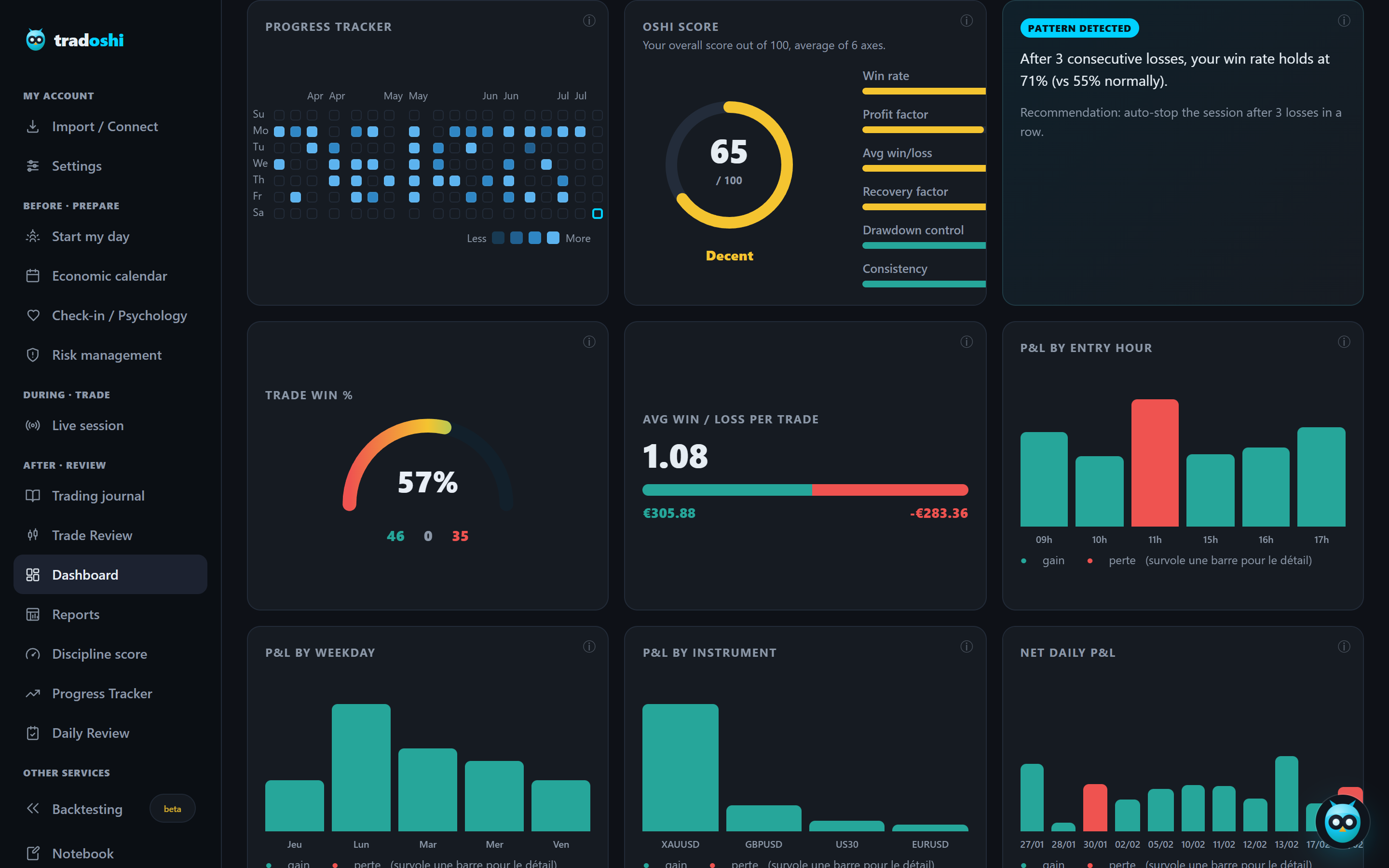
Once your strategy is tested and launched live, Tradoshi tracks its real statistics to verify it keeps your backtest's promises. It's your permanent forward test.
- Real statistics to compare directly to your backtest benchmarks.
- Real drawdown and losing streak to see whether they match your expectations.
- CSV import to also integrate your backtest or demo account results.
- Tracking over time to detect an edge that degrades on contact with the real market.
Frequently asked questions
How do I start backtesting as a beginner?
Start simple and manual: take a historical chart, scroll through it candle by candle, and spot each signal your strategy would have given, noting entry, stop, exit and result in a table. No code needed. First define your strategy precisely, test dozens of trades minimum, and be totally honest about what you'd really have done.
Do I need to code to backtest?
No, not to start. The most instructive backtesting is manual: you replay a chart candle by candle and apply your rules. It's tedious but it really makes you live your strategy and develop an intuition for your setups. Automated backtesting (with code or software) comes later, when you want to test fast on lots of data.
How many trades for a reliable backtest?
Dozens minimum, ideally more. Over ten trades, chance dominates everything and your results mean nothing. You need a sufficient sample for your win rate, profit factor and expectancy to become stable. Resist the urge to conclude fast: first accumulate enough material.
What is hindsight bias in backtesting?
It's believing, looking at the past, that you'd obviously have taken a given trade because you already know what came next. When you see price rose, it's easy to convince yourself you'd have bought at the right moment, when in real time you'd have hesitated. This bias makes the backtest artificially optimistic. The counter: hide the right part of the chart and decide candle by candle.
What do I do after a positive backtest?
Don't jump straight to serious capital. A positive backtest only proves the strategy could have won on the tested past, not that it will win live. The next step is the forward test: applying the strategy forward on unseen data, often on small size, then tracking your real trades to verify the edge holds.
What is overfitting in backtesting?
It's tweaking your rules until they fit the past perfectly, adding filter after filter to eliminate every loss observed. A system thus tailor-carved performs beautifully on the data that shaped it, but almost always collapses on new data, because it captures noise rather than a real edge.
What is the walk-forward method?
It splits your history into two blocks: you build and adjust your strategy on the first block, then test it without changing anything on the second, never seen during construction. If the statistics stay comparable, it's a far stronger signal of robustness than a simple global backtest, and it catches overfitting a global test would hide.