 By Benjamin Roure L'Hermitte
Backtesting tests your strategy on the past, forward testing tests it on the future. This seemingly subtle difference is actually fundamental: it separates a strategy that looks like it works from a strategy that really works. This guide explains the difference between backtesting and forward testing, why both are indispensable, and in which order to use them to validate a strategy without fooling yourself.
- Backtesting tests on past data, forward testing on new data.
- The forward test is the real judge: it verifies the edge on data never used to build the strategy.
- Backtest filters, forward test confirms: they're complementary, not interchangeable.
- Order matters: backtest first, forward test next, serious capital last.
A strategy can show a superb backtest and fail live, and the gap between the two is not an impression: it has been measured, on populations other than retail traders, by the studies cited below. It's not a paradox, it's the direct consequence of a trap that forward testing precisely helps avoid, and one you meet as soon as you discover backtesting. Understanding the difference between these two forms of testing is essential to avoid committing your capital to an illusion.
Backtesting and forward testing don't oppose each other, they complement each other in a validation sequence. Each plays a distinct role, and skipping either amounts to validating your strategy halfway. This guide clarifies what each really tests, why both are necessary, and how to chain them to commit serious money only to a truly proven strategy, with concrete benchmarks on how long to plan for and the psychological pitfalls specific to each stage.
Two tests, two questions
Before going further, it helps to clearly separate the two steps. Backtesting looks behind you, forward testing looks ahead, and the two answer different questions. Backtesting asks: would this strategy have won in the past? It applies your rules to historical data to simulate your trades. Forward testing asks: does this strategy win on data it has never seen? It applies your rules forward, on data later than that used to build the strategy.
This distinction is crucial, more than it first appears, because the two questions don't have the same value. Answering yes to the first is necessary but easy to rig, deliberately or not. Answering yes to the second is far harder and far more meaningful, because it proves your edge exists independent of the data used to calibrate it. Keeping a slice of history aside is not enough to ask that second question: in the NBER working paper by Harvey, Liu and Zhu, which deals with the factors claimed to explain stock returns, the authors note that holding out some data is not genuine out-of-sample testing, since all of that data remains observable to the researcher, and that a real out-of-sample test needs data in the future. That is exactly what a forward test does, and it is what makes it a far stricter and more reliable judge than backtesting: it can't be reworked after the fact the way an over-optimized backtest can.
The problem the forward test solves
Forward testing exists to solve a fundamental backtesting problem: overfitting. When you build and optimize a strategy on past data, you risk adjusting it so much to that precise data that it becomes useless for other data. The backtest, computed on the same data used to calibrate the strategy, can't detect this overfitting, because it plays at home. The size of the trap has been quantified: according to the article by Bailey, Borwein, López de Prado and Zhu published in 2014 in the Notices of the American Mathematical Society, trying only seven independent configurations of a strategy with no edge, on a two-year backtest, is enough for the best one to show an expected Sharpe ratio of 1 in sample, while its expected Sharpe ratio out of sample is 0. The habit has a name, data snooping, which Halbert White's paper published in 2000 in Econometrica calls endemic: once the same data set is used more than once to select a model, a good result may simply be due to chance. The biases that creep into the test itself, before any new data, are the subject of how to backtest a trading strategy honestly.
Optimizing a strategy then judging it on the same data is like taking an exam whose questions you wrote. The forward test is the surprise exam that reveals what you really know.
The forward test solves this problem in the simplest possible way: by changing terrain entirely. By testing the strategy on data it has never seen, it verifies it has a real edge and not just an ability to fit the past. An overfitted strategy, brilliant and convincing in backtest, arrives in the forward test with no expected edge, which reveals its true nature before it costs real money. On one condition: that it covers a single configuration, chosen before you start. The article cited above notes that holding out part of the data does not take into account the number of trials attempted before a setting is kept, and so cannot assess how representative a backtest is; the same authors, in 'The Probability of Backtest Overfitting', published in 2017 in the Journal of Computational Finance, find these standard techniques unreliable and inaccurate in the context of investment backtests. Forward testing ten variants and keeping the best is a backtest on fresh data, with the same trap. It's this ability to unmask overfitting, applied to one strategy at a time, that makes forward testing indispensable, no matter how carefully the initial backtest was built.
The forms of forward testing
Forward testing can take several forms, from the most cautious to the most committed. The safest form is paper trading, or simulated trading: you apply your strategy in real time but without money, noting your trades as if they were real. A broker's demo account is its most common form, and TradingView's documentation on its Paper Trading presents the two as one and the same tool, which places orders with simulated money and, in its own words, an execution experience identical to real trading, minus the financial risk. This lets you test on new data with no risk, at the cost of incomplete realism, on execution as much as on emotion.
The most revealing form is the forward test on small real size: you trade your strategy with real money, but risking very little. This adds the psychological dimension and the real frictions that a simulation doesn't fully reproduce, and the platforms say so themselves. According to Interactive Brokers' documentation on its paper trading accounts, orders in a simulated account never execute on any exchange, fills are simulated from the top of the book with no deep book access, and stop orders are always simulated, which may result in slightly different behavior from a production account. At TradingView, the announcement of commissions in Paper Trading states that they are turned off by default. You can combine both: paper trading first to verify the mechanics, then small real size to validate in authentic conditions before scaling up. This gradual progression limits financial exposure during the most uncertain phase of the process, the one where the strategy hasn't yet proven it holds up on unknown data.
The validation order
The effectiveness of these tests comes from their chaining in the right order. You always start with the backtest, by hand or with a program, because it's fast and eliminates bad ideas cheaply: no point forward testing for weeks a strategy that already loses on the past. The backtest is the first filter, the one that quickly sorts the promising from the hopeless, and free backtesting software is enough to run it.
| Step | Role | What it validates |
|---|---|---|
| 1. Backtest | Fast filter | Does the idea have a semblance of edge? |
| 2. Forward test | Strict judge | Does the edge hold on new data? |
| 3. Small size | Real test | Does the edge hold with fees and emotions? |
| 4. Scaling up | Deployment | Gradually, once the edge is confirmed |
This sequence protects your capital at each and every step along the way. A strategy only ever deserves to move to the next step if it clearly passed the previous one, and serious capital only ever comes last, once the edge has been confirmed end to end and not before. Skipping a step, notably the forward test, means committing real money to a strategy that has only ever proven one single thing: that it fit well a past you chose yourself.
Real tracking extends the forward test
Forward testing doesn't stop when you go live, it naturally extends into tracking your real trades. Each real trade is an additional data point that confirms or refutes that your edge holds over time. By continuously comparing your real statistics to those of your backtest, you verify your strategy keeps working and detect early any degradation.
This continuity is essential because an edge is never definitively acquired, and treating a validated strategy as permanently safe is one of the quieter ways traders let their guard down over time. The decay has been measured on long series. In the study by Sullivan, Timmermann and White published in 1999 in the Journal of Finance, 7,846 technical trading rules are applied to one hundred years of daily Dow Jones prices: over 1897-1986, the best rule beats the benchmark even after adjusting for data snooping, but over the following ten years, 1987 to 1996, the authors find scant evidence that any technical rule had economic value. On another population, 97 variables shown to predict stock returns, the study by McLean and Pontiff published in 2016 in the Journal of Finance measures portfolio returns 26% lower out of sample and 58% lower after publication. Neither study covers retail traders, but the mechanism applies to any system: market conditions evolve, and a validated strategy can degrade over time. Tracking your real trades is therefore a permanent forward test, telling you at any moment whether your edge still holds. It's the last link in a validation chain that goes from the initial backtest to the continuous tracking of your real performance.
How long should a forward test run?
The duration question comes up often, and the answer depends less on the calendar than on the number of trades. The benchmark you read everywhere, 30 to 50 trades, is a custom, not a statistical threshold. The arithmetic shows it: with the confidence interval presented in the NIST statistics handbook, from the US standards institute, a 50% win rate measured on 30 trades lies, at 95%, between roughly 33% and 67%, between 37% and 63% on 50 trades, between 40% and 60% on 100 trades, and it takes 400 trades to narrow it to between 45% and 55%. At 30 trades, a forward test therefore cannot tell a 45% strategy from a 60% one. For a strategy taking one trade a day, 100 trades is twenty weeks; for one taking a trade a week, close to two years.
That constraint changes what you can expect from a forward test. On its own, it will rarely prove your edge exists: its job is to catch a gross gap with the backtest, an error in applying the rules or a behavior you had not planned for, and then to carry on as the tracking of your real trades, where the sample eventually grows. A forward test cut after five or ten trades, on a feeling, says nothing: at ten trades, the same 50% win rate lies between roughly 24% and 76%. A shortened forward test adds almost no extra guarantee over the backtest alone.
The pitfalls of forward testing
Forward testing has its own pitfalls, distinct from those of backtesting. The first concerns paper trading: with no real money on the line, the psychological pressure is different, and it is possible to take simulated trades you would not have taken with real capital, or conversely to cut a position with less hesitation. The US futures regulators have written it into a mandatory statement: CFTC Rule 4.41 requires the commodity pool operators and commodity trading advisors it covers, when they present simulated results, to state that they do not represent actual trading and that trades which were never executed may have under- or over-compensated for the impact of market factors such as lack of liquidity, and NFA Compliance Rule 2-29, from the self-regulatory organization of those markets, adds in its prescribed statement that hypothetical trading does not involve financial risk, and that the ability to withstand losses or to adhere to a particular trading program in spite of trading losses are material points which can adversely affect actual trading results. Paper trading tests the strategy's mechanics, but tests your ability to execute it under real pressure poorly.
The other classic pitfall is premature abandonment: after a losing streak early in the forward test, the temptation is to conclude that the strategy doesn't work, when that streak might well be part of the normal behavior the backtest already predicted. Before judging a disappointing forward test, compare its results to the backtest's benchmarks (maximum drawdown, typical losing streak) to know whether the gap is really significant or just normal variance, the kind the intervals given above make visible.
A worked example: from backtest to forward test
Let's take a concrete example. A trader backtests a strategy over three years of data and gets a profit factor of 1.6 with a maximum drawdown of 12%. They then run a forward test on small real size and, after 40 trades, observe a profit factor of 1.3 with a 9% drawdown. These numbers differ from the backtest, which is normal: at 40 trades, a 50% win rate is known to within about fifteen points, and the gap between 1.3 and 1.6 cannot be told from chance. What is judged is that the benchmarks hold: the strategy remains profitable, and its drawdown stays within the backtest's limit.
A different scenario: this same trader could instead observe, after 40 forward-test trades, a profit factor of 0.7 with a 22% drawdown, close to double the backtest's maximum drawdown and beyond the one-and-a-half-times threshold, 18%, set before starting. In that case, the signal is clear: the strategy isn't behaving as expected on new data, the classic sign of overfitting in the initial backtest, or of an error in applying the rules. The difference between these two scenarios illustrates exactly why forward testing exists: it reveals what the backtest alone can never prove.
When to stop a failing forward test
Knowing when to stop a disappointing forward test matters as much as knowing when to start one. The simplest rule is to set a clear failure threshold before launching the forward test: for example, a drawdown exceeding one and a half times the backtest's maximum drawdown, or a losing streak clearly longer than the one observed in backtest. That one-and-a-half multiplier is a convention, not a statistical threshold: its value lies in being set cold, before seeing the first results, which keeps you from moving the goalposts afterward to convince yourself the strategy still works.
If that threshold is crossed, the healthiest decision is to stop the forward test, go back to the backtest, and look for what changed: different market conditions, an error in the real-world implementation of the rules, or simply overfitting in the initial backtest. Continuing to trade a strategy that has clearly failed its forward test, hoping it will catch up, is one of the surest ways to turn a controlled loss into serious damage.
Adjusting position size during the forward test
A practical question comes up often: what position size should you use during a real forward test? The most cautious answer is to risk a fraction, say a quarter or a fifth, of your usual position size, while the strategy proves itself on new data. There is no statistically correct fraction: it has to be small enough to limit the damage if the strategy fails, and large enough to keep real money on the line so the psychological pressure stays authentic.
Once the forward test succeeds, scaling up should stay gradual rather than abrupt: doubling your size all at once after a good forward test exposes you to a behavior change that nothing has tested. Scaling up in stages, re-validating at each step that the strategy keeps behaving as expected, beats jumping straight to the target size.
How Tradoshi ensures your permanent forward test
You can run the backtest itself in Tradoshi: the Backtesting module, in beta, replays history candle by candle, simulates your orders with realistic costs and scores each session with the same statistics as your journal. It's included from the Pro plan.
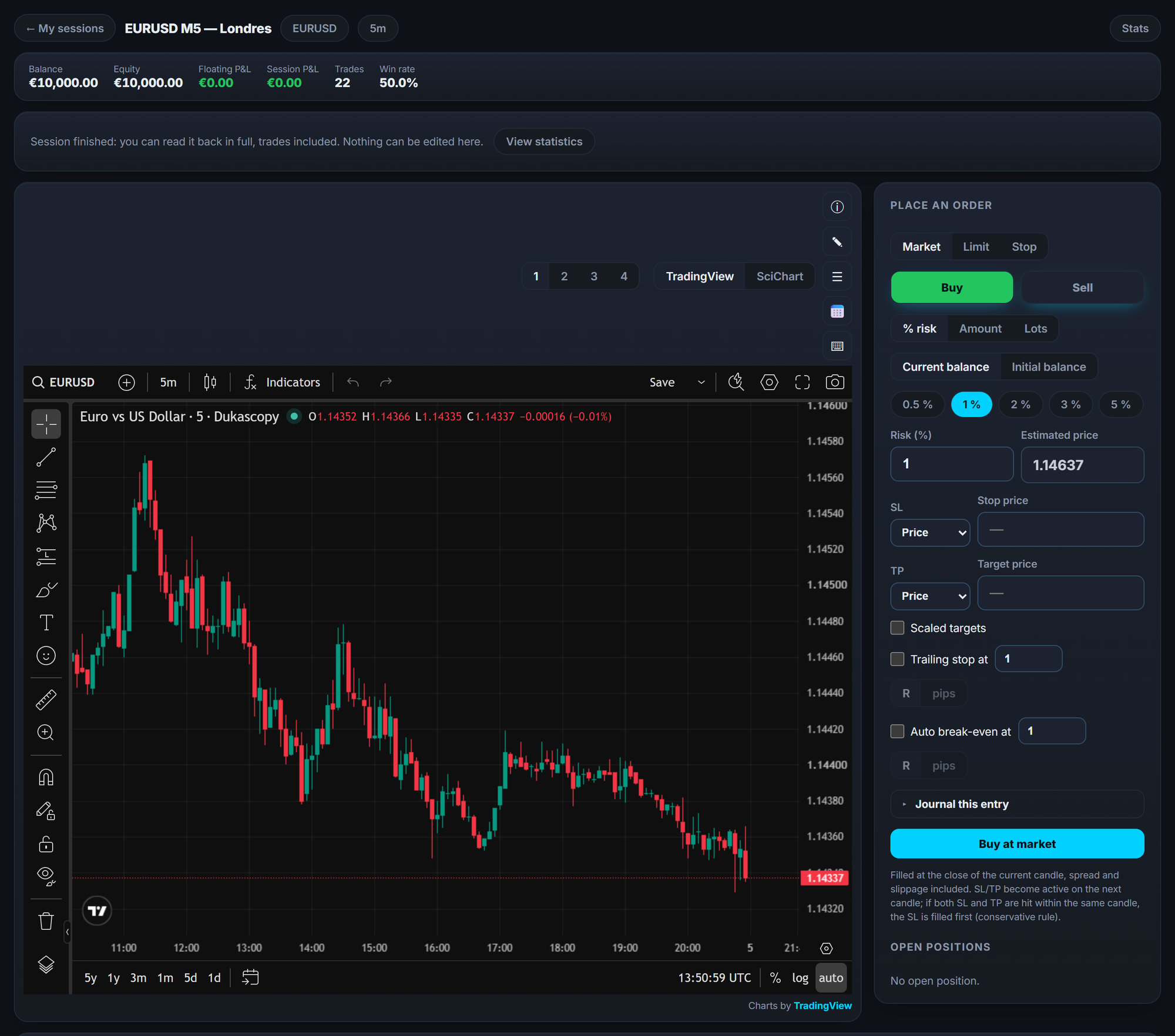
Tradoshi is your permanent forward test: it tracks your real statistics and compares them to your backtest benchmarks, to continuously verify your edge holds on the new data of your real trading.
- Real statistics updated on every sync, to compare to your backtest.
- CSV import to integrate your paper-trading or demo-account results into your tracking.
- Real drawdown and losing streak to verify they stay within your benchmarks.
- Tracking over time to detect early an edge that degrades, the real risk of a validated strategy.
Frequently asked questions
What's the difference between backtesting and forward testing?
Backtesting tests your strategy on past data (would it have won yesterday?), forward testing tests it on new data it didn't use to be built (does it win on unknown data?). The forward test is a far stricter and more reliable judge, because it proves the edge exists independent of the data used to calibrate it.
Why is forward testing so important?
Because it solves the overfitting problem, which the backtest can't detect. A strategy over-optimized on past data can show a superb backtest then collapse live. The forward test, by testing it on never-seen data, unmasks this overfitting before it costs real money.
What is paper trading?
It's a form of forward testing where you apply your strategy in real time but without real money, noting your trades as if they were real. This lets you test your strategy on new data with no financial risk, at the cost of a slight lack of emotional realism and frictions (fees, execution) that a small-real-size test reproduces better.
In which order should I validate a strategy?
Backtest first (fast filter that eliminates bad ideas and gives benchmarks), then forward test (strict judge on new data, in paper trading then small real size), and finally gradual scaling up once the edge is confirmed. Serious capital comes last. Each step is only crossed if the previous one succeeded.
Does forward testing stop when you go live?
No, it extends into tracking your real trades. Each real trade confirms or refutes that your edge holds over time. By continuously comparing your real statistics to your backtest, you detect early any degradation, because an edge is never definitively acquired: market conditions evolve and a validated strategy can degrade.
How many trades do you need for a reliable forward test?
There is no statistical threshold at 30 or 50 trades, that is a custom. At 30 trades, a 50% win rate lies, at 95%, between roughly 33% and 67%; at 100 trades, between 40% and 60%; it takes 400 trades to narrow it to between 45% and 55%. A forward test therefore serves first to catch a gross gap with the backtest, then carries on as the tracking of your real trades. Cut after five or ten trades, it adds almost no extra guarantee over the backtest alone.
When should you stop a failing forward test?
Set a failure threshold before launching the test, for example a drawdown exceeding one and a half times the backtest's. That multiplier is a convention, not a statistical threshold: its value lies in being set before seeing the results. If that threshold is crossed, the healthiest decision is to stop, go back to the backtest, and look for what changed, rather than continuing to trade while hoping the strategy catches up.
Is a demo trading account enough for a forward test?
For the mechanics, yes: a demo trading account applies your rules in real time, on data your backtest has never seen, and that is a forward test. What it leaves out, the platforms document themselves: at Interactive Brokers, orders in a simulated account never execute on any exchange, fills are simulated from the top of the book and stop orders are always simulated; on TradingView, Paper Trading commissions are turned off by default. Switch the fees on, log your trades as if they were real, then move to small real size to test what no simulation contains: your behavior when the loss is real.