Crypto trading means buying and selling digital assets like bitcoin or ether to try to profit from their price movements, on markets that run continuously, with no closing day or hour. It's a world that looks like forex or stocks on the surface, but several mechanics (a market that never sleeps, the funding rate, custody risk) make it structurally different. This guide explains the basics of crypto trading and what really sets it apart from other markets.
- Spot and futures/perpetuals are the two main ways to trade crypto, with very different risk profiles.
- The market never closes, which profoundly changes the psychological load compared to a market with fixed hours.
- Crypto volatility far exceeds that of forex or major stocks, in both directions.
- Where you hold your funds matters: leaving crypto on an exchange isn't the same as holding it yourself.
Crypto attracts for good and bad reasons: a young, highly volatile market, accessible with minimal capital, and an entirely digital infrastructure that lets you open an account in minutes. The very features that make it appealing are also what make it demanding, especially for a trader used to more traditional, more regulated markets.
This guide covers the two main ways to trade crypto, how the funding rate works on perpetuals, the psychological impact of a market that never closes, the volatility level specific to this asset class, the question of custody, and what that concretely changes for a trader keeping a serious journal.
What crypto trading is
Crypto trading means buying and selling cryptocurrencies, like bitcoin, ether or other digital assets, aiming to profit from their price swings. Unlike a stock, a cryptocurrency doesn't represent a piece of a company, and unlike forex, it's not backed by any national economy: its value rests on supply and demand, the perceived utility of the underlying network, speculation, and sometimes simple trends or market sentiment.
This market grew up outside traditional financial channels, via specialized trading platforms, exchanges, which let you buy, sell and sometimes borrow cryptocurrencies with leverage. This recent origin and still-forming structure explain why some protections usual on other markets (strict regulation, deposit guarantees) remain partial or nonexistent depending on the platform and jurisdiction used.
Spot vs futures and perpetuals
Trading spot means directly buying the digital asset itself: if you buy bitcoin spot, you actually own that bitcoin, which you can then hold, transfer or resell. It's the crypto equivalent of buying a stock: no leverage by default, risk limited to the amount invested, and real ownership of the underlying asset.
Trading futures or perpetuals, on the other hand, means opening a contract that tracks the asset's price without ever actually holding it, generally with leverage. Classic futures have a fixed expiration date, while perpetuals, an innovation specific to crypto, never expire and can theoretically be held indefinitely. The leverage available on these products is often much higher than in forex or stocks, which considerably amplifies liquidation risk in the event of an adverse move.
| Trading mode | Actual ownership | Typical leverage | Main risk |
|---|---|---|---|
| Spot | Yes | None or low | Decline in the asset's price |
| Futures | No, contract with expiry | Often high | Liquidation before expiry |
| Perpetuals | No, contract without expiry | Often very high | Liquidation + funding rate |
The funding rate, a mechanic specific to perpetuals
Since a perpetual contract has no expiration date, it needs a mechanism to stay aligned with the underlying asset's spot price: that's the role of the funding rate. Periodically, often every eight hours, a payment is exchanged between long and short positions: if the perpetual's price is above the spot price, longs pay shorts, and vice versa if the perpetual trades below spot.
This mechanism has a concrete consequence for a trader keeping a position open for several days: the funding rate represents a recurring cost, or sometimes income, added to the pure result of the price movement. In a strongly trending market, a high and persistent funding rate can significantly reduce the profitability of a long-held position, even if the trade's direction was correct, somewhat like swap on a forex position held overnight.
A market that never closes: the psychological toll
Crypto trading stands out for a feature few traders anticipate before dealing with it: the market never closes, not at night, not on weekends, not on holidays. Unlike stocks or even forex, where natural pauses exist, crypto runs continuously, meaning a major move can happen at any hour, including while you're asleep.
This constant availability creates a particular psychological pressure: the urge to check positions constantly, the difficulty of truly disconnecting, and the risk of making tired decisions at hours when a trader on a fixed-hours market would simply be offline. This dimension deserves to be taken as seriously as financial risk management: a market that never sleeps requires the trader to set their own time and availability limits, or fatigue becomes a risk factor in its own right. Building a fixed trading window for yourself, and genuinely logging off outside it, is one of the simplest and most effective guardrails against this specific pressure.
Volatility far above traditional markets
Crypto also stands out for volatility levels generally well above those of forex or major stocks. Moves of several percent within hours, or even minutes during announcements or market events, are common on major cryptocurrencies, and even sharper on smaller-cap assets.
This high volatility cuts both ways: it creates more movement to capture, but it also demands stricter risk management, with position sizes generally smaller than you'd use on a more stable market for the same level of capital risk. A stop calibrated like on a regular stock can turn out far too tight on a crypto asset, getting hit by normal market noise before the anticipated move even has a chance to develop. This is why many experienced crypto traders size their stops as a percentage of average recent volatility rather than a fixed distance copied from another market.
Where to hold your funds: exchange vs personal wallet
A question specific to crypto, with no real equivalent in traditional markets, is custody of funds. Leaving your cryptocurrencies on an exchange, the trading platform itself, is convenient for active trading, but exposes you to the platform's own risk: bankruptcy, hacking, or restricted access to funds in the event of a technical or regulatory problem.
The alternative is transferring your cryptocurrencies to a personal wallet, where you hold the access keys yourself, which eliminates platform risk but transfers full responsibility for security to the user: a lost or compromised key means a permanent loss of funds, with no recourse. This topic, custody of your assets, deserves dedicated treatment given how many technical implications and security best practices are involved; just remember that for an active trader, keeping the bulk of funds meant for trading on the exchange used daily, while avoiding leaving disproportionate dormant capital there, is basic caution.
What it changes for a trader keeping a journal
For a trader used to forex or stocks, crypto requires a few adjustments in how trades are journaled. Higher volatility means potentially more scattered R-multiples, which requires a larger sample of trades before drawing reliable conclusions about your edge. The funding rate, on perpetual positions held for several days, must be factored into the net result calculation, or you'll systematically overstate a strategy's real profitability.
Finally, the absence of a fixed session changes how you analyze performance over time: segmenting your trades by hour or day of the week is still relevant in crypto, but with an important nuance, namely that 'outside market hours' doesn't really exist, which makes personal discipline around trading hours even more decisive than on a market where the market itself forces a pause.
On a market that never closes, it's up to you to set the hours. No one else will do it for you.
Bitcoin, altcoins and correlation
Bitcoin holds a particular place in the crypto ecosystem: despite the multiplication of projects, it remains the reference asset to which most other cryptocurrencies, called altcoins, stay strongly correlated. In practice, this means a major bitcoin move, up or down, generally drags most other assets in the market along with it, even without a reason specific to those projects.
This correlation has a direct consequence for diversification: holding or trading several different altcoins at once doesn't provide the same risk diversification as holding several stocks from different sectors, since most of these assets tend to rise and fall together, pulled along by bitcoin. Some altcoins also have a higher beta than bitcoin, meaning they amplify its moves in both directions, generally with lower liquidity and wider spreads, which adds execution risk to watch on top of market risk.
How Tradoshi helps you with crypto
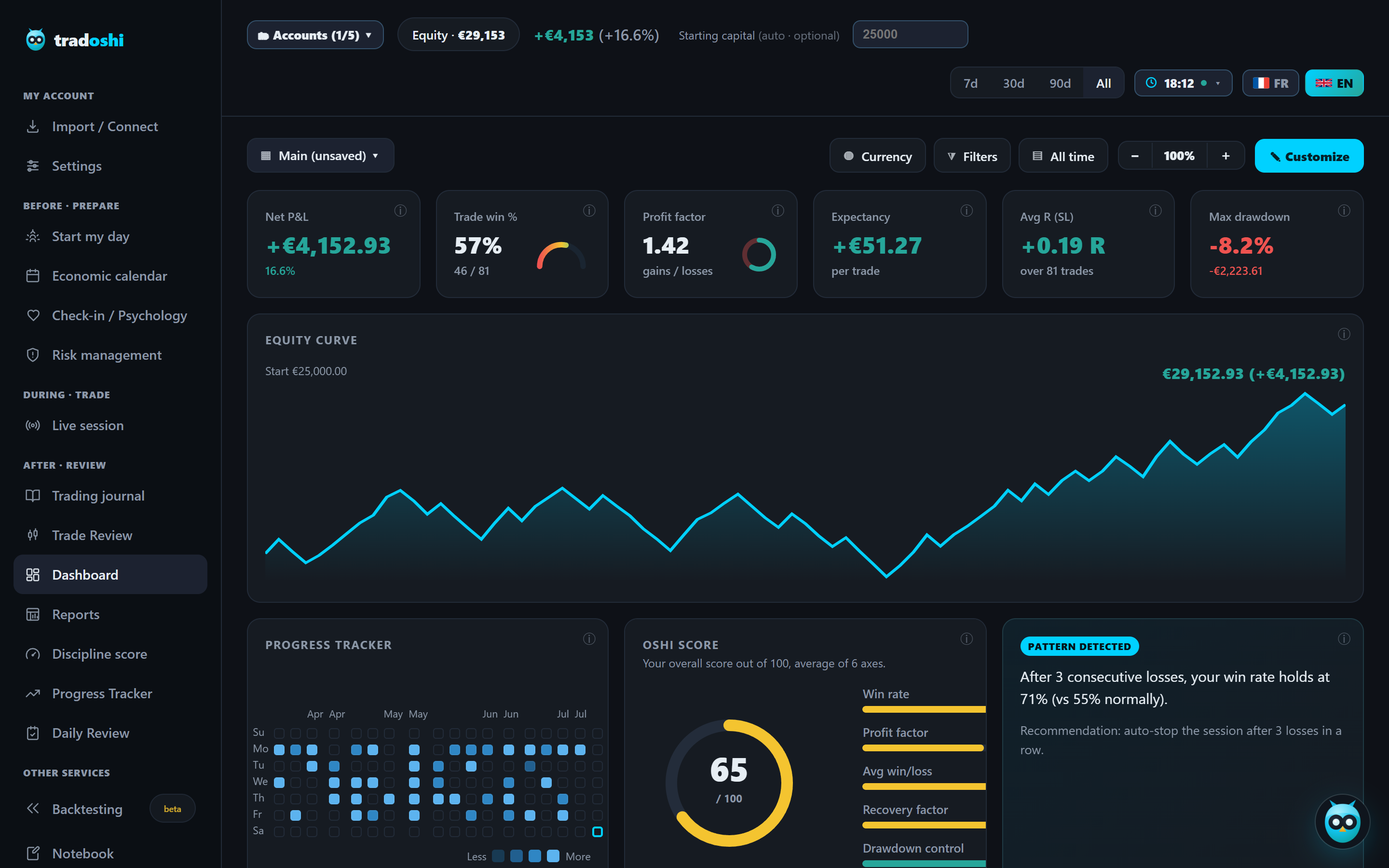
Tradoshi connects directly to nine major crypto exchanges to sync your trades automatically, and helps you watch for signals specific to this market: fatigue from constant availability, dispersion in your results due to volatility, the funding rate's impact on positions held for several days.
- Automatic sync with nine major crypto exchanges, read-only.
- Statistics adapted to crypto volatility, in R-multiple rather than raw value.
- Emotional check-in to spot fatigue from a market available 24/7.
- Configurable stop rules to protect you where the market itself never stops.
Frequently asked questions
What is crypto trading?
It's buying and selling cryptocurrencies, like bitcoin or ether, aiming to profit from their price swings. Unlike a stock, crypto doesn't represent a piece of a company, and unlike forex, it isn't backed by any national economy: its value rests on supply, demand and speculation.
What's the difference between spot and perpetuals?
Spot means directly buying the asset, which you actually own. Perpetuals are leveraged contracts that track the asset's price without holding it, with no expiration date, continuously adjusted through a funding rate. Risk and leverage are generally much higher on perpetuals.
What is the funding rate?
It's a periodic payment, often every eight hours, exchanged between long and short positions on a perpetual contract, to keep its price aligned with the spot price. It represents a recurring cost or income that must be factored into the net result of a position held for several days.
Why does the crypto market never close?
Because it runs on decentralized digital infrastructure, with no physical exchange floor and no regulated hours like stocks or even forex. This constant availability creates a particular psychological load: the urge to check positions continuously and the difficulty of truly disconnecting.
Is crypto more volatile than forex or stocks?
Yes, generally significantly so. Moves of several percent within hours are common on major cryptocurrencies, even sharper on small-cap assets, which requires more cautious risk management and position sizing than you'd use on a more stable market.
Should you leave your crypto on an exchange?
It depends on the use case: keeping funds meant for active trading on the exchange is convenient, but exposes you to the platform's own risk (bankruptcy, hacking). Transferring the rest to a personal wallet eliminates that risk, but shifts full responsibility for security to the user. Avoiding disproportionate dormant capital on an exchange is basic caution.
What is a stablecoin and why does it matter for a trader?
A stablecoin is a cryptocurrency whose value is pegged to a stable asset, most often the US dollar, letting you hold value outside the market without converting back to a traditional currency. For an active trader, stablecoins serve as a temporary safe harbor between positions and as the standard quoting base, since most crypto pairs trade directly against a stablecoin rather than against a traditional currency.