Search 'how much does a trader earn' and you'll land on numbers that make no sense: unsustainable monthly percentages, unverifiable screenshots, promises of passive income. The truth is less spectacular and more useful: a trader's income depends almost entirely on their capital and their actual return, not on some magic talent, and most retail traders don't make money in a sustainable way. Here's an honest answer, with no invented number.
- Most retail traders lose money or tread water, a well established reality of the industry.
- Income depends on capital and return, not a fixed amount promised by a course or an influencer.
- Claims of 'X% a month' are almost always misleading, cherry-picked or unsustainable over time.
- A funded account changes the picture: income no longer comes from your own capital but from a profit split.
The topic of trading income attracts more lies than almost anything else in this business. It's probably the area where the gap between the image projected on social media and the reality lived by most participants is widest in the entire financial industry. This article isn't trying to discourage you, it's trying to replace the fantasy with an honest understanding of what actually determines trading income.
You won't find any invented statistic or any percentage pulled from a phantom study here. What you will find are the mechanisms that explain why 'how much does a trader earn' has no single answer, and why it's precisely that absence of a universal answer that should put you on alert whenever someone gives you one that's too precise.
The wrong question
Asking 'how much does a trader earn' is like asking 'how much does an entrepreneur earn'. The answer depends entirely on who, with what capital, with what skill, and for how long. A trader starting with 500 euros and a trader managing a 100,000 euro funded account can't be compared with the same number, even if they achieve the exact same percentage return.
This confusion between return (the percentage gain on capital) and income (the euro amount that return represents) is behind most of the misleading numbers floating around. A 5% monthly return can represent 25 euros on a small account or 5,000 euros on a large one: the same skill, the same return, produces a radically different income depending on the capital behind it.
Why most traders lose or stagnate
It's a widely acknowledged and documented reality across the financial industry: most retail traders, those trading their own capital without structured training or rigorous risk management, don't make money in a sustainable way. It's not some mystical fate, it's the mechanical consequence of identifiable factors: undercapitalization, missing risk management, transaction costs that erode small accounts, and psychology poorly managed in the face of losses.
This isn't unique to trading, it touches most highly competitive activities with a low barrier to entry: most restaurants close within their first years, most content creators don't make a living from their work. Trading doesn't escape this dynamic, and claiming otherwise, or claiming that 'your strategy' will inevitably escape it, is wishful thinking rather than honest analysis.
What actually determines a profitable trader's income
For the minority of consistently profitable traders, income is calculated by a simple but often ignored equation: available capital multiplied by the actual return over the period. A trader with 10,000 euros and a 20% annual return earns 2,000 euros over the year. A trader with 100,000 euros and the same 20% return earns 20,000 euros. The skill is identical, the income isn't, purely because of starting capital.
| Capital | Annual return | Annual income (illustrative) |
|---|---|---|
| €5,000 | 15% | €750 |
| €25,000 | 15% | €3,750 |
| €100,000 | 15% | €15,000 |
This purely illustrative table shows why an identical, respectable return isn't enough to produce a livable income if starting capital is too small. It's precisely this arithmetic reality, more than a lack of skill, that pushes many retail traders toward solutions letting them trade larger capital than their own, like funded accounts.
Why 'X% a month' almost always sounds wrong
Promises of high, consistent monthly returns, often displayed by courses or influencers, run into a simple mathematical problem: a compounded return, even modest looking on paper, becomes absurd if sustained indefinitely. A high, constant monthly return, applied over several years, would turn any small account into a disproportionate fortune, which almost never happens in reality.
These claims almost always rest on one of three biases: cherry-picking (showing the best month out of dozens, never the real average), unsustainability (a return achieved once, on an exceptional market, presented as repeatable every month), or simply lying, when no verifiable result backs the claim. A modest annual return sustained year after year is infinitely rarer, and infinitely more valuable, than an isolated exceptional month.
Trading your own capital vs a funded account
The income mechanics change fundamentally depending on whether you trade your own capital or a prop firm funded account. With your own capital, income belongs to you entirely but stays capped by the size of that capital, often modest at the start. With a funded account, you trade capital much larger than your own, but profit is split according to a percentage set by the firm, generally in your favor but never 100%.
This path eliminates neither the risk nor the demand, it shifts the problem: you first need to pass an evaluation that proves your discipline through your own behavior, without necessarily having a large personal capital to risk directly. That's one reason more and more serious traders, once their skills are proven on a small account, turn to these structures to multiply their potential income without having to save for years to accumulate a large personal capital.
Gross return isn't your net income
A return displayed as a percentage often hides costs that erode the income actually pocketed: spreads, commissions, financing fees on positions held, and slippage on execution. These costs exist regardless of account size, but they weigh proportionally much heavier on a small account, where every fixed fee represents a bigger share of the capital deployed. A trader stacking up round trips on a small account can see a significant share of their gross return disappear before even calculating net income.
That's one reason the return shown by a strategy on paper, before fees, never tells the whole story. Two traders with the same gross return can end up with very different net incomes depending on trade frequency, position size and their broker's specific fees. Evaluating real performance always requires reasoning net of fees, never on a theoretical gross return that ignores the real cost of getting in and out of the market repeatedly.
Consistency matters as much as the average
An average annual return of 15% can hide two very different realities: a trader progressing steadily, month after month, with moderate swings, and a trader stringing together one exceptional month followed by several catastrophic ones, landing on the same average for the year. The second trajectory is far more fragile, because it exposes you to a higher risk of ruin during the bad stretches, even if the final average looks identical.
That's why experienced traders look beyond the simple average return to assess the quality of a performance: consistency, the size of the maximum losses endured, and the ability to limit bad months matter just as much as the final number. Trading income built on an irregular performance is income you can't anticipate from one month to the next, which makes it hard to fit into a real life budget.
The time before becoming profitable, if it happens
No universal timeframe guarantees profitability in trading, and trusting a precise number ('6 months', '2 years') is the same kind of wishful thinking as monthly return promises. The time needed depends on the quality of learning, the consistency of practice, the ability to draw lessons from mistakes rather than repeat them, and honestly, on a share of factors nobody fully controls.
What's certain is that time invested alone guarantees nothing: a trader who accumulates screen hours with no method, no journal, no analysis of their mistakes, can stagnate for years without ever becoming profitable, while a methodical trader can progress faster with fewer hours but more rigorous practice. The amount of time invested isn't what matters, the quality of what that time produces is.
How Tradoshi helps you see your reality, not a fantasy
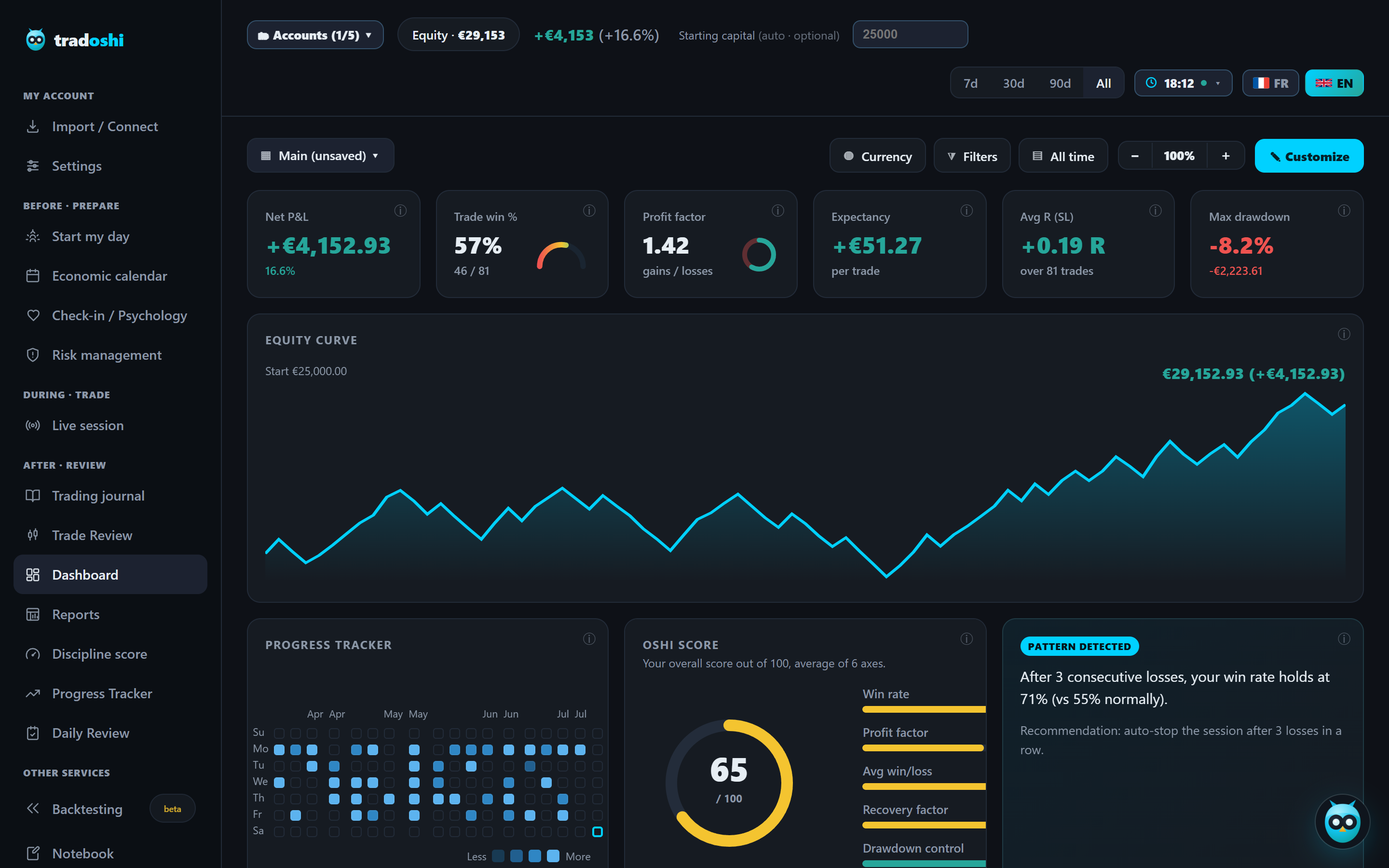
Tradoshi promises no return, because no honest app can. What it does is give you the real numbers of your own performance, so you base your decisions on measured facts rather than comparisons with unverifiable numbers seen on social media. Your actual return, your expectancy, your profit factor become visible, month after month.
- Real statistics: return, expectancy, profit factor and win rate calculated on your real trades, not promises.
- Progress tracking to see your actual trajectory instead of comparing yourself to strangers' screenshots.
- Prop firm module to track your path toward a funded account if you choose that route.
- Detailed journal that distinguishes what comes from your skill from what comes from market variance.
Frequently asked questions
Is it true that most traders lose money?
Yes, it's a widely acknowledged reality in the financial industry: most retail traders don't make money sustainably, for identifiable reasons (undercapitalization, missing risk management, transaction costs, poorly managed psychology), not mystical fate.
How much can you earn trading?
There's no universal number. Income depends on available capital multiplied by the actual return achieved over the period, not a fixed amount. The same 15% return produces very different income depending on whether starting capital is €5,000 or €100,000.
Why are promises of high monthly returns suspicious?
Because a high, constant monthly return, sustained indefinitely through compounding, would become mathematically absurd over several years. These claims almost always rest on cherry-picking, a non-repeatable exceptional result, or a plain lie.
Does a prop firm funded account guarantee income?
No, it only changes the income mechanics: you trade capital larger than your own but profit is split according to a percentage set by the firm. You first need to pass an evaluation proving your discipline, the risk and demand don't disappear.
How long before becoming profitable in trading?
No universal timeframe guarantees it. Time invested alone isn't enough: a trader with no method or journal can stagnate for years, while a rigorous trader progresses faster with fewer hours. Quality of practice matters more than quantity of time spent.
How do I know if my trading return is good?
By comparing it to your own trajectory over time, not to unverifiable numbers seen on social media. A modest return sustained year after year, measured on your real trades, is more meaningful than one exceptional month, yours or anyone else's.
Do trading fees really affect final income?
Yes, often more than people imagine. Spreads, commissions and slippage weigh proportionally heavier on a small account, where they represent a bigger share of the capital deployed. Two strategies with an identical gross return can produce very different net incomes depending on trade frequency, position size and broker fees.
Is living off trading alone realistic for a beginner?
Rarely in the first years, and never without enough capital to generate a livable income at the return achieved. Aiming for a measured supplemental income on a reasonable capital, rather than an immediate replacement income, is a far more realistic expectation until performance consistency is proven over an extended period of time, ideally across different market conditions rather than a single favorable stretch.