Type 'day trading reddit' into a search bar and you fall into a rabbit hole: green screenshots, red screenshots, endless arguments about the one true strategy, and strangers telling you exactly what you want to hear. It's raw, it's unfiltered, and some of it is genuinely useful. Most of it isn't. Here's how to tell the difference before it costs you money.
- Reddit is neither a mentor nor a scam factory: it's a raw feed you have to filter yourself.
- Not all trading subreddits share the same goal: some chase discipline, others chase entertainment.
- Survivorship bias runs the whole show: losses get buried, wins get framed and posted.
- Your real edge gets built elsewhere: in a journal, a routine, and rules you actually keep, not in a comment thread.
Why everyone eventually googles 'day trading reddit'
It's almost a rite of passage. You start out, you want real stories, real people, proof that someone else went through the same mess you're going through. Paid courses give you a polished version of trading. Reddit gives you the unfiltered cut: accounts blown up in a single session, dumb questions everyone has but nobody wants to ask out loud, gurus getting torn apart in the comments. There's an honesty to that chaos you won't find in a glossy sales page.
The problem is that honesty gets buried under an avalanche of noise. For every post that actually explains a real risk management mistake, there are ten showing a gain screenshot with zero context, no visible stop loss, no mention of the risk taken to get there. Reddit's own format, the upvote system, rewards whatever gets a reaction, not whatever is accurate. A post saying 'I made 40 percent this month' will blow up. A post saying 'I lost 15 percent following my plan and that's fine' will die in silence. Guess which one actually teaches you something about trading?
And yet, wanting real feedback from real traders isn't a bad instinct. The issue is failing to separate an anecdote from a method, a lucky streak from an actual edge. Let's break down how to sort through it.
Trading subreddits aren't all built the same
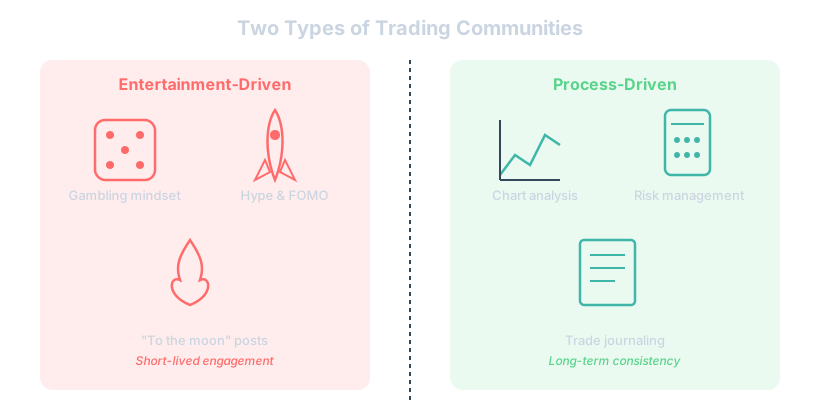
There are several subreddits loosely tied to day trading, and lumping them together is one of the most common beginner mistakes. r/wallstreetbets, for instance, was built on self-mockery and extreme bets. It's an entertainment forum where massive wins and catastrophic losses get celebrated with the same dark humor. Looking for a serious trading method there is a bit like asking a casino floor for budgeting tips.
Other, quieter communities lean much more toward process: risk management, statistics, sober experience sharing. That's where you'll find discussions about position size, risk to reward ratios, journaling habits. This is closer to what a serious trader should actually be looking for. But even in these calmer corners, quality swings wildly from post to post, and moderation never guarantees the content is actually correct.
The lesson here is simple: before taking any piece of Reddit advice seriously, ask yourself which subreddit it came from, and more importantly, what that subreddit exists for. A forum built for engagement and shock value will never produce the same quality of discussion as one built for genuine peer support.
Survivorship bias: the number one trap on these forums
Here's the single most important mechanic to understand, and it goes well beyond Reddit. On any forum, who actually posts? Mostly people who just won big, or people who just lost big and are looking for comfort or a cathartic explanation. The trader who wins modestly and consistently, who sticks to a plan without drama, almost never posts. He has nothing flashy to show. The result: your Reddit feed gives you a completely warped picture of what real trading success looks like.
Take a concrete example. Out of a hundred people who try day trading, imagine, purely as an illustration, that five end up profitable over the long run. Those five aren't necessarily spending their time posting screenshots. Meanwhile, among the other ninety-five, plenty will post their one great winning session before losing it all back the following month, never returning to mention it. You only see the snapshot, never the full equity curve. That's exactly the pattern covered in this piece on why most traders lose money, and Reddit is basically a live, ongoing demonstration of it.
This bias has a direct psychological consequence: it feeds FOMO. You see a post showing plus two thousand dollars in one morning, and a little voice tells you that you should be there too, that you're falling behind, that your caution might be excessive. That's precisely the mechanism described in this article on FOMO in trading. The isolated screenshot has zero statistical value, but your brain treats it as proof anyway.
What Reddit actually gets right
Let's be fair: not everything belongs in the trash. Reddit has a few real strengths that paid courses often lack.
- Raw, unfiltered feedback on brokers, platforms, and hidden fees, often more honest than a sponsored comparison site.
- Detailed accounts of specific mistakes: someone describing how they blew up their account overtrading on a Friday afternoon is worth more than a theoretical article.
- A genuine range of opinions on the same question, ten different ways to think about placing a stop, which forces you to form your own view instead of blindly following one guru.
- A sense that you're not alone during a losing streak or a mental block. That has real value, even if it can't replace actual inner work.
These strengths exist, but they demand active effort from you. It's not about scrolling passively hoping wisdom seeps in by osmosis. It's about reading a post, asking yourself what it concretely teaches, and checking whether it matches your own experience or more structured sources.
What Reddit can never give you
Reddit cannot give you discipline. It can hand you ideas, leads, warnings. But discipline, the kind that makes you honor your stop loss on a Friday afternoon when you're down 3 percent on the day and desperate to get it back, doesn't come from a post with a thousand upvotes. It gets built, session after session, with written rules you follow even when nobody's watching.
It also can't replace a personalized trading journal. Stats people post on Reddit are rarely verifiable, often massaged, sometimes flat-out fabricated to flatter an ego or set up a paid course pitch in the DMs. Your own performance, on the other hand, doesn't lie if you measure it properly. That's the whole point of keeping a useful trading journal: you build a truth that belongs to you, independent of the surrounding noise.
Finally, Reddit absolutely cannot manage your risk for you. Nobody on that forum knows your account size, your real tolerance for loss, your life goals. Advice that works for a fifty thousand dollar account run by someone with ten years of experience can be reckless applied as-is to a two thousand dollar account run by a three month beginner. Risk management is personal, full stop.
Spotting fake signals and disguised scams
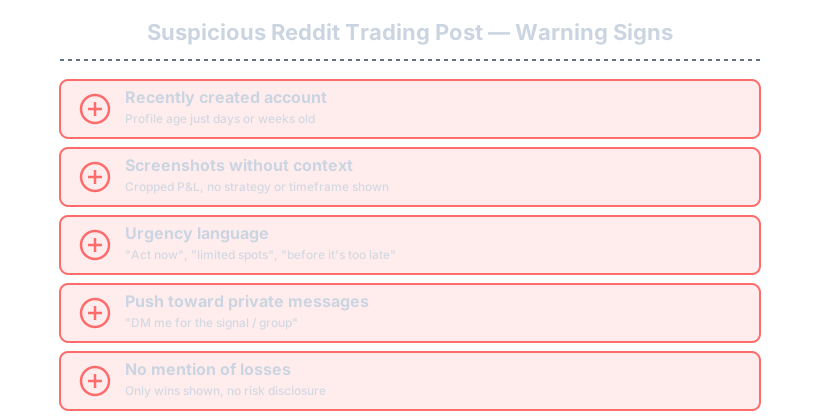
It has to be said plainly: a good chunk of trading content on Reddit exists to sell you something. A signal service, a paid course, a Discord group, a magic indicator. The pattern is almost always the same: a post showing an impressive gain, comments asking 'how do you do it?', and a private reply that turns into a sales pitch.
Some signs should set off alarm bells right away. A recent account posting only wins, never losses. P&L screenshots with zero context on risk taken or the strategy's actual track record. Language pushing urgency, 'join before spots run out', or exclusivity, 'secret strategy the banks don't want you to know'. None of that vocabulary has anything to do with trading, it's pure marketing, and it exploits the exact psychological biases covered in this piece on fear and greed in trading.
The simple rule to apply: if someone is genuinely, consistently profitable, they statistically have zero incentive to sell you their secret for 97 dollars a month. Serious traders who share for free tend to do it calmly, without urgency, with nuance and honest warnings about the limits of what they're describing.
How to actually use Reddit without getting played
The goal isn't to abandon Reddit, it's to change how you consume it. Here's a concrete, almost mechanical approach that lets you extract value without absorbing the noise along with it.
- Read with a specific question in mind, never as passive scrolling. Looking for feedback on a particular broker? Stay on that topic, ignore the rest.
- Systematically hunt for the context behind a gain screenshot: account size, risk taken, track record over several months. No context means no value.
- Always cross-check the information against a more structured source, a respected book, or your own documented experience in your journal.
- Ignore completely any post pushing urgency or nudging you toward a DM or an external link.
- Treat every strategy claim as a hypothesis to test yourself, never as a truth to copy blindly.
Applied consistently, this turns Reddit from a slot machine of dopamine hits into what it should be: one input among many, weighted appropriately, never trusted blindly. You're not there to find your strategy. You're there to stress test your own thinking against strangers who disagree with you.
The discipline gap between reading and doing
Here's an uncomfortable truth: reading about trading discipline and actually having it are two completely different muscles. You can read fifty posts about cutting losses early and still hold a losing position for three extra hours because you 'felt' it would come back. Knowledge absorbed passively rarely survives contact with a live position and real money on the line.
This is where a lot of Reddit-educated traders get stuck. They can quote risk management principles perfectly in a comment thread, then blow through their own daily loss limit an hour later during a real session. The gap isn't knowledge, it's execution under pressure. Building that execution muscle requires something closer to a structured routine, the kind described in this guide to building a trading routine that actually holds, rather than another scroll session before market open.
Think of it like reading about weightlifting form versus actually lifting the bar with proper form under fatigue, on rep twelve, when your body wants to cheat. The theory helps. It's not the same thing as the practice. Trading discipline works the same way: it's forged in repetition, not in consumption of other people's stories.
Building your own process instead of borrowing someone else's story
At some point you have to stop collecting other people's anecdotes and start building your own record. This means writing down your rules before the session, not improvising them mid-trade based on what worked for some anonymous poster last Tuesday. It means defining, in advance, how much of your capital you're willing to risk per trade, and sticking to it regardless of how confident you feel that morning.
It also means tracking your own numbers instead of comparing yourself to unverifiable screenshots. Your win rate, your average win to loss ratio, your actual drawdown: these are yours, they're real, and they tell you far more about your trajectory than any viral post ever could. A trader who tracks these consistently over months has more usable information than someone who's read a thousand Reddit threads and remembers none of the details clearly.
None of this happens by accident. It happens because you decided, deliberately, to build a system around your own behavior rather than around whatever's trending on a subreddit this week. Ask yourself honestly: are you making decisions based on your plan, or based on what you scrolled past twenty minutes ago?
How Tradoshi helps you
Tradoshi won't tell you which Reddit post is legit and which one is a thinly veiled sales pitch. That judgment call stays yours. What it can do is give you a place to turn scattered ideas into an actual measured practice. You can import your trades automatically from MT5, MT4, cTrader or your crypto exchange, or add them manually, and start seeing your real numbers instead of comparing yourself to strangers' screenshots.
The statistics panel gives you your win rate, profit factor, expectancy, drawdown, R-multiple and average win to loss ratio, alongside an overall Oshi Score out of 100, so you have a grounded picture of where you actually stand. The risk management tools let you define how much of your capital you risk per trade, calculate position size, set your own custom risk rules, and check a daily risk calendar before you even open a chart.
On the psychology side, you can log an emotional check-in before a trade and later review how your emotions correlate with your results, which does more for your self-awareness than reading a hundred anonymous posts about tilt. The Trade Review feature lets you replay a trade, debrief it with the emotion you felt, tag it with labels you define yourself, and check it against your own plan adherence. The discipline score then measures, honestly, how well you followed your own rules, not someone else's Reddit wisdom. That's the difference between consuming content and actually building an edge.
A final word on forums and ego
There's one more thing worth naming directly: posting on Reddit changes behavior. Once you know your trade might end up as a screenshot, you're subtly incentivized to take bigger risks for a better story. That's not a hypothetical, it's basic human nature, and it quietly pushes people toward exactly the kind of overtrading and oversized positions described in this piece on why traders take too many positions. Nobody brags online about the boring 1 percent risk trade that hit a modest, planned target.
Keep that in mind every time a post makes your stomach twist with envy or urgency. The account behind it might be real. The context almost never is. Your job isn't to beat that anonymous poster. It's to beat your own numbers from last month, quietly, with a process nobody needs to applaud for it to work.