The path from beginner to profitable trader is more predictable than you'd think. Almost all traders who succeed go through the same stages, in the same order, and fail in the same places. Knowing this path in advance doesn't make it shorter, but it spares you from believing you're unique in your struggles, and tells you where you really stand.
- The path is predictable: almost all profitable traders go through the same stages.
- It takes years, not months: rushing is the number-one cause of failure.
- The tipping point is about psychology and discipline, not a better strategy.
- Measuring your progress is what distinguishes those who advance from those who go in circles.
We often imagine the profitable trader as someone who found the right strategy, the right secret, and took off. The reality is far more down-to-earth: becoming profitable is a long journey, made of predictable stages, where the real work isn't finding a magic method but transforming yourself. Most traders fail not from a lack of talent, but because they quit before getting through the necessary stages.
Knowing this path in advance has real value: it tells you where you stand, what awaits you, and above all that your struggles are normal and shared. This guide describes the real stages from beginner to profitable trader, the traps of each, and why the final tipping point is always about psychology and discipline, never yet another strategy.
Stage 1: beginner's luck
Many traders start by winning. A few easy trades, an intuition that pays off, and confidence shoots up. That's beginner's luck, and it's a trap, because it makes you attribute to your talent what actually comes from chance and favorable market conditions. You conclude trading is easy, increase your size, and lay the foundations of the fall to come.
The danger of this stage is that it installs unearned confidence and bad habits. Since everything works, you feel no need to manage your risk, keep a journal, discipline yourself. You learn the worst possible lesson: that trading on feel pays. That lesson will be billed to you dearly at the next stage.
Stage 2: the first real drawdown
Inevitably, luck turns. A losing streak arrives, perfectly normal statistically, but devastating for a trader who wasn't prepared. Without risk management or discipline, that streak hurts: the account melts, confidence collapses, and panic sets in. It's the first real test, and many traders quit here, wrongly concluding that 'trading doesn't work'.
The first drawdown isn't the end of your trading journey. It's the start of your real learning, if you don't run.
Those who survive this stage do so by understanding one essential thing: the problem wasn't the market, it was the absence of risk management. The first drawdown is the moment you realize that winning a few trades isn't enough, that you need a method and discipline. It's painful, but it's the real starting point of the path to profitability.
Stage 3: the quest for the perfect strategy
After the first drawdown, the near-universal reflex is to seek the solution in the wrong place: a better strategy. The trader starts collecting methods, indicators, courses, convinced the key is finding the right system. They jump from strategy to strategy, abandon each at the first drawdown, and never build any exploitable data.
| Stage | Belief | Reality |
|---|---|---|
| Beginner's luck | Trading is easy | It was chance |
| First drawdown | Trading doesn't work | Risk management was missing |
| Strategy quest | I need a better system | The problem is psychology |
| Awareness | The problem is me | The real start of progress |
This stage can last years, and it's where the majority burns out and quits. The trader goes in circles, because they seek outside a solution that's inside. Until they understand their strategy was probably already sufficient and the real problem was their execution, they keep collecting beginnings without ever building profitability.
Stage 4: the psychological awareness
The decisive turning point comes when the trader stops looking outside and looks inside. They realize their losses don't come from their strategy, but from what they do when money is at stake: revenge trading, over-risk, decisions under emotion. It's an uncomfortable awareness, because it shifts responsibility from the strategy to oneself, but it's the real start of progress.
From that moment, the work changes nature. It's no longer about finding the right method, but about becoming able to execute a correct method with discipline. The trader starts keeping a journal, measuring their discipline, setting safeguards. They finally understand that trading is work on oneself as much as on the market, and it's that mindset shift that opens the door to profitability.
Stage 5: discipline and consistency
Once the awareness is made, comes the long, unspectacular work of building discipline. The trader learns to follow their plan, hold their rules, manage their emotions, measure their progress. It's not glorious: it's repetitive, patient, even boring. But it's exactly that work that turns a trader who knows what to do into a trader who actually does it.
Discipline is built through repetition and small wins, day after day. As it sets in, performance follows: controlled days become the norm, disasters become rare, and the capital curve starts rising, slowly, steadily. The trader discovers that consistency, not the grand gesture, is what makes lasting profitability.
Stage 6: lasting profitability
Lasting profitability isn't a spectacular arrival point, it's the quiet culmination of all this work. The profitable trader hasn't found a secret: they have a decent edge, solid risk management, proven discipline, and they execute all of it consistently. Nothing magical, just the patiently built mastery of what they control. Most people underestimate how long it takes and quit well before.
The most important message of this path is that it takes years, not months, and rushing is the number-one cause of failure. Each stage is necessary, none can be skipped. Knowing the path doesn't shorten it, but it tells you where you stand, reassures you about the normality of your struggles, and gives you the perseverance to continue where the majority quits. Measuring your progress is what lets you know you're truly advancing, even when it doesn't yet show in your account.
Why most quit before the end
The path to profitability is long, and most traders quit before reaching it, not from a lack of talent but from a lack of perseverance. The causes of quitting are predictable: the first big drawdown that makes you conclude 'it doesn't work', financial exhaustion from blowing accounts, the weariness of not seeing results despite the effort, or the discouraging comparison with spectacular gains seen on social media. Each of these causes strikes at a precise stage of the path.
Knowing these quit points in advance partly vaccinates you against them. When you know the first drawdown scares off the majority, you can prepare to get through it instead of suffering it. When you know apparent stagnation often precedes the tipping point, you find the strength to continue where others stop. Simply knowing that your struggles are normal, shared and temporary gives you a huge advantage: not quitting at the precise moment perseverance was about to pay off. Most people who fail at trading don't fail, they stop.
The role of capital in the path
An often underestimated factor of the path is managing your learning capital. Many traders burn too much money too fast during the learning stages, ending up short of capital just before acquiring the necessary skills. The right approach is to preserve your capital while learning: trade small, even practice on a demo account for the basics, to stay in the game long enough to get through all the stages.
The idea is to separate the cost of learning from the trading capital itself. Losing money while learning is normal, but these losses should be calibrated as training fees, not as capital you plan to grow immediately. A trader who approaches their beginnings preserving their capital and risking very little gives themselves time to learn without ruining themselves, while one who bets big from the start often gets financially eliminated before even having the chance to progress. Surviving financially during learning is a condition of the path.
Profitability isn't a finish line
We imagine profitability as a definitive arrival point, a state you reach once and for all. That's false. Trading is a craft requiring permanent upkeep: markets evolve, edges erode, and your own discipline can loosen. A profitable trader who stops working on themselves and their system often ends up losing again. Profitability is a state to maintain, not a summit to conquer once.
This reality is liberating rather than discouraging: it means the path never truly ends, and that each stage crossed made you sturdier for what's next. The lasting profitable trader is the one who keeps learning, measuring, adjusting, indefinitely, with the humility to know nothing is acquired. This mindset of continuous progress, rather than reached destination, is precisely what distinguishes those who stay profitable over years from those who are for a time then relapse. The path doesn't stop at profitability, it continues through it.
How many trades does it take to judge a system?
A question comes up often at the strategy-quest stage: after how many trades can you say a system works or doesn't? The answer always disappoints impatient beginners: far more than they hope. Ten or twenty trades say almost nothing, because short-term randomness completely dominates the signal. A streak of five losses in a row on an otherwise profitable system is statistically ordinary; interpreting it as the system's failure is the classic mistake of this stage.
It generally takes several dozen, even a hundred, trades executed with consistent execution before the numbers start telling a reliable story about the system's real edge. That's one reason jumping from strategy to strategy is so destructive: every premature abandonment resets the counter to zero, and the trader never builds the sample size needed to properly judge anything. Staying on one system long enough, with rigorous execution, is a necessary condition for eventually being able to say whether it works.
Recognizing the signs you're approaching the tipping point
The tip toward profitability doesn't happen all at once, it's announced by discreet signs before the account even reflects it. The first sign is a drop in the emotional intensity of trades: losses stop triggering panic or anger, they become neutral events you log and learn from. The second is the gradual disappearance of off-plan trades: fewer and fewer impulsive entries, more and more trades that follow the checklist exactly.
The third sign, often the most telling, is a shift in your relationship to the daily result: the trader who's tipping worries less about today's P&L and more about whether they executed their plan correctly. This shift of attention, from result to process, almost always precedes lasting profitability, sometimes by several months. Spotting these signs in yourself lets you know you're truly progressing, even when the account doesn't yet clearly show it.
The trap of theoretical over-learning
One last trap especially lies in wait for analytical traders or those from an academic background: spending a disproportionate amount of time reading, taking courses and watching analyses, at the expense of time spent actually executing trades and learning from them. Theory has its place, but it never replaces the direct experience of seeing your own money on the line and observing your own emotional reaction under real conditions.
This trap is comfortable because it feels like progress (you learn, you read, you feel competent) without ever facing the real discomfort of live trading, where the psychological tipping point actually happens. A trader who's read twenty books on trading but never journaled their last hundred trades knows far less about themselves than a trader who's read a single book but rigorously analyzed their own practice. Useful learning in trading is mostly experiential, not theoretical.
How Tradoshi supports you on the path
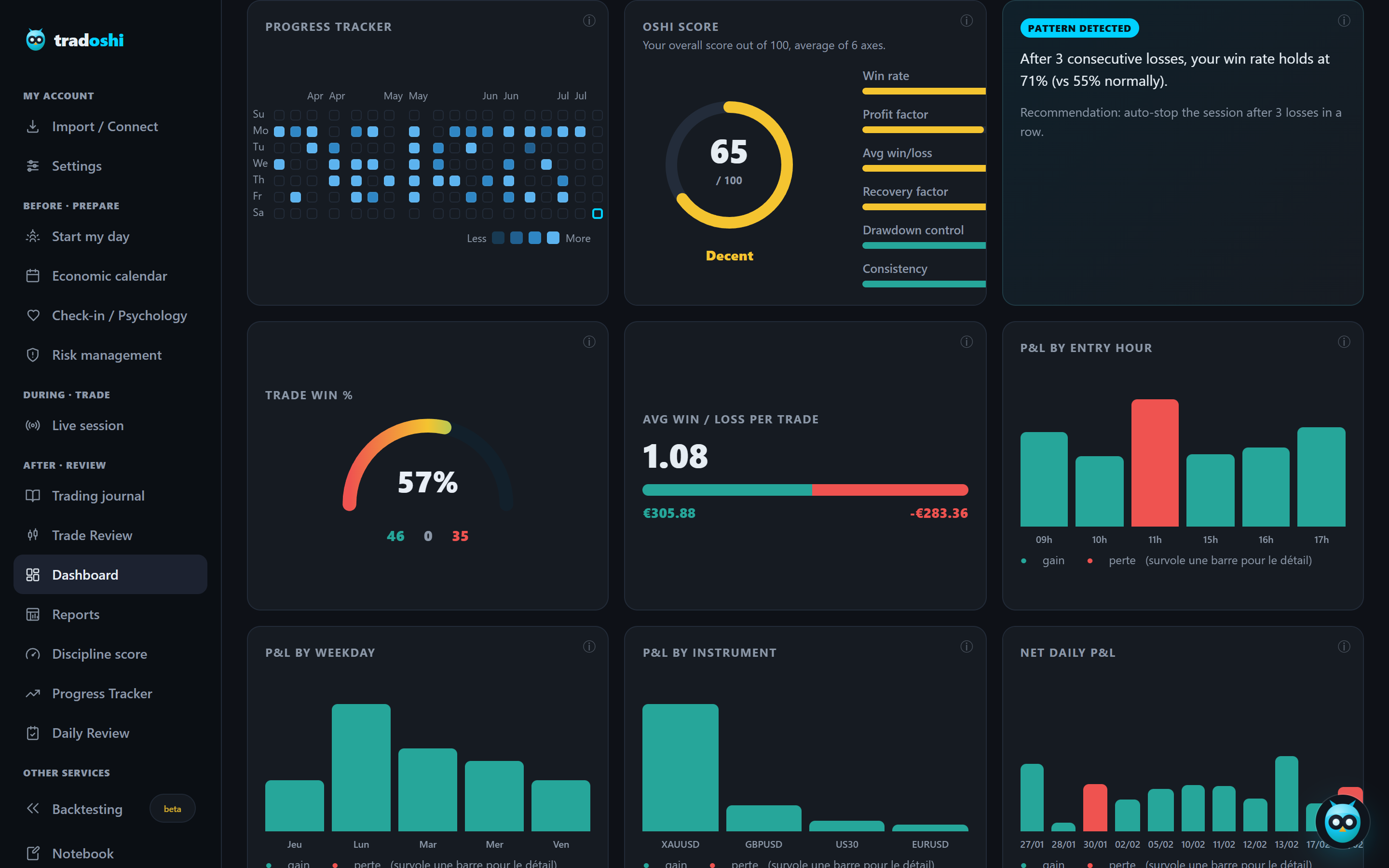
Tradoshi measures your discipline and edge to place you on this path and show you you're progressing, even when profitability isn't there yet.
- Discipline score: it measures your progress on the skill that decides the tipping point.
- Expectancy and average R: they tell you whether your edge is real, regardless of your last trades.
- Progress tracking: your streaks of disciplined days show you you're truly advancing.
- Emotion → performance: it helps you reach the psychological awareness, the decisive stage.
Frequently asked questions
How long does it take to become a profitable trader?
Years, not months, and rushing is the number-one cause of failure. The path goes through predictable stages (beginner's luck, first drawdown, strategy quest, psychological awareness, discipline, profitability) none of which can be skipped. Most people underestimate how long it takes and quit well before getting through the necessary stages.
What are the stages from beginner to profitable trader?
Six predictable stages: beginner's luck (easy gains wrongly attributed to talent), the first real drawdown (where many quit), the quest for the perfect strategy (seeking the solution in the wrong place), the psychological awareness (the problem is me), building discipline, and finally lasting profitability as the quiet culmination of all this work.
Why is beginner's luck a trap?
Because it makes you attribute to your talent what comes from chance and favorable conditions. It installs unearned confidence and bad habits: since everything works, you feel no need to manage your risk or discipline yourself. You learn the worst possible lesson, that trading on feel pays, and that lesson will be billed dearly at the first drawdown.
Should I change strategy when I'm not profitable?
Usually no. The quest for the perfect strategy is a trap stage that can last years: the trader jumps from method to method seeking outside a solution that's inside. Your strategy is probably already sufficient; the real problem is usually your execution and psychology. Before changing method, check your discipline first.
What really tips you toward profitability?
Psychology and discipline, not a better strategy. The decisive turning point comes when you stop seeking the solution outside and realize your losses come from what you do when money is at stake (revenge, over-risk, decisions under emotion). From there, the work becomes building the discipline to execute a correct method, which opens the door to lasting profitability.
How do I know if I'm really progressing?
By measuring your discipline and edge, not just your account. Profitability arrives late in the path, but you can see well before that your discipline is improving and your edge is real. A rising discipline score, streaks of controlled days and a positive expectancy show you you're advancing, even when it doesn't yet show in your capital curve. That's what gives you the perseverance to continue.
How many trades does it take to know if my system works?
Generally several dozen, even a hundred, executed with consistent discipline. Ten or twenty trades say almost nothing, because short-term randomness largely dominates the signal; a losing streak on a profitable system is statistically ordinary. Jumping from strategy to strategy before reaching that sample size means you never properly judge anything.
How do I know I'm getting closer to profitability?
Three discreet signs often precede the account: a drop in the emotional intensity of losses, fewer and fewer off-plan trades, and interest shifting from the daily result toward correctly executing the plan. This shift of attention, from result to process, almost always precedes lasting profitability, sometimes by several months.