Expectancy is the most important number you can know about your trading, yet one of the least calculated. It tells you how much you can expect to win (or lose) on average per trade over the long run. It's the mathematical answer to the only question that truly matters: does my system make money, yes or no?
- Expectancy = your average gain per trade over a large number of trades.
- It combines win rate and the size of gains/losses into one decisive number.
- Positive = winning system, negative = losing system, unambiguously.
- It only materializes over the long run, through normal losing streaks.
Many traders can't say, with numbers, whether their system makes money. They have an impression, a feeling, sometimes distorted by their last trades. Expectancy replaces that impression with a mathematical certainty: it computes, from your win rate and the size of your gains and losses, how much each trade returns on average. It's the arbiter of your trading.
Knowing your expectancy changes everything, because it tells you not only whether you're profitable, but by how much, and therefore what you can expect from your system. This guide explains how expectancy is computed, why it's more reliable than any other isolated statistic, and why it only manifests over time, provided you survive the losing streaks.
What expectancy is
Expectancy is the average of what you win or lose per trade, computed over a large number of trades. In other words, if you took the same type of trade a thousand times, expectancy tells you how much you'd have won on average each time. It's a number that synthesizes your entire edge into a single value: above zero, each trade returns on average; below, each trade costs on average.
The formula combines two ingredients: the probability of winning (your win rate) times your average gain, minus the probability of losing times your average loss. The result is your expected gain per trade. What makes expectancy so precious is that it incorporates both the frequency of your gains and their size, the two dimensions the win rate alone ignores. It can't be flattered by a misleadingly nice win rate.
How to compute it
Computing expectancy is simpler than it looks. Let's take a concrete example to anchor it:
| Ingredient | Value | Role |
|---|---|---|
| Win rate | 40% | Probability of winning |
| Average gain | 300 | Average size of a gain |
| Loss rate | 60% | Probability of losing |
| Average loss | 150 | Average size of a loss |
| Expectancy | +30 | (0.4 × 300) − (0.6 × 150) |
In this example, expectancy is +30 per trade: (0.4 × 300) − (0.6 × 150) = 120 − 90 = 30. This system wins, on average, 30 per trade, even though its win rate is only 40%. That's the whole power of expectancy: it reveals that a system where you lose more often than you win can be widely profitable, provided your gains are enough bigger than your losses.
Why it's the king number
Expectancy is superior to all other isolated statistics because it directly answers the real question: does my system make money, and how much? The win rate alone doesn't say. The gain/loss ratio alone doesn't say. The profit factor comes close, but expectancy goes further by giving you an average amount per trade, which lets you project your performance and reason in units of risk.
You can ignore many statistics in trading. Expectancy isn't one of them: it alone tells you if you're playing a winning game.
Expressed in R (units of risk), expectancy becomes even more universal: an expectancy of +0.3 R means each trade returns on average 30% of your risk, regardless of your position size. It's the number every serious trader should know by heart, because it condenses their entire edge into a single value comparable over time.
Expectancy only materializes over the long run
There's a fundamental trap to understand: expectancy is a long-run average, not a promise for each trade or each week. A positive-expectancy system still loses regularly, and goes through losing streaks. Over a small number of trades, you can perfectly well be at a loss while your expectancy is positive: it's variance that dominates in the short run, and expectancy that dominates in the long run.
This distinction is crucial for your psychology. If you understand that your positive expectancy will only manifest through a large number of trades, you can get through a losing streak without panicking, knowing your edge will eventually express itself. If you ignore it, you risk abandoning a winning system at the trough of a normal streak, right before the average recovers. Positive expectancy is a promise, but only to those who stay in the game long enough.
Expectancy and survival
A positive expectancy isn't enough to make you rich: you still have to survive long enough for it to materialize. That's where expectancy meets risk management. A system with a nice expectancy but a position size too big can ruin you during a normal losing streak, before expectancy has time to play out. Expectancy tells you that you win in the long run; risk management guarantees you reach that long run.
That's why the two always go together. Compute your expectancy to know whether your system is a winner, then size your risk to be certain you survive the losing streaks that pave the way. A positive edge protected by prudent management is the combination that makes profitable traders; a positive edge destroyed by excessive risk only leads to ruin, despite the good expectancy on paper.
Expectancy by setup type
Your overall expectancy is useful, but breaking it down by setup type is even more powerful. Not all your setups have the same expectancy: some are very profitable, others barely positive, others outright losing without you knowing. By computing the expectancy of each type of configuration you trade, you discover where your edge really concentrates, and where you lose money thinking you're doing useful trading.
This analysis opens a direct, often spectacular improvement path. If you discover one of your setups has a negative expectancy, abandoning it mechanically improves your overall performance, without you having to trade the rest better. Conversely, identifying your highest-expectancy setup tells you what to focus on. Many traders are profitable on one or two setups and lose the rest on mediocre configurations they take out of habit; breaking down expectancy reveals these leaks and lets you cut them.
Expectancy and frequency: the real potential
Expectancy per trade doesn't tell everything: you must combine it with frequency to know your real potential. A very-high-expectancy setup that only appears once a month produces less than a modest-expectancy setup that appears every day. What matters in the end is expectancy multiplied by the number of opportunities: it's that combination that determines how much your system can really produce over a period.
This perspective sometimes changes priorities. A trader may be tempted to only hunt their highest-expectancy setups, but if they're too rare, their capital stays largely unemployed. Finding the right balance between quality (high expectancy) and frequency (enough opportunities) is a key art of building a profitable system. The best system isn't necessarily the one with the highest expectancy per trade, it's the one that produces the best total expectancy once frequency is accounted for.
Expectancy evolves: monitoring it over time
Your expectancy isn't a constant set in stone: it evolves with time, market conditions and your own progress. A system that had a nice expectancy can see its edge erode when the market changes or when too many traders exploit the same inefficiency. Conversely, your improving discipline can raise your real expectancy by reducing the gap between your theoretical edge and your execution.
That's why you must monitor your expectancy over time rather than compute it once and for all. A lasting drop in your expectancy is an important signal: either your edge is eroding and you must adapt your method, or your execution is degrading and you must rework your discipline. Tracking your expectancy's evolution, over rolling windows of many trades, lets you detect these changes early and react, instead of discovering too late that your system no longer works like before.
Common mistakes when computing expectancy
The first mistake is computing expectancy on too few trades. On twenty trades, a single big win or big loss tips the number one way or the other, without reflecting the system's real quality. Expectancy only makes sense computed on a sufficient sample, ideally several dozen trades at minimum, so the average stabilizes and stops being dominated by one or two exceptional events.
The second mistake is forgetting fees and slippage in the computation. A system showing a positive expectancy on paper, ignoring commissions, spread and execution slippage, can turn out neutral or even negative once those real costs are included. On high-frequency, small-gain strategies, these fees eat a significant share of the theoretical expectancy, and ignoring them gives a far too optimistic picture of real profitability.
The third mistake is mixing unrelated trades into a single overall computation. A system that combines several very different setups (scalping and swing, say) can show a positive overall expectancy that masks a strongly winning setup offsetting a strongly losing one. That's why expectancy by setup type, covered above, is almost always more useful than the overall number alone.
Expectancy and position size: two separate decisions
A common confusion is believing a better expectancy automatically justifies risking more. Yet these are two distinct decisions answering two different questions: expectancy tells you whether your system is good, position size tells you how much you can afford to bet on it without risking ruin during an unlucky losing streak. A system with excellent expectancy and a poorly calibrated position size can still destroy an account.
Take an example: two traders have exactly the same expectancy of +0.3 R per trade. The first risks 0.5% of their capital per trade, the second risks 5%. Over the long run, both theoretically benefit from the same edge, but the second experiences capital swings ten times more violent for the same expected outcome, and a losing streak that would be trivial for the first can be fatal for the second. Good expectancy protects the system, good position size protects the trader executing it.
Theoretical expectancy vs realized expectancy: the gap that matters
There's almost always a gap between the expectancy computed on a backtest or on paper, and the one you actually realize in live trading. This gap comes from several sources: execution slippage, hesitations that make you enter a bit late or exit a bit early, and above all the plan deviations you don't notice yourself. A system can have a theoretical expectancy of +0.4 R and a real expectancy of +0.15 R, simply because of how you execute it day to day.
Measuring this gap between theoretical and realized is extremely instructive, because it tells you precisely how much your execution costs you. If the gap is small, your execution faithfully follows your plan and the work to do lies in the strategy itself. If the gap is large, the problem isn't your edge but your execution discipline, and that's where you should focus your efforts first, because it's often the fastest gain available for your overall profitability.
How Tradoshi computes your expectancy
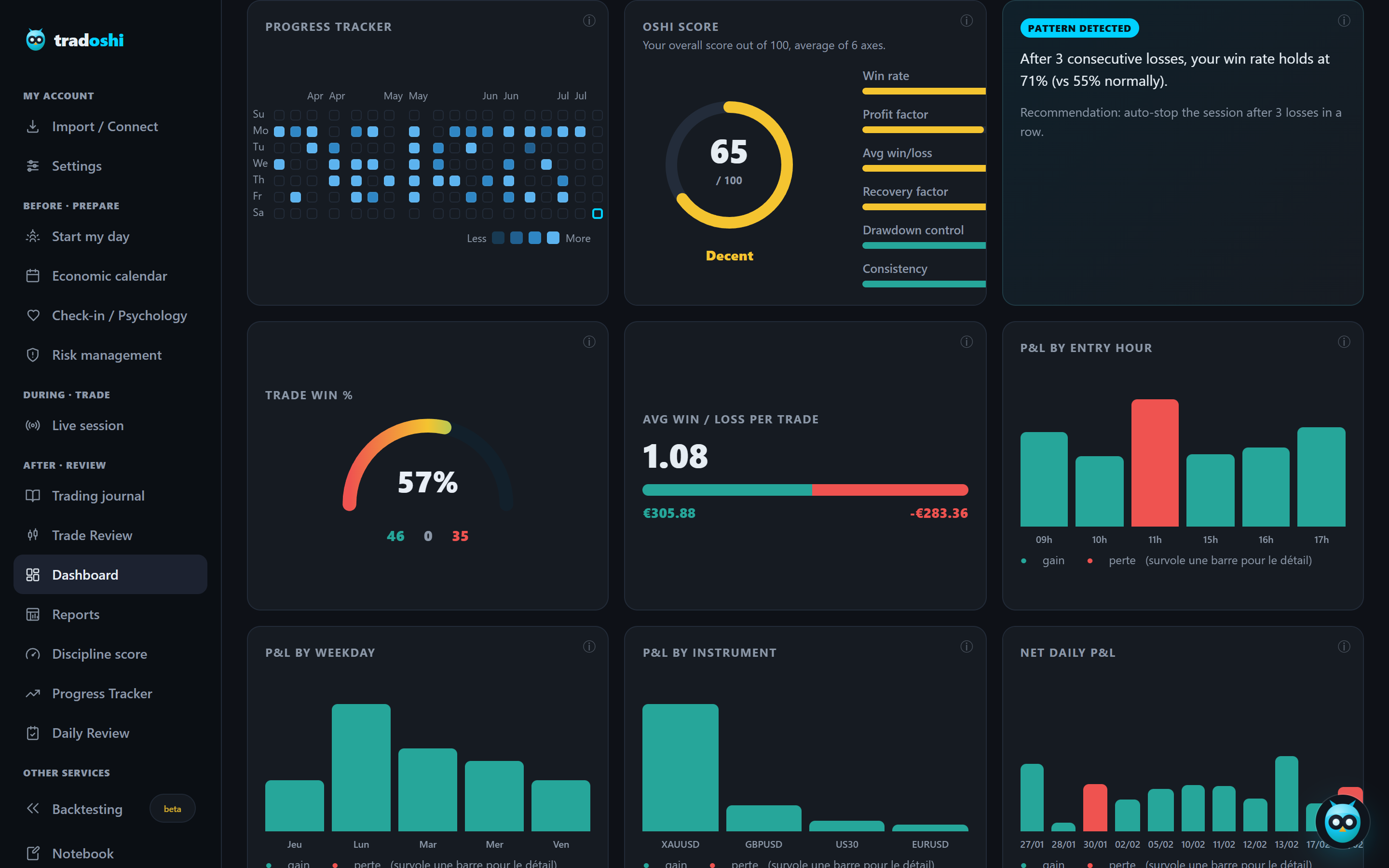
Tradoshi computes your expectancy automatically on your real trades, in money and in R, so you know in black and white whether your system makes money and by how much.
- Expectancy in money: your average gain per trade computed on your real trades.
- Expectancy in R: your edge per trade in units of risk, comparable over time.
- Breakdown: win rate, average gain and average loss shown to understand where your edge comes from.
- On a sufficient sample: your expectancy is placed in the context of your number of trades to stay credible.
Frequently asked questions
What is expectancy in trading?
It's your average gain per trade over a large number of trades, i.e. your system's expected gain. It combines your win rate and the size of your gains and losses into one number: positive, your system makes money; negative, it loses. It's the mathematical answer to the only real question: is my system profitable?
How do I compute expectancy?
The formula is: (win rate × average gain) − (loss rate × average loss). For example, with 40% win rate, a 300 average gain and a 150 average loss: (0.4 × 300) − (0.6 × 150) = 120 − 90 = +30 per trade. This system wins 30 per trade on average despite a win rate of only 40%.
Why is expectancy the most important number?
Because it directly answers the real question: does my system make money, and how much? The win rate alone doesn't say, nor does the gain/loss ratio alone. Expectancy incorporates both and gives you an average amount per trade, which lets you project your performance. Expressed in R, it condenses your entire edge into a single value comparable over time.
Does a positive expectancy guarantee winning?
Over the long run yes, but not on each trade or each week. Expectancy is an average: a winning system still loses regularly and goes through losing streaks. Over a small number of trades, variance dominates and you can be at a loss despite a positive expectancy. It only materializes through a large number of trades, provided you survive in between.
Can a system win with a win rate below 50%?
Yes, absolutely, and expectancy proves it. A 40%-win system can have a widely positive expectancy if its average gains are far bigger than its average losses. It isn't the frequency of your gains that decides your profitability, it's the combination of that frequency and the relative size of your gains and losses, exactly what expectancy measures.
Is a positive expectancy enough to succeed?
No, you also have to survive long enough for it to materialize. A system with a nice expectancy but a position size too big can ruin you during a normal losing streak, before expectancy plays out. That's why expectancy and risk management always go together: one tells you that you win in the long run, the other guarantees you reach that long run.
On how many trades should I compute my expectancy?
On a sufficient sample, ideally several dozen trades at minimum. On twenty trades, a single big win or big loss tips the number without reflecting the system's real quality. The larger the sample grows, the more the average stabilizes and stops being dominated by one or two exceptional events.
Does a better expectancy justify risking more per trade?
No, these are two separate decisions. Expectancy tells you whether your system is good; position size tells you how much you can afford to bet without risking ruin during an unlucky losing streak. Two traders with the same expectancy but very different sizes experience very different capital swings for the same theoretical edge.