Forex has a statistical trap most traders never see: two pairs that move almost together give the illusion of diversified edge, when in reality a single market move has simply been counted twice. Add to that sessions whose personality changes completely throughout the day, and spread and swap costs that eat into tight pip targets, and you get a market that, without a journal built for it, hides as much as it reveals.
- Session tagging (Sydney, Tokyo, London, New York, overlaps) often reveals a very uneven edge depending on the hour.
- Correlated pairs artificially inflate your real exposure if you don't track them together.
- Spread and swap bite proportionally harder into tight pip targets.
- Pip-based vs percentage-based sizing: two different logics you should choose consciously, not by default.
Forex lends itself to a minimalist journal, pair, direction, result, precisely because the market's mechanics seem simple at first glance. That's a mistake that costs money: forex has its own sources of statistical bias, largely invisible unless your journal explicitly captures them.
This guide details the fields and tracking habits that make the difference between a forex journal that actually tells you something about your edge, and one that piles up rows without ever revealing the real mechanics of your performance.
Session tagging, the most common blind spot
The currency market doesn't have one personality, it has at least four: the Asian session (Tokyo, Sydney), calm and often range-bound on major pairs, the London session, which brings volume and directionality, the London/New York overlap, generally the most liquid and volatile part of the day, and the late US session, more erratic. The same setup can have a completely different edge depending on which session it's taken in.
Without an explicit 'session' field in your journal, you simply can't answer a question as basic as 'am I better on London or New York?' Many forex traders discover, once they start tagging their trades by session, that a significant share of their losses concentrates in one specific time window, often the one they trade out of habit rather than real edge.
Correlated pairs: a risk hiding in plain sight
It's one of the best-known facts of forex: some pairs tend to move in the same direction or in opposite directions, because they share a common currency or closely related economic dynamics. EUR/USD and GBP/USD, for example, often tend to move in a fairly similar direction to each other, as do some pairs tied to the Australian and New Zealand dollars. It's not an absolute rule, the strength of that relationship varies over time, but it's a well-known enough phenomenon that every forex trader should account for it.
The trap is believing that opening three positions on three different pairs diversifies your risk, when in reality, if those pairs are correlated, you may have taken the same dollar bet three times over, with three times the risk you think you took. Without tracking that groups your open positions by underlying currency, this risk concentration stays invisible until the day a single market move hits all three positions at once.
Spread and swap: costs that eat into small targets
Forex is often traded with targets of a few dozen pips, which makes the spread (the gap between bid and ask price) proportionally far more significant than on an instrument with wider average moves. A two-pip spread on a twenty-pip target represents 10% of your target in entry and exit cost alone, a figure many traders never explicitly calculate.
| Cost | What it represents |
|---|---|
| Spread | Cost paid on entry and/or exit, heavier on small targets |
| Swap (rollover) | Cost or gain from holding overnight, tied to the interest rate differential between currencies |
| Commission (ECN accounts) | Fixed fee per lot, separate from spread |
| Slippage | Gap between the intended price and the actual execution price |
Swap, the cost or gain tied to holding a position overnight, depends on the interest rate differential between the pair's two currencies, and can work for or against you depending on your position's direction. On strategies that hold positions for several days, this accumulated factor deserves separate tracking from price result, exactly like funding on crypto perpetuals. Ignoring these costs systematically overstates your real edge.
It is also the cost spreadsheets forget most often, because it appears neither in your entry price nor in your exit price. If you keep your journal by hand, the forex section of the Excel trading journal template details the three columns to add so that swap, pip value and lot size stop skewing your statistics.
Pips or percentage: a choice to make consciously
Forex offers two measurement logics that rarely coexist well in the same journal unless you explicitly choose which one takes priority for you. Pip-based measurement gives a direct, familiar read of price movement, useful for judging a setup's execution quality. Percentage-of-capital measurement brings everything back to the same denominator, your real risk, and lets you compare trades taken with different position sizes.
The problem shows up when a trader reasons purely in pips without ever tying that number back to their real percentage risk: two twenty-pip winning trades can represent totally different risk levels if position size wasn't the same. The right move is keeping both pieces of information, pips for the technical read, percentage or R-multiple for the risk read, rather than picking one over the other.
Leverage, more present in forex than elsewhere
Forex is historically one of the markets where retail leverage on offer is highest, letting you control a much larger position than the capital actually deposited. This amplifies both gains and losses, and makes tracking position size, in lots and in percentage of capital risked, particularly important so you don't underestimate your real exposure.
A forex journal that only logs the result in currency without ever tying that result back to the leverage and size actually used gives an incomplete picture of the risk taken. That's especially true for traders who vary their position size from trade to trade based on conviction, a practice that can be legitimate but that needs to be tracked explicitly to be judged objectively.
Economic announcements, a context to tag
Forex reacts strongly to scheduled macroeconomic announcements, rate decisions, employment figures, inflation, which can trigger, within seconds, moves far wider and far more erratic than the rest of the session. A trade taken right before or during that kind of announcement doesn't carry the same risk profile as a trade taken under normal market conditions, even if the initial technical setup was identical.
Tagging trades taken near a major economic announcement in your journal lets you check whether your strategy genuinely holds up in that kind of context, or whether it simply benefited once from a lucky move that validated a stop that was too wide. That tag is also what lets you objectively distinguish a strategy built to trade these announcements, which should be judged with its own yardstick, from a classic technical strategy that should probably avoid them instead.
Major, minor and exotic pairs: different conditions
Not all currency pairs offer the same liquidity or behavior. Major pairs, which include the US dollar against the most traded currencies, generally benefit from a tight spread and abundant liquidity nearly around the clock. Minor pairs, and especially exotic pairs, which involve less traded currencies, often show a wider spread, more irregular liquidity depending on the hour, and sometimes more erratic moves.
A journal that logs the category of pair traded (major, minor, exotic) lets you check whether your technical edge genuinely holds up on pairs with tougher conditions, or whether it only works well on the most liquid pairs where execution is cleanest. It's a useful distinction before extending a strategy tested on EUR/USD to less common pairs while wrongly assuming market behavior will be identical.
How Tradoshi helps with your forex journal
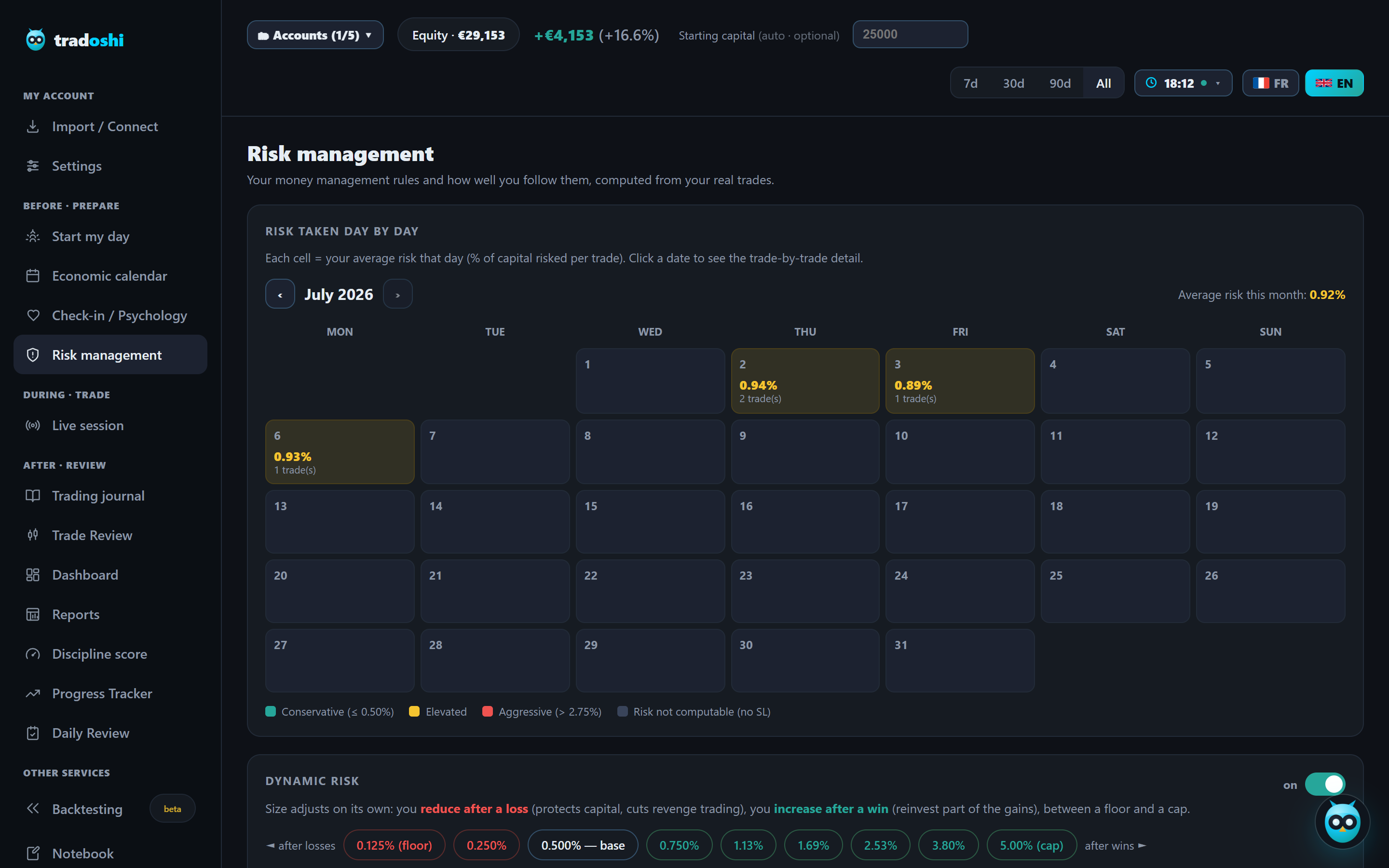
Tradoshi connects directly to your MT4/MT5 accounts via a read-only investor password, automatically imports your trades, and computes your statistics (R-multiple, expectancy, win rate, profit factor) accounting for the forex specificity of imported trades.
- Automatic MT4/MT5 sync, read-only, no manual entry.
- Multi-currency handling for accounts denominated in a currency different from yours.
- Position size calculator that ties your percentage risk to your lot size.
- Universal CSV import for any broker not natively connected.
Frequently asked questions
Why tag my forex trades by session?
Because the currency market has a different personality depending on the session (Sydney, Tokyo, London, New York, overlaps), in terms of volume, directionality and volatility. The same setup can have a very different edge depending on the hour. Without this tag, you can't tell whether your performance depends heavily on when you trade.
What is correlation between currency pairs and why track it?
Some pairs, like EUR/USD and GBP/USD, tend to move in a fairly similar direction because they share a common currency or linked economic dynamics. Taking several positions on correlated pairs can mean taking the same bet multiple times without realizing it, inflating your real risk beyond what you think.
Does spread really hurt my small pip targets?
Yes, proportionally more than on an instrument with wider average moves. A two-pip spread on a twenty-pip target already represents 10% of the target in entry and exit cost alone, a cost many traders never explicitly calculate.
Should I measure my forex performance in pips or percentage?
Both, for different purposes. Pips give a direct read of price movement and setup execution quality. Percentage of capital (or the R-multiple) brings everything back to the same denominator, the real risk taken, letting you compare trades taken with different position sizes.
What is swap in forex and why track it?
It's the cost or gain from holding a position overnight, depending on the interest rate differential between the pair's two currencies. On strategies that hold positions for several days, this accumulated factor deserves separate tracking from price result so it doesn't distort your real edge.
How does Tradoshi import my forex trades?
Through a direct connection to your MT4/MT5 accounts with a read-only investor password, or via CSV import for any broker not natively connected. Your statistics are then computed automatically, including multi-currency handling if your account is denominated in a currency different from yours.
Should I tag trades taken during an economic announcement?
Yes. A trade taken right before or during a major macroeconomic announcement doesn't carry the same risk profile as a trade taken under normal market conditions. This tag lets you check whether your strategy genuinely holds up in that context or simply benefited once from luck.
Does the pair category (major, minor, exotic) affect my performance?
Often, yes. Major pairs generally offer a tight spread and abundant liquidity, while minors and exotics show a wider spread and more irregular liquidity. Tracking this category lets you check whether your edge holds up on pairs with tougher conditions.
Does it matter whether the account is demo or live for what I should track?
The journal's content doesn't fundamentally change, but a demo account tends to mask some real execution costs like slippage around announcements, because simulated execution is often more generous than real execution. Keeping that difference in mind avoids overestimating an edge validated only in demo.
Should I log the account type (standard, ECN, cent) with my broker?
It's useful, because these account types don't share the same spread, the same commission structure, or sometimes the same leverage level. Comparing performance from a fixed-commission ECN account with performance from a variable-spread standard account without distinguishing the two can distort the real read of your transaction costs.
Does the day of the week really affect my forex performance?
It's an often-overlooked but real factor. Mondays and Fridays have different liquidity dynamics from the rest of the week, the former waiting for direction, the latter sometimes marked by profit-taking before the weekend. Tagging the day of the week, alongside session, rounds out the picture and sometimes reveals surprising performance patterns.