Many traders keep their journal in an Excel or Google Sheets spreadsheet. It's better than nothing, and often an excellent starting point. But as you progress, the spreadsheet shows its limits, and a dedicated app becomes a real gain in time and reliability. This guide honestly compares the spreadsheet and the dedicated journal, their strengths and weaknesses, to help you choose based on your profile.
- The spreadsheet is free and flexible, perfect to start and understand the indicators.
- But it requires manual entry that's time-consuming and a source of errors and abandonment.
- The dedicated journal automates entry, stats and breakdowns, and adds the psychology dimension.
- The right choice depends on your trade volume and what you want to analyze.
The spreadsheet is the first reflex of the trader who wants to get structured, and it's a good reflex, one you shouldn't feel bad about even if you eventually outgrow it. Building your own journal in Excel forces you to understand the indicators you compute, which has real educational value, especially if you start from the columns a trade journal spreadsheet needs rather than a blank sheet. Many serious traders started this way, and for a small trade volume, a well-built spreadsheet can be more than enough.
But the spreadsheet has limits that appear with time and volume. Manual entry becomes a chore, errors creep in, and advanced analyses require technical skills. This guide objectively compares the two approaches, without pretending either is perfect, so you choose knowingly based on where you are, covering both how to build a solid spreadsheet and its hidden costs and reliability gaps. And if you are already weighing paid tools against each other, the comparison with Edgewonk breaks down plan by plan what each one actually unlocks.
The spreadsheet's strengths
The spreadsheet has real qualities it would be dishonest to ignore. It's free, universally available, and totally flexible: you can build exactly the columns and calculations you want, without depending on an editor's choices. This freedom is valuable for those with very specific needs or who like to master their tool end to end. A trader following an unusual strategy, with indicators specific to their method, can build exactly the tracking they need, without waiting for some third-party app to add the matching feature.
Its greatest value is educational. By building the calculation of your win rate, profit factor or expectancy yourself, you really understand what these indicators measure, instead of receiving them ready-made. For a beginner trader wanting to internalize the concepts, building your own spreadsheet is an excellent exercise, often more instructive than using a tool that does everything for you, if only because it forces you to ask what each number actually means before you trust it.
The spreadsheet's limits
The spreadsheet's Achilles heel is manual entry, a problem that mechanically worsens with trade volume and therefore hits the most active traders first, the very ones who'd benefit most from rigorous tracking. Recording each trade by hand, with its entry, exit, result, details, is a chore that takes time and discourages. Many traders abandon their spreadsheet journal not for lack of will, but because entry becomes a burden you put off, until you no longer keep it at all.
The best journal in the world is useless if you don't fill it in. And manual entry is the leading cause of abandonment of spreadsheet journals.
Manual entry is also a source of errors: a mis-recorded value, a broken formula, a forgotten trade, and your statistics become wrong without you knowing. Add to that the difficulty of advanced analyses: doing breakdowns by hour, by setup or crossing with emotions requires pivot tables and skills not everyone has. The spreadsheet quickly shows its limits as soon as you want to go beyond basic statistics, and rebuilding those pivot tables from scratch every time you add a new dimension to analyze gets old fast.
What a dedicated journal brings
A dedicated journal first solves the entry problem by automating it. By connecting to your trading account, it imports your trades on its own, with their details, without you having to record anything. This automation eliminates both the chore and the errors, and above all it guarantees your journal is always up to date, which is the condition for it to truly serve you. A journal updated three times a week rather than in real time loses much of its value, because the context details of a trade fade from memory fast.
Beyond entry, and this is where the gap widens further over time, a dedicated journal offers advanced analyses out of the box: automatically computed indicators, breakdowns by time, instrument and setup, curves and calendars, all without building a single formula. A good dedicated journal also adds dimensions a spreadsheet reaches with difficulty, like crossing your emotions with your performance or a discipline score. It turns hours of tinkering into immediate, reliable analysis, and above all it removes the risk of a calculation error lurking in any formula built and edited by hand over months.
The psychological dimension
There's one area where the spreadsheet is particularly weak, and it's often the one that matters most: psychology. Tracking your emotional state, crossing your emotions with your performance, measuring your discipline, all of this is very hard to do cleanly in a spreadsheet, while it's often the most decisive part of trading. A spreadsheet excels at raw numbers, but struggles with anything touching behavior.
It's precisely on this dimension that a modern journal's real added value plays out, more so than on the raw numbers a spreadsheet already handles reasonably well. Linking your emotional states to your results, spotting your at-risk combos, measuring your rule adherence day after day, these are analyses that turn an accountant's journal into a tool for behavioral progress. The spreadsheet can count your trades; understanding why you win or lose, through your psychology, requires a tool built for it from the ground up, not bolted on afterward as one more column in an already overloaded sheet.
How to choose based on your profile
The right choice depends first on your trade volume, since that single variable predicts more about whether a spreadsheet will hold up than almost anything else. If you take a few trades per week, a well-built spreadsheet can suffice, and its being free is a real argument. If you take many trades, manual entry quickly becomes unmanageable, and a dedicated journal's automation is no longer a luxury but a necessity to keep your journal over time.
| Your profile | Suitable tool |
|---|---|
| Beginner, few trades | Spreadsheet: free and educational |
| High trade volume | Dedicated journal: automated entry |
| Advanced analysis wanted | Dedicated journal: breakdowns out of the box |
| Psychology/discipline focus | Dedicated journal: emotion, discipline |
The second criterion is what you want to analyze. If you're content with basic statistics, the spreadsheet can do the job. If you want fine breakdowns, discipline tracking and crossing with your emotions, a dedicated journal will save you precious time and open analyses out of the spreadsheet's reach. Many traders start on a spreadsheet to learn, then switch to a dedicated journal as their volume and analysis ambitions grow, often right around the point where manual entry becomes the main drag on their progress rather than a minor annoyance.
Building your spreadsheet: what to plan for
If you choose the spreadsheet route, you might as well build it right from the start. The basic columns are date, instrument, direction (long or short), entry price, exit price, position size, and result in currency and in R (risk multiple). Without these minimum columns, you can't reliably compute indicators like win rate or profit factor down the line.
Beyond these basic columns, planning from the start for a setup column, an emotion column, and a free-notes column saves you from having to reorganize the whole sheet later, once hundreds of rows are already filled in. Many traders regret not thinking of these columns from day one, and end up having to retroactively re-enter information they no longer remember precisely.
Classic mistakes in a trading spreadsheet
Beyond manual entry, a trading spreadsheet accumulates classic mistakes that eventually make it unreliable. The broken formula is the most common: a row inserted in the wrong place, a copy-pasted cell that shifts a reference, and suddenly your win rate or profit factor calculation is wrong without any alert going off. These silent errors are particularly dangerous because they inspire false confidence.
The lack of backup is another frequent weakness: a spreadsheet stored only locally, with no backup copy, can be lost in an instant from a computer failure or a bad manipulation. Many traders discover the importance of backups after losing months of data, a costly lesson to learn that way. An online spreadsheet (Google Sheets, for instance) reduces this risk, but doesn't eliminate the other fragilities.
A worked example: the hidden cost of manual entry
The time spent on manual entry is rarely quantified, even though it represents a real cost. Imagine a trader who takes 15 trades a week and spends an average of two minutes per trade recording the information in their spreadsheet: entry, exit, size, result, context. That's 30 minutes a week, roughly 26 hours a year, just for entry, not counting the time spent fixing errors or rebuilding a broken formula.
A good chunk of those 26 annual hours could be reinvested in the analysis itself, trade review, or simply rest, rather than a repetitive, low-value task. That's not a disaster in itself, but it's a real opportunity cost worth knowing before deciding the spreadsheet will remain your permanent solution, especially if your trade volume grows over time.
Data security and reliability
Beyond time, data reliability is an underrated concern. A local spreadsheet depends on a single device and a single copy, barring personal discipline around regular backups. A dedicated app, on the other hand, generally syncs your data to the cloud automatically, with regular backups managed by the service, eliminating this risk without any effort on your part.
Cross-device sync matters too: checking or editing your spreadsheet from a phone, on the go, is possible but rarely comfortable, while a dedicated app is generally designed from the start to work as well on mobile as on desktop. For a trader who wants to check their statistics anywhere, this difference tips the balance beyond the mere question of automating entry.
Partially automating your spreadsheet
Between the pure spreadsheet and the dedicated journal, there's a middle path: partially automating your spreadsheet with scripts or connectors. Google Sheets, for example, lets you use Google Apps Script to connect certain broker or exchange APIs and automatically import part of your data, reducing manual entry without fully switching tools.
This middle-ground solution requires technical skills that few traders have or want to acquire, and it stays fragile: an API that changes format, a script that silently breaks, and half the sheet ends up empty with nothing to flag it. It's a viable option for a trader comfortable with code, but it effectively turns the spreadsheet into something closer to a dedicated tool, without the reliability or support that comes with one.
How Tradoshi positions itself
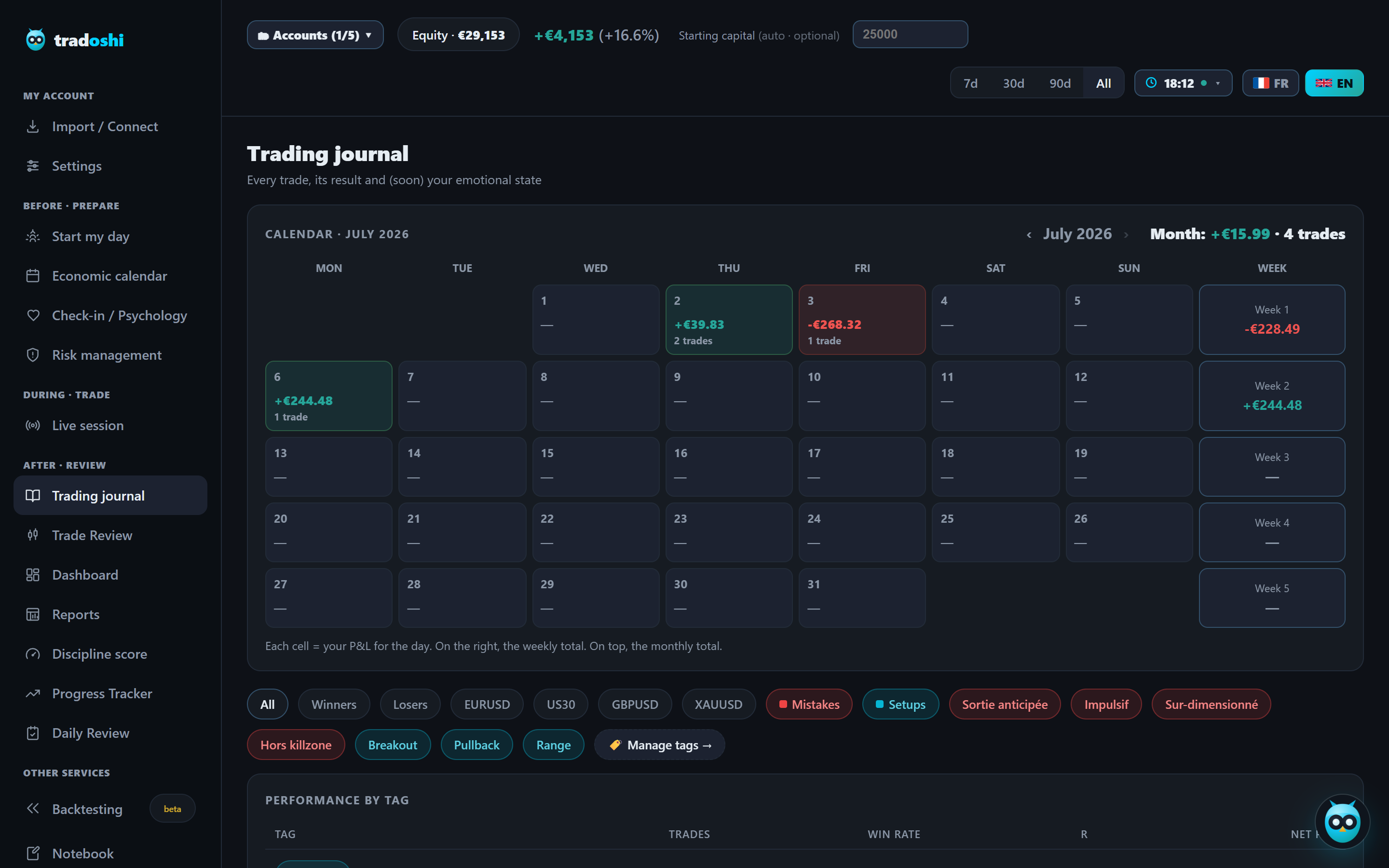
Tradoshi is a dedicated journal that automates what the spreadsheet does by hand, and adds what it can't do at all, no matter how much time you invest building it. It syncs your trades, computes your statistics and breakdowns, and integrates the psychological and discipline dimension.
- Automatic sync of your trades from your broker or exchanges, without manual entry.
- Out-of-the-box indicators and breakdowns (win rate, profit factor, by hour, instrument, setup) without formulas.
- Discipline score and emotion crossed with performance, which the spreadsheet reaches with difficulty.
- Universal CSV import to start from your existing spreadsheet history.
Frequently asked questions
Excel journal or dedicated app for trading?
The spreadsheet (Excel, Google Sheets) is free, flexible and educational, ideal to start and understand your indicators. A dedicated app automates entry, statistics and breakdowns, and adds the psychological dimension. The right choice depends on your trade volume and what you want to analyze: few trades and basic statistics, the spreadsheet suffices; high volume or advanced analysis, the dedicated journal wins.
What's the main flaw of an Excel journal?
Manual entry. Recording each trade by hand is a time-consuming, error-prone chore, and it's the leading cause of abandonment of spreadsheet journals: many traders stop not for lack of will, but because entry becomes a burden you put off. And a journal you don't fill in is useless.
Does a spreadsheet have advantages over a dedicated app?
Yes. It's free, totally flexible (you build exactly the columns and calculations you want), and above all educational: building the calculation of your win rate or profit factor yourself really makes you understand these indicators. For a beginner wanting to internalize the concepts, building your own spreadsheet is an excellent exercise.
Can you do psychological analysis in a spreadsheet?
With difficulty. Tracking your emotional state, crossing your emotions with your performance or measuring your discipline is very laborious in a spreadsheet, while it's often the most decisive part of trading. It's precisely the area where a dedicated journal brings the most value over the spreadsheet, which excels at raw numbers but struggles with behavior.
Can you migrate from a spreadsheet to a dedicated journal?
Yes, most dedicated journals let you import an existing history via a CSV file, letting you start from your spreadsheet data without re-entering everything. Many traders start on a spreadsheet to learn, then migrate to a dedicated journal as their trade volume and analysis ambitions grow.
What columns should a trading spreadsheet include?
At minimum: date, instrument, direction, entry price, exit price, position size, and result in currency and in R. Also plan from the start for a setup column, an emotion column and a free-notes column, to avoid having to reorganize the whole sheet once it already holds hundreds of rows.
How much time does manual entry cost over a year?
It depends on volume, but the order of magnitude often surprises: a trader taking 15 trades a week who spends two minutes per trade on entry loses roughly 26 hours a year, not counting error fixes. That's a real opportunity cost to weigh against the time saved by automated entry.